Anastasiopolis/Peritheorion
Anastasiopolis/Peritheorion, the city that “overlooked” the Via Egnatia
At the Kaledes site, south of the modern villages of Amaxades and Koptero, on the border between the Regional Units of Rhodope and Xanthi, are preserved the remains of one of the most important fortified cities of Thrace, consecutively named Anastasiopolis and Peritheorion. The city, in the bight of Lake Vistonis, among the cultivated fields of the fertile plain of Komotini, once had a port which communicated via the lake with the Thracian Sea. Its strategic location, from which it could control the Via Egnatia and the narrow plain between the Rhodope Mountains and Lake Vistonis, made it an important military centre, capable of putting up a strong resistance to besiegers during the Byzantine civil wars (first half of the 14th c.) and later during the Ottoman advance (third quarter of the 14th c.).
Scholars accept the information, provided in a later period by the Emperor John Kantakouzenos (1347-1354), that Anastasiopolis was founded by Anastasius I (491-518 AD), who gave it his name and had it fortified. Justinian I (527-565 AD) later reinforced the coastal walls when building fortifications in the region of Thrace to face the constant Slavic invasions. He also, in order to ensure control of the Thracian hinterland, built a large aqueduct/cross-wall running from the city to the Rhodope foothills.
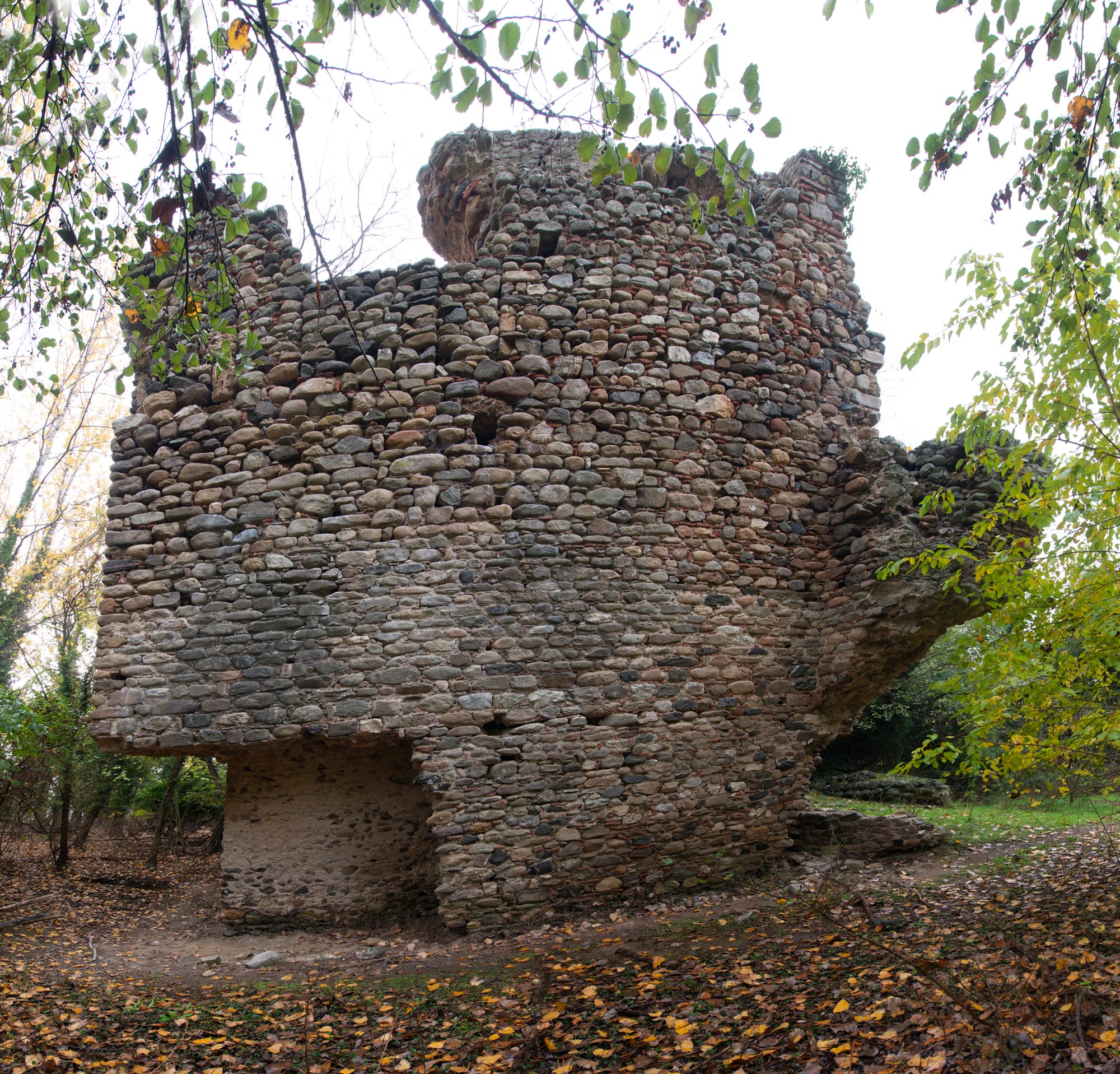
According to one view, Anastasiopolis was a station of the Via Egnatia, as it was built on or near the changing station (mutatio) of Stabulo Diomedis (Diomedes’ Stables), a name commemorating the eighth labour of Hercules, the capture of the man-eating mares of King Diomedes of Thrace. This view is supported by the remains of an ancient roadway, probably the Via Egnatia, which have been found a short distance from Anastasiopolis, along the north bank of the River Kosynthos. However, it has also been argued that the ancient road may have run a little to the north of Anastasiopolis, at the level of the modern Egnatia Motorway, following the foothills of the Rhodope range. There is a theory that the Via Egnatia passed through a gate in the Justinian cross-wall, protected by a quadrilateral and a round tower.
History
Little is known about the history of Anastasiopolis in Early Christian times. The city was first mentioned by its new name, Peritheorion (meaning “overlooking”), in the minutes of the Council of Constantinople in 879, which was attended by James, the bishop of the city. Afterwards, Anastasiopolis and Peritheorion are referred to simultaneously in written sources, at least until the 13th century. Today it is more widely accepted by scholars that the two names denote the same city. In the Byzantine period, Peritheorion flourished thanks to the development of trade due to its natural harbour. It was even one of the cities where the Venetians held important commercial and economic privileges from the second half of the 11th century onwards. In 1083 it is mentioned among the cities where the Monastery of the Theotokos Petritzonissa in Bačkovo , Bulgaria, owned significant property, as it did elsewhere in Thrace (Mount Papikion).
The written sources referring to the Byzantine castle-city are more numerous in the Late Byzantine period, when Thrace found itself at the centre of the wars of the time, especially during the civil wars that rocked Byzantium in the first half of the 14th century. Peritheorion is one of the cities of Thrace which were destroyed in 1205/6 by the invasions of the Bulgarian ruler Kalojan (Ioannitza or “Skyloioannes”). At the beginning of the 14th century, probably in the summer of 1307, a major battle took place here between two warring bands of Catalan mercenaries, who, after being invited by Εmperor Andronikos II Palaiologos (1282-1328) to aid him in repelling the Ottomans, crossed over from Asia Minor to Thrace and plundered the region. The deadly battle dealt a serious blow to the Catalan Company, whose members then moved on to Eastern Macedonia, Chalcidice and eventually Southern Greece.
Under Emperor Andronikos II, the episcopal see of Peritheorion seems to have been elevated to a metropolitan see. According to the narrative of John Kantakouzenos, Andronikos III Palaiologos (1328-1341), the grandson of Andronikos II, found the city in ruins and radically rebuilt it. In 1342 and 1343, John Kantakouzenos attempted to capture the city in vain. On 7 July 1345, he joined forces with Umur Pasha of the Emirate of Aydın and defeated the troops of the Bulgarian warlord Momchil (Momitzilos or Momtsilos in Greek), who was killed in the battle. In 1355, the lord of Peritheorion, Despot John Asanes, surrendered the impregnable city to John V Palaiologos (1354-1391), who, however, was unable to lay claim to it until 1357. In 1354 and again in 1361, Peritheorion was probably sacked by the Ottomans. This was a time when Thrace was being ravaged by Serbs, Bulgars and Ottomans, who repeatedly took part in the civil conflicts of the opposed Byzantine forces, on one side or the other, and then turned to pillaging.
Peritheorion was conquered by the Ottomans probably in 1383, relatively late compared to the other cities of Thrace, which had fallen into Ottoman hands by 1373 at the latest. For a short period of time before the Ottomans conquered Peritheorion, the city was administered by local rulers. The inhabitants decided on the affairs of their city and, cut off as they were from the Thracian hinterland, communicated with Constantinople only by sea.
During Ottoman times, Lake Vistonis was renamed Buru and Peritheorion was renamed Buru Kale, the “Tower of Buru”. In 1403 the city was briefly restored to the Byzantines until 1422, when it was recaptured by the Ottomans. The city then gradually fell into decline. In Ottoman times, the gradual shrinking of the Christian population led to the merging of the metropolitan see of Peritheorion with that of Xanthi, which is still a unified metropolis today (Holy Metropolis of Xanthi and Peritheorion). Travellers visiting Buru Kale in the 17th century describe a scene of utter desolation. The French friar Robert de Dreux saw only two churches and a priest, poor and disillusioned by the decay of his town. The Ottoman traveller Evliya Çelebi found the once “beautiful and impregnable” walls of the city in ruins, with only fifty Christian houses and five shops within them.
Monuments
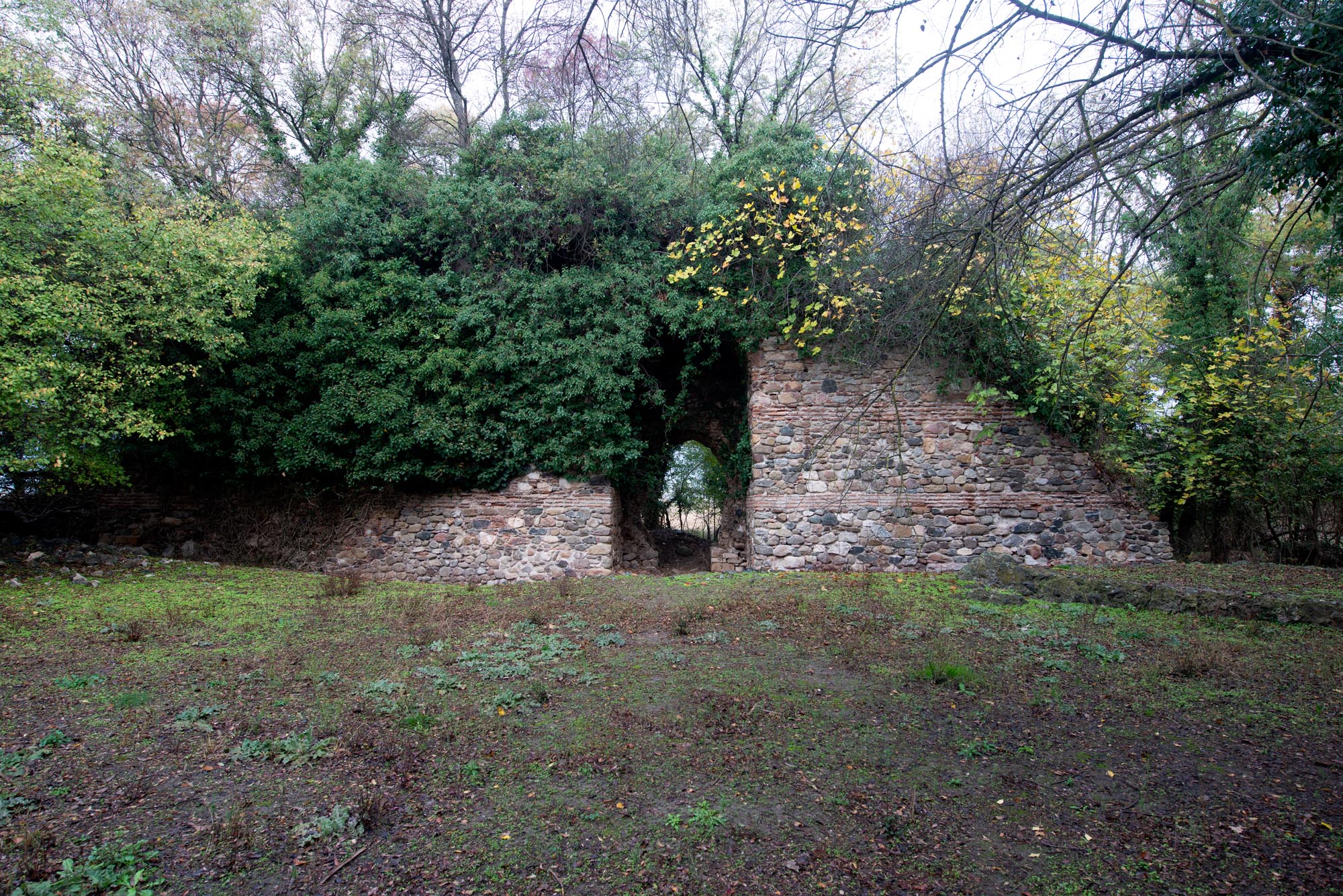
Today only the remains of the walls and the city aqueduct are visible. The harbour facilities have been buried due to the silting of Lake Vistonis.
Fortifications
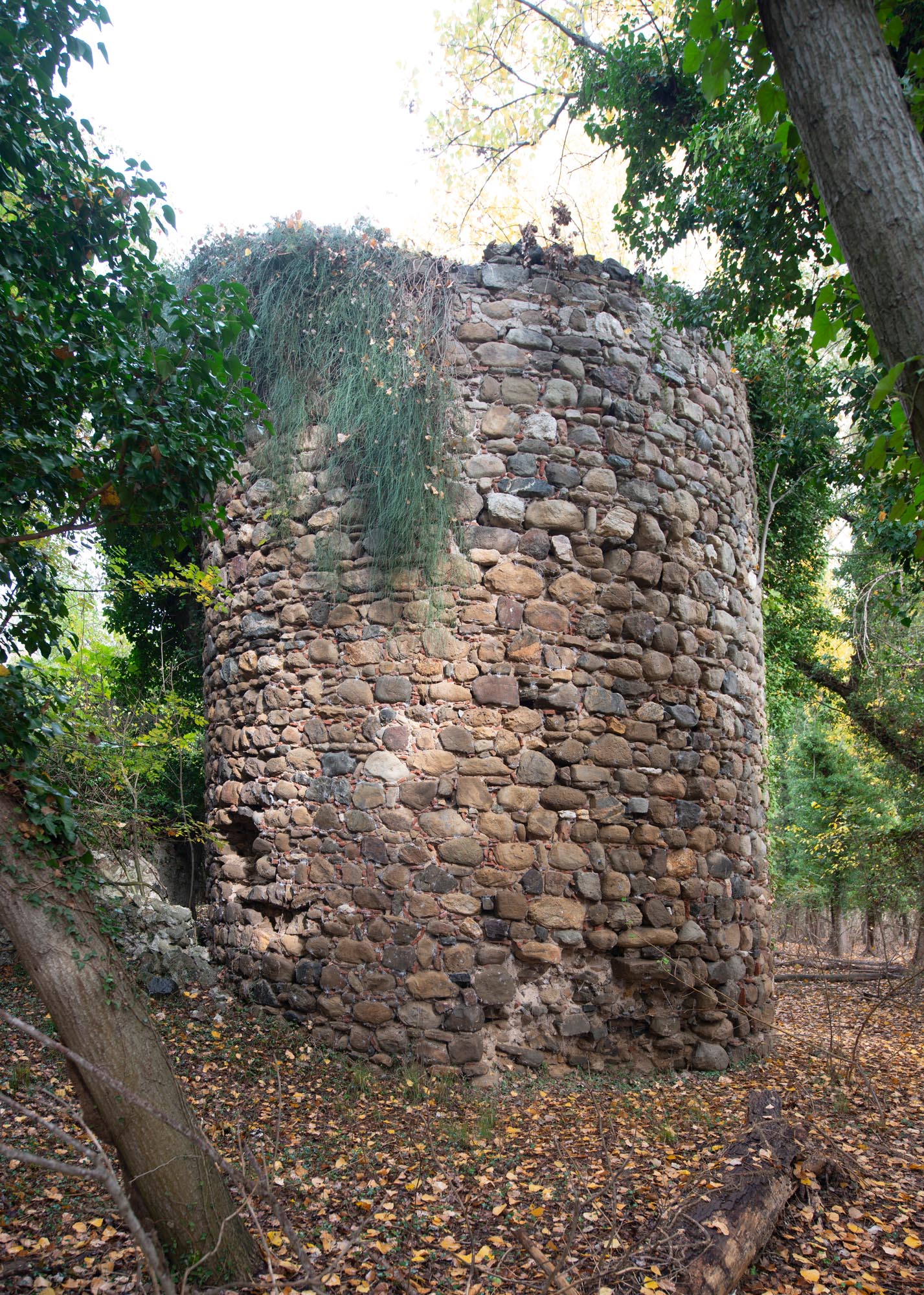
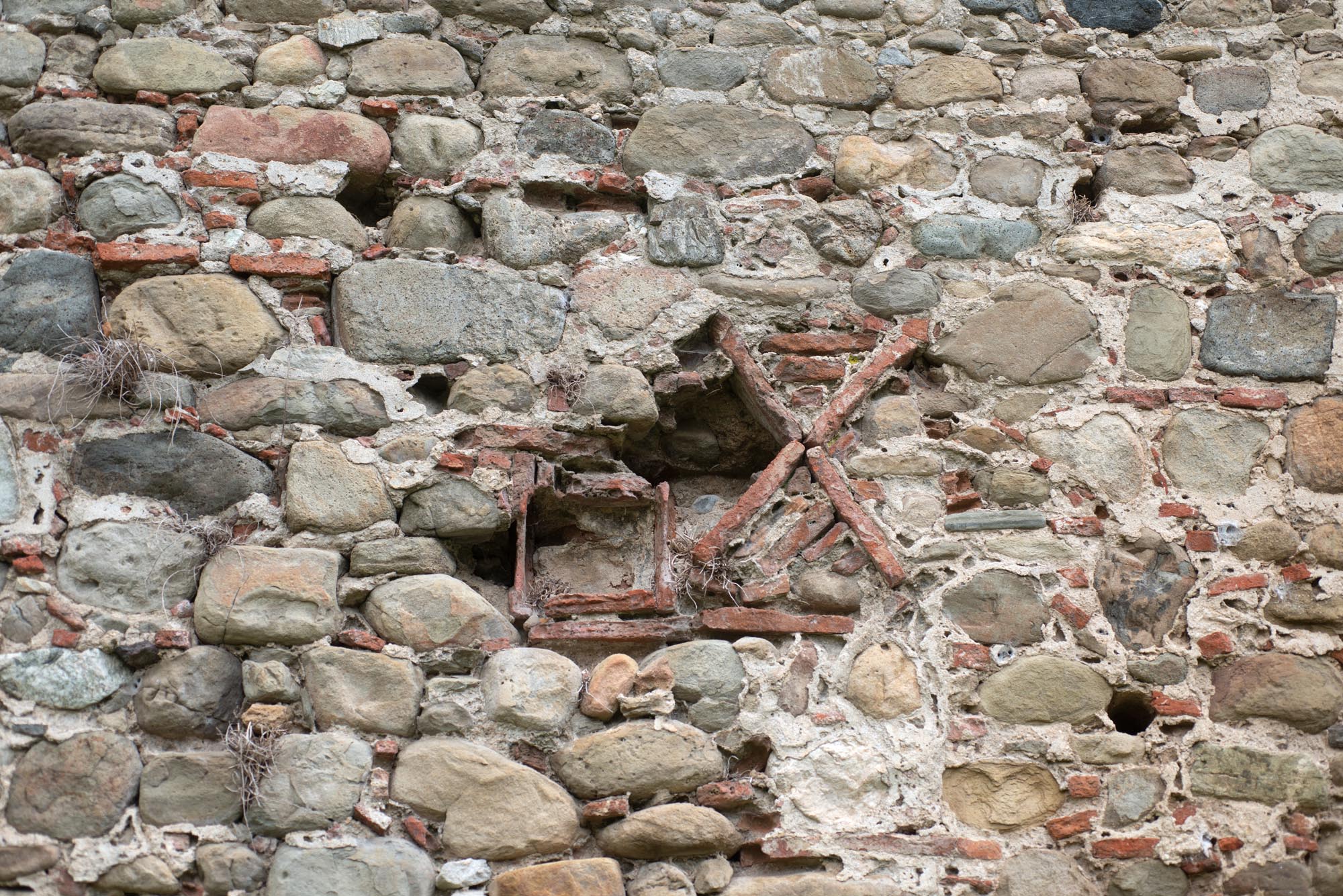
The polygonal fortifications are reinforced at regular intervals by square and round towers. The central gate of the wall is on the southeast side, facing the lake and the former city harbour, and is protected by two strong quadrilateral towers. Set into the walls are brickwork monograms of the Palaiologoi, which are probably associated with the extensive repairs carried out by Andronikos III Palaiologos. It is mainly due to these building works that the walls of the city have the form they have today. One of the monograms is attributed, according to one view, to the Kantakouzenos family and is probably associated with a repair of the walls carried out by John or his son, Matthew Kantakouzenos, who assumed control of the city at various intervals during the Byzantine Civil War of 1341-1347.
The Cross-wall of Justinian I
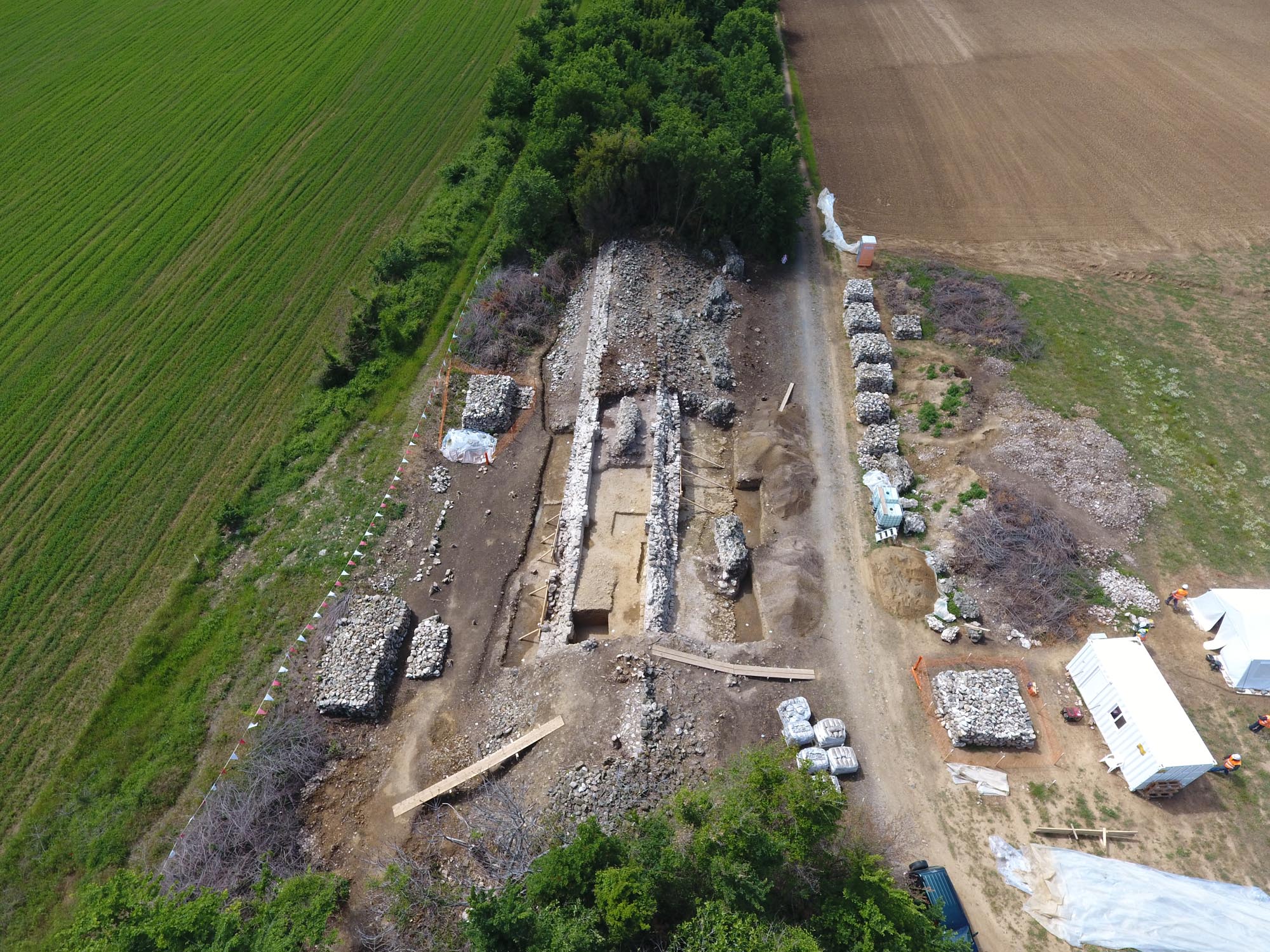
The cross-wall started at the northwest corner of the fortifications of Anastasiopolis and ran 2.4 km to the Rhodope foothills. It also functioned as an aqueduct, carrying water from Rhodope to the city. Today it is preserved along most of its length, although not in good condition. A significant part of the wall was investigated and consolidated during the construction of the Trans-Adriatic Pipeline in Northern Greece. The maximum height of the cross-wall is 3 m. It consists of two parallel walls, 1.40-1.60 m thick, with a corridor between them 3.60-3.80 m wide, along which ran the conduit that carried water to the city. The corridor could also be used by soldiers when necessary. Evliya Çelebi refers to the wall, “whose length is an hour” and “nothing can pass through it, neither man nor caravan”.