Thessaloniki

Thessaloniki, “the first after the first”

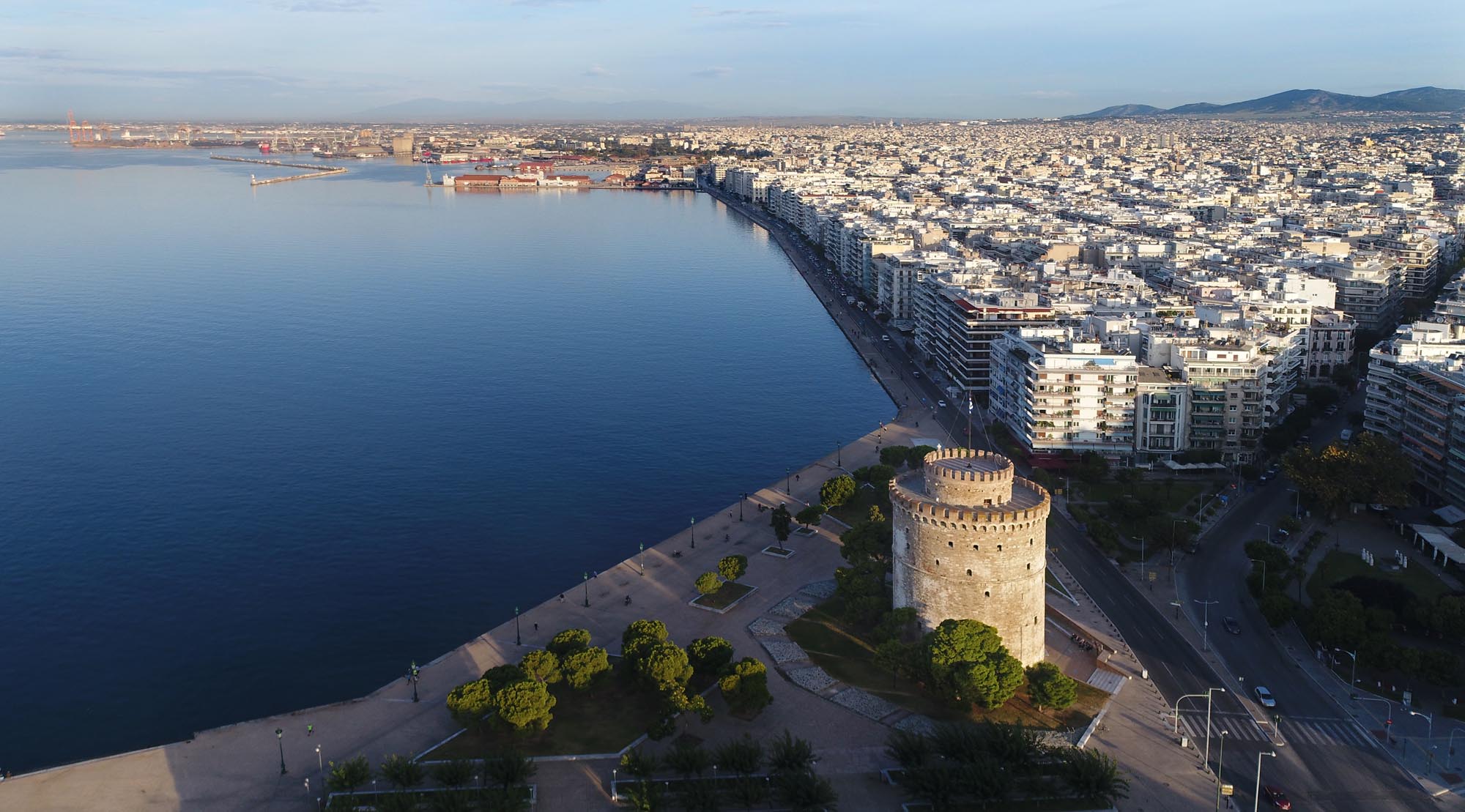
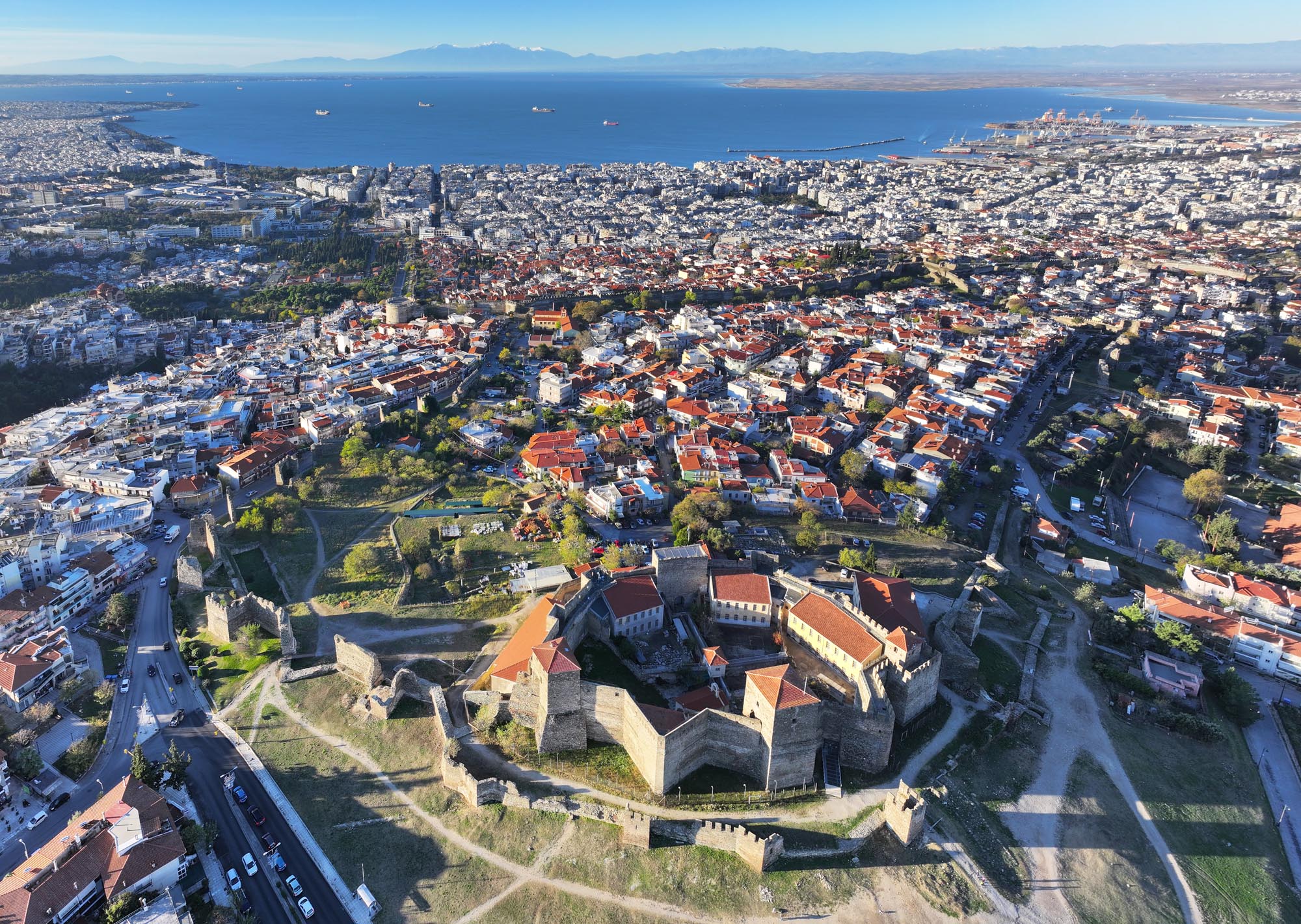
Thessaloniki, the “Nymph of the Thermaic Gulf”, lying in the bight of the largest gulf of the Aegean Sea, has been one of the most important ports of the Mediterranean through the ages. The vast wealth of monuments and archaeological sites forming part of the modern urban fabric of the city tells the story of its long, rich, multicultural history. The city’s Early Christian and Byzantine monuments are particularly significant, revealing the crucial role it played in the political and cultural events of Byzantium, as the “Co-Queen” of the Byzantine Empire. Covering a lengthy period of time, from the 4th to the 15th century AD, they represent the art and culture of Byzantium through the ages, with the result that Thessaloniki is now considered an “open museum” of Byzantine art. Fifteen of the city’s Early Christian and Byzantine monuments were inscribed on the UNESCO World Heritage List in 1988, making Thessaloniki one of the few cities with such a large number of monuments on the list.

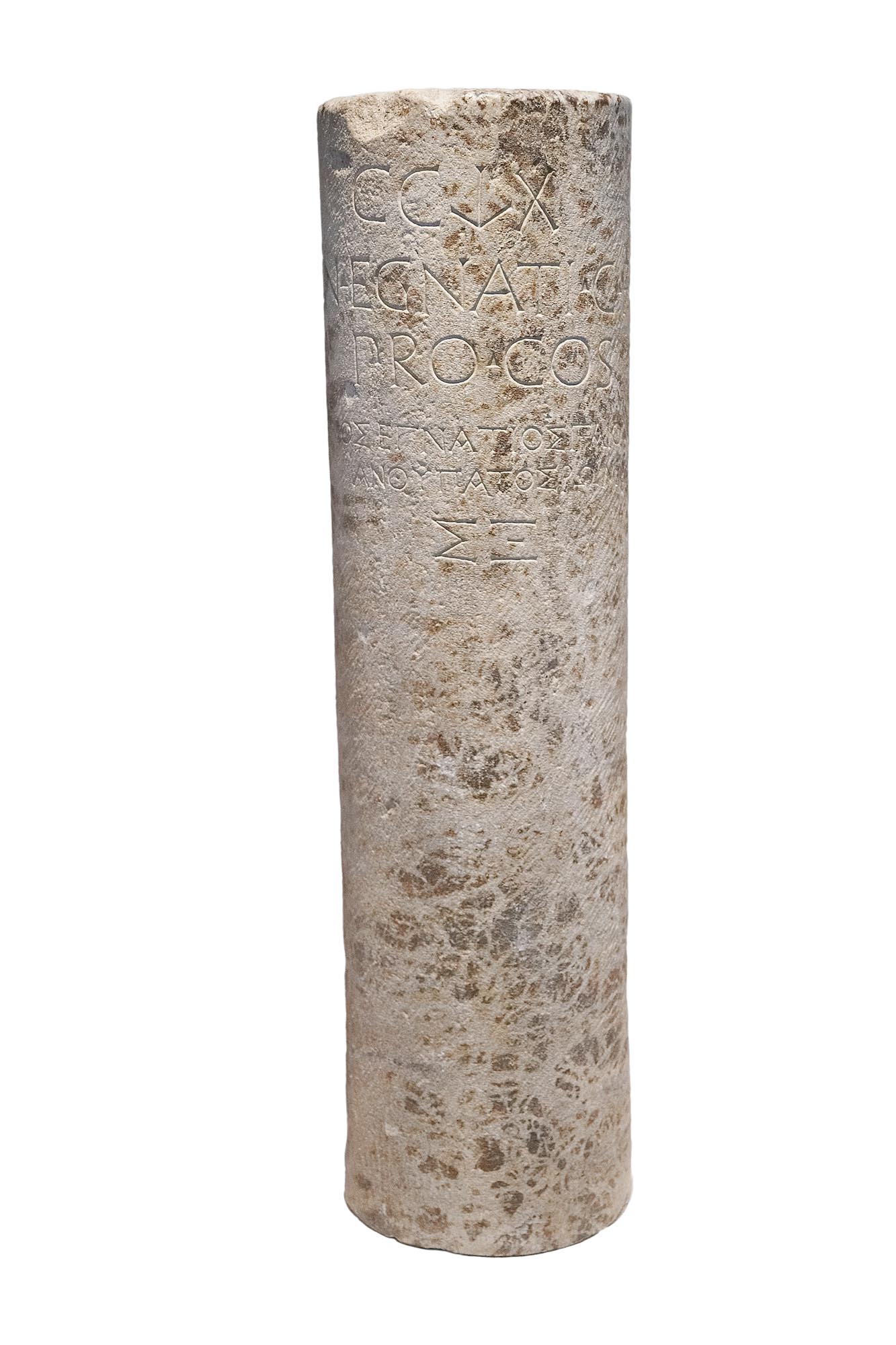
Μιλιοδείκτης Γνάιου Εγνάτιου Γαΐου, Α. Μ. Θεσσαλονίκης, φωτ. Ο. Κουράκης / Milestone of Gnaeus Egnatius Gaius, Thessaloniki Archaeological Museum, no.6932, phot. O. Kourakis
Μιλιοδείκτης Γνάιου Εγνάτιου Γαΐου, Α. Μ. Θεσσαλονίκης, φωτ. Ο. Κουράκης / Milestone of Gnaeus Egnatius Gaius, Thessaloniki Μιλιοδείκτης Γνάιου Εγνάτιου Γαΐου, Α. Μ. Θεσσαλονίκης, φωτ. Ο. Κουράκης / Milestone of Gnaeus Egnatius Gaius, Thessaloniki Archaeological Museum, no.6932, phot. O. Kourakis

The favourable and naturally protected geographical location of Thessaloniki has been a decisive factor in its development and growth into one of the most active commercial and economic centres of the Balkans from its founding to the present day. Apart from its port, Thessaloniki has also always looked to its rich hinterland. Byzantine sources note the harmonious coexistence of land and water, which ensured an abundance of goods, and often mention its natural surroundings: Mount Chortiatis, which crowns the city on the north, protecting it from enemies; the large and fertile plains which spread out on the east and west and are described as earthly paradises with many trees and plentiful water; the two large lakes to the east, Koroneia and Volvi, full of fish large and small; and the two large, navigable rivers to the west, the Axios and the Gallikos (Echedoros), which facilitated trade with the Balkan hinterland.

Two highways passed through Thessaloniki: the Via Egnatia, which ensured communication with Constantinople to the east and the ports of the Adriatic to the west, and a second major road which ran north through the valley of the Axios, connecting Thessaloniki to the cities of the Balkan Peninsula and the Danube.

The Via Egnatia did not actually pass through the city, as is widely believed today due to the large modern avenue of the same name that runs through the city centre and was so named after the Great Fire of 1917. As has been convincingly argued by archaeologist Charalambos Makaronas, the ancient street started at the two gates in the western city wall. The eastern branch of the ancient road started from the Letaia Gate and ran in a north-easterly direction along the northwest foot of Mount Chortiatis, before turning towards the basin of Lakes Koroneia and Volvi, following the course of the modern Thessaloniki–Kavala highway. The western branch of the Via Egnatia started from Golden Gate and, crossing the major Axios and Gallikos rivers, continued towards Pella and the other cities west of Thessaloniki.

Four milestones of the Via Egnatia are associated with Thessaloniki. The most important was found in the silted-up banks of the River Gallikos and mentions Proconsul Gnaeus Egnatius [son of] Gaius, after whom the road was named (148-120 BC). The Greek and Latin inscription states that the milestone was set up 260 Roman miles from Dyrrachium, placing it seven Roman miles west of Thessaloniki. The second milestone, now in the Louvre, was found near the Gallikos. The other two milestones are linked to the eastern branch of the Via Egnatia, connecting Thessaloniki with Constantinople. The first, found north of Thessaloniki near the road leading to Lagadas, was set one Roman mile from Thessaloniki, according to the Greek inscriptions it bears, which refer to emperors and caesars of the First and Second Tetrarchy (before 284 to 305/6 AD). The second, found at the 6th km of the Thessaloniki–Serres highway, is an imposing column 2.28 m high, with a maximum diameter of 0.43 m. Its Latin inscription places it 5 Roman miles from Thessaloniki and records the repairs to the Via Egnatia from Dyrrachium to Neapolis (modern Kavala) undertaken by the Emperor Trajan in 112 AD, because the ancient road “had been neglected for a long time”.

History

Thessaloniki was founded in 316/5 BC by King Casander of Macedon (305-297 BC), who played a leading role in the civil conflicts over the succession of Alexander the Great. Cassander, who succeeded in becoming ruler of Pella, subsequently married Alexander’s half-sister Thessalonike. In order to achieve his political aims, he proceeded to establish two powerful new urban centres, in particularly advantageous positions from an economic and military point of view. The larger of the two cities, Cassandreia, to which he gave his name, was built on the neck of the homonymous peninsula of Chalcidice. The second city, which was to become one of the largest urban centres in the region, was named after his wife. He populated it via settlement, moving the inhabitants of 26 townships around the Thermaic Gulf there.

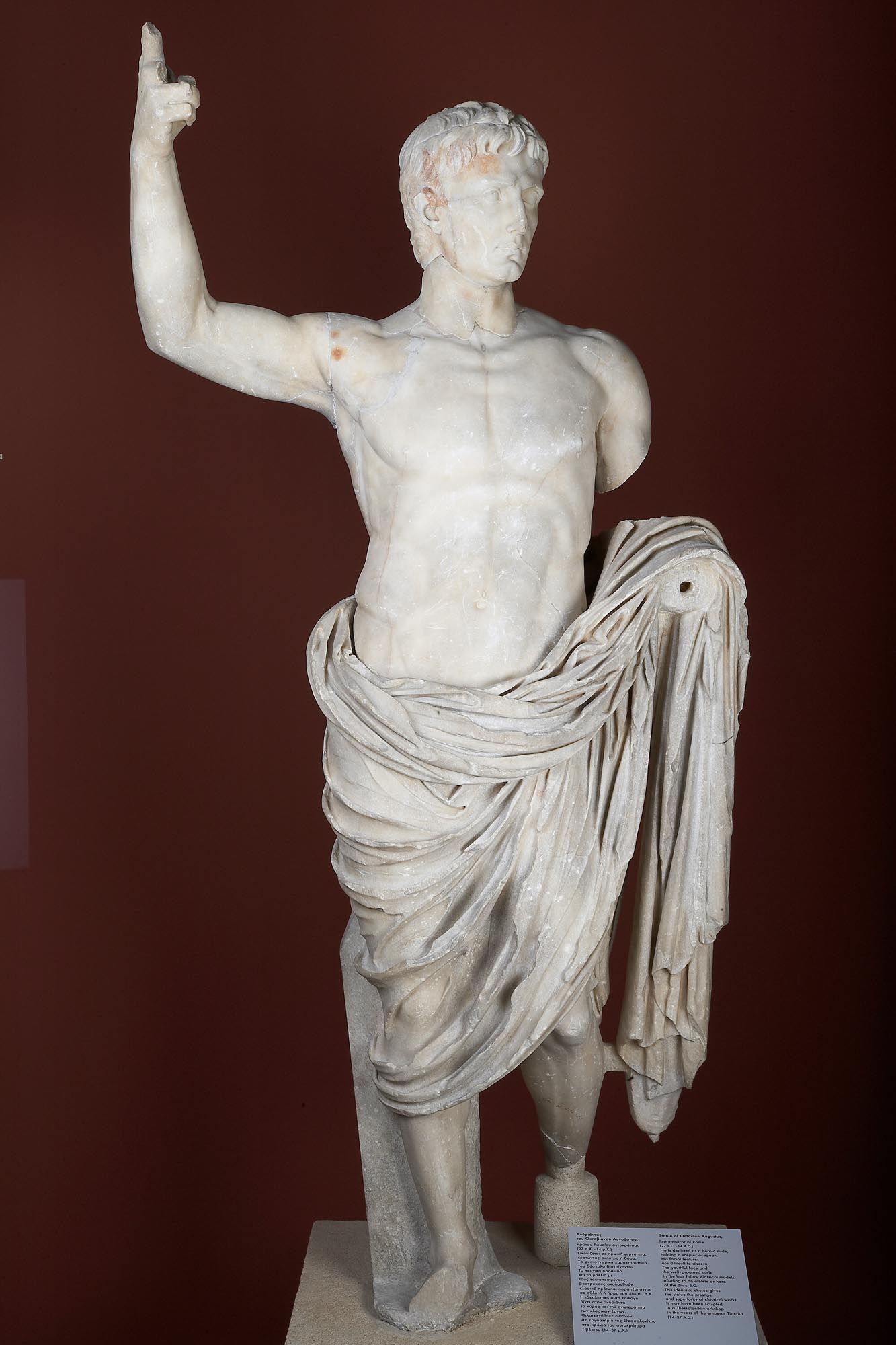
After the overwhelming Roman victory at the Battle of Pydna in 168 BC, Macedonia became a Roman province, initially with four administrative regions, one of which had Thessaloniki as its capital. Subsequently (after 148 BC), Thessaloniki became the capital of the whole Provincia Macedoniae, whose borders were much wider than those of the old Macedonian Kingdom, extending northwest to the Adriatic Sea and south to Mount Oeta in Central Greece. With Octavian’s victory in the naval Battle of Actium in 31 BC and the establishment of the Pax Romana, the city enjoyed a great flowering of economic and intellectual life. It became the most populous city in Macedonia, evolving into an important commercial centre while also experiencing a remarkable cultural boom, as the birthplace of important men of letters and the arts, and the home of prominent poets, orators and philosophers of the time. Its cosmopolitan character led the poet Antipater to describe the city as “the mother of all Macedonia”, while the geographer Strabo called it “the metropolis of today’s Macedonia”.

Thessaloniki was one of the cities of Macedonia that St Paul the Apostle visited twice, in 49 and 56/7 AD. Despite his expulsion by the Thessalonians, his preaching laid the foundations for the establishment of one of the first Christian communities in Greece.

Ανδριάντας Οκταβιανού Αυγούστου, Α. Μ. Θεσσαλονίκης / Statue of Octavian Augustus, Thessaloniki Archaeological Museum no. 1065
Tourta A., “Thessalonike”, in J. Albani – E. Chalkia (eds.), Heaven and Earth: Cities and Countryside in Byzantine Greece, Αθήνα 2013, fig. 55 (ψηφιακή επεξεργασία ΔΒΜΑ / digital processing DBMA

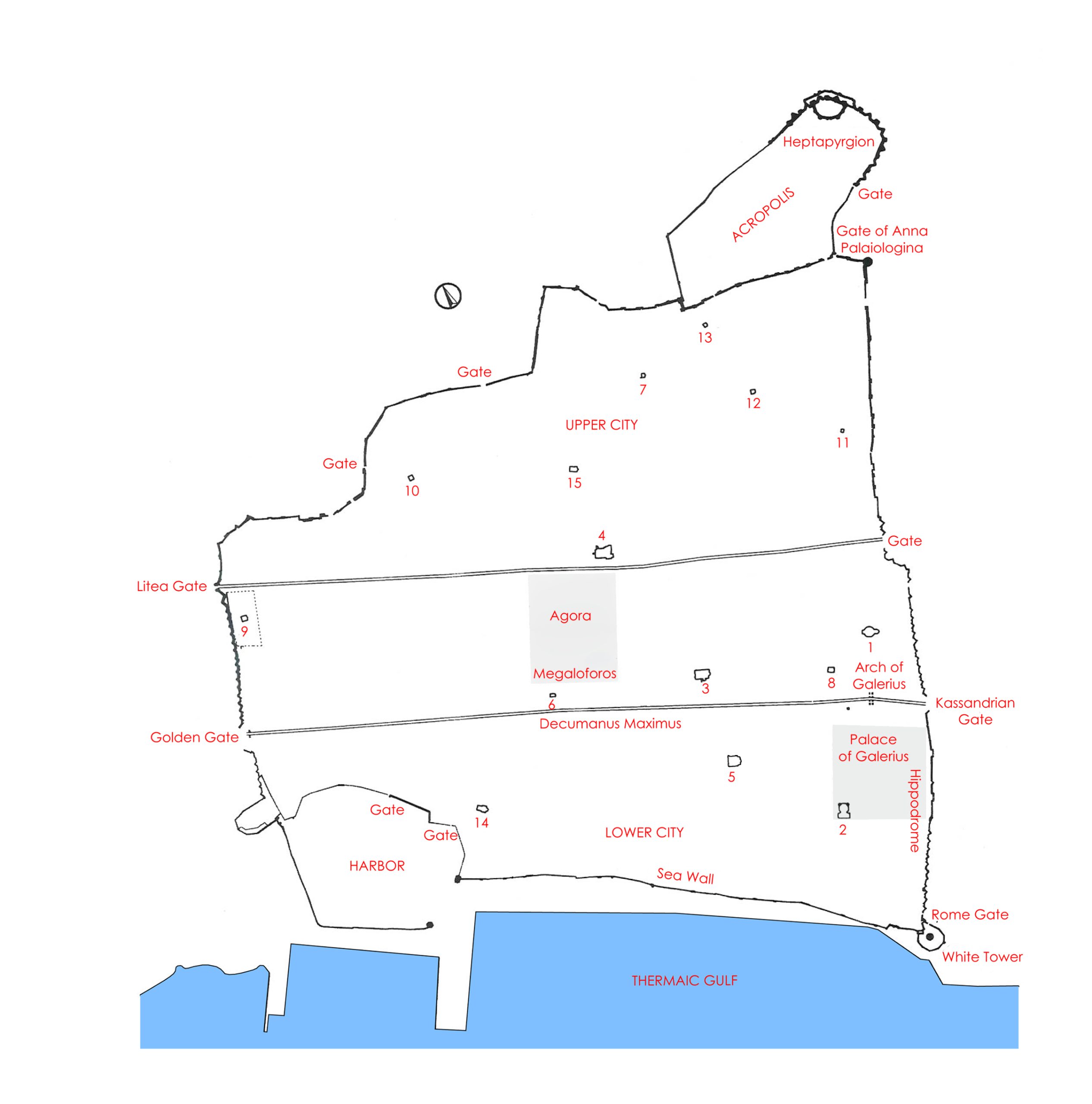
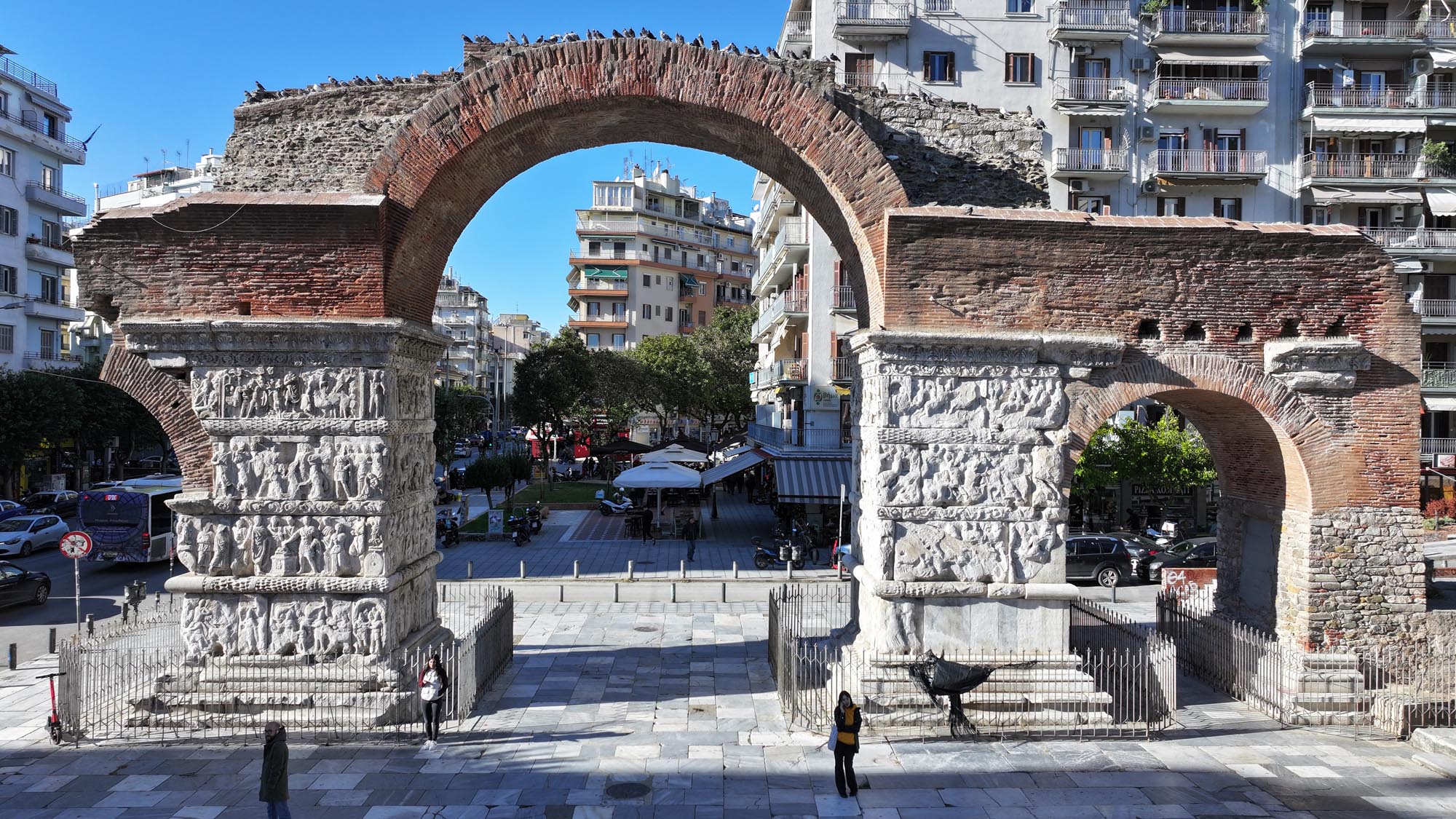
At the turn of the 4th century AD, Thessaloniki was designated the seat of the Eastern Roman Empire by Galerius, who was then Caesar. The written sources do not provide precise information on the transfer of Galerius’ seat to Thessaloniki, but according to most scholars, the city was his seat for two periods of time (from 298 to 303 AD and from 308 to his death in 311 AD). In 305 AD, after issuing an edict against the Christians, Galerius ordered the beheading of St Nestor and the spearing to death of St Demetrios, titled Philopolis (“lover of the city”) and Myrobletes (the “Myrrh-gusher”), the patron saint of the city, who, it is believed, protected it from barbarian threats for centuries. Galerius, who in the meantime had been proclaimed Augustus (emperor), embellished the city with an ambitious building programme, extending the eastern boundary of its residential area with the construction of a luxurious palace complex that included public administrative buildings, pagan shrines and athletic facilities covering an area of 15 hectares. Part of the Galerian Complex is the Arch of Galerius, the famous Kamara, one of the most iconic monuments of the city. The palace of Galerius was set directly against the city’s famous hippodrome, of which only a few remains are preserved today in the basements of apartment buildings. In the time of Galerius the form of the walled city, which Thessaloniki preserved until the end of the 19th century, was finalised.

A few years after Galerius’ death, the Augustus of the Western Roman Empire, Constantine the Great, arrived in Thessaloniki. He remained in the city for two years, preparing his fight against his political rival Licinius. Enchanted by the city’s beauty, the farsighted future sole Emperor (324-337 AD) saw to it that it was provided with a series of major engineering works, the most important of which was the construction of the “burrowed harbour”, a unique achievement for the time. The harbour of Constantine, where a fleet of 200 triaconters (thirty-oared galleys) and 2,000 merchant ships was assembled, served the trade of Thessaloniki until the 18th century, when it began to be silted up due to rising sea levels and the present-day Ladadika district arose in its place.

One of the most dramatic moments in the history of the city is associated with the emperor Theodosius the Great (379-395 AD), who strengthened the city’s walls and made it a base of operations in his fight against the Goths. In the month of May, probably in 390 AD, he suppressed the inhabitants’ revolt against the Gothic garrison stationed in the city by ordering the slaughter of all the spectators of the chariot races in the hippodrome, resulting in the tragic death of 7,000 citizens, or even 15,000 according to other sources. The works constructed in Thessaloniki on the orders of Theodosius the Great turned it into a “megalopolis”, which was henceforth, until its final capture by the Ottomans in 1430, the second-greatest city in the Empire after Constantinople (“Thessaloniki, the first city of the Romans after the great city”). The vitality and dynamism of Byzantine Thessaloniki is confirmed by the fact that it successfully fought off successive enemy invasions during its long history: the Avaro-Slavs in the 6th and 7th centuries, the Saracens in the 10th century, the Bulgarians from the late 9th to the 11th century, and the Normans in 1185.

In 1204, after the fall of the Byzantine Empire to the Crusaders, the Latin Kingdom of Thessalonica was founded and the city was ceded to Boniface of Montferrat, who converted the churches of St Demetrios and St Sophia into Catholic churches. The probably Latin bishop of the city Varinus smuggled the relics of St Demetrios to Italy, where they were discovered centuries later by Byzantinologist Maria Theochari in the Abbey of San Lorenzo in Campo, and returned to Thessaloniki in 1979.

In 1224, Thessaloniki was captured by the Despot Theodore Komnenos Doukas (1215-1230) and became the capital of the Despotate of Epirus. The triumph of his conquest of the city and the expansion of the Despotate of Epirus was followed in 1227 by Theodore’s coronation, probably in the metropolitan church of St Sophia, as “Emperor of the Romans”. In 1246, Thessaloniki was incorporated into the Empire of Nicaea by John III Doukas Vatatzes (1222-1254). A few years later, in 1261, on the recapture of Constantinople by Emperor Michael VIII Palaiologos, the city again became part of the Byzantine Empire. In 1342-1349, the city was shaken by the Zealots’ Revolt, when the popular classes rose up against the nobles who supported John Kantakouzenos in his dispute with the legitimate heir to the throne, John V Palaiologos. In 1387, after a four-year siege, the city became a tributary to the Ottomans for the first time. In 1403 it was restored to the Byzantines, but in the face of the continuing Ottoman threat it was forced to surrender to the Venetians, on condition that the latter would allow some form of self-government and strengthen the city’s defences.

During the Palaiologan period (1261-1430), Thessaloniki experienced a great intellectual and artistic flourishing. In the monuments of this period, which stand out for their splendid architecture and their wall paintings of unparalleled artistry, one can observe all the manifestations of the “Palaiologan Renaissance”, the great flowering of letters and the arts that marked the period following the Reconquest of Constantinople by Michael VIII Palaiologos in 1261. Both the architecture and the painting of the Palaiologan monuments of Thessaloniki served as models across a wide area, from Epirus to Thrace and from Thessaly to Old Serbia, including Mount Athos and the neighbouring Balkan countries, leading many scholars to speak of a “School of Thessaloniki”.

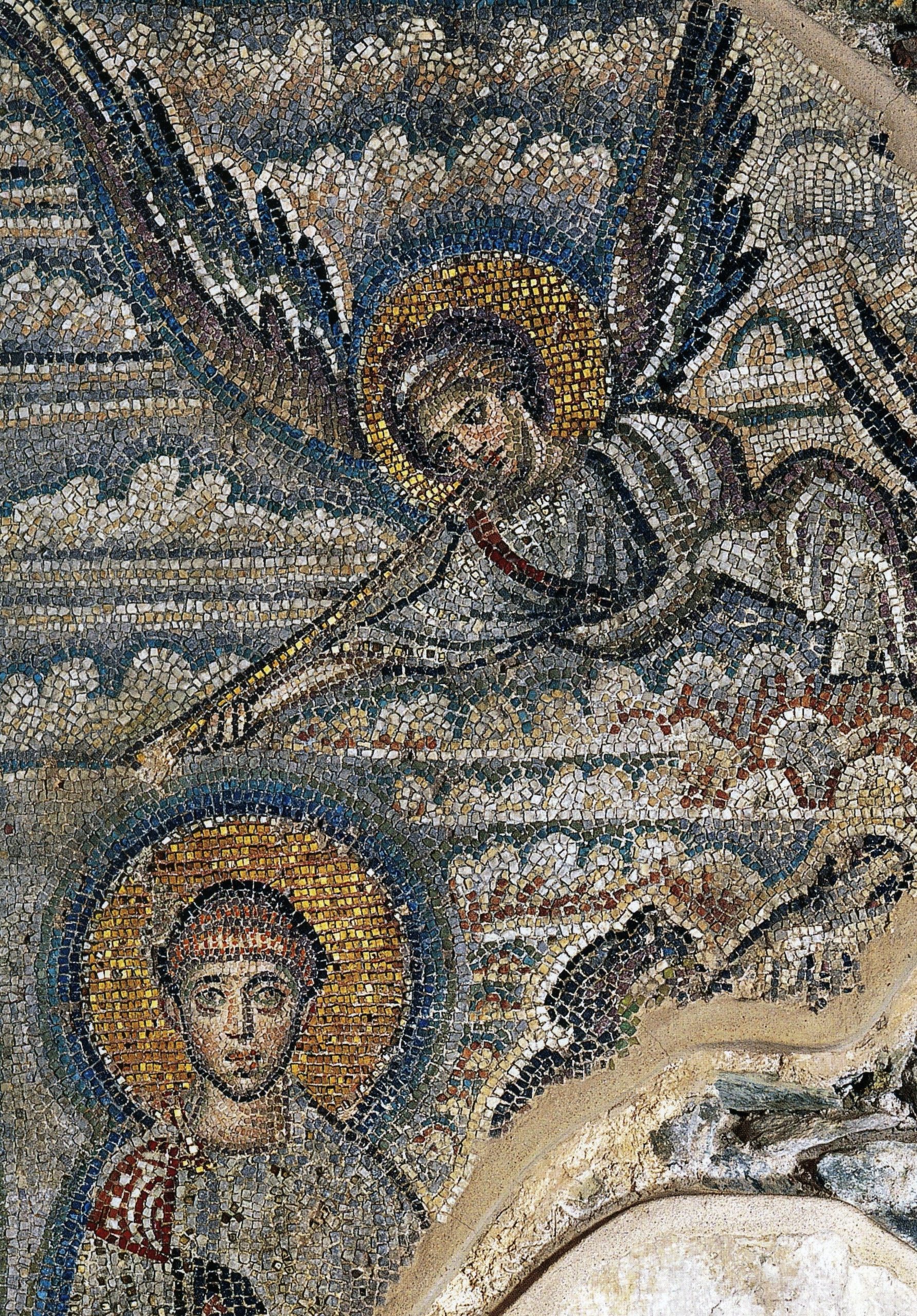
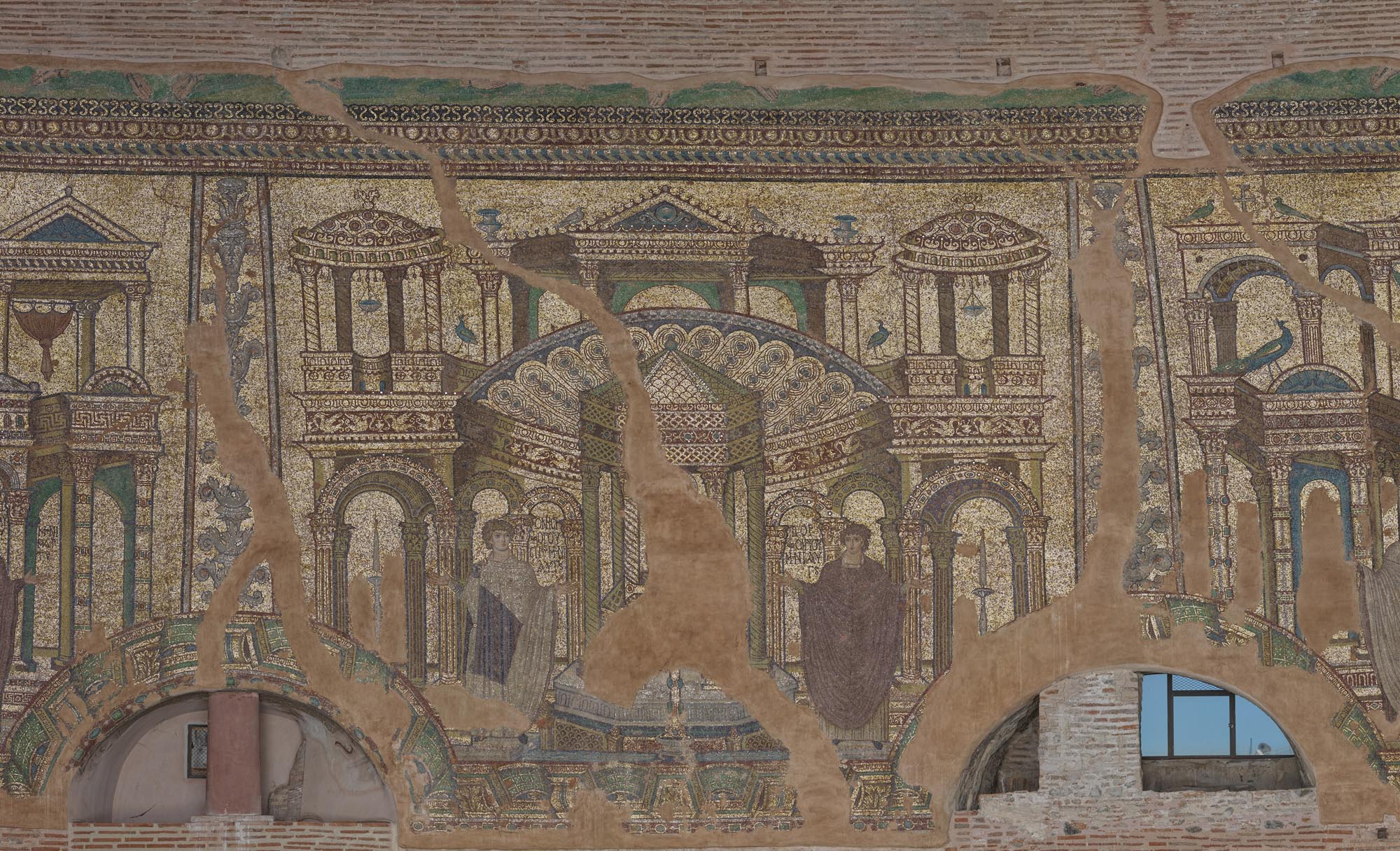
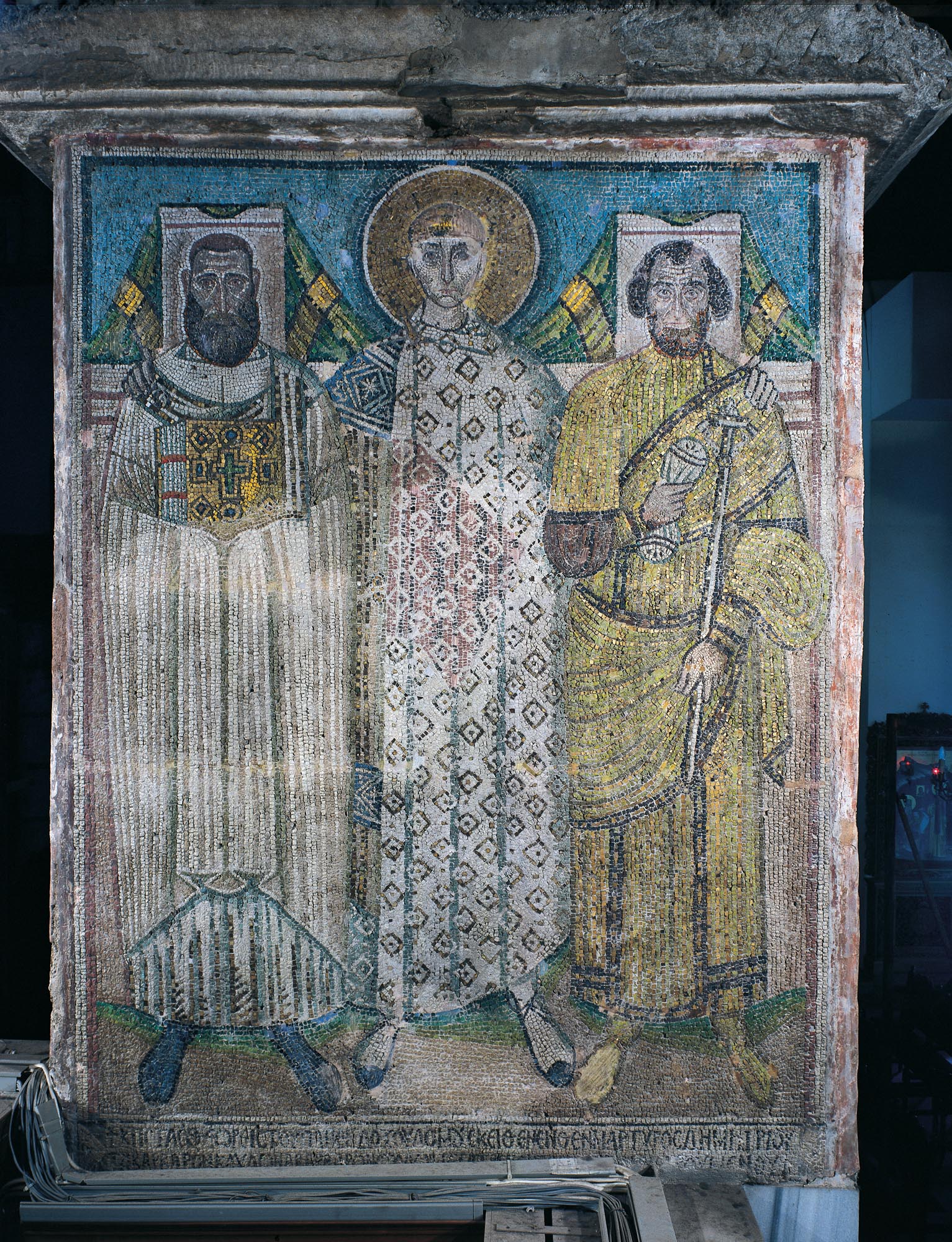
Ψηφιδωτό από τον Αγ. Δημήτριο/ Church of St Demetrius, wall mosaic (φωτ. ΕΦΑ Πόλης Θεσσαλονίκης/ phot. Eph. of Antiquities of Thessaloniki City)
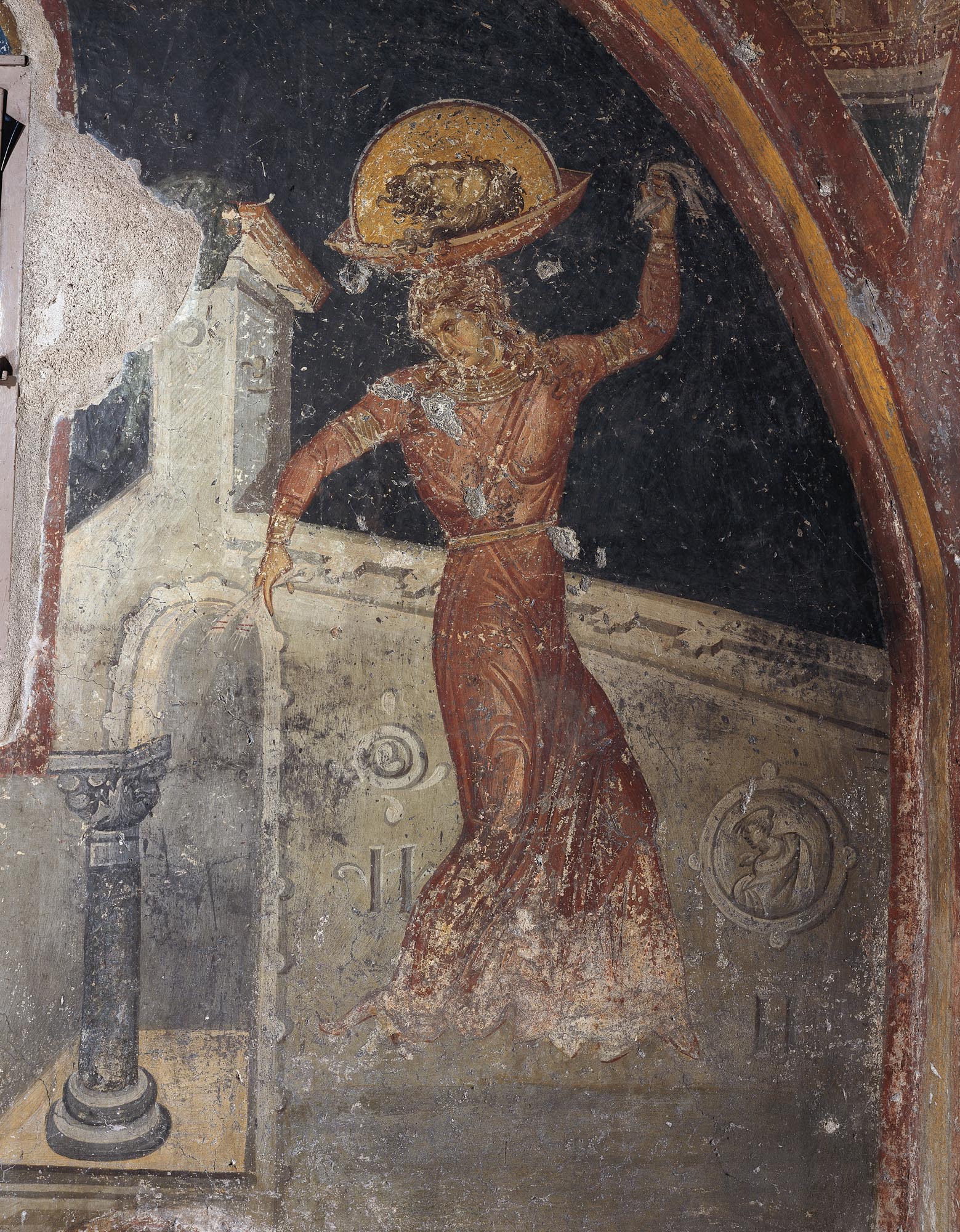
Η Σαλώμη, τοιχογραφία, ναός Αγ. Αποστόλων/ Salome, fresco, church of the Holy Apostles (αρχείο ΕΦΑ Πόλης Θεσσαλονίκης / Archive of the Ephorate of Antiquities of Thessaloniki City)

On 29 March 1430, Thessaloniki fell into the hands of the troops of Sultan Murad II. It soon became an important centre of the Ottoman Empire, with the construction of large public and religious buildings and the conversion of Christian churches into Muslim mosques. Selanik, as the Ottomans called the city, became part of the Eyalet of Rumelia, of which Adrianople was the capital, and was designated the seat of the Sancak of Selanik. The Ottoman conquest was followed by a period of financial hardship and demographic decline for the city’s Christian population. Gradually, however, the city began to recover. The installation of a large number of Jews contributed decisively to the strengthening of its population and its economic development. It is estimated that by the beginning of the third decade of the 16th century, 15,000 Sephardim, Spanish-speaking Jews, had arrived in the city. In a census of 1519, Thessaloniki had the population of a great city by the standards of the time: 29,000 inhabitants, almost half of whom were Jewish.

The various ethnic groups inhabiting Thessaloniki were organised in districts. The Muslims mainly lived in the Upper City, while the Jews were established in the city centre, in the area of the ancient Forum, and the Greeks were scattered along Egnatia Street and the east wall of the city.

φωτ. Κ. Ξενικάκης / phot. K. Xenikakis

The city’s population growth was occasionally interrupted by natural disasters, such as the great fire of 1620, which burnt down most of the city, epidemics, such as the plague that decimated the population in the early 1620s, and external military and political unrest, like the violence against the city’s Christian population and their expulsion at the outbreak of the Greek Revolution of 1821. Nevertheless, Thessaloniki remained one of the largest cities in the Ottoman Empire.

Τζαμί Χαμζά Μπέη (Αλκαζάρ)/ Hamza Bay Mosque (Alcazar) [αρχείο ΔΒΜΑ, φωτ, Στ. Στουρνάρας / archive of DBMA, phot. St. Stournaras]

From the 18th century onwards, Thessaloniki was the most important commercial centre of the wider region, handling a quarter of the foreign trade of the Ottoman Empire. In its port, hundreds of ships transported a variety of goods, and from its markets caravans of dozens of pack animals set out for the cities of the Balkans and Central Europe. The Venetian trading post, which had been established in the city since the 16th century, was joined by the consulates of France, Britain, the Netherlands, Naples, Ragusa, Denmark, Sweden and Austria, expanding the city’s trade with the great commercial centres of Europe. During the same period, the Frangomachalas (Frankish Quarter) arose near the port and the market, growing into a large Franco-Levantine community. Numerous hans provided temporary accommodation and supplies to traders and travellers, attesting to the booming commercial activity of the city. The Ottoman traveller Evliya Çelebi mentions 16 hans in Thessaloniki and an unknown number of caravanserais, while tax registers of 1906 record 87 hans in the city.

During this period, Thessaloniki was a multicultural centre with a cosmopolitan atmosphere. In its markets mingled “all races and all costumes in a colourful, spectacular hodgepodge of operetta and Babylon”, as the poet Napoleon Lapathiotis noted, impressed, in 1915.

Travellers waxed lyrical about the city, which presented an unrivalled, idyllic picture from the sea, a great amphitheatre enclosed by a strong and imposing wall. They were impressed by its long, high walls with their massive towers, its numerous churches crowned with tall domes, its mosques with their towering white minarets, its small, shady squares, its spacious harbour, its lively crowds of merchants and seamen, and its rich monuments such as the Rotunda and the Kamara.

The appearance of Thessaloniki began to change radically from the second half of the 19th century. Its eastern land and sea walls were gradually demolished after 1869 in order to expand the city and “modernise” it, renouncing its medieval character. This expansion of the city, the opening of major streets, the construction of large civic buildings, and the implementation of major construction projects, such as the new artificial harbour (1903) changed the picture of the city for ever, while the railway, which connected it with the major commercial centres of Europe in 1888, played a key role in its modernisation. A milestone in the modern history of Thessaloniki was the Great Fire of 1917, which destroyed 9,500 buildings across most of the city centre, making more than 70,000 people homeless. The French architect, urban planner and archaeologist Ernest Hébrard drew up an ambitious new urban plan for the zone destroyed by the fire, but it was not implemented in its original form.

Four years before the Great Fire, the city had been liberated by the Greek Army on the feast of St Demetrios (26 October 1912). Under the Treaty of Bucharest (28 July/10 August 1913), Thessaloniki, along with other major cities of Macedonia, was incorporated into the Greek state. During the first World War, Greece sided with the Entente and between 1914 and 1918 Thessaloniki was transformed into a military base for the Allied Army of the Orient, made up of five national armies (France, Britain, Italy, Serbia and Russia). The presence of this multiracial army, which turned the city into a vast military camp, was instrumental in its spectacular transformation with a series of infrastructure projects, such as the construction of hospitals and schools, and even the conduct of archaeological excavations. Another milestone in the city’s modern history was the great wave of refugees, mainly from Asia Minor and Eastern Thrace, who arrived following the Asia Minor Catastrophe (1922) and boosted the city’s population.

Monuments on the UNESCO world heritage list

Walls

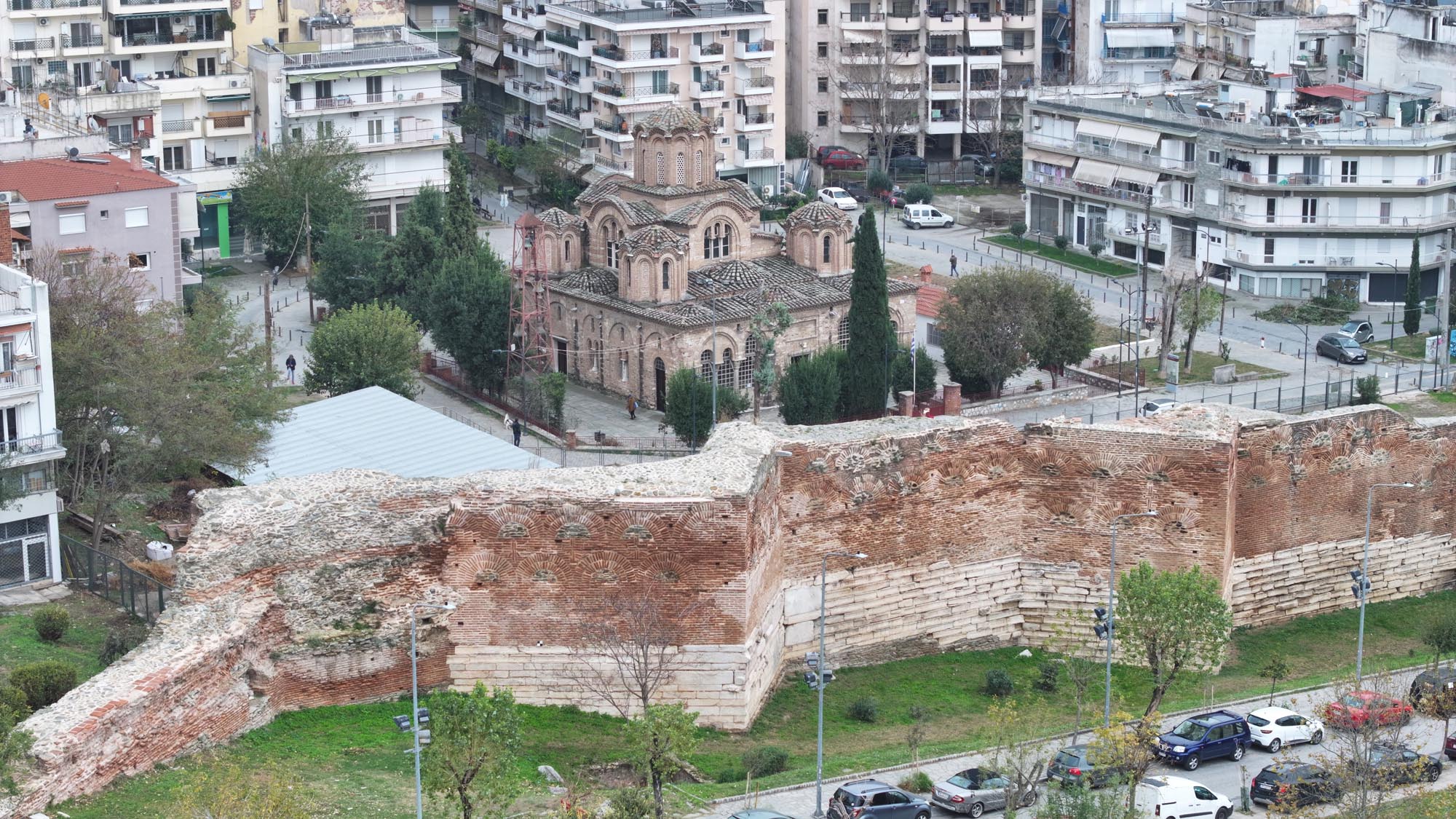
Thessaloniki was provided with strong fortifications from the time of its founding by Cassander in 316/5 BC. In the middle of the 3rd century AD, the Hellenistic fortifications were succeeded by those of Roman times, in order to counter the raids of the Goths. The walls that we see today were built at the end of the 4th century AD, during the reign of Emperor Theodosius the Great (379-395 AD), incorporating the remains of the earlier Hellenistic and Roman fortifications. Over the following centuries, the walls underwent successive repairs and rebuilding, in many cases confirmed by inscriptions preserved in various parts of the fortifications.

The fortified enceinte of Byzantine Thessaloniki is trapezoidal in plan and densely reinforced with alternating triangular bulwarks and square towers. In the vulnerable sections on the plain, the fortifications were reinforced by a wall (the outer wall or diateichisma). On the side of the sea, the city was protected by a low sea wall which enclosed the port of Constantine the Great in its southwest corner. A striking feature of the sea wall’s construction is the fact that it is founded on wooden piles sunk in the sandy coastal soil.

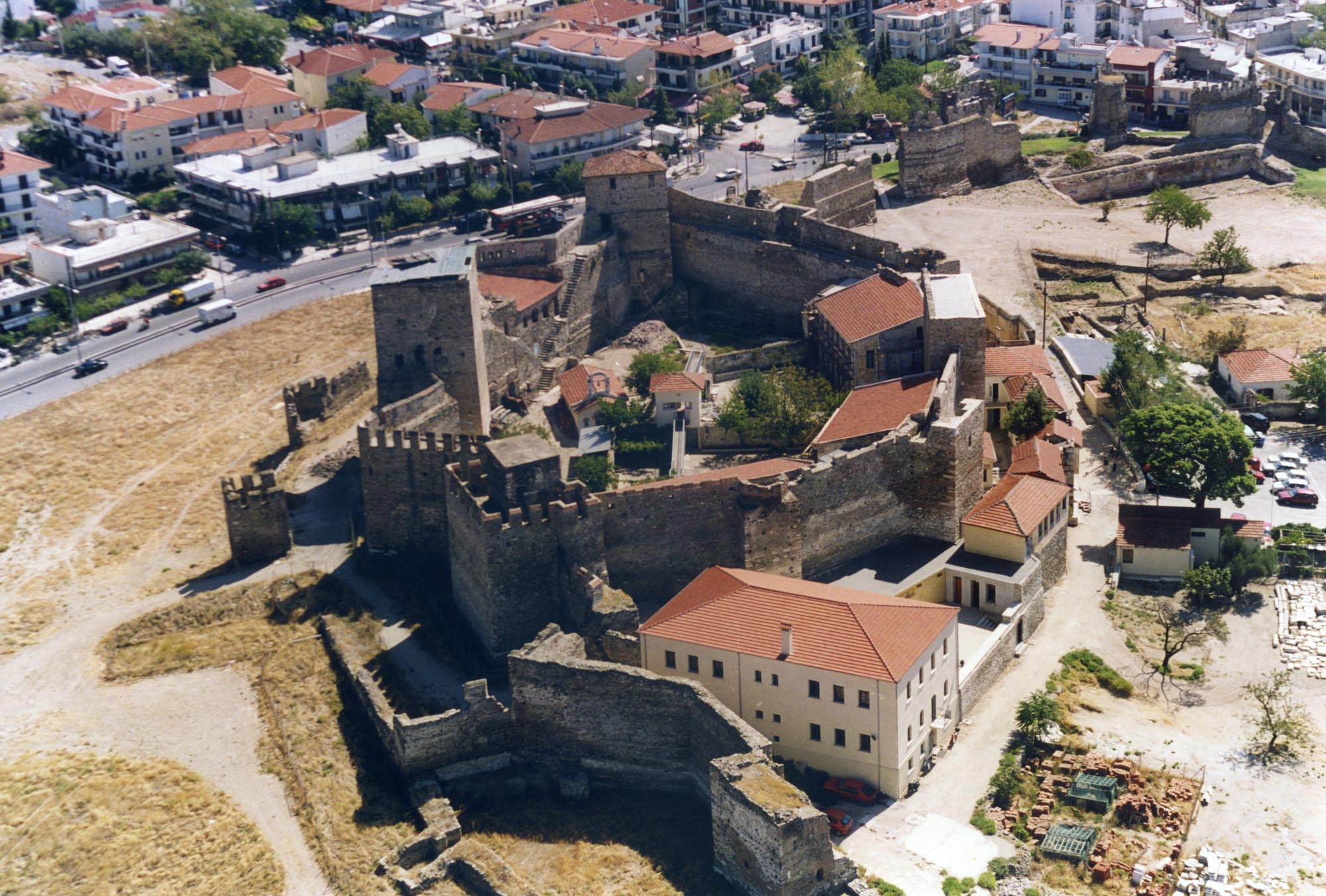
The acropolis adjoins the northeast section of the fortifications. At its highest, northeast end, rises the Heptapyrgion (“Fortress of Seven Towers”) a small polygonal fortress with an area of about 6,000 m2, also known as the Yedi Kule (meaning the same in Turkish). It presents different construction phases ranging from Early Christian to Ottoman times. The marble Ottoman inscription set above the lintel of the main gate records interventions and renovations of towers and parts of the fortress by Çavuş Bey, the first Ottoman governor of the city. The fortress is associated in the collective memory of the inhabitants with its use as the prison of Thessaloniki for about a hundred years, from the late 19th century up to 1989, when the prison was moved elsewhere.

The city had four main gates, two in the west and two in the east side of the fortifications, from which the main roads of the city started. On the west, Thessaloniki was entered through the monumental Golden Gate (Vardar Gate or Axios Gate), originally a triumphal arch commemorating the victory of Octavian and Mark Antony at the Battle of Philippi in 42 BC. The Golden Gate was the starting point of the city’s main east-west thoroughfare, the decumanus maximus of the Roman period, which in Byzantine times was called the Mese Hodos (Middle Road) or Leophoros (Avenue). The Leophoros ended at the Cassandrian Gate (Kalamaria Gate) on the east side of the fortifications, near the Galerian Complex (early 4th c. AD). Large parts of the decumanus maximus have come to light in the excavation at the Agia Sophia and Venizelou metro stations, under the modern Egnatia Street, during the construction of the Thessaloniki Metro. The particularly impressive excavation finds, which include the remains of the individual works of architecture (colonnaded arcades, shops, fountain building/nymphaeum, etc.) that lined the 5-metre-wide, marble-paved main street, which has followed much the same course down to the present day, add to our knowledge of not only the topography of Thessaloniki, but also the urban planning of Byzantine cities in general.

The second main gate in the west wall, north of the Golden Gate, was the Letaia Gate. From here the second main road ran across the city to the New Golden Gate in the eastern fortifications. Other smaller gates (sallyports) in the walls mainly served a military function.

After conquering the city in 1430, the Ottomans reinforced its fortifications, adapting them to the new techniques of warfare imposed by the development of artillery from the mid-15th century onwards. One of the new additions was the Fortress of Kalamaria, a fortified octagonal enclosure with turrets at the corners and embrasures in the sides. It was built in 1535/6, during the reign of Suleiman the Magnificent (1520-1566), at the southeast end of the fortifications, where the east wall met the sea wall. In the centre of the enceinte stood the round White Tower, formerly known as the Tower of the Janissaries and the Bloody Tower (Kanli Kule) since, according to the historian Michael Hatzi Ioannou (1888), who calls it the “Bastille of Thessaloniki”, those condemned to death were slaughtered on the battlements, their blood staining the walls. The remains of the octagonal enceinte, known from old photographs and descriptions, were uncovered during an excavation in 2005, during the landscaping of the area around White Tower.

The White Tower, together with the Trigonion Tower in the Upper City, also known as Zincirli Kule (Chain Tower) or Kusakli Kule (Belted Tower), and the Vardaris Fortress in the southwest part of the city, was one of the strongest fortresses built by the Ottomans to strengthen the fortifications that survives to this day.

The total perimeter of the Byzantine city walls was 8 km. Today, after the demolition of much of the walls at the end of the 19th century, they are preserved to half their length, which is about 4 km. They are visible in several parts of the centre of Thessaloniki, especially in the Upper City, and still form an undeniably imposing unit within the modern urban fabric, clearly defining the boundaries of the historic city centre.

 

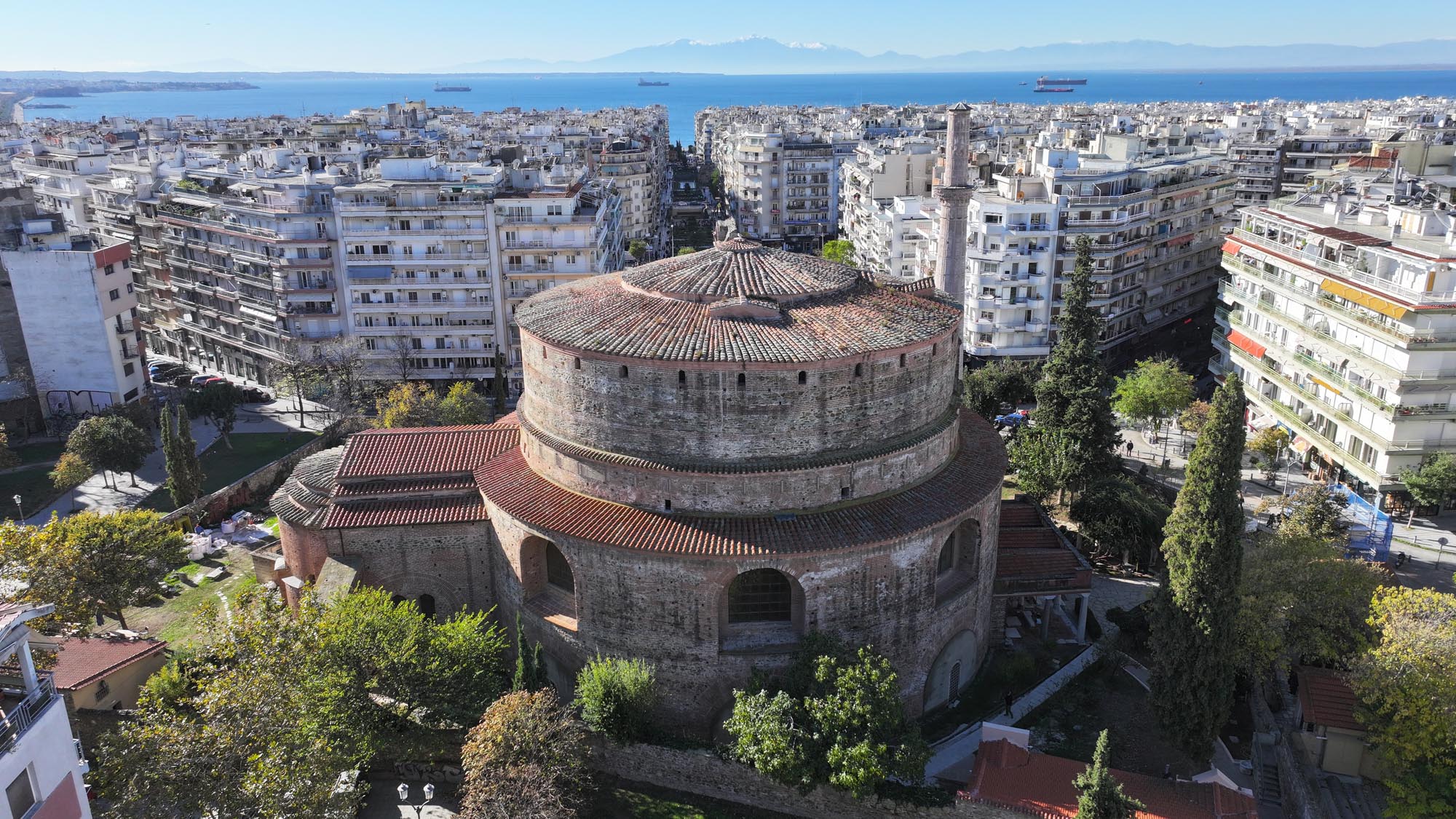
The Rotunda, which owes its name to its circular shape, is now dedicated to St George and is located in the east part of the city, on the north side of Dimitriou Gounari Street. With a diameter of 24.50m and a height of 29.80 m, it is one of the most impressive and also the oldest and most enigmatic monuments of the city. As it stands on the Roman road that connected the Kamara with the Late Roman Palace of the Caesar and then Emperor Galerius (293-305 AD), it is believed to be part of the same extensive building programme. Due to its size and architectural form, it has been suggested that it was either a temple dedicated to Zeus, the Cabeiri (the tutelary deities of the emperors of the Tetrarchy) or the imperial cult, or a secular building serving the needs of the imperial complex. More recently, however, it has been argued that it was built to serve as the mausoleum of Emperor Constantine the Great (306-337 AD), who endowed the city with a series of notable buildings and major construction works.

The conversion of the Rotunda into a Christian church, probably dedicated to the Asomatoi or Archangels, is a milestone in its history. This conversion is clearly marked by the addition of a large sanctuary in the east part of the original building, variously dated between the late 4th and the first half of the 6th century.

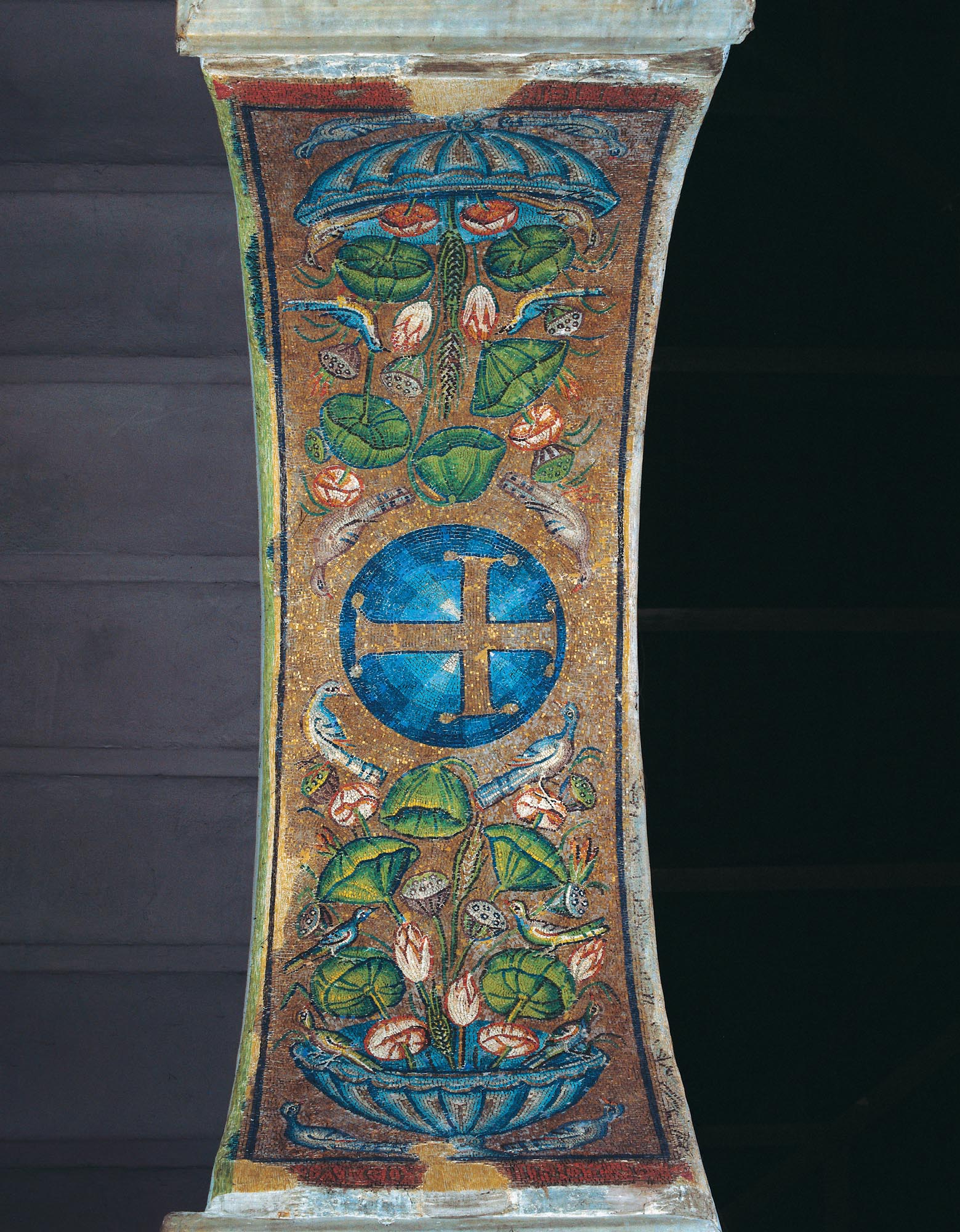
Inside the monument, the exceptional mural mosaics are most impressive. They are generally considered to be some of the greatest masterpieces of Early Christian art, strongly influenced by the Greco-Roman tradition.

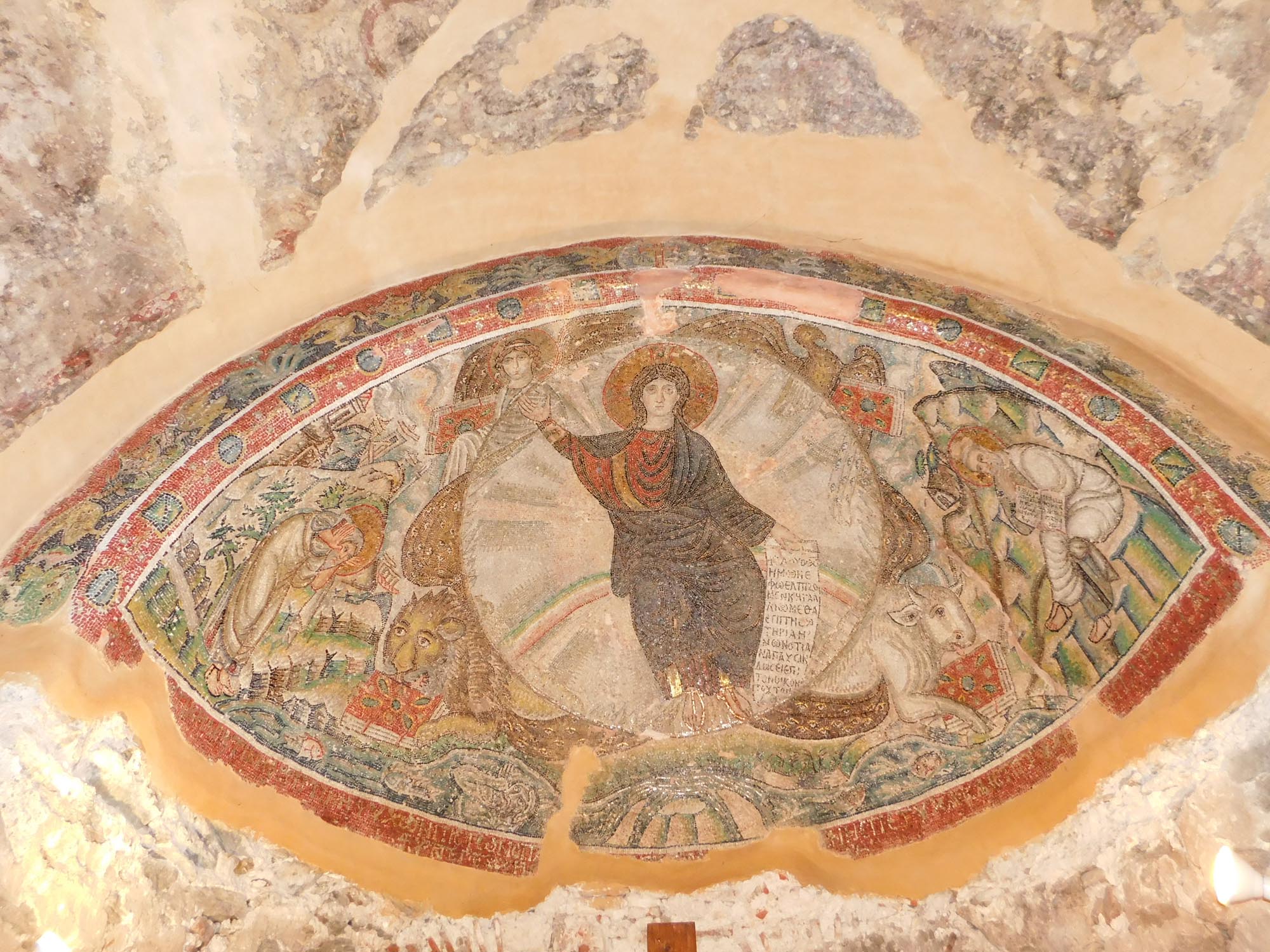
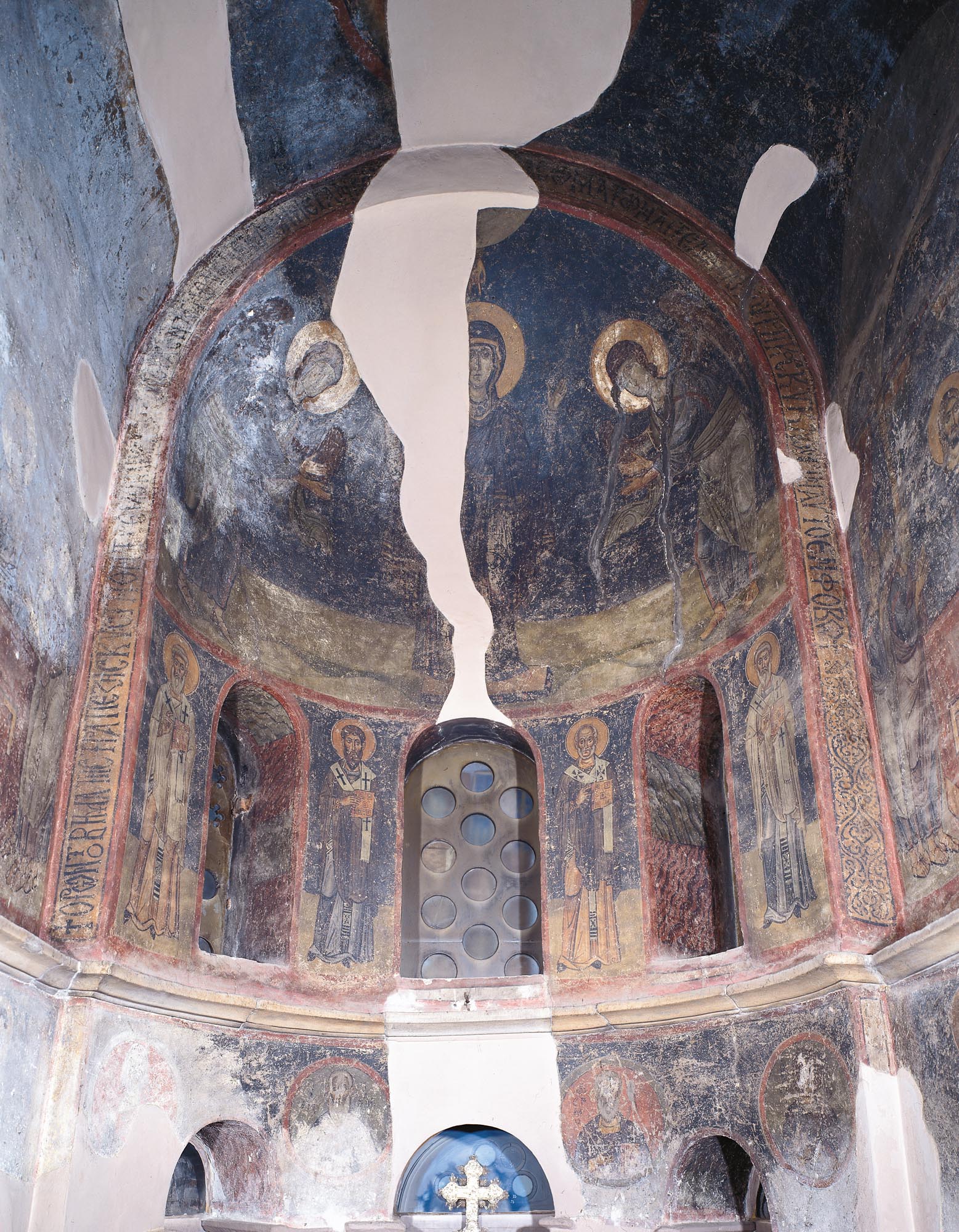
In the Upper City, on a side street off Timotheou Street, stands the church dedicated today to Hosios (holy monk) David of Thessaloniki. It was originally the katholikon of a monastery dedicated to Christ the Saviour of Latomos, named after the quarries (latomeia) that once existed in the area. The church, of which only the east part is preserved today, was built in the late 5th or early 6th century AD. It is a cross-in-square church with a conch on the east. The mosaic depicting the Theophany (Christ appearing in triumph) in the sanctuary apse, one of the few mosaics described by a later Byzantine writer, specifically Ignatios, the abbot of Akapniou Monastery in Thessaloniki (11th or 12th c.), dates from the same period. According to Ignatios, the mosaic was covered with oxhide and mortar, probably during the Iconoclastic period, and later miraculously revealed during the reign of Emperor Leo V the Armenian (813-820). The late-12th-century frescoes that adorn the interior of the church are also important works of art.

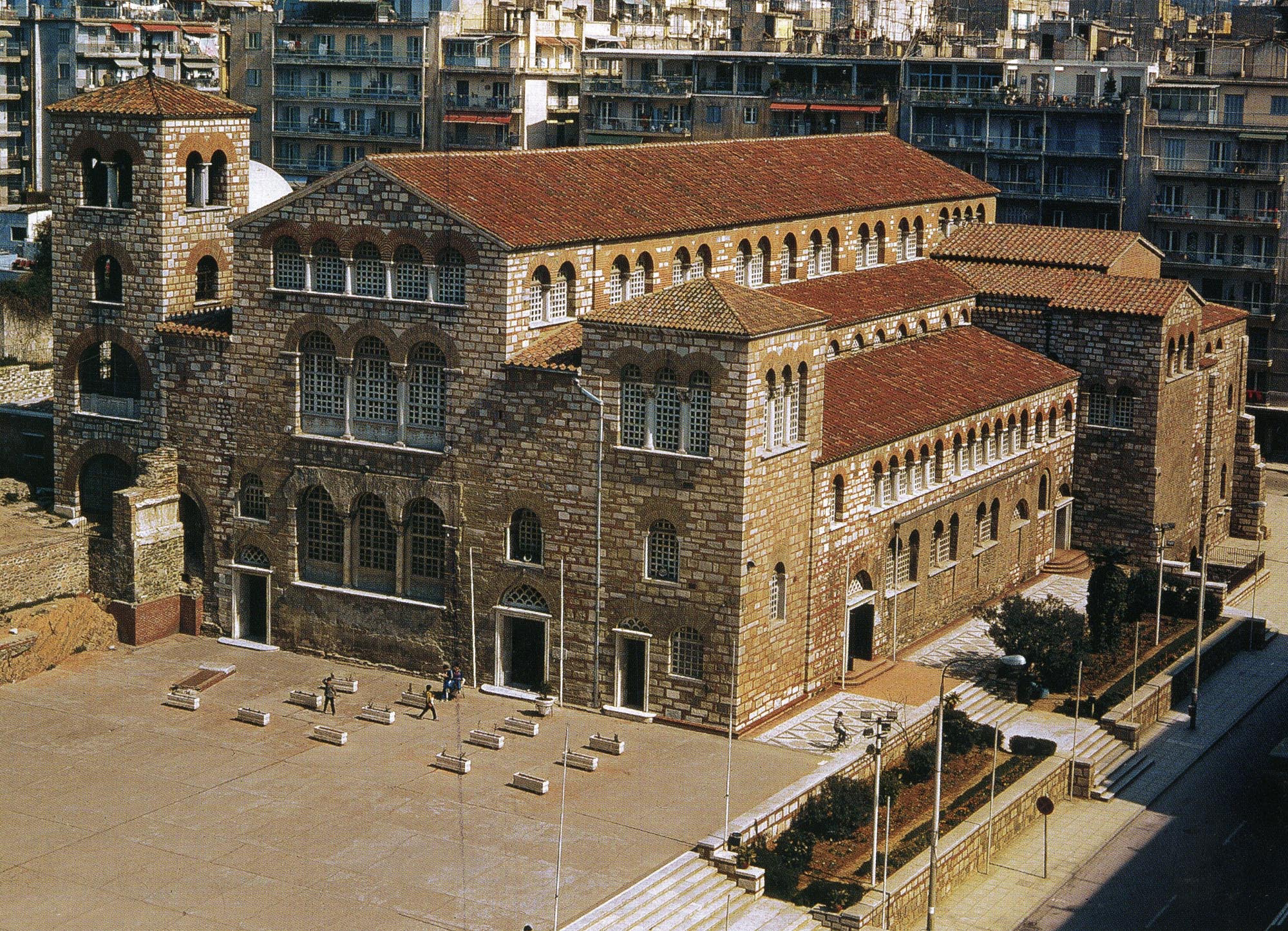
On Agiou Dimitriou Street, north of the Roman Forum, stands the church of the patron saint of Thessaloniki. It was erected in the mid-5th century AD by Leontios, the prefect of Illyricum, in the place where, according to tradition, the saint was imprisoned and martyred. The church is a five-aisled basilica with a triple transept on the east. Its present reconstructed form is the result of extensive restoration work that began in 1918 and was completed in 1948, after its almost total destruction in the Great Fire of 1917. Particularly noteworthy is the surviving sculptural decoration of the monument and its mural mosaics consisting of individual votive images, offerings made by ordinary citizens or city officials (5th-9th c. AD). Attached to the south wing of the transept is the chapel of St Euthymios, in the shape of a small three-aisled basilica. It is decorated with remarkable frescoes dating from 1302/3, representative examples of early-14th-century Palaiologan painting in Thessaloniki.

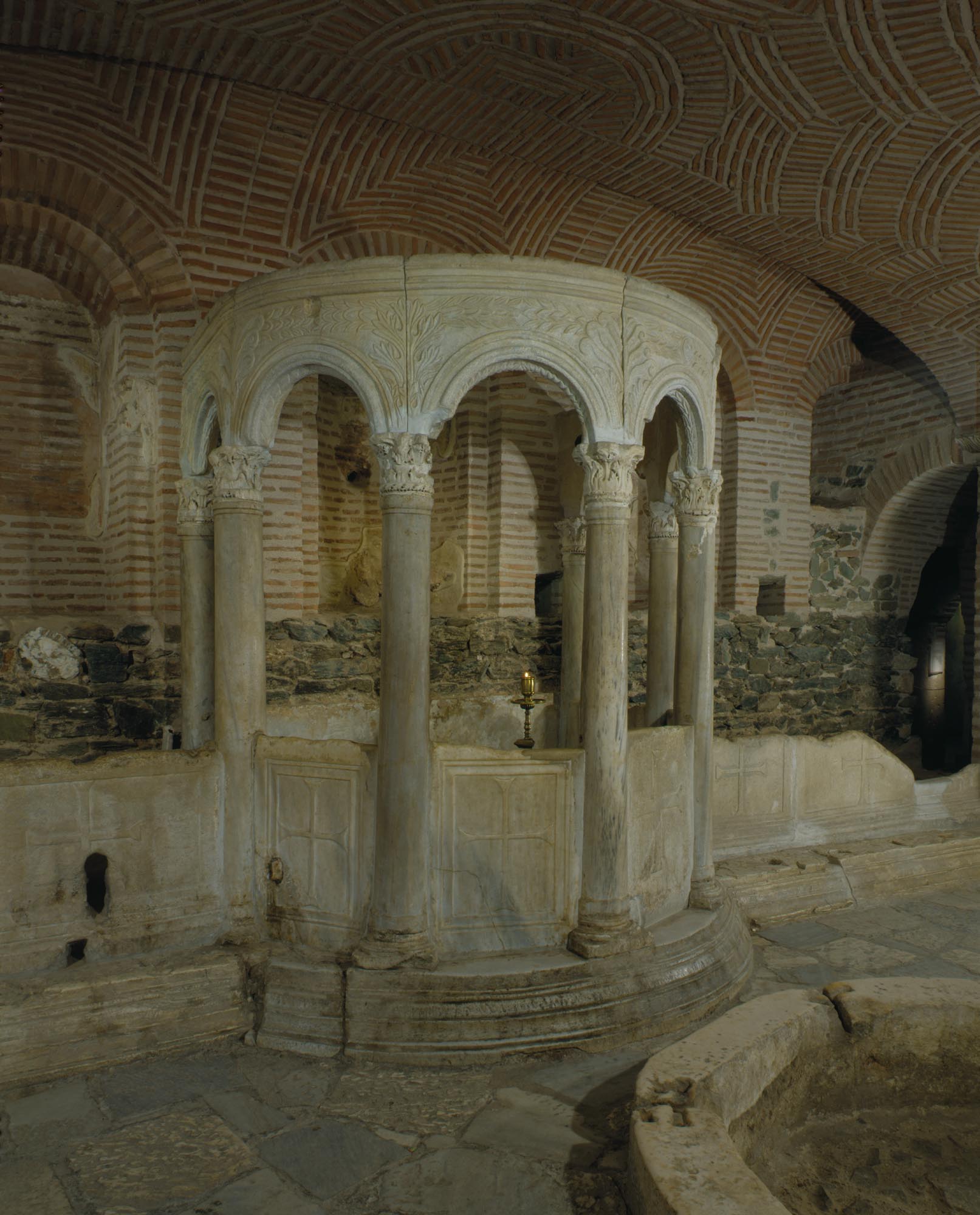
Underneath the transept is the Crypt, where, according to tradition, the saint was martyred. During the Byzantine period it was associated with the miracle of the saint’s body flowing with myrrh which was collected by the faithful. Today the Crypt houses an exhibition of archaeological finds representing the various phases of the church’s history and use.

The church of St Demetrios rapidly became a major Christian pilgrimage centre. The myrrh flowing from the body of the miracle-working saint attracted crowds of believers suffering from various diseases who came to obtain the holy myrrh, seeking the saint’s intercession for their healing. Saint Demetrios was also seen as the philopolis and philopatris (“lover of the city” and “patriot”) patron saint of the city, protecting it from dangers of all kinds, whether internal, such as the discord that occasionally disturbed its order, or external, such as raids and sieges by barbarian tribes, and even plague and famine.

The cult of Saint Demetrios was especially celebrated in Thessaloniki. The Demetria, the festival with which the city honoured its patron saint every October, lasted for many days and included a large annual fair held in the plain outside the west wall of the city. By the standards of the time, this fair was “international”, as it was attended by merchants and traders from all parts of the known world, even countries “beyond the Alps and the land of the Celts”, according to the description by Timarion, who visited Thessaloniki, probably in the first half of the 12th century. In this huge open-air market, one could find all kinds of goods: yarn, textiles, household equipment, various utensils and furniture, and even live animals such as cattle, sheep and pigs. The Demetria festival was revived in 1966 and is still held today as a cultural festival, including theatre, music and dance events, art exhibitions and various other activities.

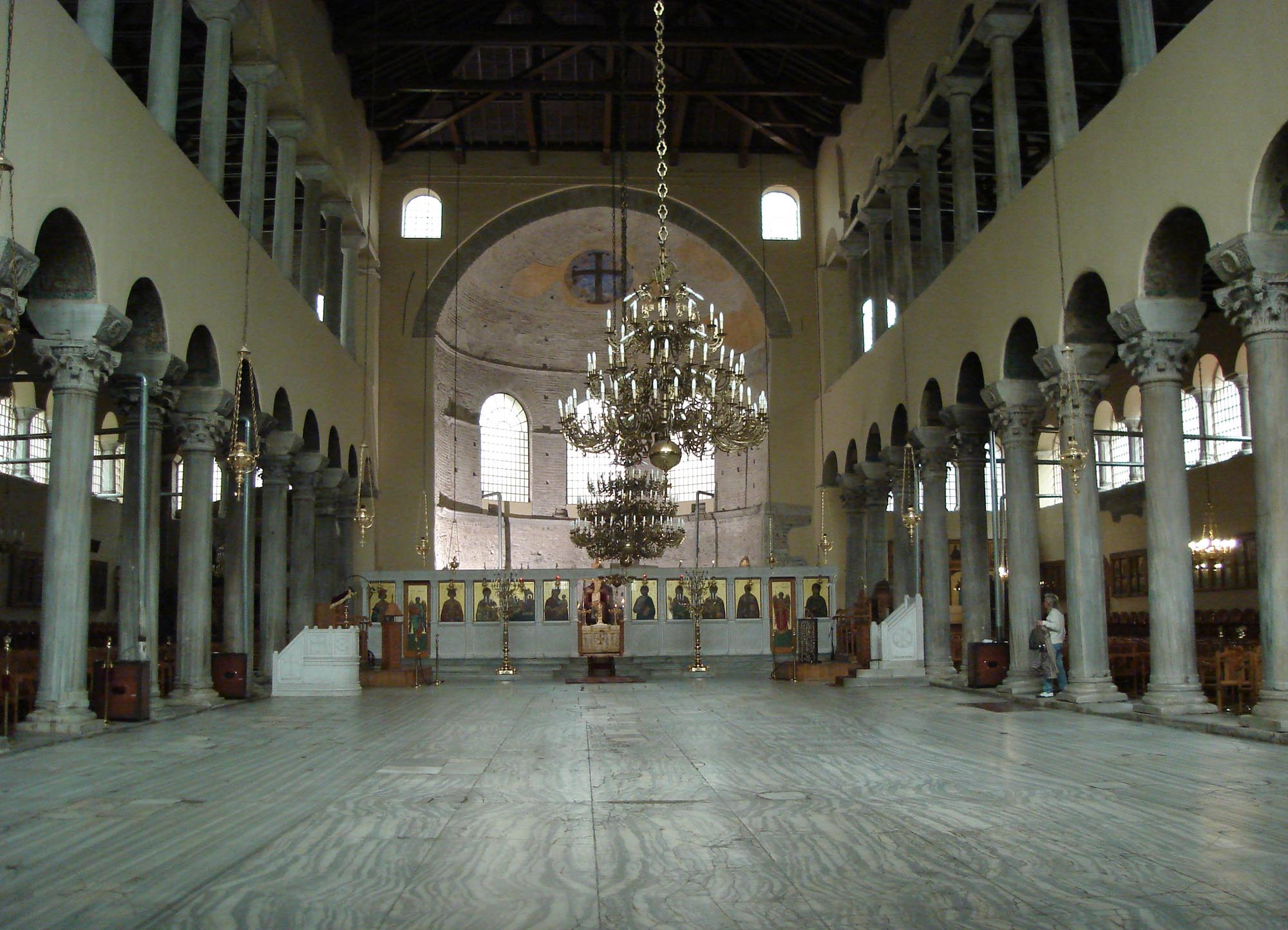
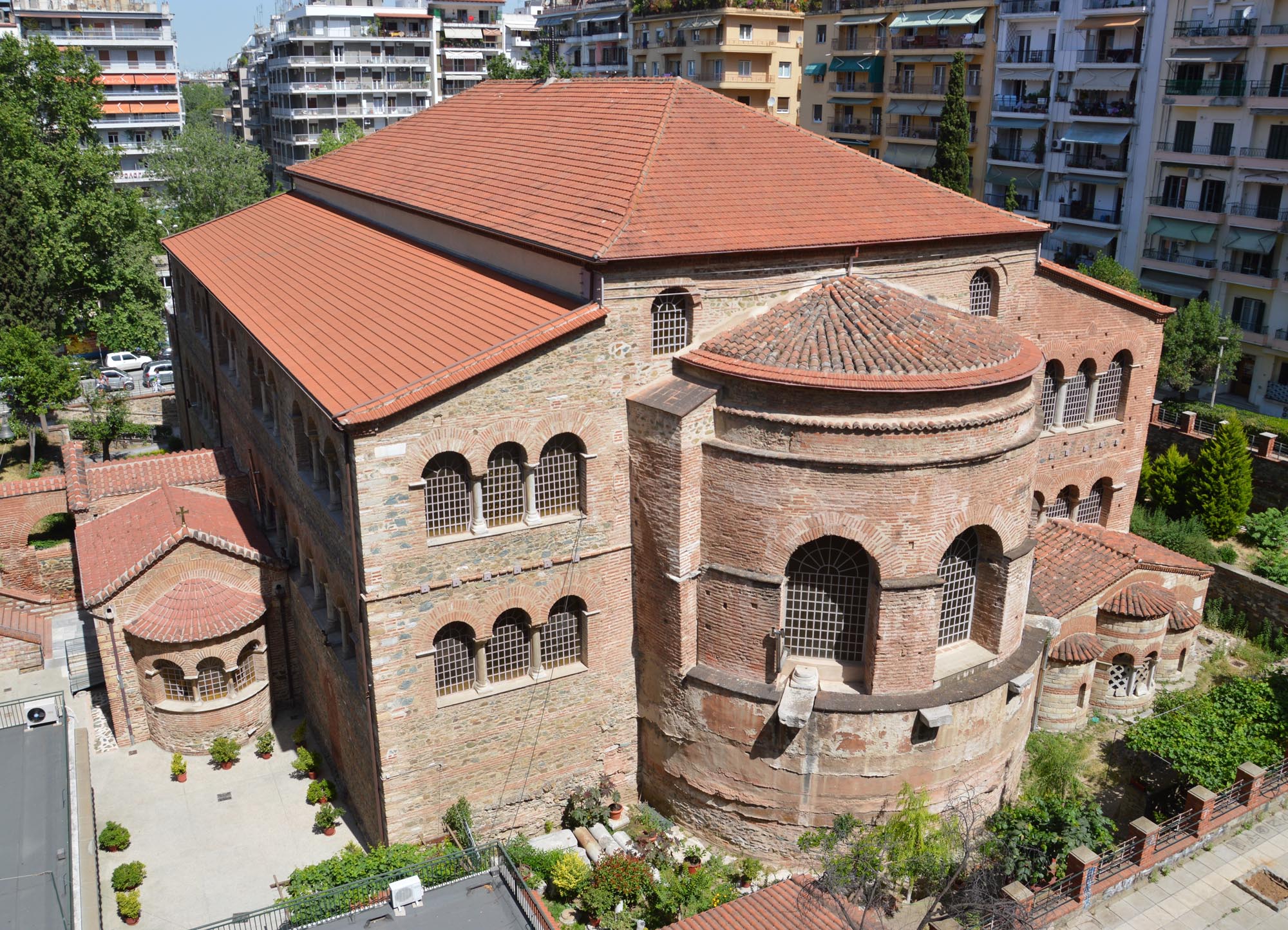
In the centre of the city, on Agias Sophias Street, is the “great church” of the Theotokos Acheiropoietos, the most representative example of the three-aisled wooden-roofed basilica with narthex and galleries, a widespread type with numerous variations in the ecclesiastical architecture of the Early Christian period. Built in the last decade of the 5th or the first decade of the 6th century AD, during the reign of Anastasius I (491-518 AD), it has undergone numerous repairs during its long history spanning over fifteen centuries. The sculptural decoration is particularly remarkable, the most distinctive feature being the capitals of the colonnades on the ground floor, which are said to have been made by the same sculpture workshop in Constantinople that created the column capitals of the basilica of the Monastery of Stoudios in Constantinople. Inside the church are preserved exceptional mural mosaics, recently argued to belong to two different phases: the mosaics on the ground floor are contemporary with the founding of the basilica, while those of the galleries were created after the first structural repairs to the basilica in the mid-7th century AD.

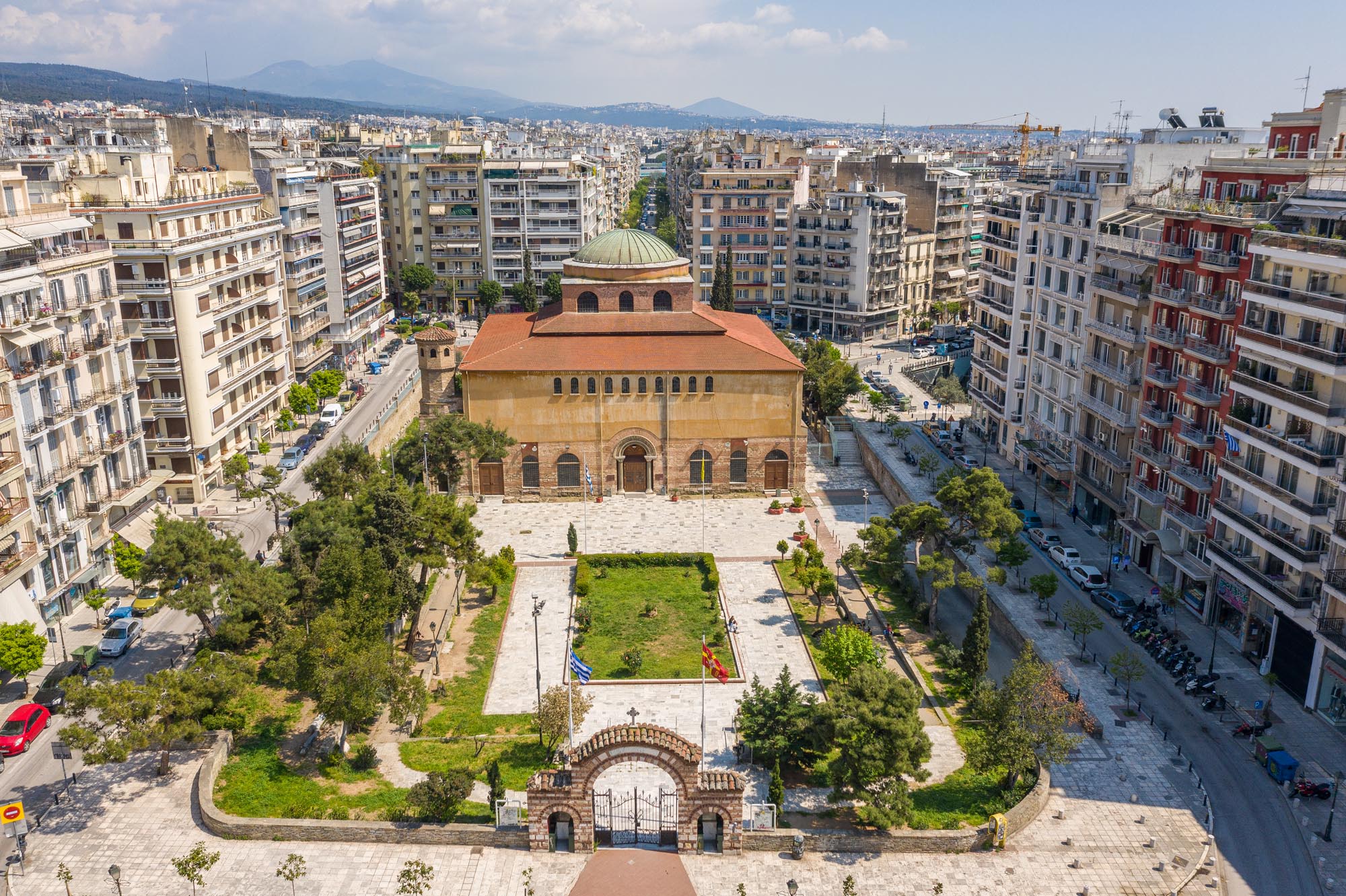
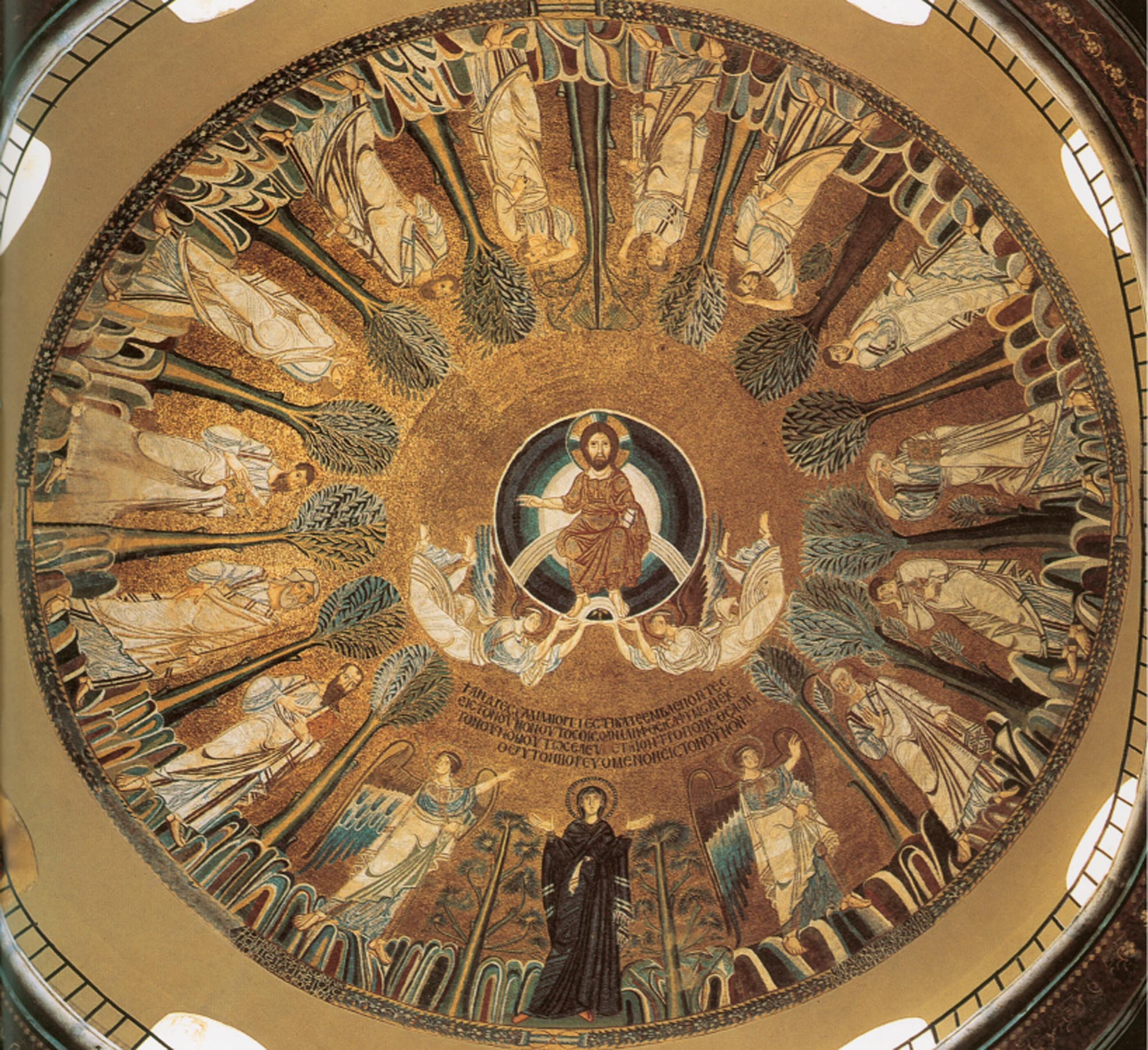
South of Egnatia Street, on Agias Sophias Street, is the church dedicated to the Wisdom and the Word of God. It is one of the most important ecclesiastical monuments of Thessaloniki, as it was the metropolitan church of the city from its foundation until its conversion into a mosque in 1523/4. According to the prevailing view, it was built in the 7th or 8th century AD, on the site of a large five-aisled basilica of the 4th or 5th century AD. The imposing church is a typical example of a transitional cross-domed basilica, in imitation of Hagia Sophia in Constantinople. The interior preserves remarkable mural mosaics, the dating of which has been the subject of debate. Three different phases have been identified, to the first of which belongs the decoration of the sanctuary, one of the most important and most accurately dated group of images of the Iconoclastic period, created, according to the surviving inscriptions, at the time when Constantine VI was co-emperor with his mother Irene (780-788). The representation of the enthroned Virgin and Child in the semi-dome of the apse has been dated between the 9th and the 12th century, while the representation of the Ascension in the dome is considered a masterpiece of the art of the Macedonian Renaissance (second half of the 9th-first half of the 10th c.).

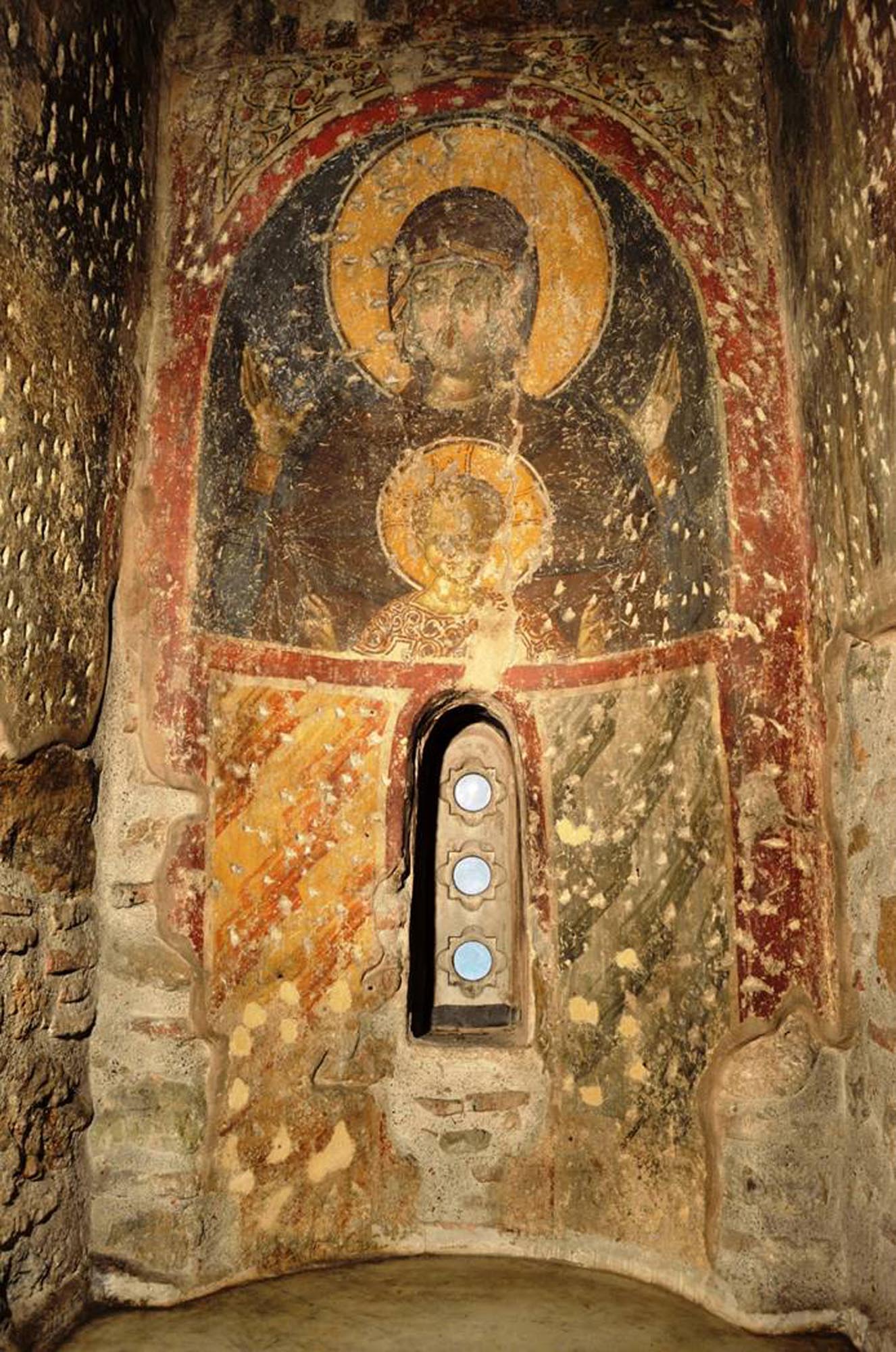
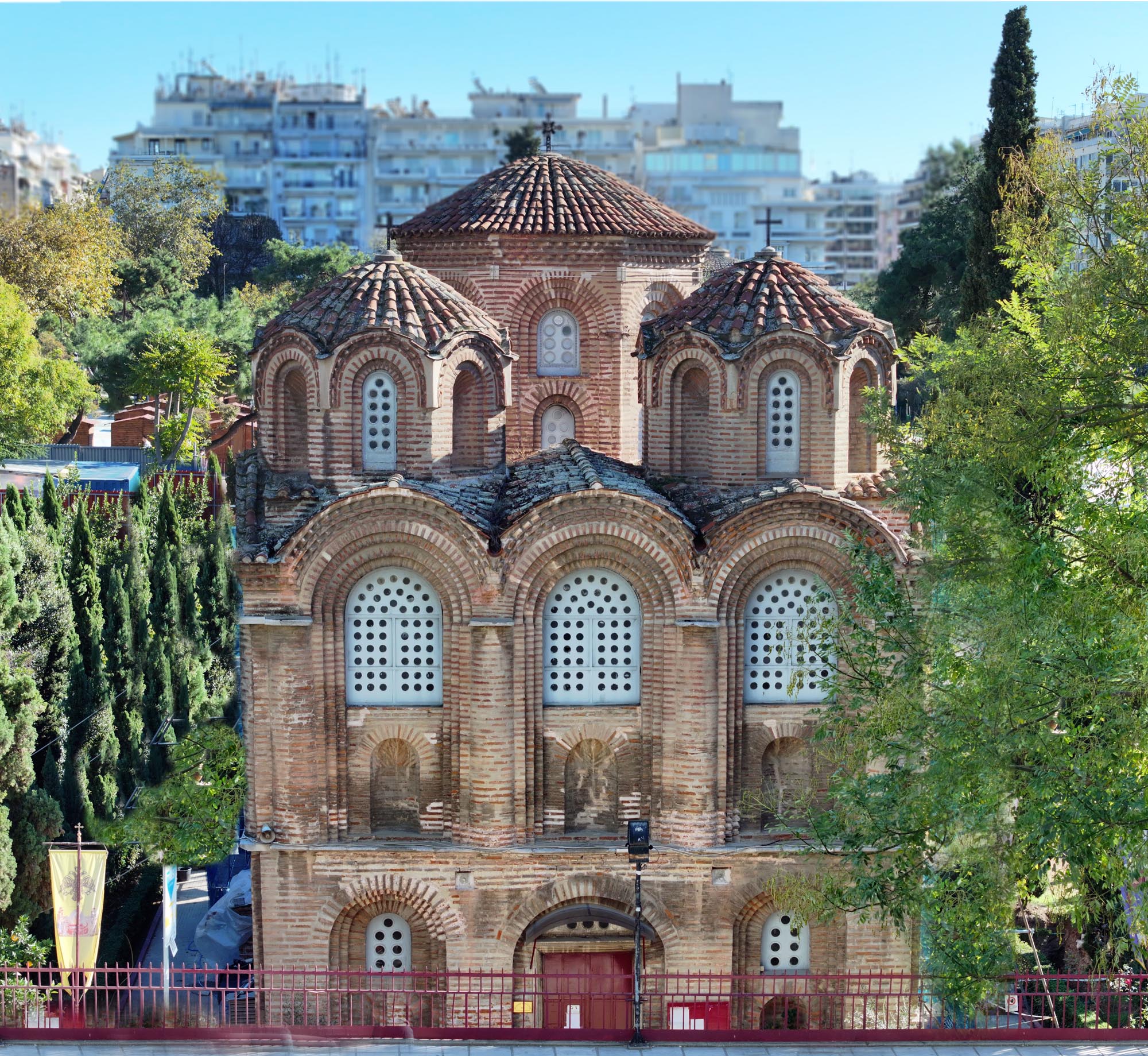
The church of the Panagia Chalkeon (“Virgin of the Coppersmiths”), on Egnatia Street, was built, according to an inscription, in 1028 by the senior official Christophoros and his family. The tomb of Christophoros, “Protospatharios and Kapetanios of Longobardia”, is in an arcosolium set in the thickness of the north wall of the church. The monument is a cross-in-square church with a dome and stands out for its elegant proportions and exclusively brickwork masonry. Its interior is decorated with frescoes which, although only fragmentarily preserved, form an extremely interesting group contemporary with the founding of the church.

Αρχείο ΕΦΑ Πόλης Θεσσαλονίκης / Archive of the Ephorate of Antiquities of Thessaloniki City

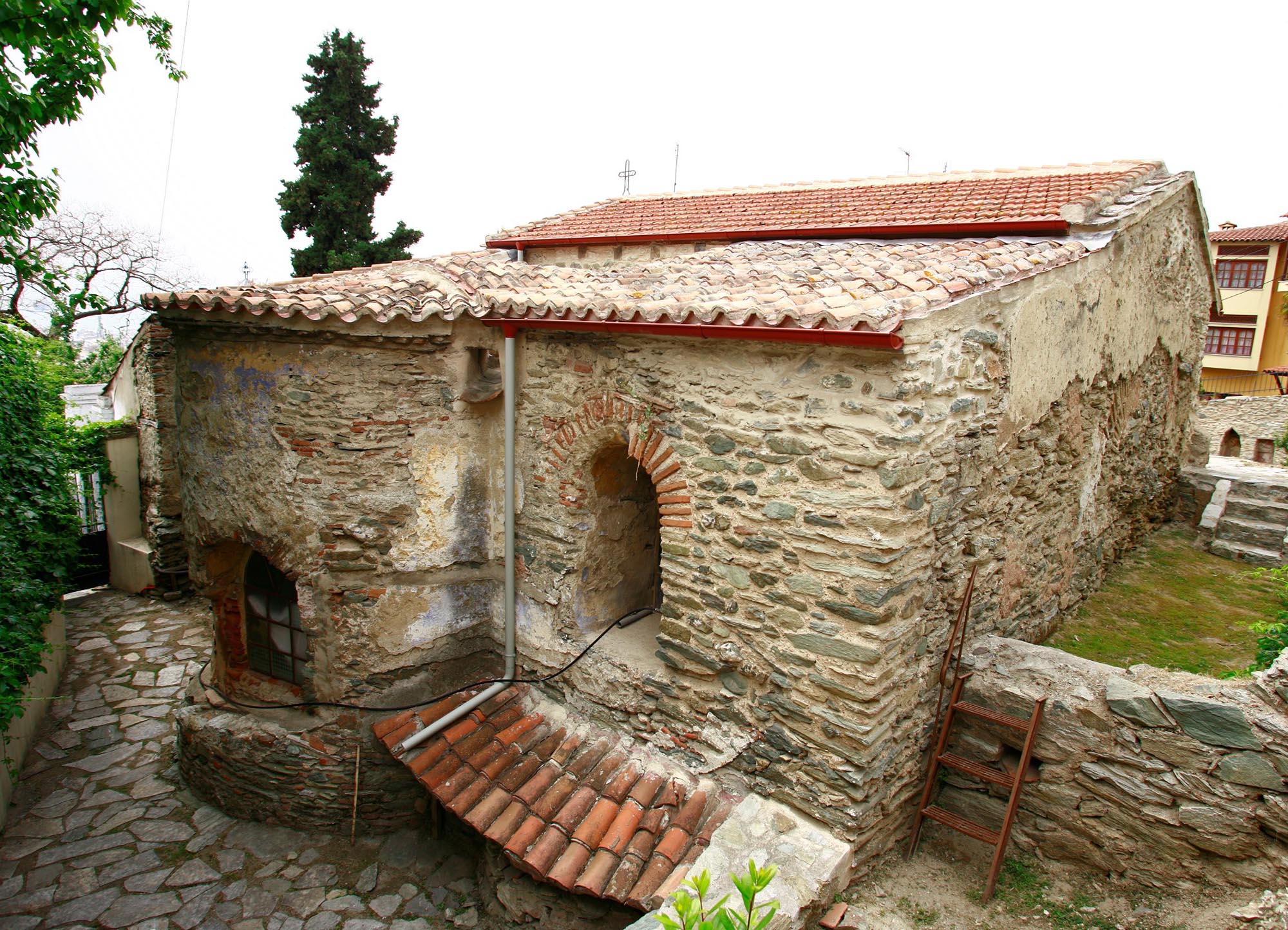
The church stands at the junction of Arrianou and Iasonidou Streets, not far from the Arch of Galerius and the Rotunda. Its current name is not the original one. It was either the katholikon of the Monastery of Panagia Peribleptos, also known as the Monastery of Kyr Isaac, after its founder, the metropolitan bishop Jacob (1295-1314), or the katholikon of the Monastery of Christ Pantodynamos, which, according to written sources, was founded after the mid-13th century by Theodore Kerameas, the deposed Archbishop of Ohrid. It is a complex cross-in-square church with a dome and ambulatory, terminating in two chapels on the east side. A few fragments of the fresco decoration, which dates from the beginning of the 14th century, are preserved in the prothesis and the diaconicon.

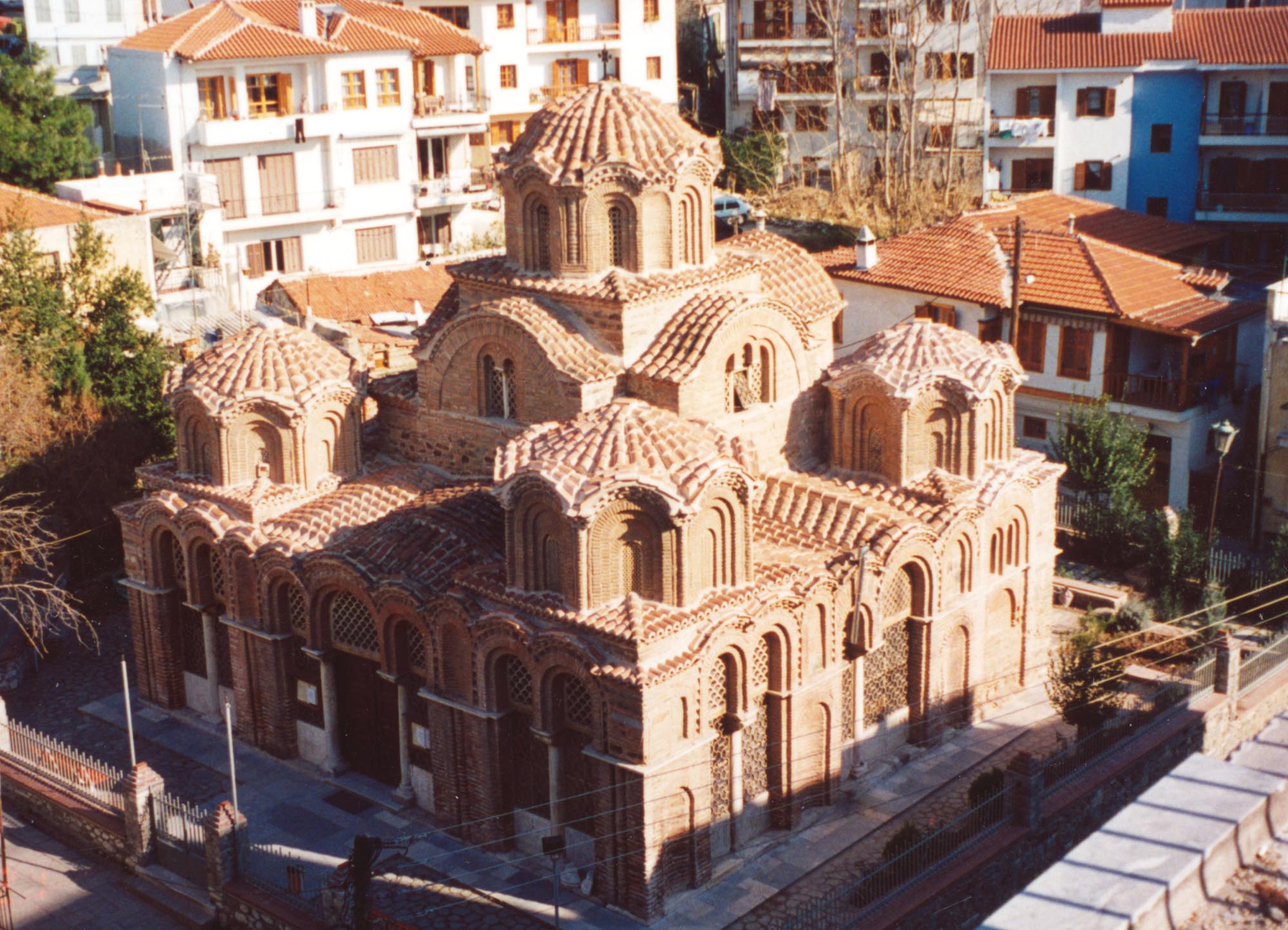
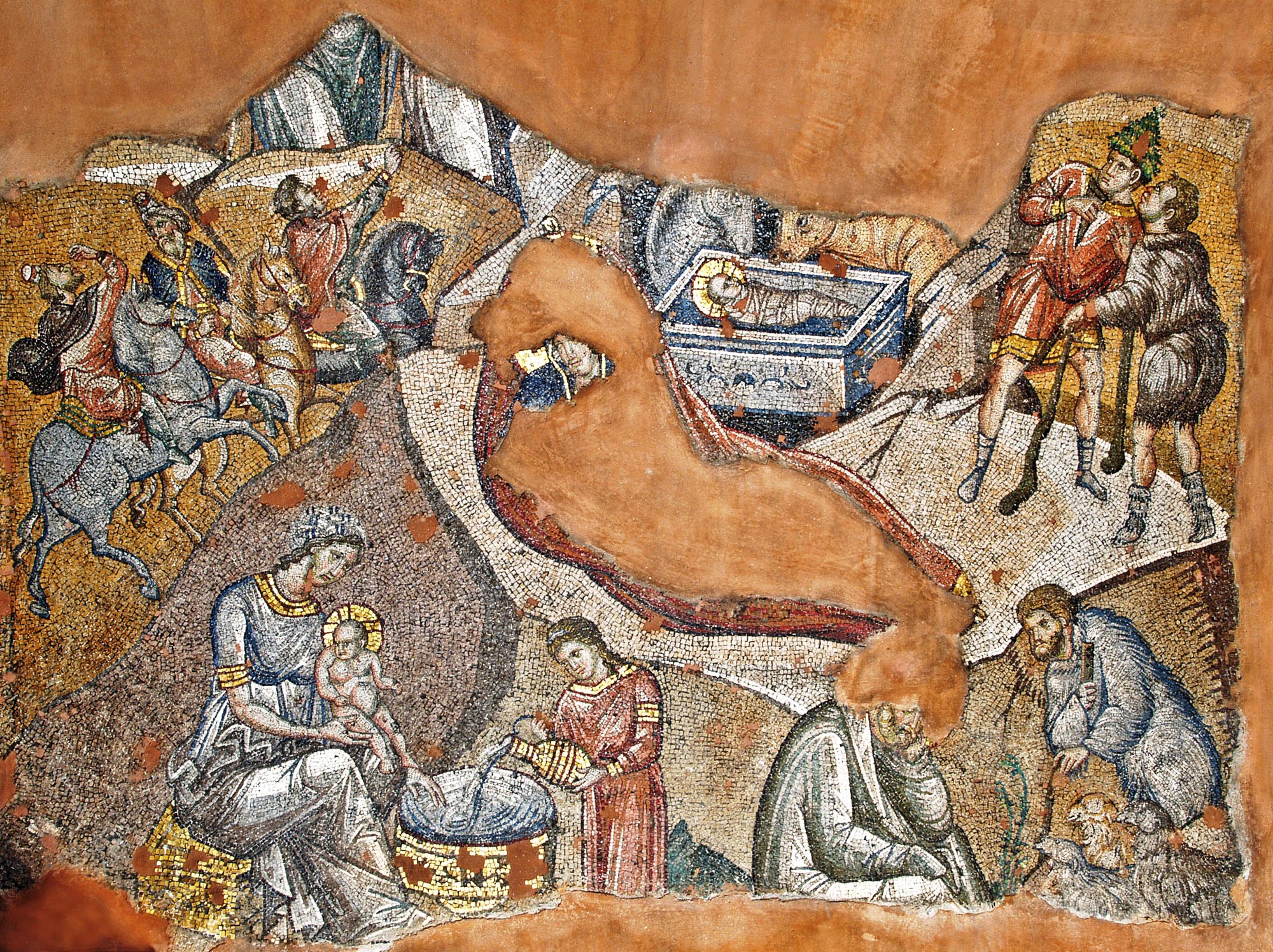
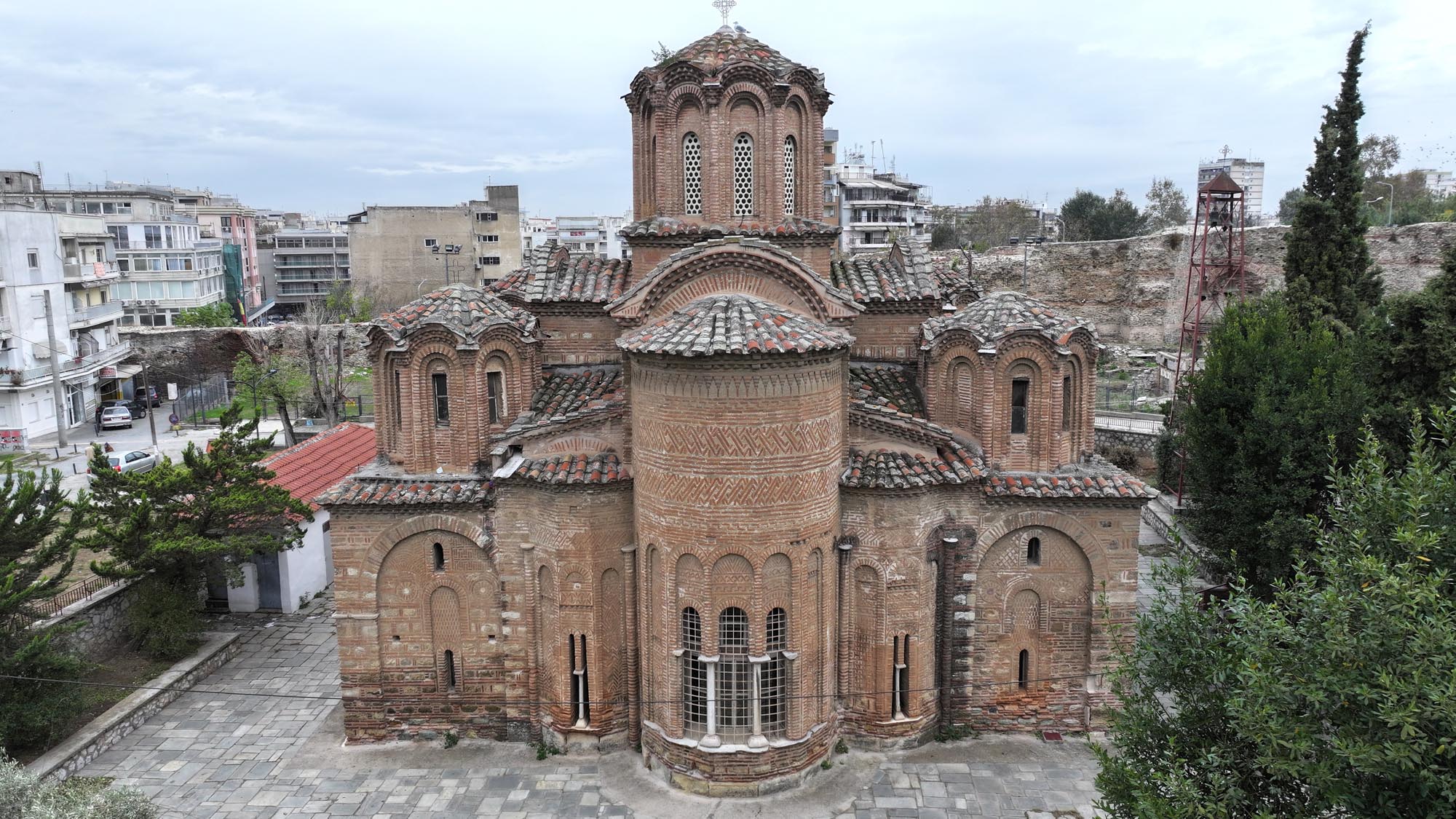
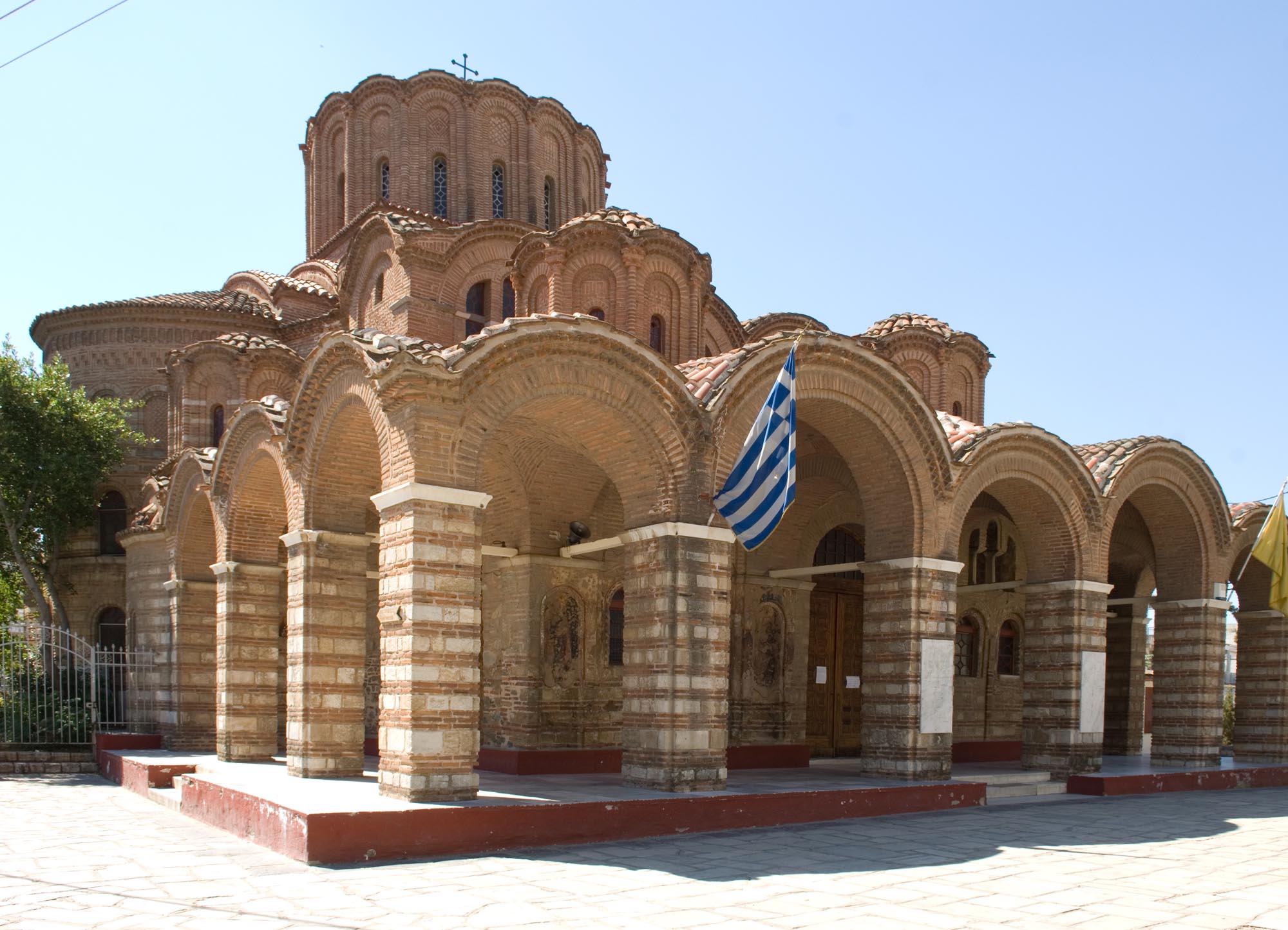
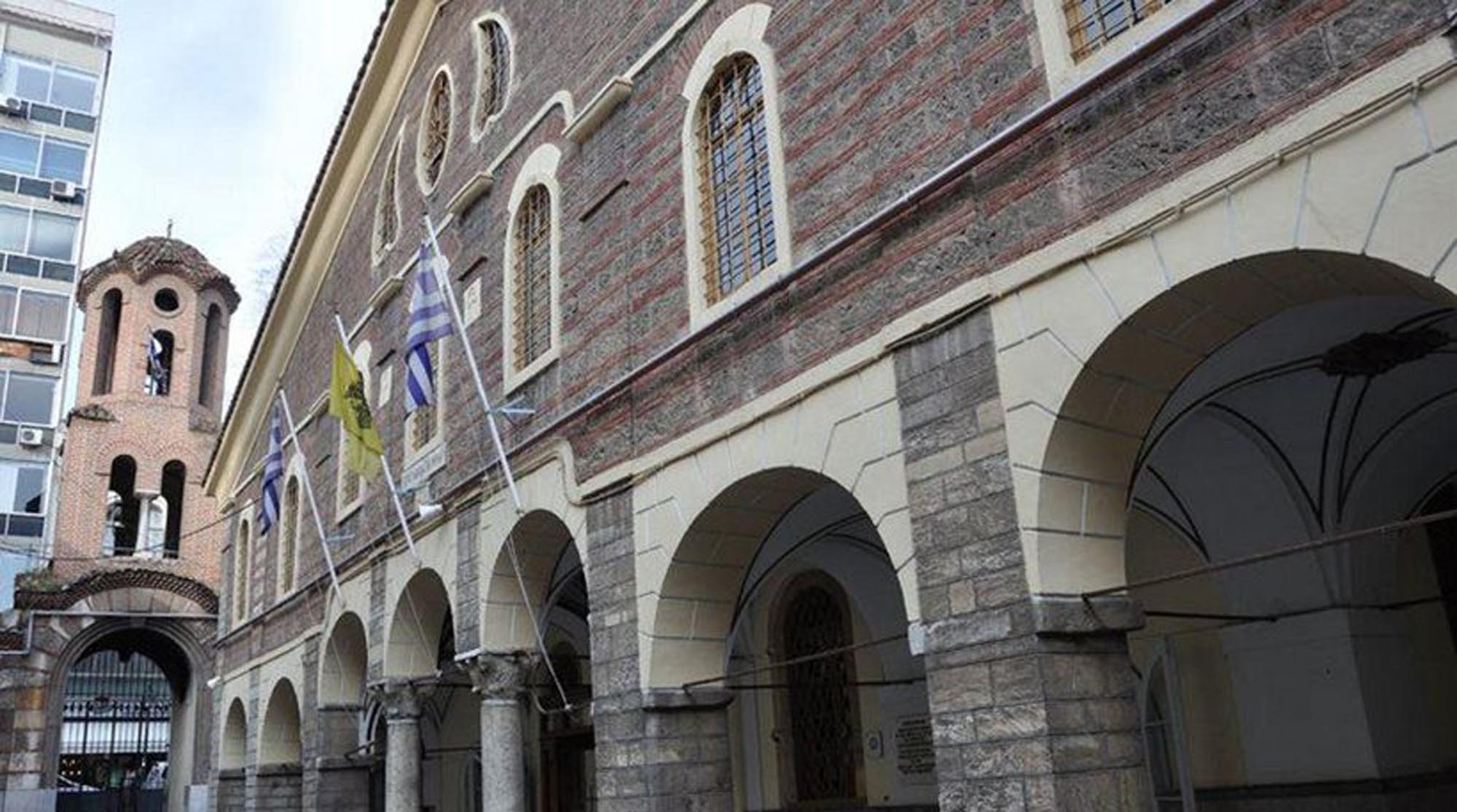
Built close to the west wall, at what is now the beginning of Olympou Street, it was once the katholikon of a monastery that was probably dedicated to the Virgin. Its present name is due to the popular belief that it was roofed with 12 domes for the Twelve Apostles. The church was built, according to inscriptions, by Patriarch Nephon of Constantinople (1310-1314) and his disciple Paul, the abbot of the monastery. It is a complex cross-in-square church with an ambulatory, roofed, apart from the central dome, with four more small domes at the corners. It stands out for its exceptionally harmonious proportions and its richly decorated façades with arches, conches, brick half-columns and decorative brickwork of rich subject matter and excellent execution. The church is not only an exquisite example of architecture but also a masterpiece of Palaiologan painting, as we see from the very fine mosaics and frescoes preserved inside.

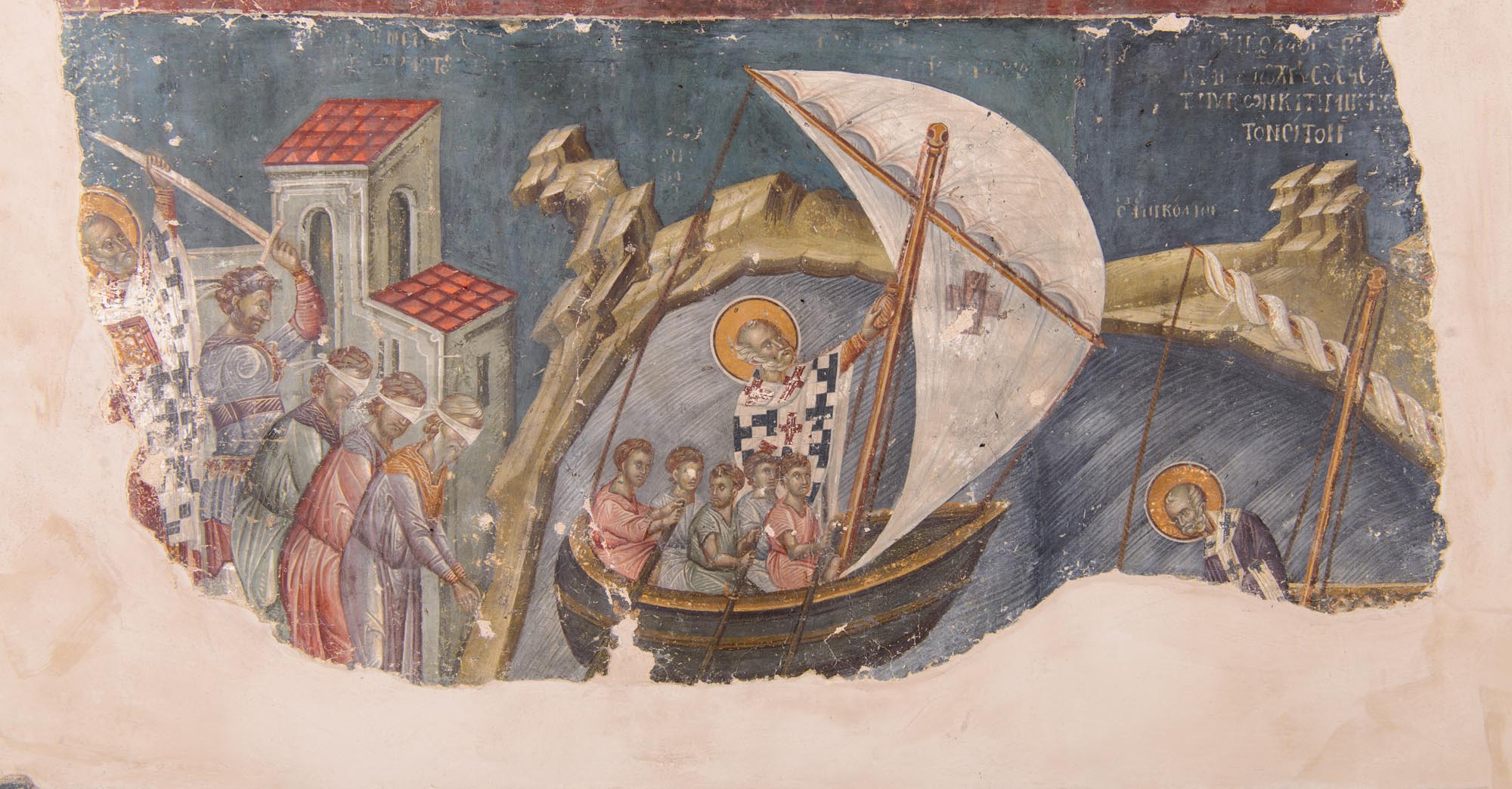
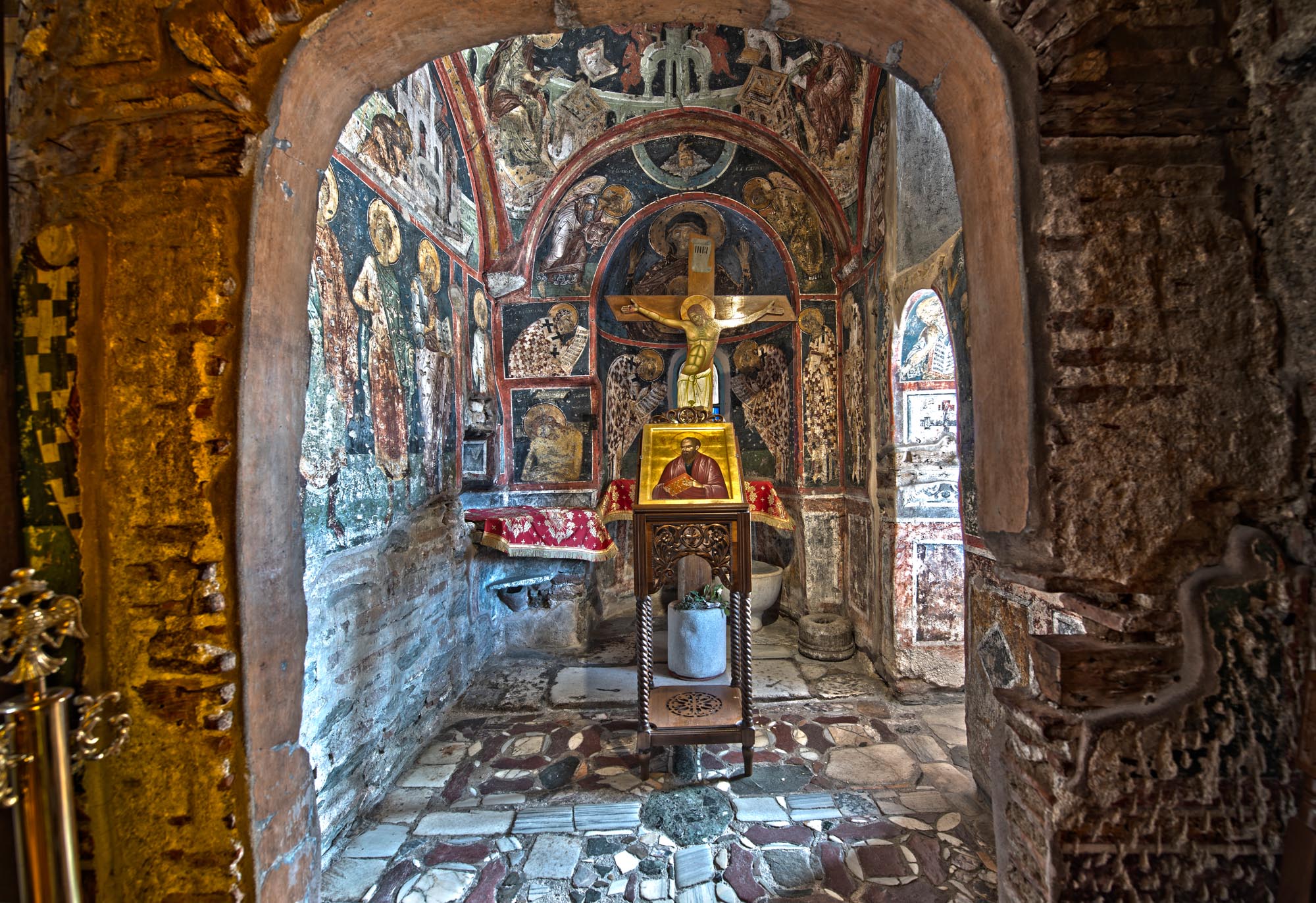
Built in the second decade of the 14th century near the east wall, now between Irodotou and Apostolou Pavlou Streets in the Upper City, the church of St Nicholas the Orphan was once the katholikon of a monastery. Originally a three-aisled basilica, it is now a single-nave timber-roofed church, with an ambulatory on three sides terminating in two symmetrical chapels on the east. The interior is decorated with frescoes of excellent quality, one of the most completely preserved groups of paintings in Thessaloniki and a representative example of Palaiologan art of the early 14th century. The construction and the fresco decoration of the church are associated with the Serbian Kralj (king) Stefan Uroš II Milutin (1282-1321), who is known from written sources to have founded churches in Thessaloniki.
Αρχείο ΕΦΑ Πόλης Θεσσαλονίκης / Archive of the Ephorate of Antiquities of Thessaloniki City

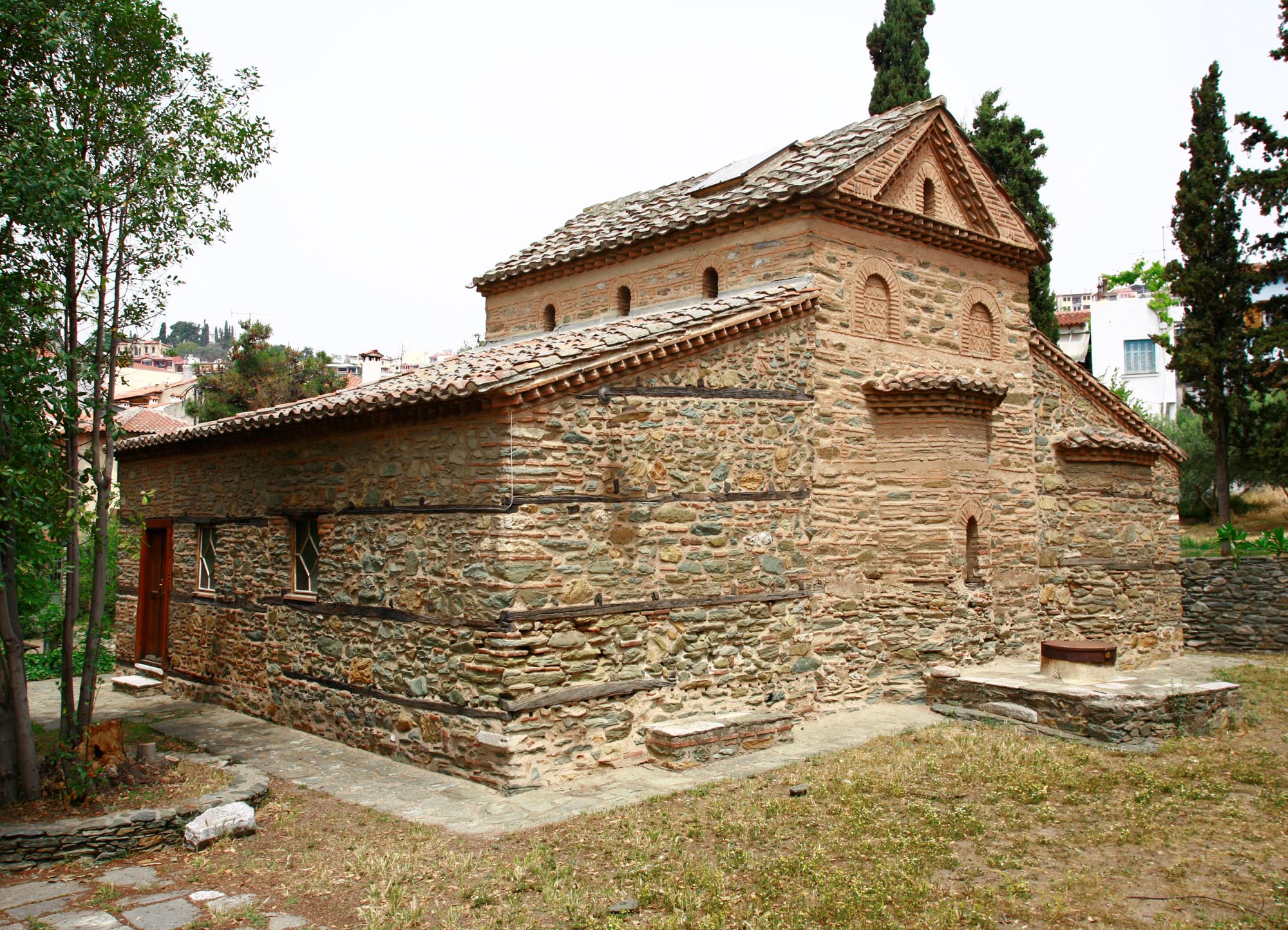
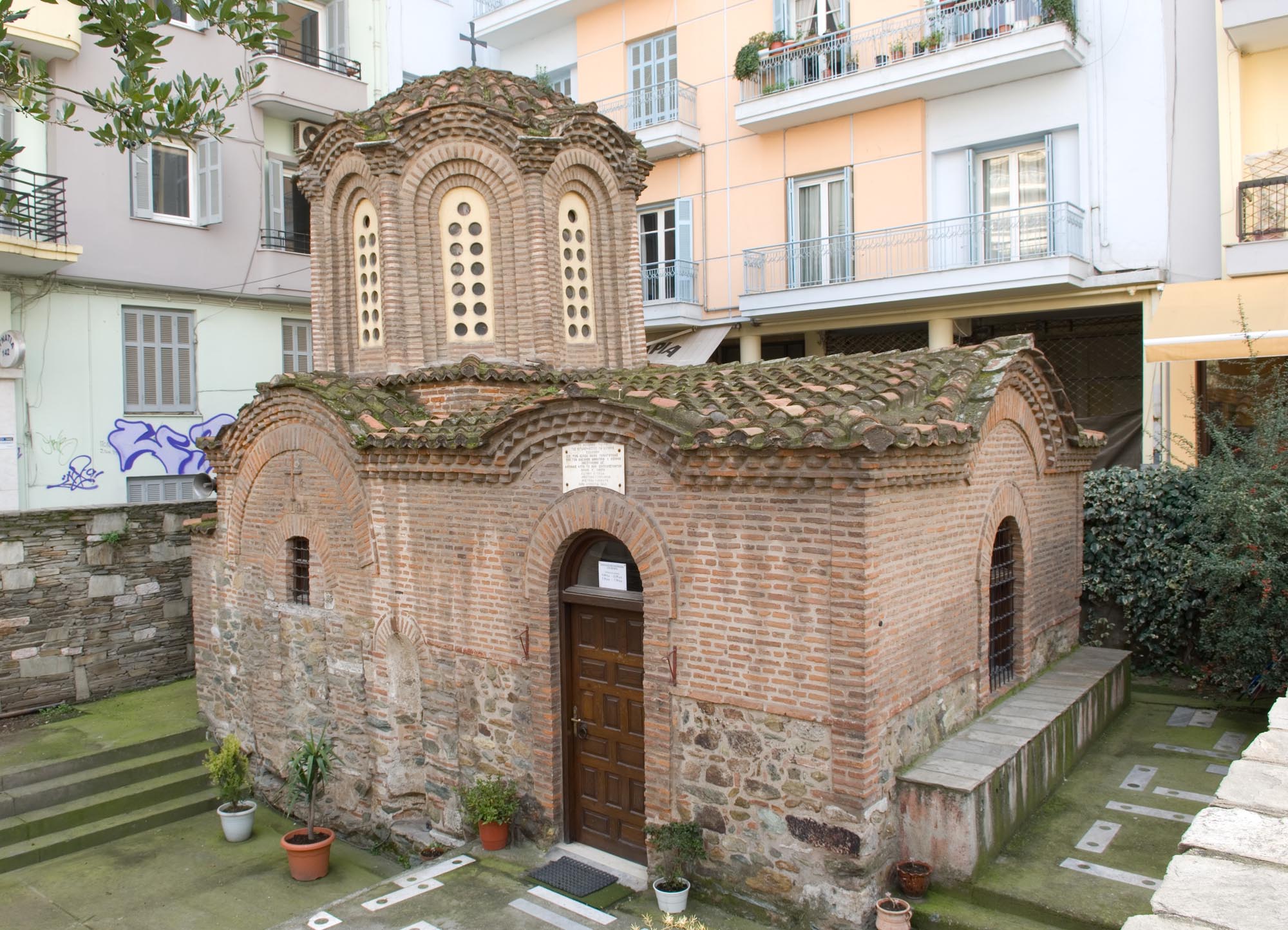
Above Olympiados Street, on the outskirts of the Upper City, is the church of St Catherine. This is not its original name, as it was once the katholikon of a monastery, either the Monastery of Christ Pantodynamos or Philokalli Monastery. The church of St Catherine has recently been associated with the healing relics of Hosios Nicodemus. It dates from the late 13th or early 14th century and is of the same type as the church of the Holy Apostles. Its elegant proportions and intricate façades make it an excellent example of Palaiologan architecture. Its fresco decoration, which is fragmentarily preserved, follows the painting tradition of the early 14th century.

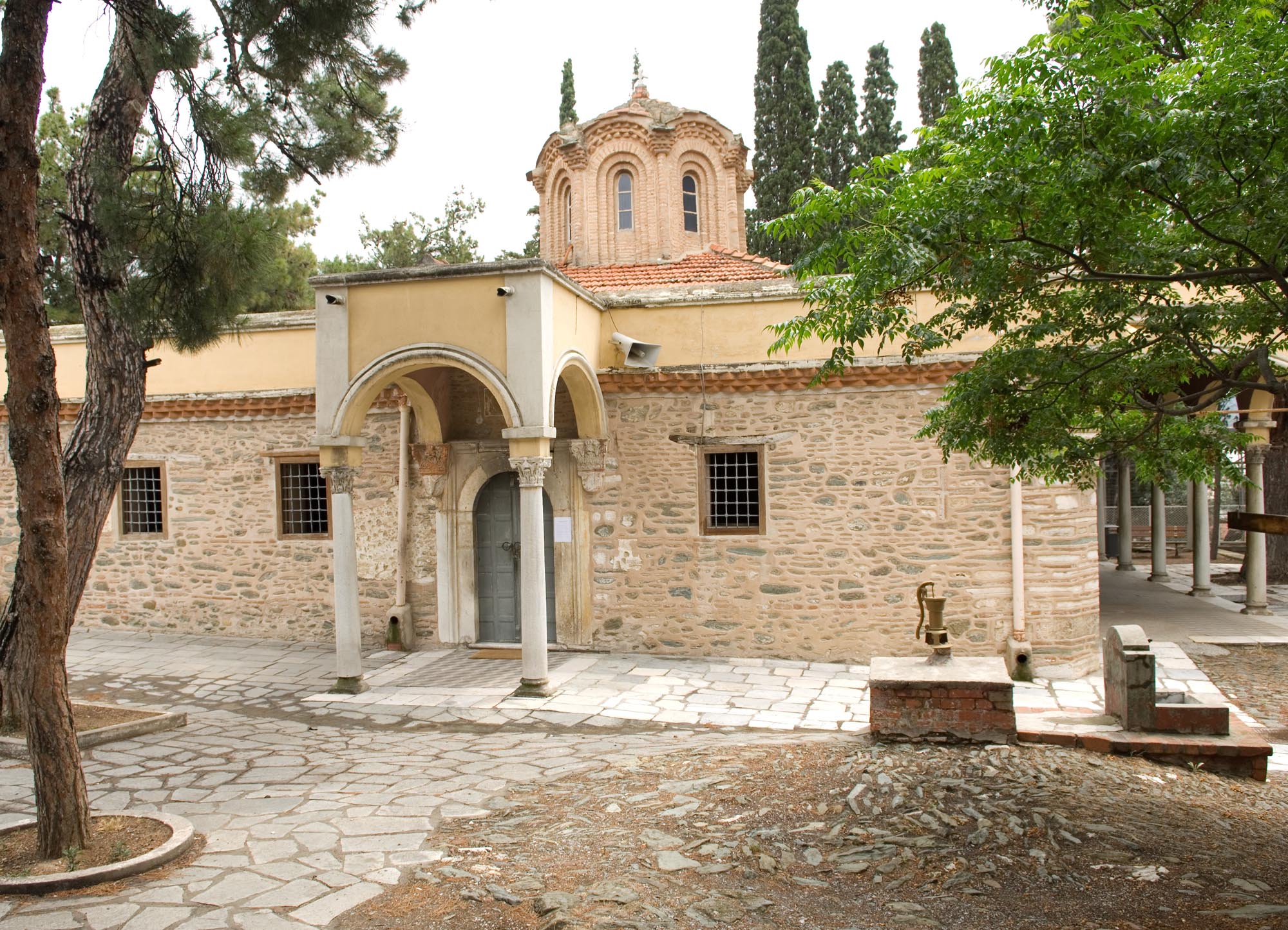
The stavropegic monastery, i.e. directly subject to the Ecumenical Patriarchate of Constantinople, lies on Akropoleos Street, just outside the walls of the Byzantine acropolis, in the Upper City. It is the only Byzantine monastery of the city that is still active today. The monastery, originally dedicated to Christ Pantocrator and today dedicated to the Transfiguration, was founded between 1351 and 1371 by the monk and later Metropolitan of Thessaloniki Dorotheos Vlatis, a disciple of St Gregory Palamas, the great spiritual figure of Thessaloniki. Of the original complex only the katholikon survives. It is a rare variant of the cross-in-square church, in which the dome is not supported on columns but on the walls of the sanctuary and on pillars. The nucleus of the church is surrounded by a colonnade terminating in two chapels on the east. The frescoes inside the monument are dated between 1360 and 1380.

At the junction of Egnatia and Paleon Patron Germanou Streets is the small church of the Saviour, a tetraconch cross-in-square church with a rectangular plan and a high dome. Inside it features remarkable fresco decoration, thought to be contemporary with the construction of the church in the mid-14th century. A recent study of the frescoes has narrowed the date of their execution to the five-year period 1345-1350. This was a funerary church, based on the burials uncovered in an excavation in the courtyard and inside the church, and was probably the katholikon of a monastery dedicated to the Virgin.

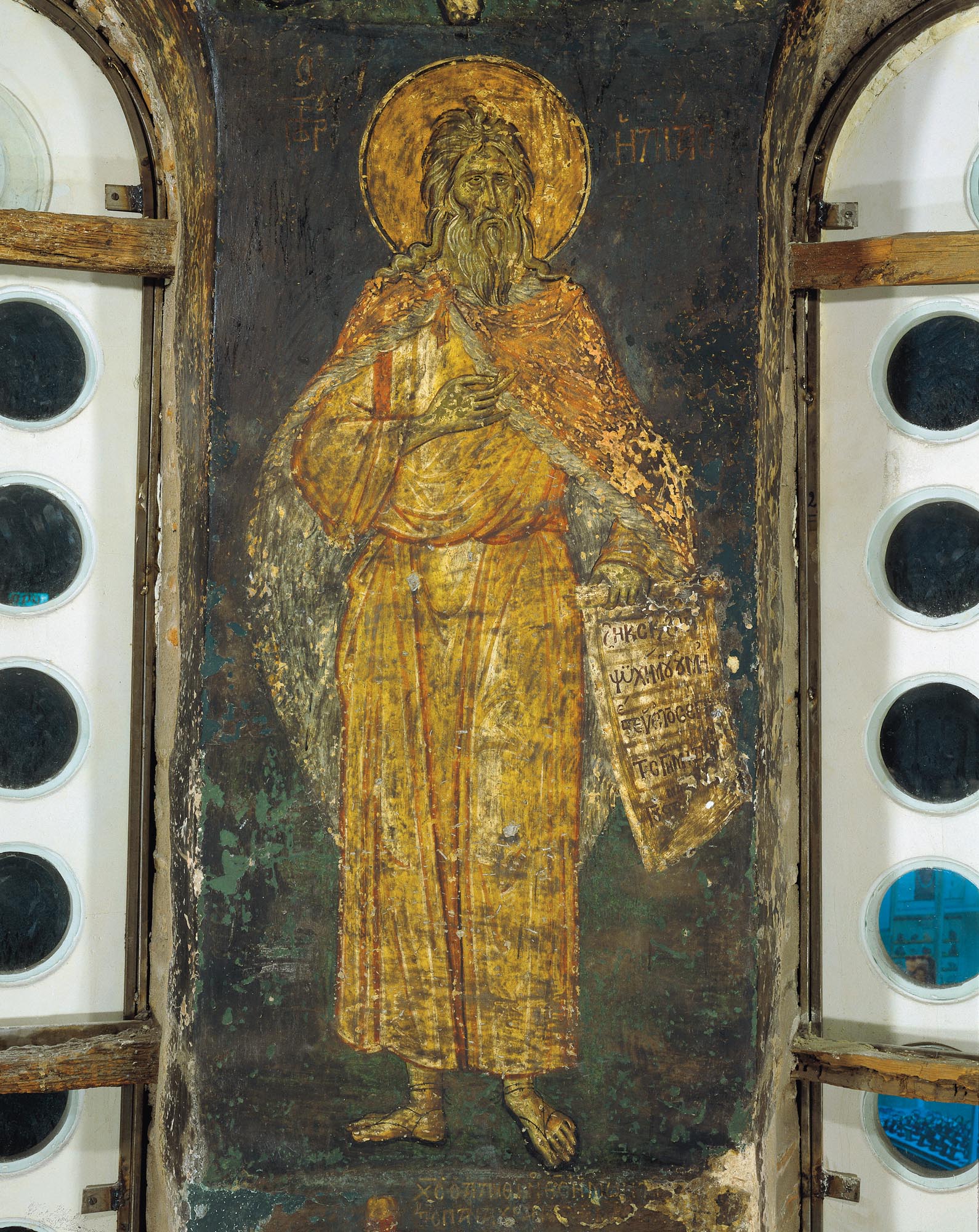
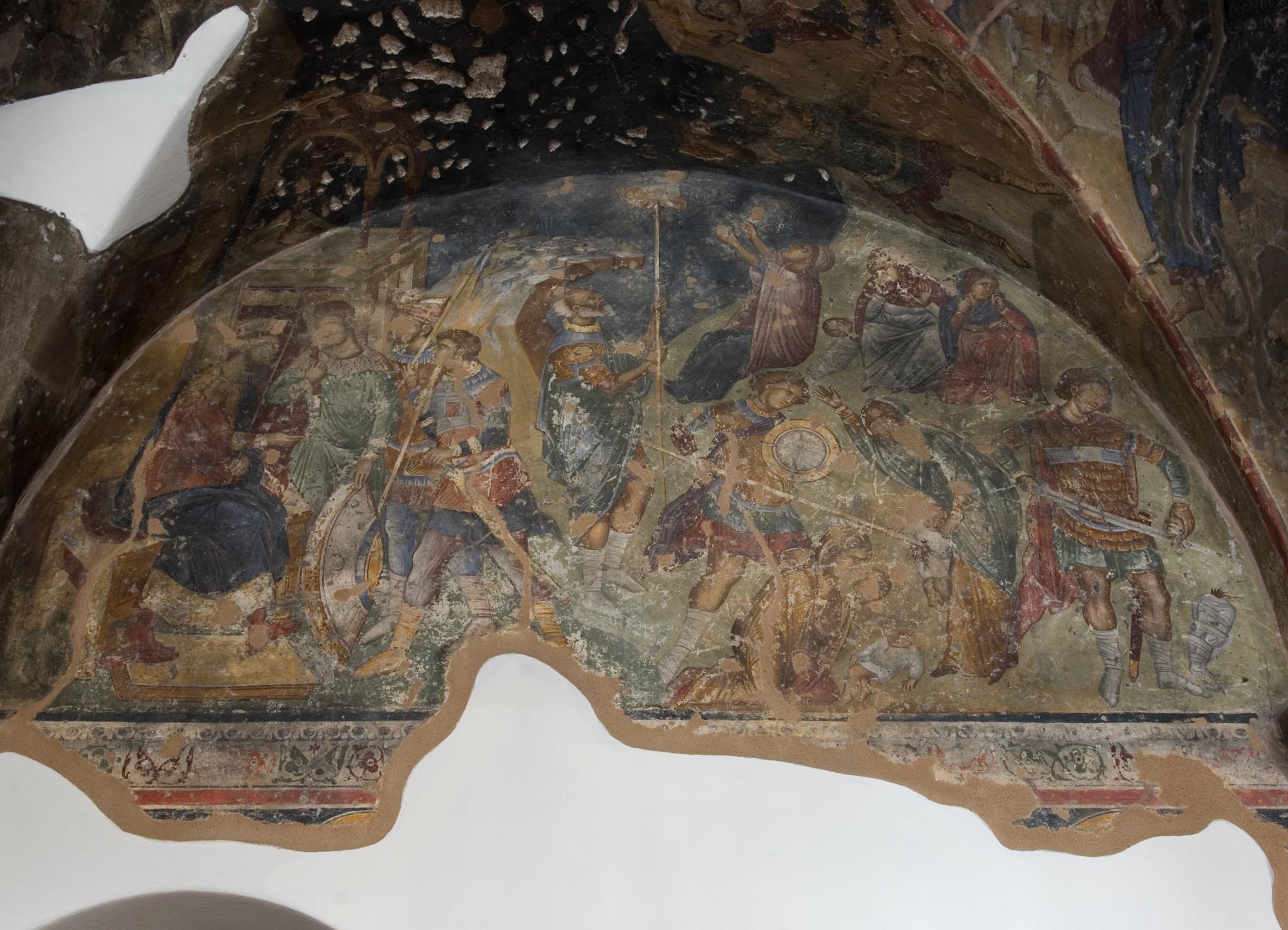
This imposing church stands on Olympiados Street, at the junction with Prophitis Ilias Street. Until recently it was wrongly identified as the katholikon of the Nea Moni (New Monastery), founded in 1360-1370 by Makarios Choumnos, an important spiritual figure of Thessaloniki. More recently, it has been suggested that it was the katholikon of Akapniou Monastery or the Monastery of Agioi Anargyroi (the Holy Unmercenaries). The church is of the Athonite type (four-columned cross-in-square church with the lateral arms of the cross ending in choirs) common on Mount Athos, which was used exclusively for monastery katholika. The monument stands out for its intricate façades, designed according to the principles of Palaiologan architecture in Thessaloniki. Of its fresco decoration, only the Massacre of the Innocents, representative of the last phase of Palaiologan art (1360-1380), survives today.
φωτ. Κ. Ξενικάκης / Phot. K. Xenikakis

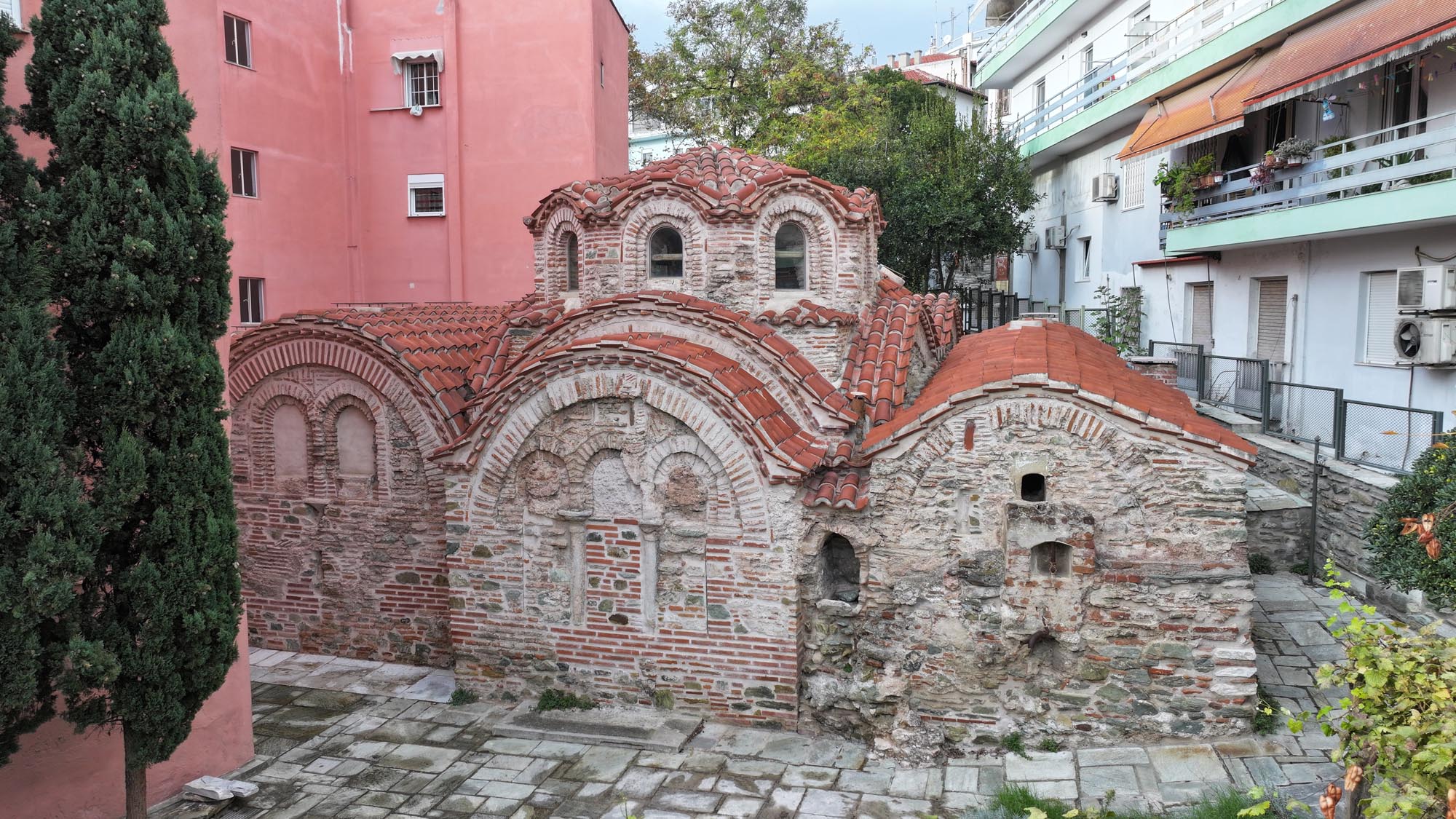
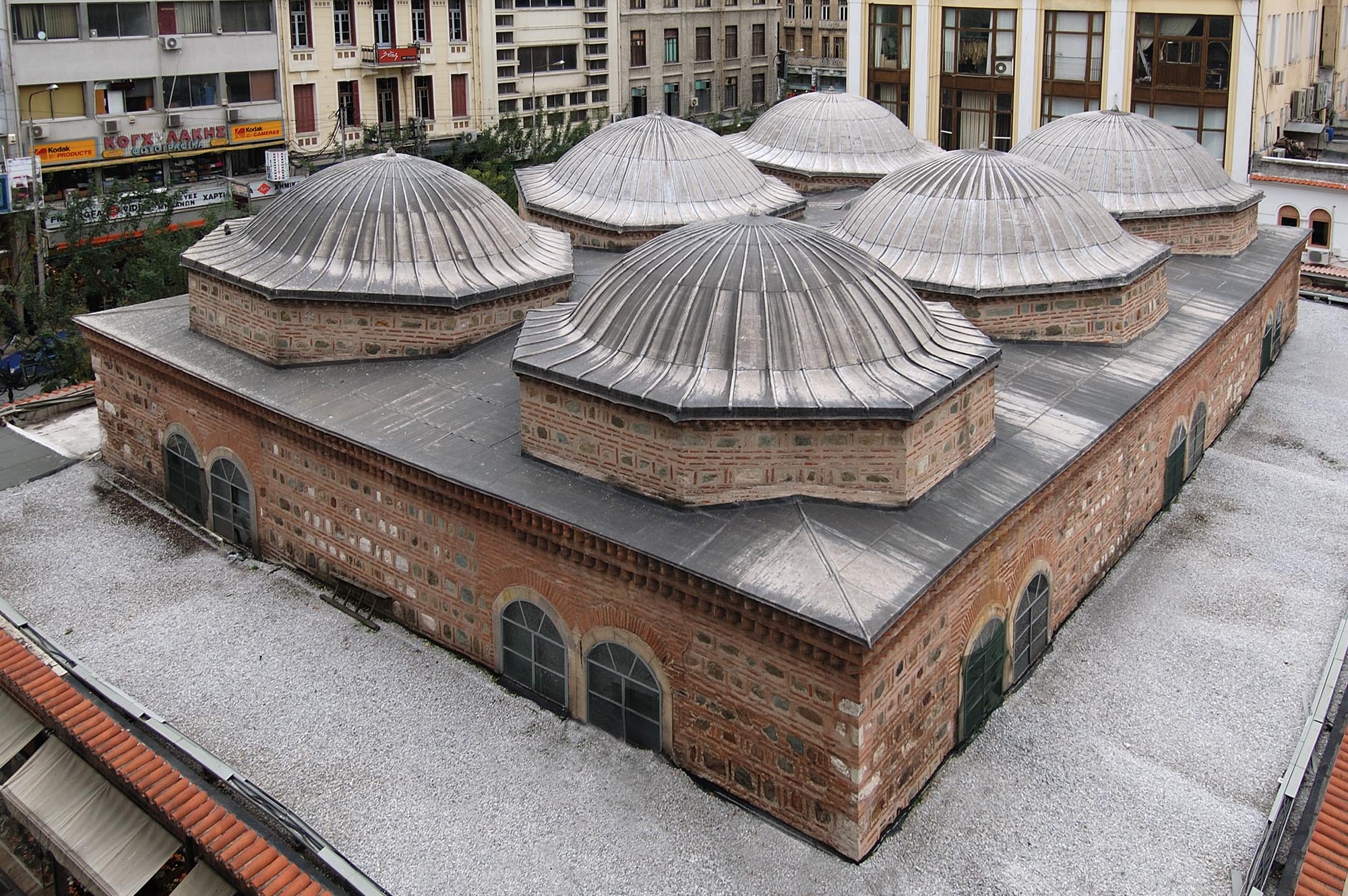
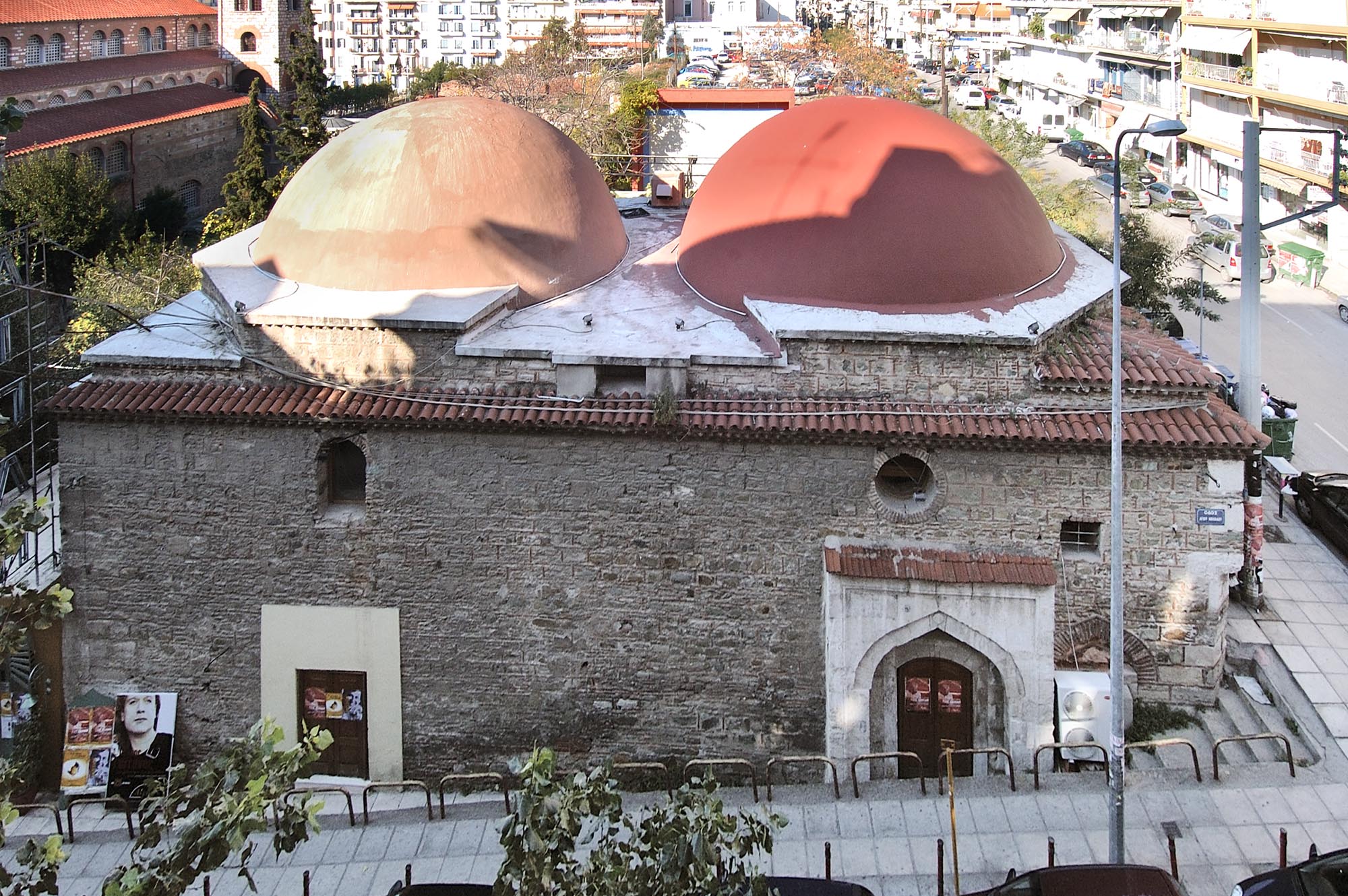
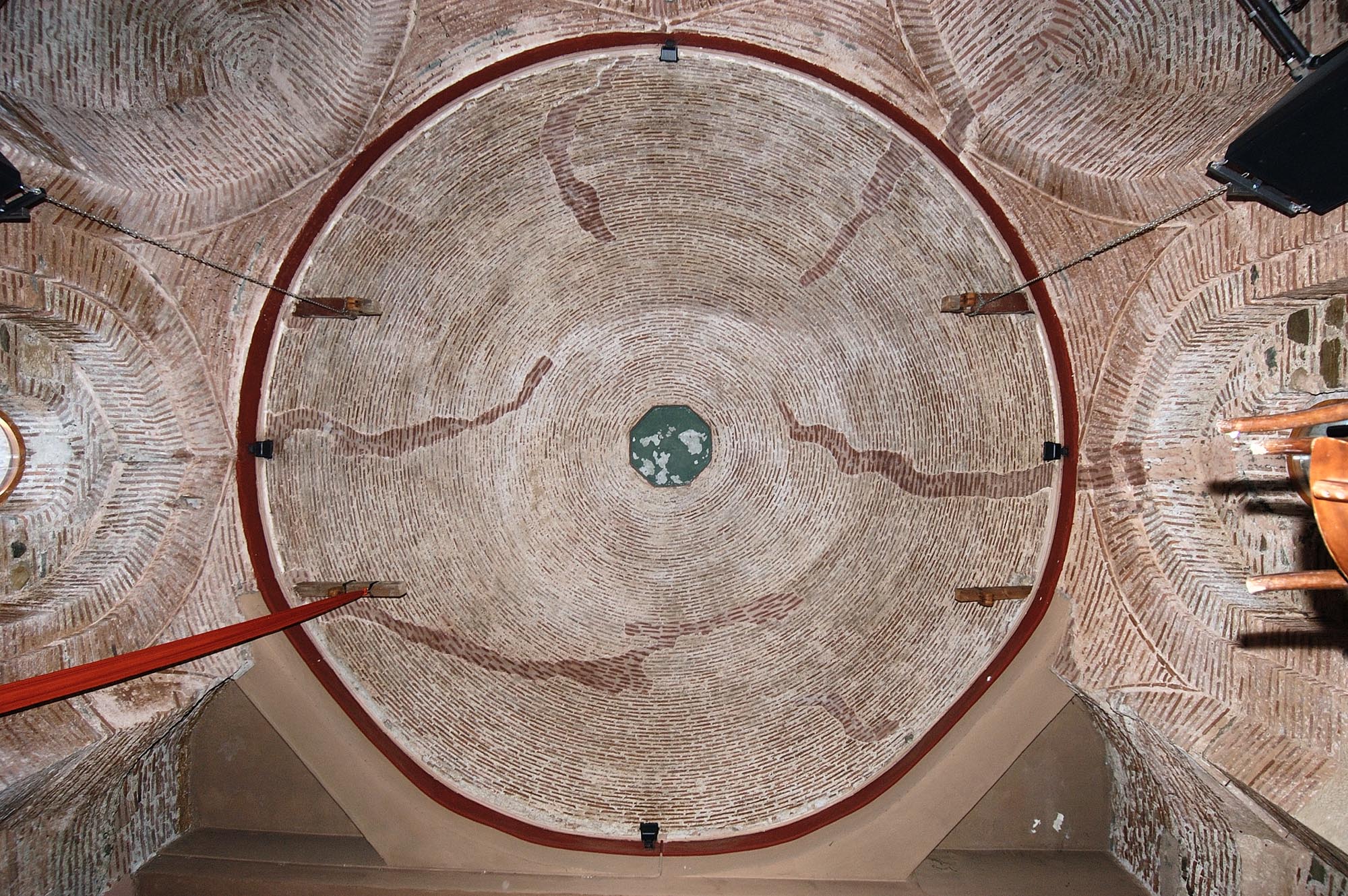
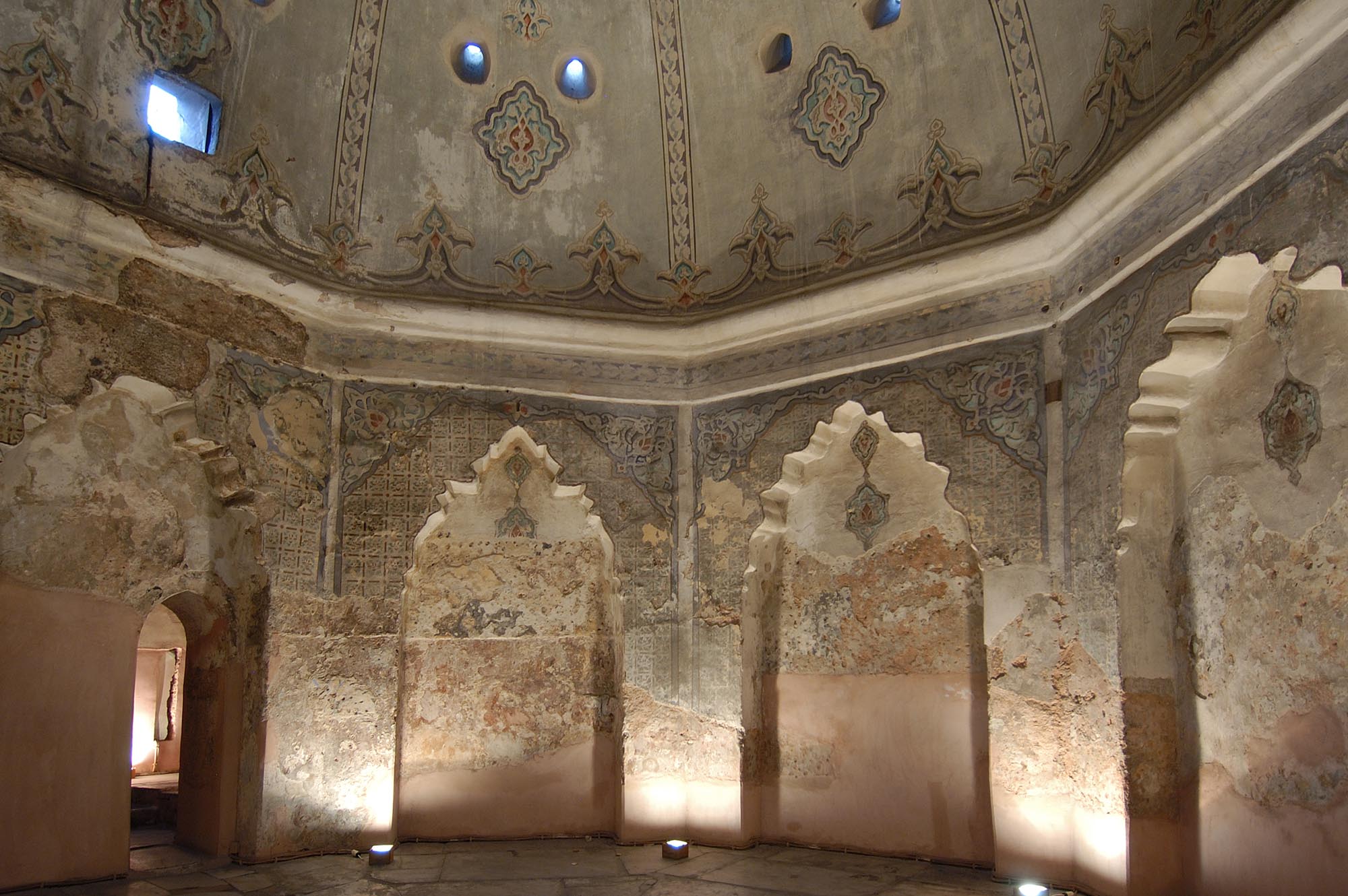
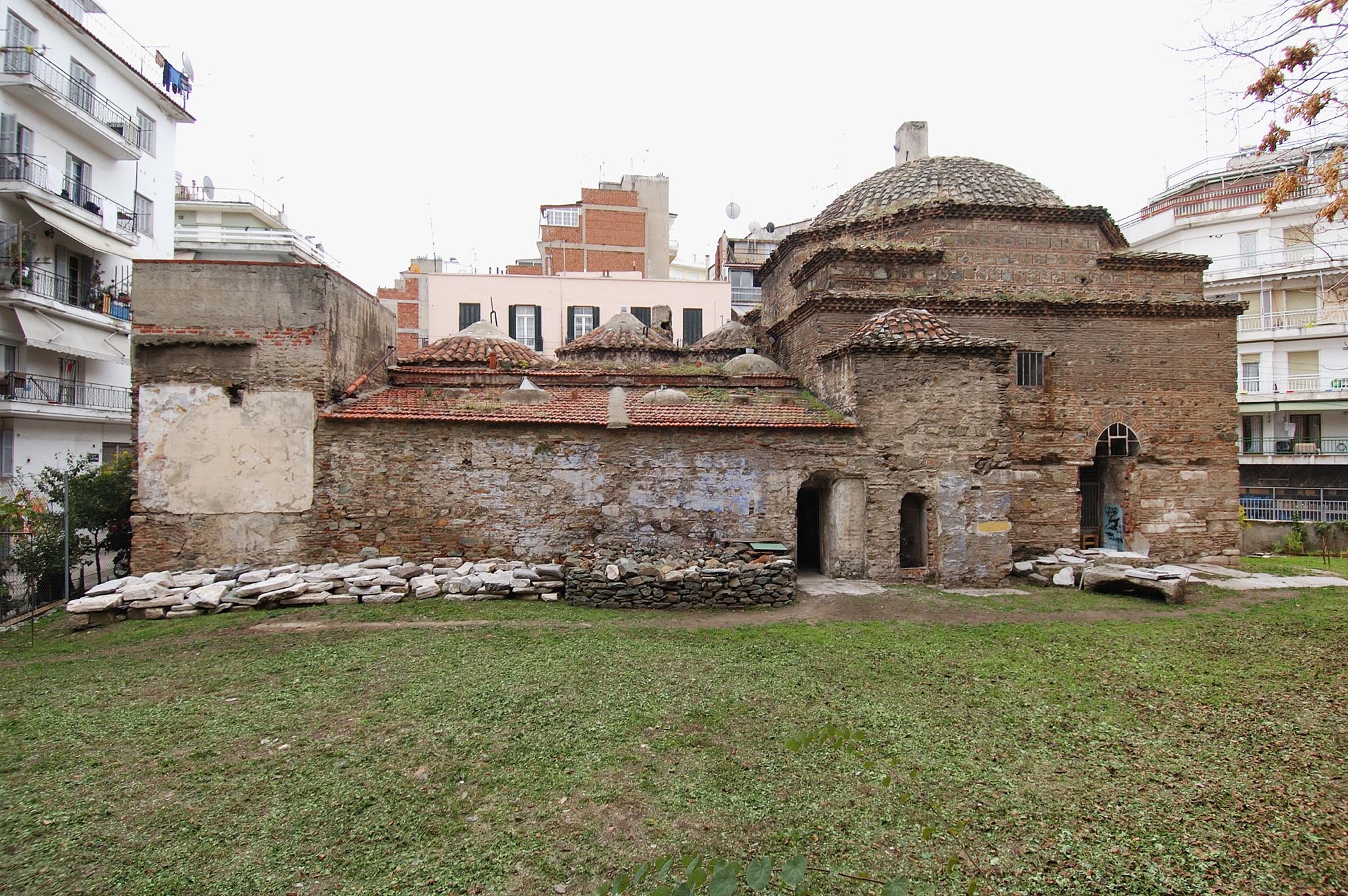
On the outskirts of the Upper City, on Theotokopoulou Street, is the only Byzantine public bathhouse that still survives in Thessaloniki today, one of the many that the city once had. It probably dates from the second half of the 12th or the beginning of the 13th century.

Other monuments and antiquities of Thessaloniki

Arch of Galerious (Kamara)

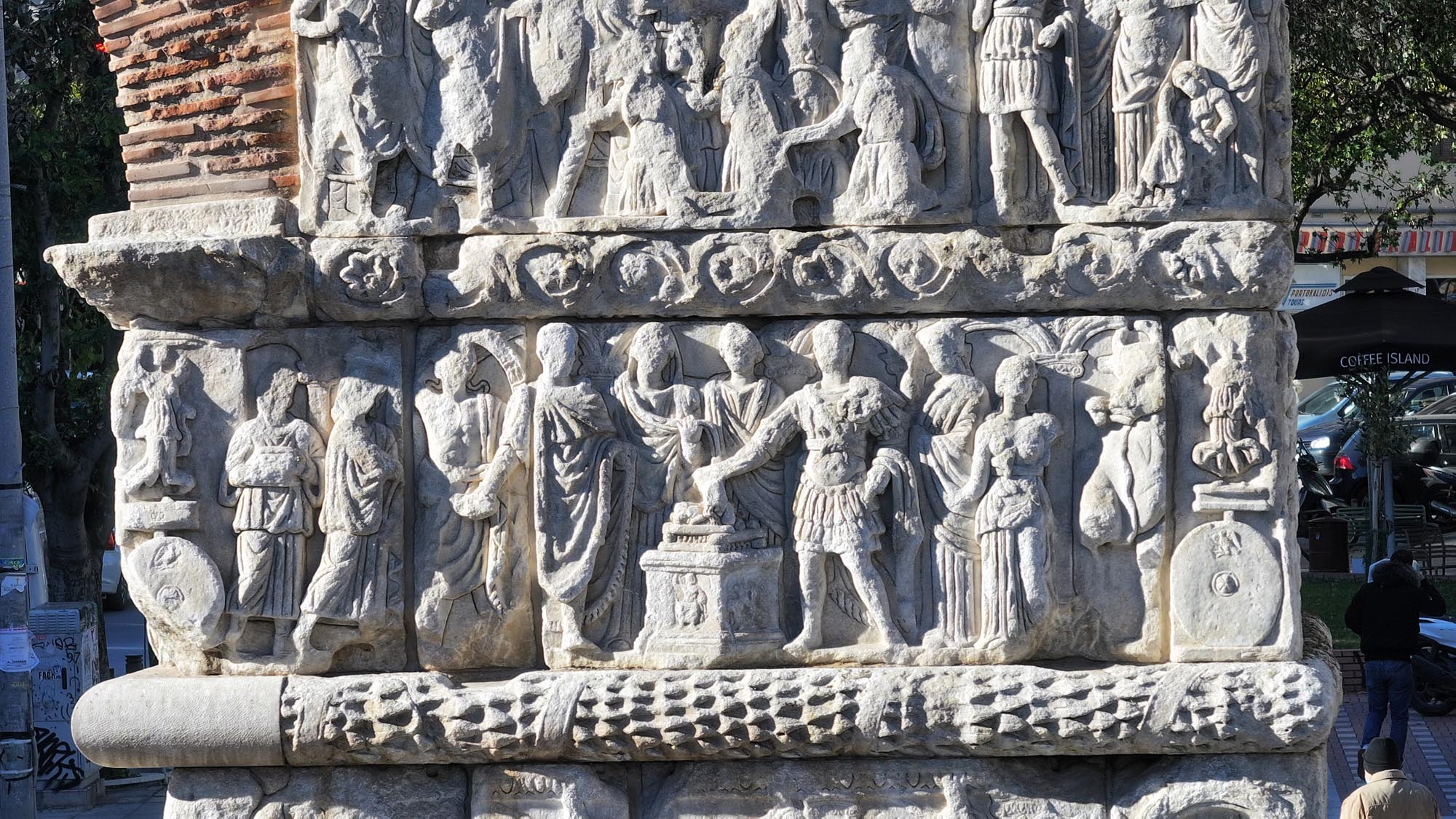
The triumphal arch on Egnatia Street, erected between 299-303 AD by Caesar and later Emperor Galerius, on the axis of the Palace of Galerius, is a reference point of the city today. It is only part of an octopylon, an eight-pillared gateway, which was erected at the intersection of two main thoroughfares of the city, the decumanus maximus, which ran east-west through the city, and the cardo, a vertical road running north-south, which coincides with the present-day Gounari Street. Originally there were two further pillars, which together with the existing ones created a square space, open at both ends, with a vaulted roof. Most of the reliefs of the arch celebrate Galerius’ victorious campaign against the Persians.

The remains of the imposing complex erected by Galerius (early 4th c. AD) are preserved in Navarinou Square, in the eastern part of the city.

φωτ. Κ. Ξενικάκης / phot. K. Xenikakis

The best-preserved phase of the complex in the heart of the city, of which it was the administrative centre for three centuries, dates from around the second half of the 2nd to the early 3rd century AD, during the Severan period. It occupies an area of four insulae and is arranged in a square U-shape around a paved square. Of its three sides, the best known are the east side with the Odeum,which has been restored today, and the south side with the cryptoporticus (covered gallery) and shops. Very little remains of the west side.

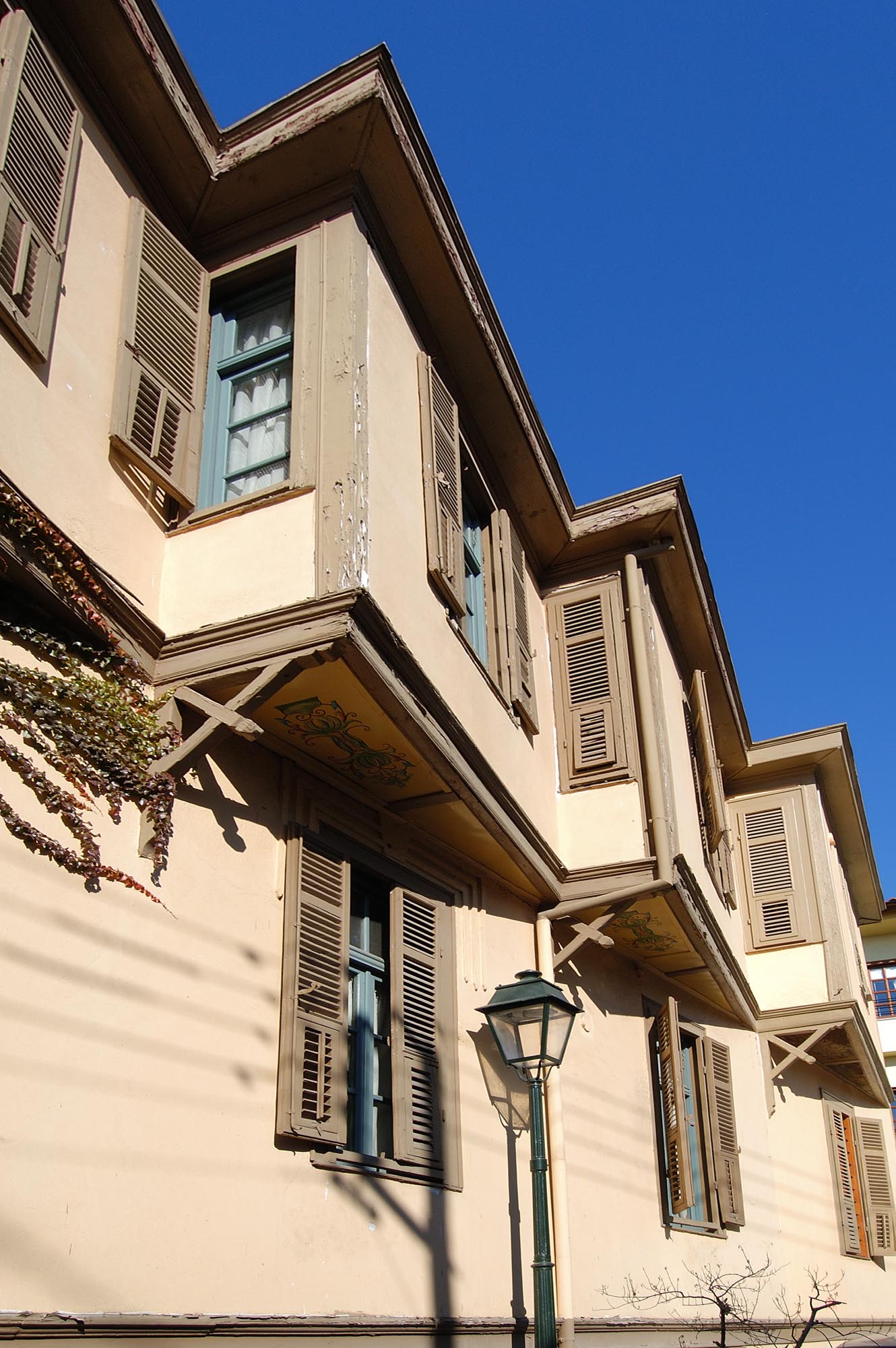
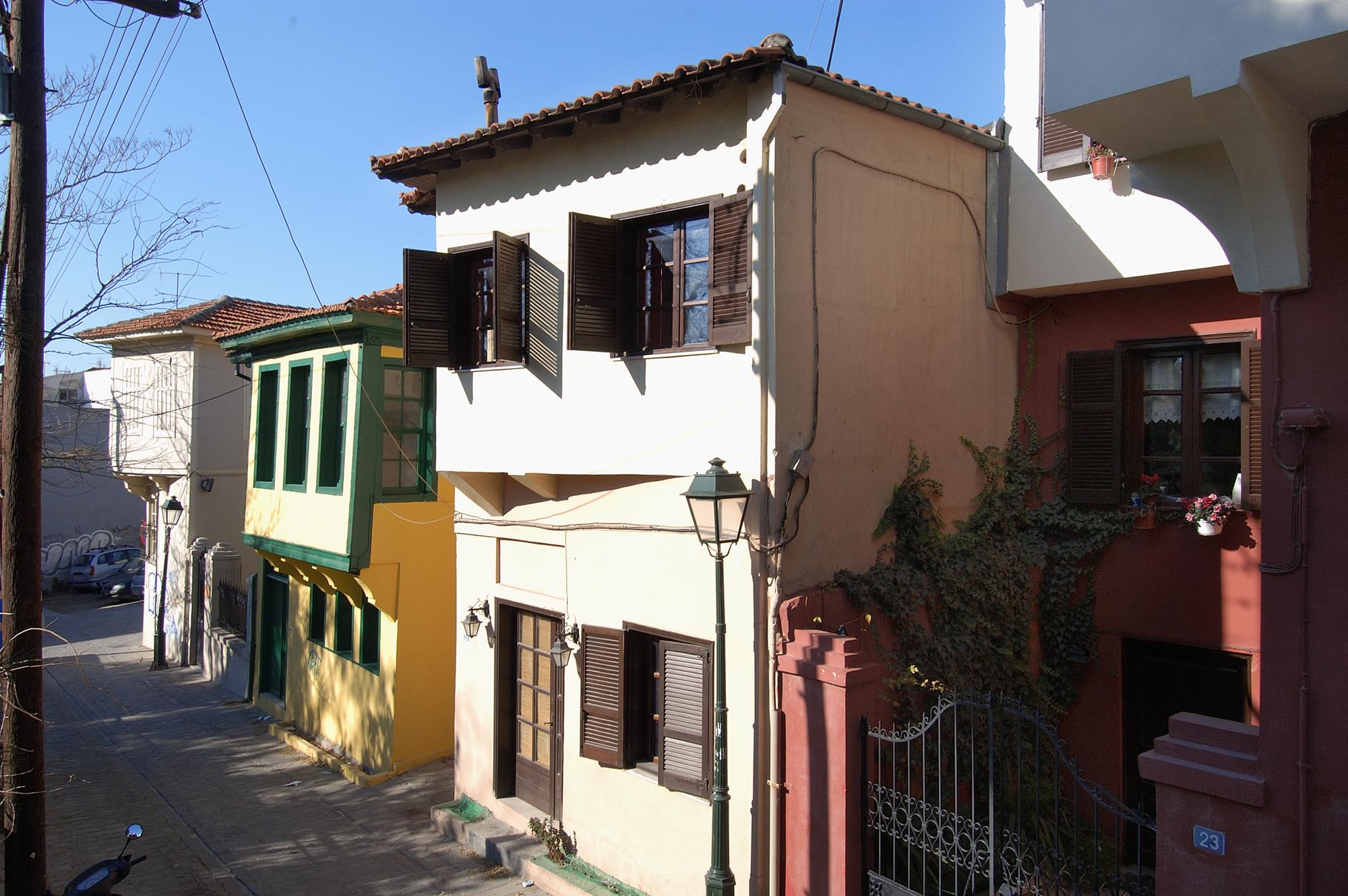
The Upper City, which was designated a listed traditional settlement in 1979, essentially starts above Agiou Dimitriou Street, forming the upper part of the city within the walls. Unaffected by the Great Fire of 1917, it has followed a different course of urban development compared to the rest of the city. Time seems to have stood still here, with the small houses with their typical şahnişins (overhanging covered balconies), the elegant mansions, the flower-filled courtyards and the narrow cobbled alleyways.

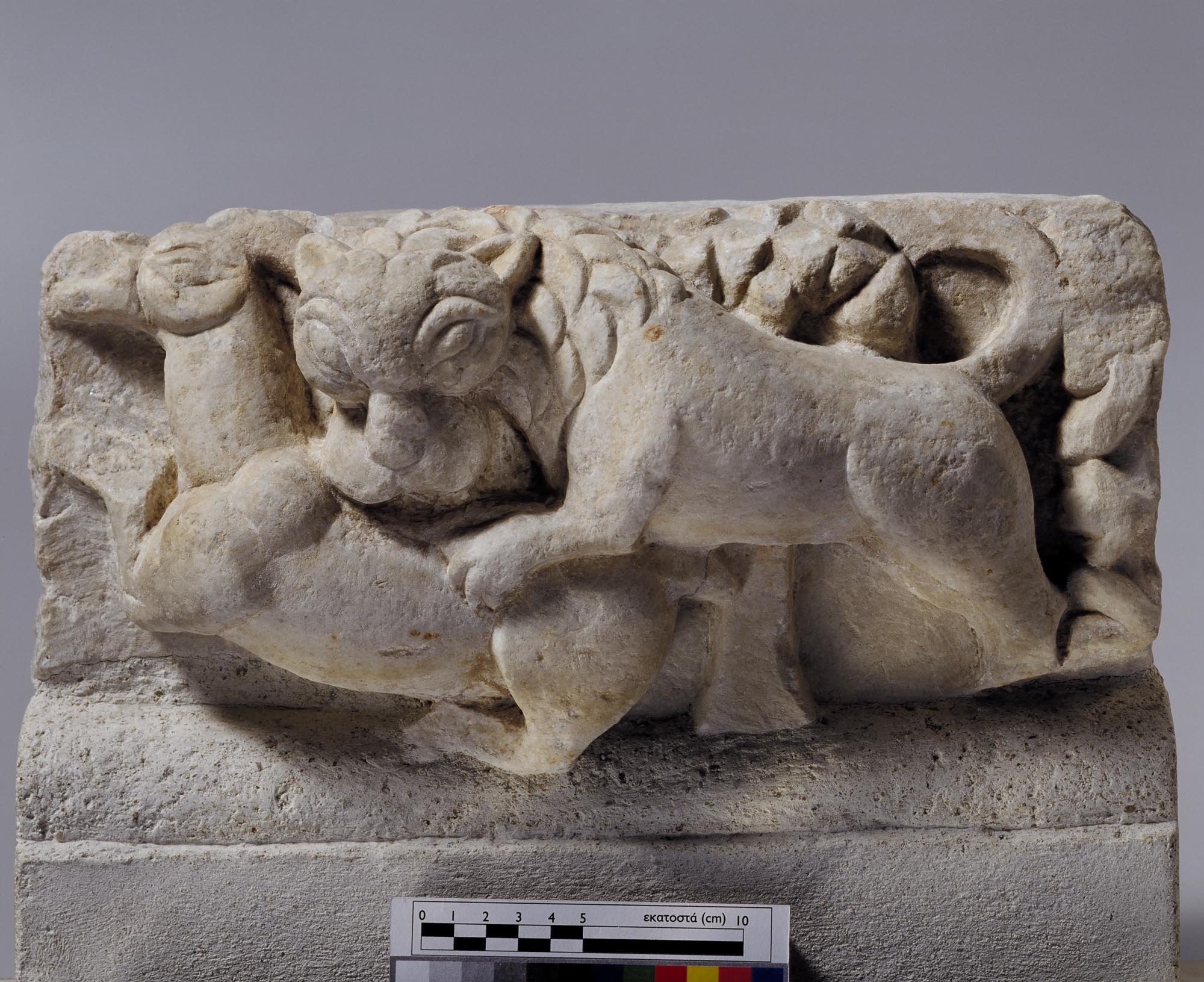
A special group of buildings in the city are the churches built during the period of Ottoman rule, including the churches of Nea Panagia, St Anthony, St Athanasios and St Gregory Palamas. Of these, the church of St Menas at the junction of Ionos Dragoumi and Vassileos Irakliou Streets, in the heart of today’s commercial centre, owes its current form to the last reconstruction work in 1852. Its original nucleus, however, dates from the Early Christian period, as evidenced, among other things, by the elaborate architectural sculptures with animals and birds, originating from the church and now housed in the Museum of Byzantine Culture.

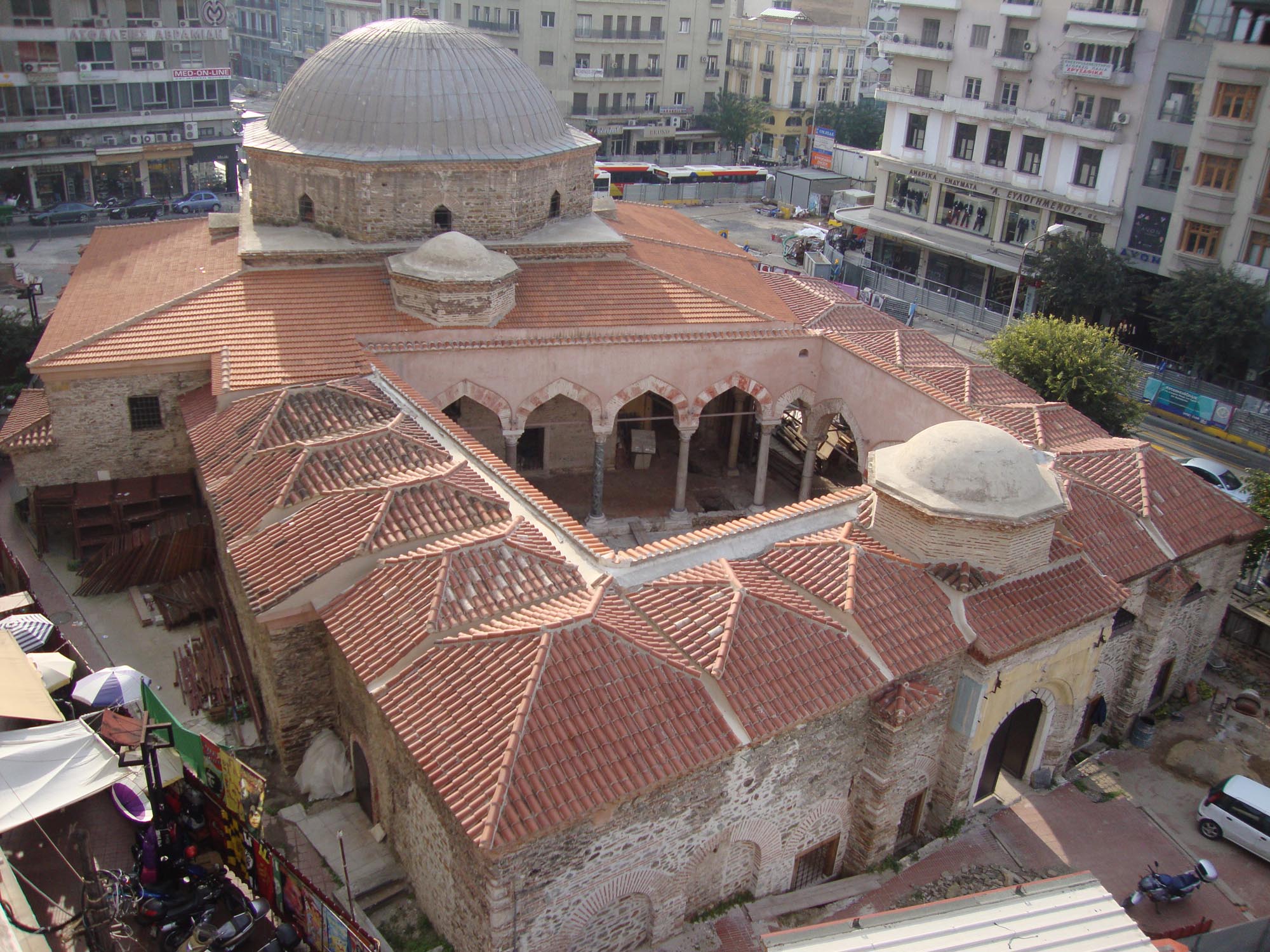
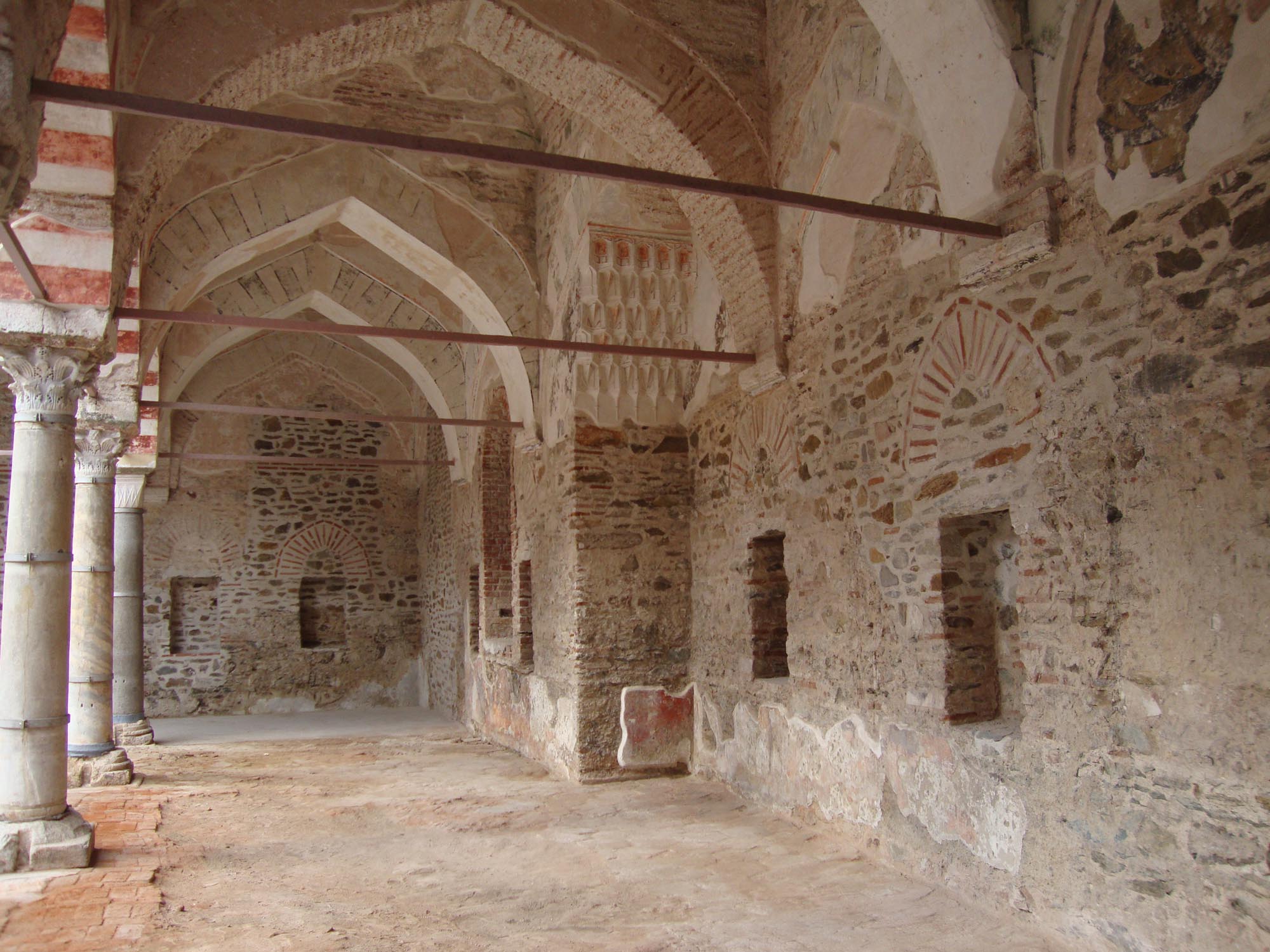
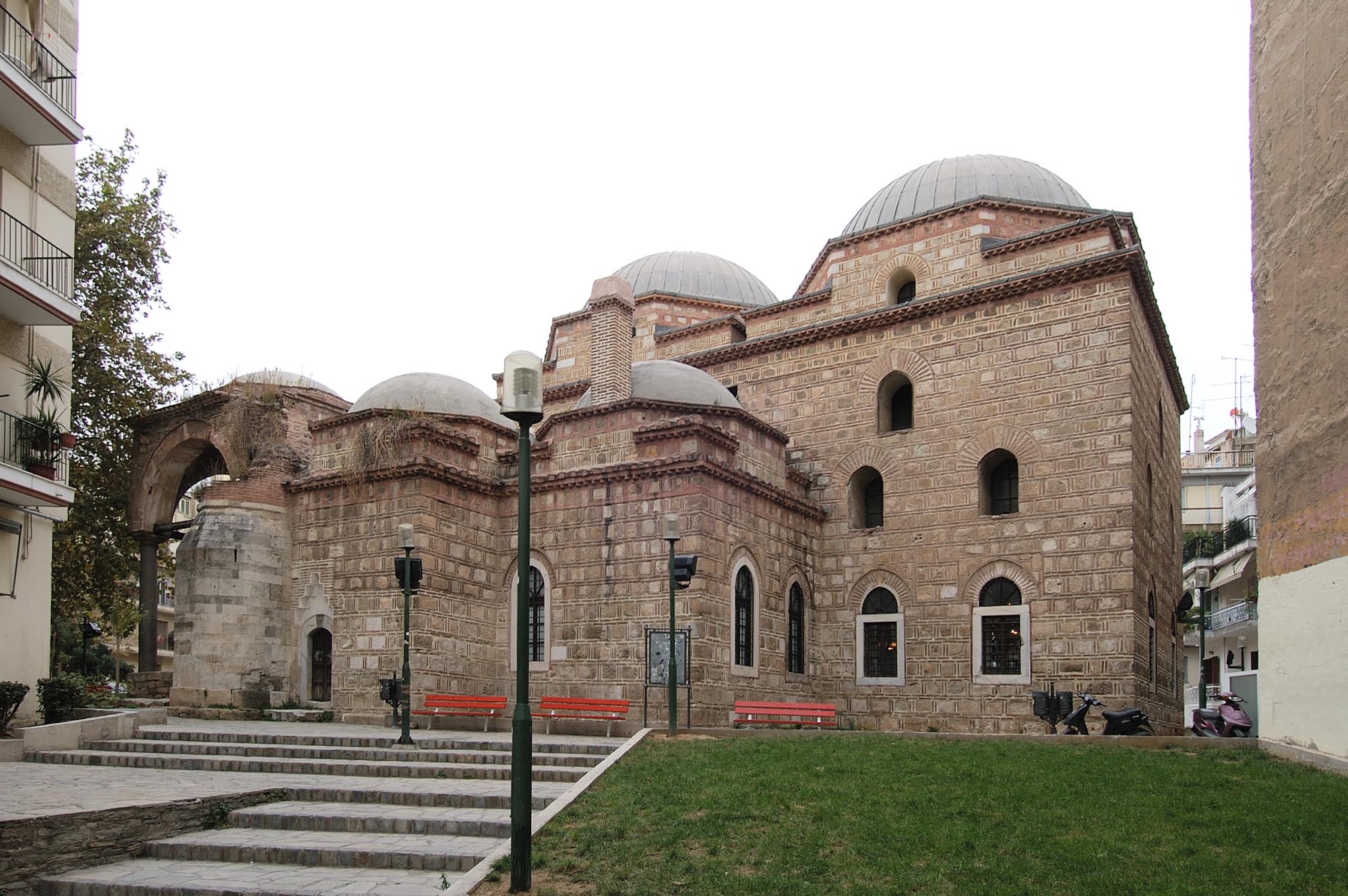
Known as the Alcazar after the cinema that operated in it for a time, the mosque is located at the junction of Egnatia and Venizelou Streets, the central crossroads of the city through the ages. It is one of the most important examples of Ottoman architecture in Greece, the largest and only mosque in the Balkans with a colonnaded courtyard, except for the mosques founded by the Sultan in Edirne and Istanbul. According to an inscription, it was erected in 1467/8, originally as a mescit, a neighbourhood mosque without a minaret, by Hafsa Hatun, the daughter of the military official Hamza Bey. It subsequently underwent further repairs and extensions, the most important being its conversion, probably in the mid-16th century, into a mosque with the addition of a colonnade and minaret.

The Alaca (Colourful) Imâret stands above Kassandrou Street in the Upper City, northeast of the basilica of St Demetrios. It was erected in 1484 by Grand Vizier Ishak Pasha, who retired to Thessaloniki to serve as wali (governor). The mosque housed an imâret and a madrasa (religious school).

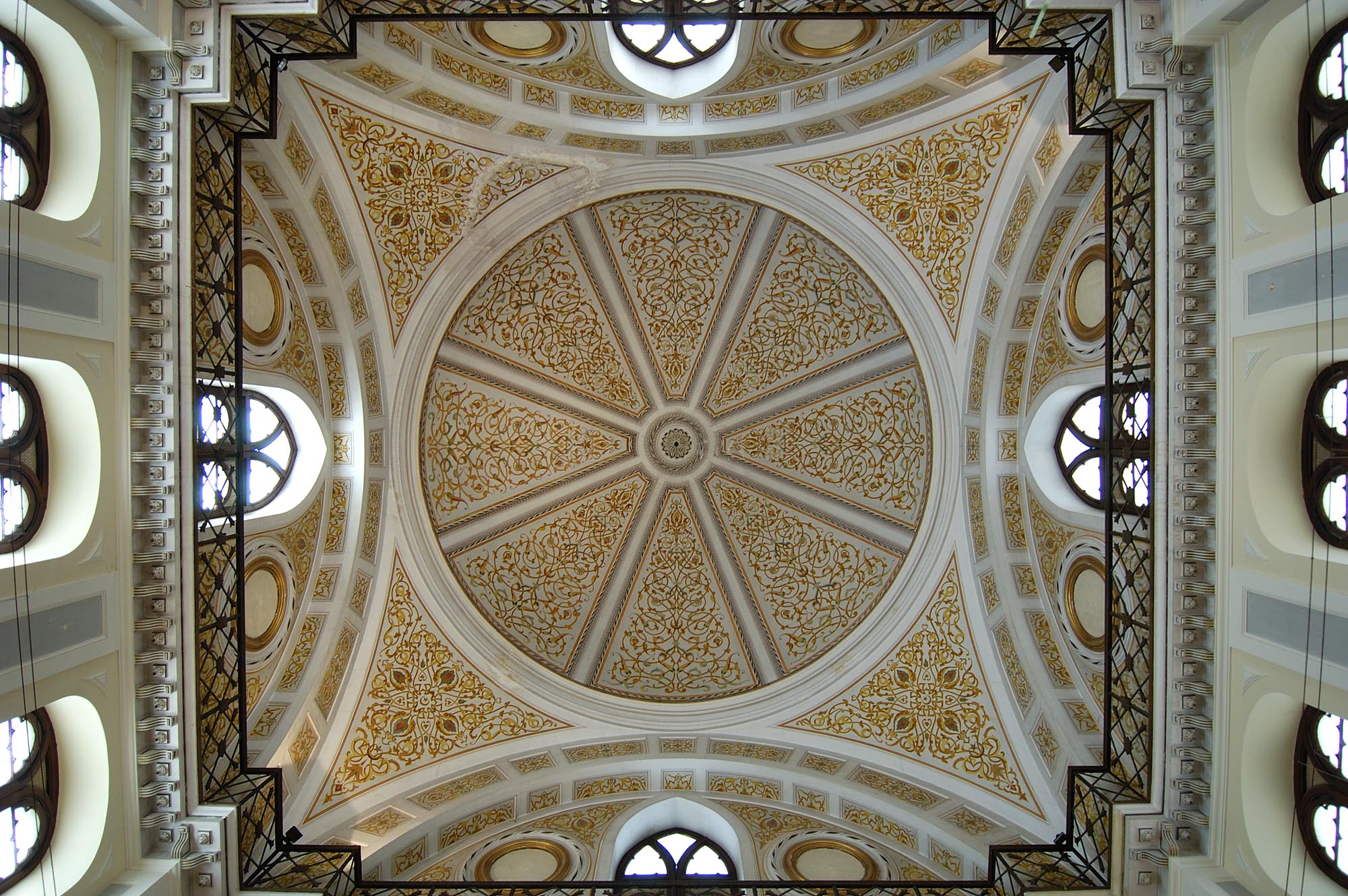
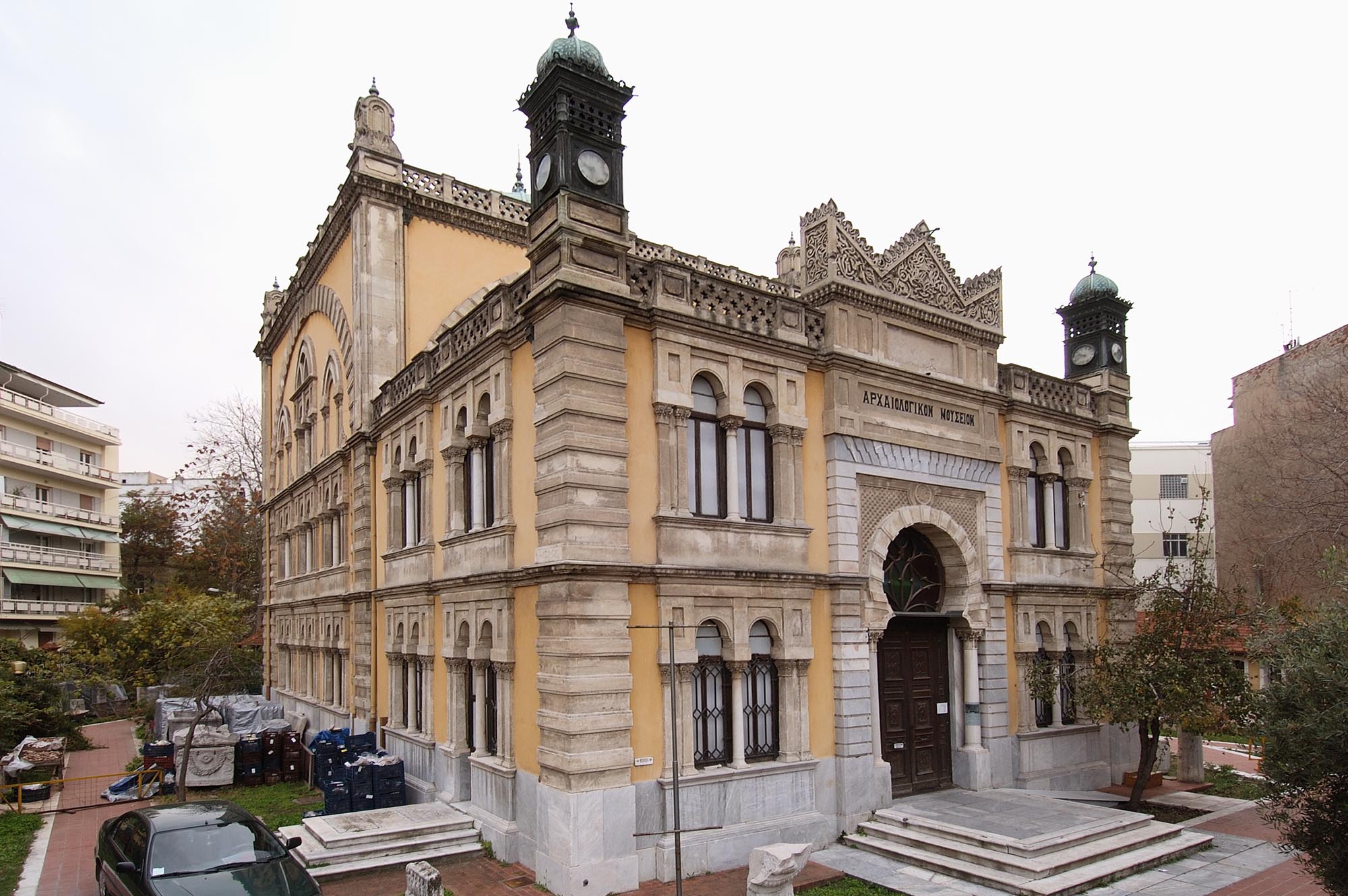
The Yeni (New) Mosque, on Archaiologikou Mouseiou Street, was built in 1900-1902, during the reign of Sultan Abdul Hamid II (1876-1909). It was designed by the Italian architect Vitaliano Poselli, who also designed other city buildings, such as the Government House, the old Philosophy Faculty and the Villa Allatini. The construction of the mosque was paid for by the Dönme, the city’s Jewish converts to Islam. The two-storey building, in the Eclectic style, is known as the Old Archaeological Museum, as it housed the city’s Archaeological Museum from 1925 to 1962. Today it is used for exhibitions organised by the Municipality of Thessaloniki.

Αρχείο ΔΒΜΑ, φωτ, Στ. Στουρνάρας / Archive of DBMA, phot. St. Stournaras

The mosque is located inside the former Pavlos Melas Barracks, now the Metropolitan Park of Pavlos Melas Municipality. The last mosque to be built in or around Thessaloniki, it was erected in 1903-1904 by Hassan Fehmi Pasha, governor of the Eyâlet of Thessaloniki, who dedicated it to his wife Ferideh Hanim.

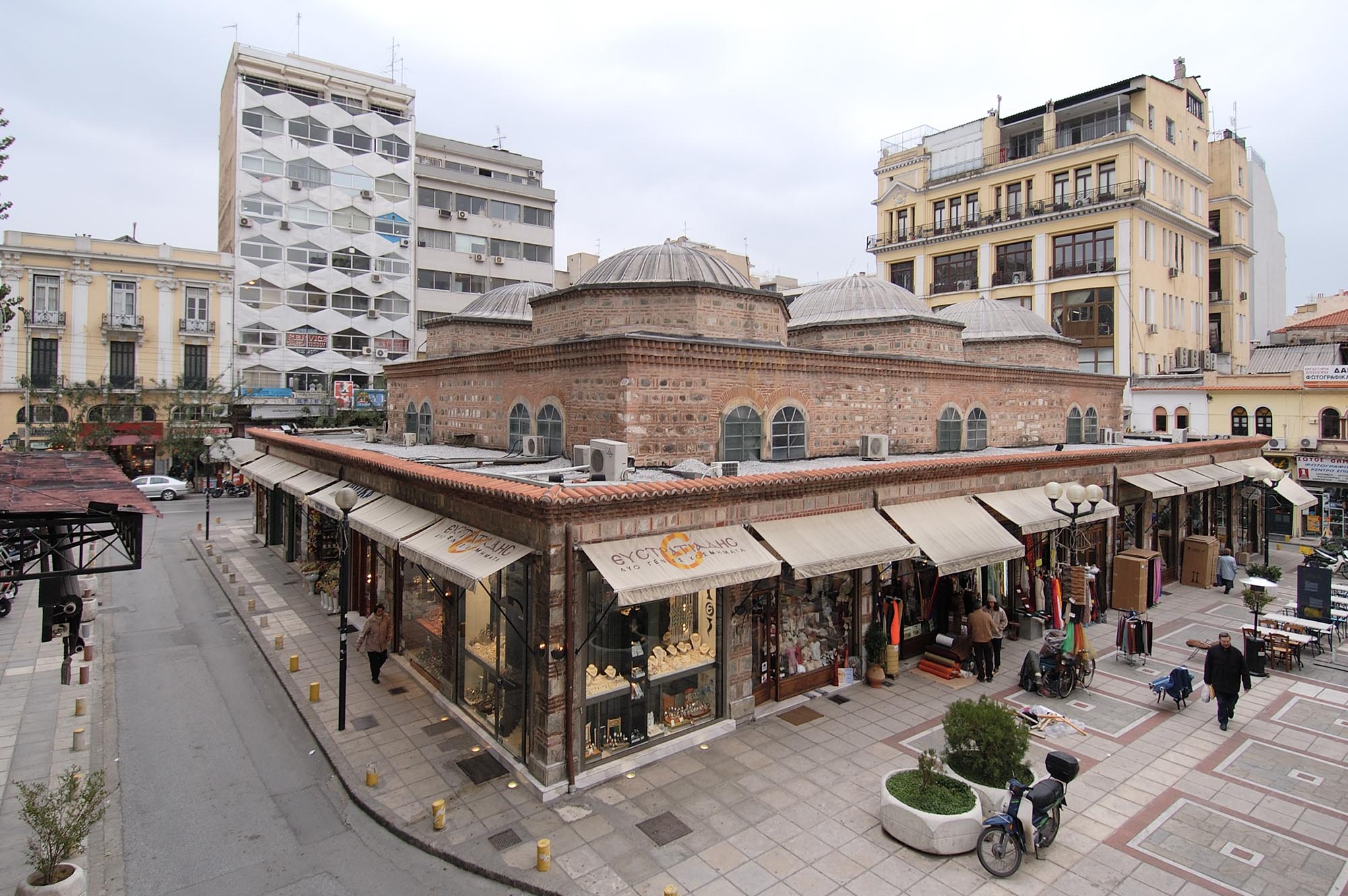
The Bedesten, or Cloth Market, is located on Venizelou Street, south of Egnatia Street, and is one of the most important Ottoman monuments of the city, in the heart of the market. The building, which housed shops selling textiles and other valuable and perishable goods, is first mentioned in a tax list of 1472/3, the terminus ante quem for the dating of the monument, which, according to the prevailing view, was erected by Sultan Mehmed II between 1455 and 1459. The building, which made Evliya Çelebi dizzy with the scent of perfumes when he visited it in the the late 1670s, is one of the few Ottoman monuments in the city to have retained its original use.

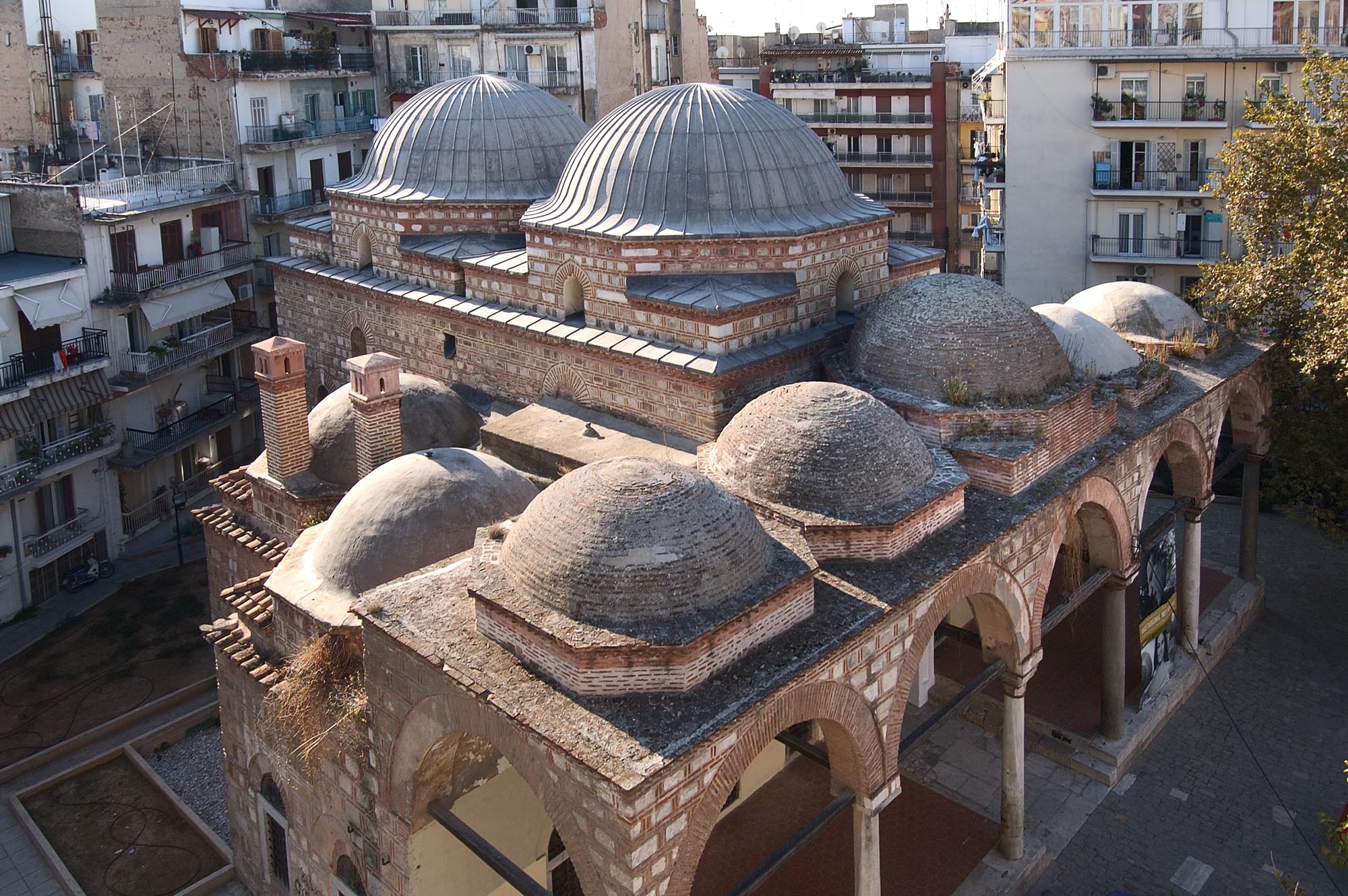
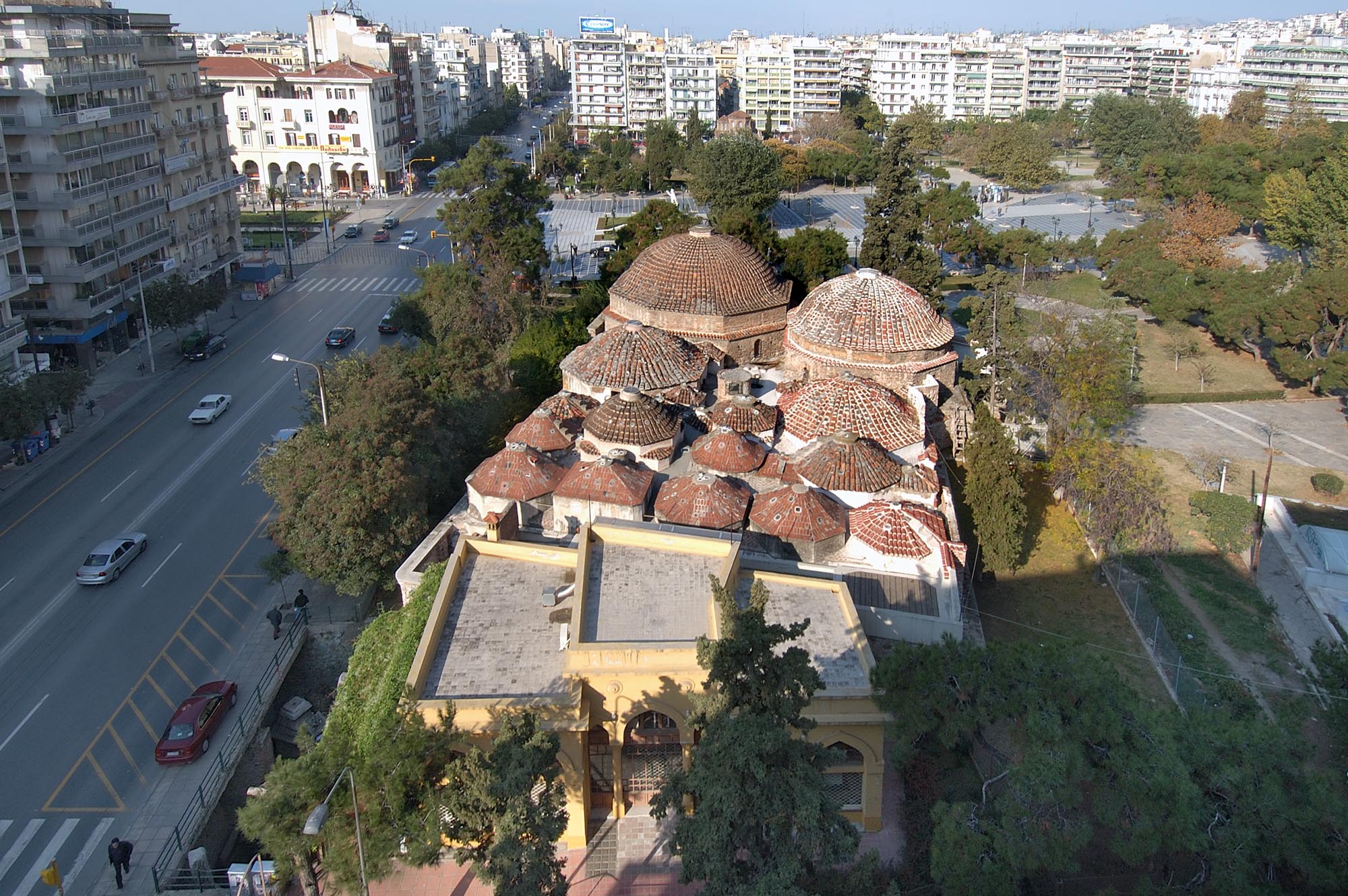
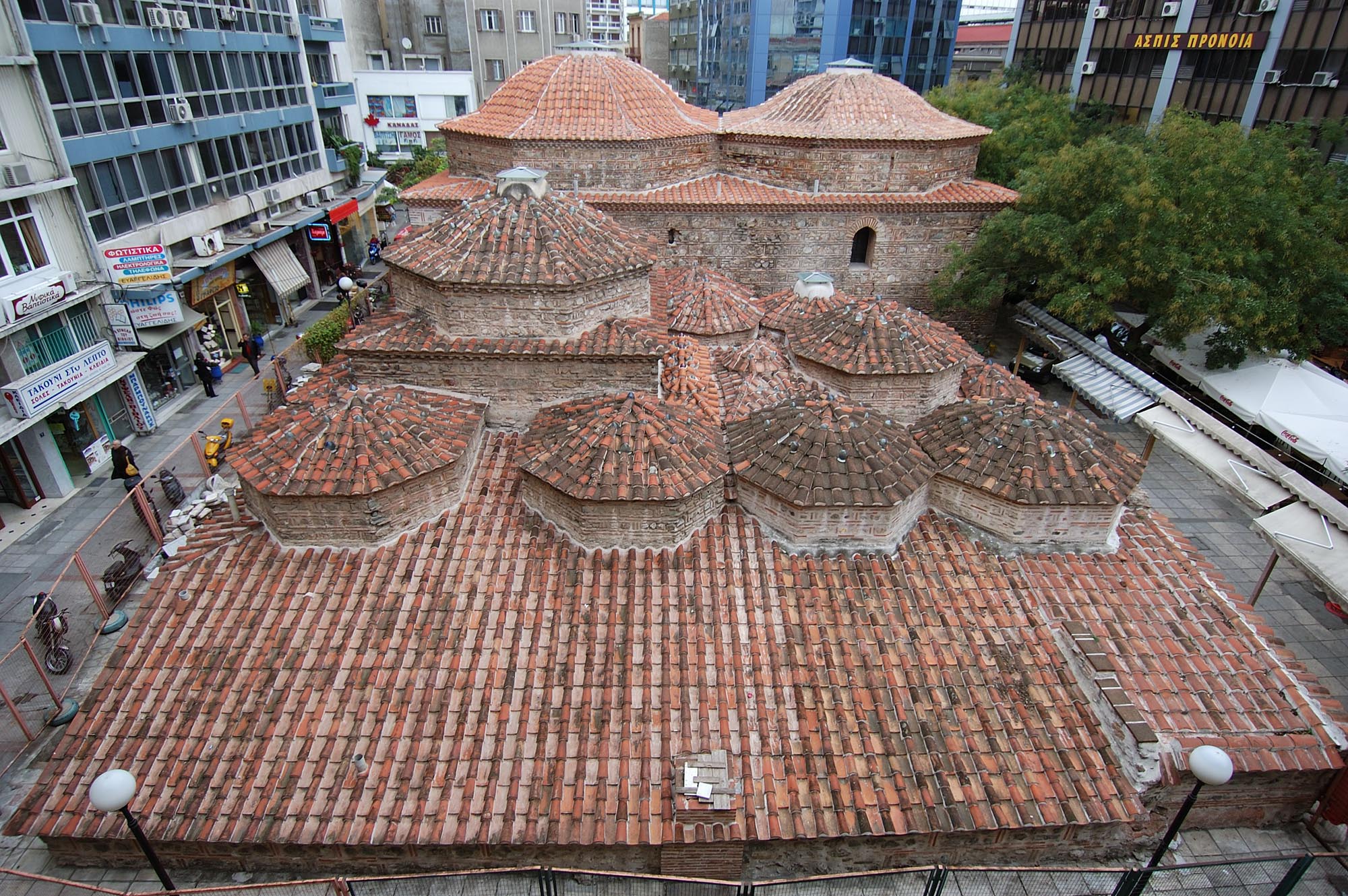
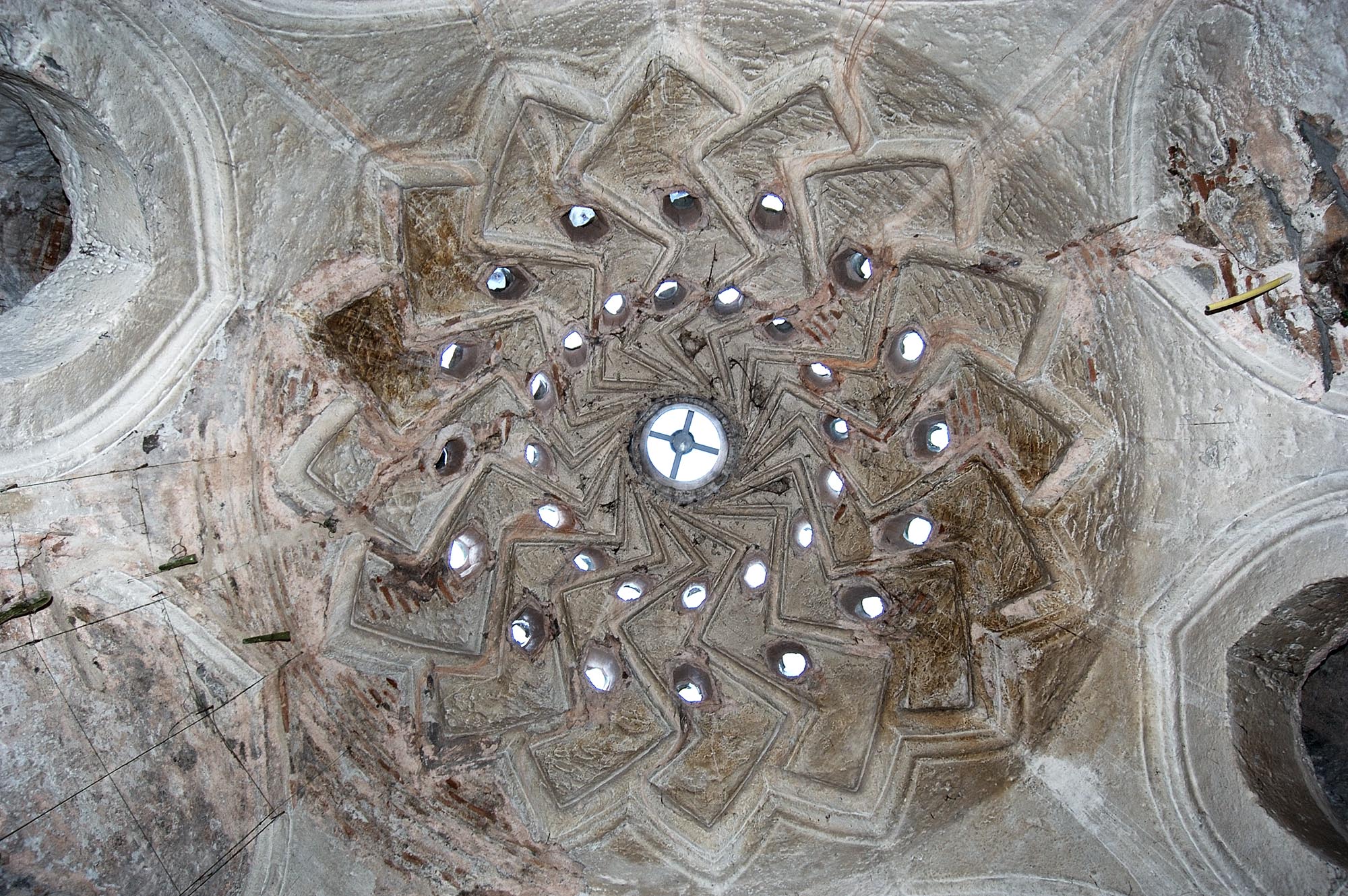
Of the many baths of the Ottoman period that once adorned the city, the Bey Hammam, opposite the church of Panagia Chalkeon, at the junction of Mitropolitou Gennadiou, Egnatia and Aristotelous Streets, was the first to be built in Thessaloniki, probably in 1444 by Sultan Murad II (1421-1451) shortly after the conquest of the city. It is the largest double hammam in Greece, with separate areas for men and women. It was in use until 1968 (as the “Paradise Baths”) and is occasionally used as a cultural venue today, while it is also open to the public as a museum.

North of the church of St Demetrios, at the junction of Kassandrou and Agiou Nikolaou Streets, is the double Yeni Hammam (New Hammam), built in the late 16th century by Hüsrev Kethüda, the owner of a religious establishment in Thessaloniki who probably served as a kethüda (administrator) under Grand Vizier Sokollu Mehmed Pasha. It is also known as the Aegli, due to its use as a cinema until 1978.

Yet another double hammam is the Pazar Hammam (Bazaar Hammam), in the central Modiano Market (Stoa Modiano), at the junction of Vassileos Irakleiou and Komninon Streets. It is also known as the Yahudi Hammam (Jewish Hammam), because it is located in the former Jewish Quarter. It is also called the Louloudadika, due to the flower shops on Vassileos Irakleiou Street that were set along the main north façade of the monument. It was built in the late 15th or early 16th century and, according to 19th- and 20th-century sources, was founded by Khalil Ağa, an official of the Sublime Porte, who was in charge of the Sultan’s harem.

The Pasha Hammam near the west wall of the city, at the junction of Pineiou, Kalvou and Panagioti Karatza Streets, is also known as the Phoenix Baths or the Bath of the Holy Apostles, due to its proximity to the Byzantine church of the same name. It was erected by Cezerizade Koca Kasım Pasha, Vizier of Sultans Bayezid II (1481-1512) and Selim I (1512-1520). It was initially used as a women’s hammam before being converted into a double hammam with the addition of the necessary rooms.

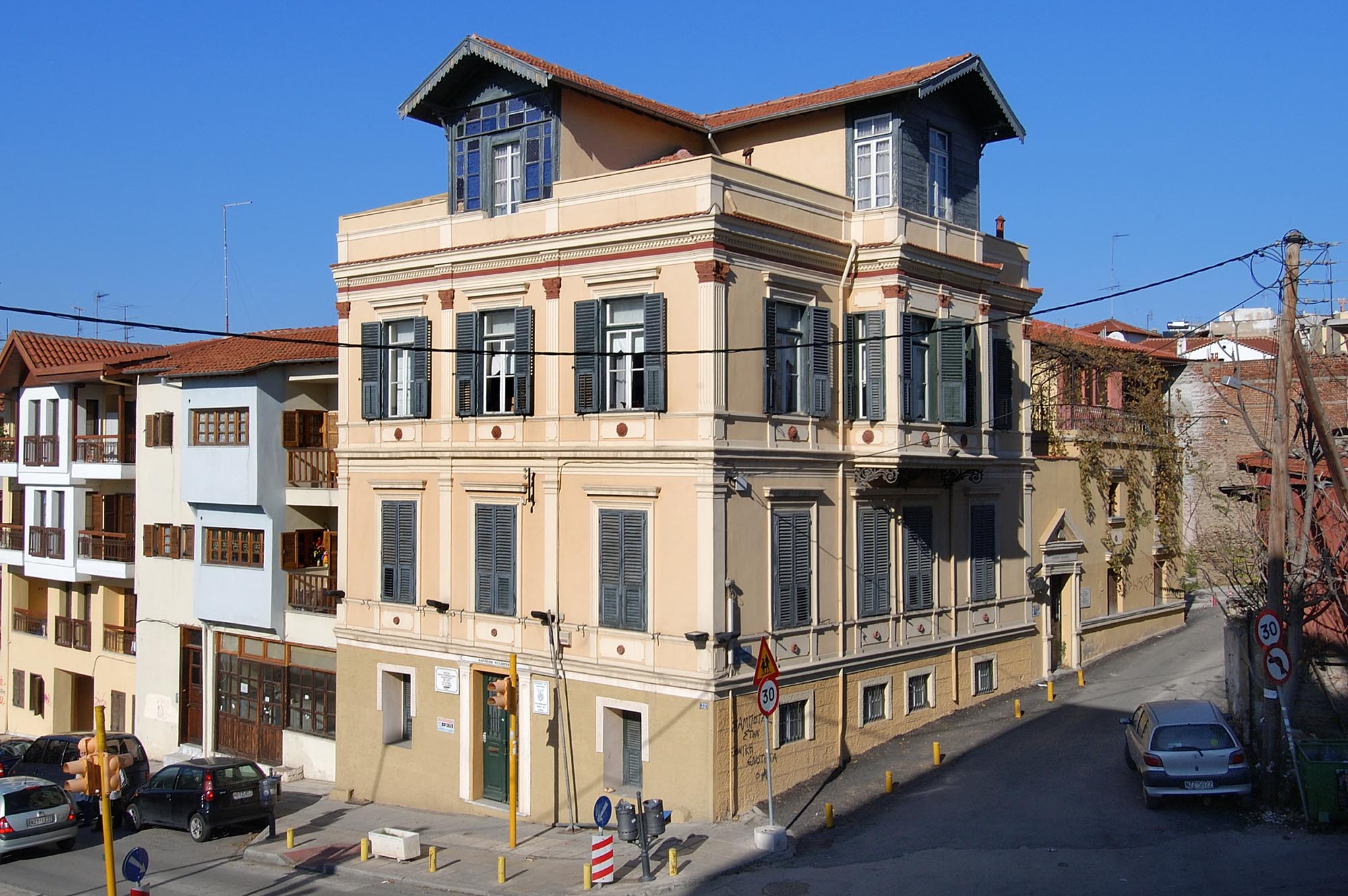
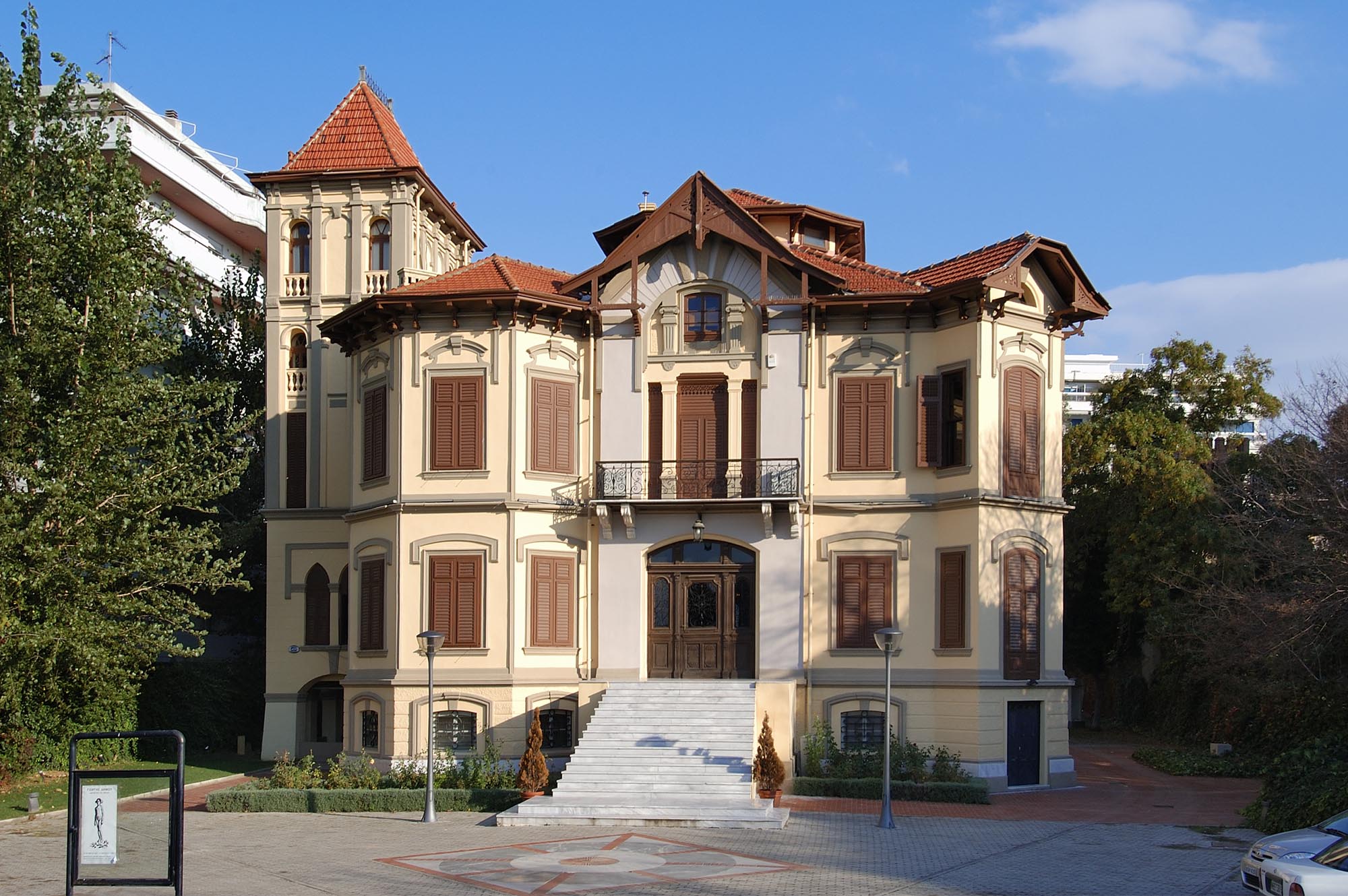
The architecture of Thessaloniki in the late 19th and early 20th centuries united all the architectural movements of the time, including Neoclassicism, Eclecticism and the Neo-Ottoman style. Similarly to Constantinople, European architects were invited to the city as part of its Europeanisation, introducing Western architectural trends.

A significant number of villas, reflecting the city’s economic prosperity and embodying modern architectural trends, were built in the Hamidiye district, also known as the “Avenue of the Towers” or “Avenue of the Courtyards”, along what is now Vasilissis Olgas Avenue. In this area, the most representative examples of secular architecture of this period include the Mansion of Hafiz Bey (School for the Blind, 1879), the Mansion of Ahmed Kapandji (before 1898), the Mansions of Yusuf and Ahmed Kapandji (1905), the Mansion of Major General Seifullah Pasha (1905) and the Casa Bianca or Villa Fernandez (1911-1913).

In the Upper City, a notable example is the konaki (residence) of Hifzi Efendi (1897-1905).

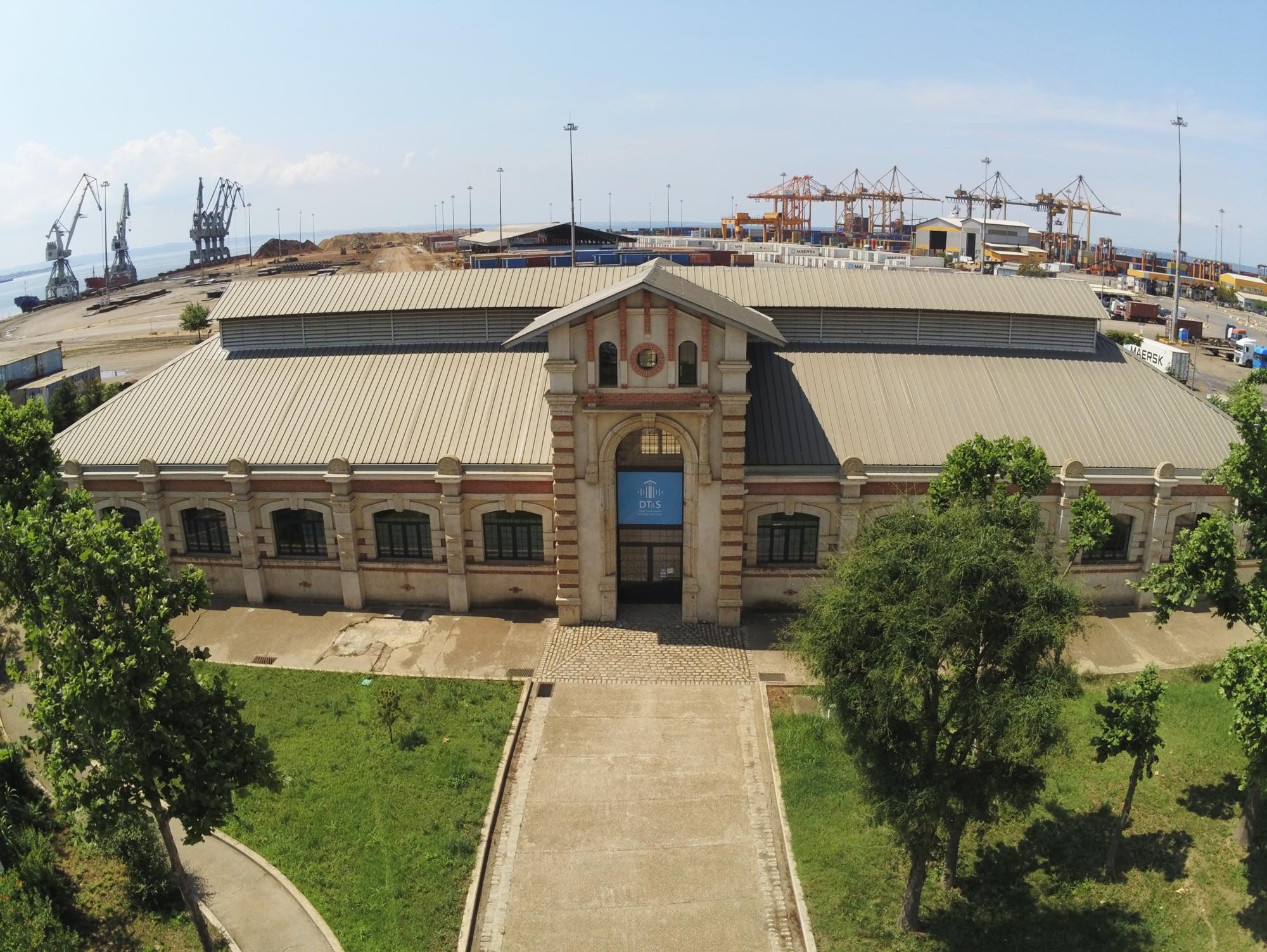
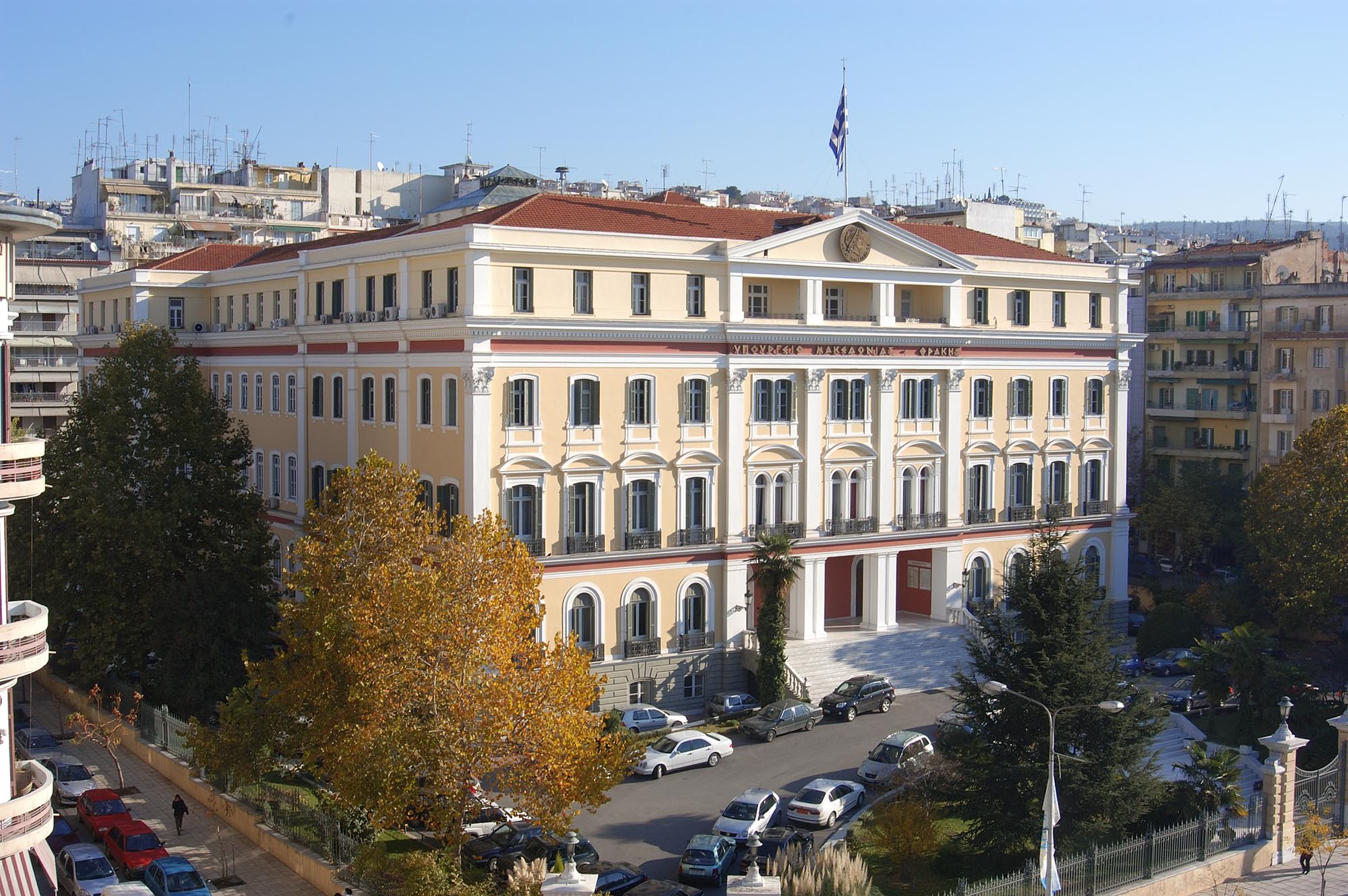
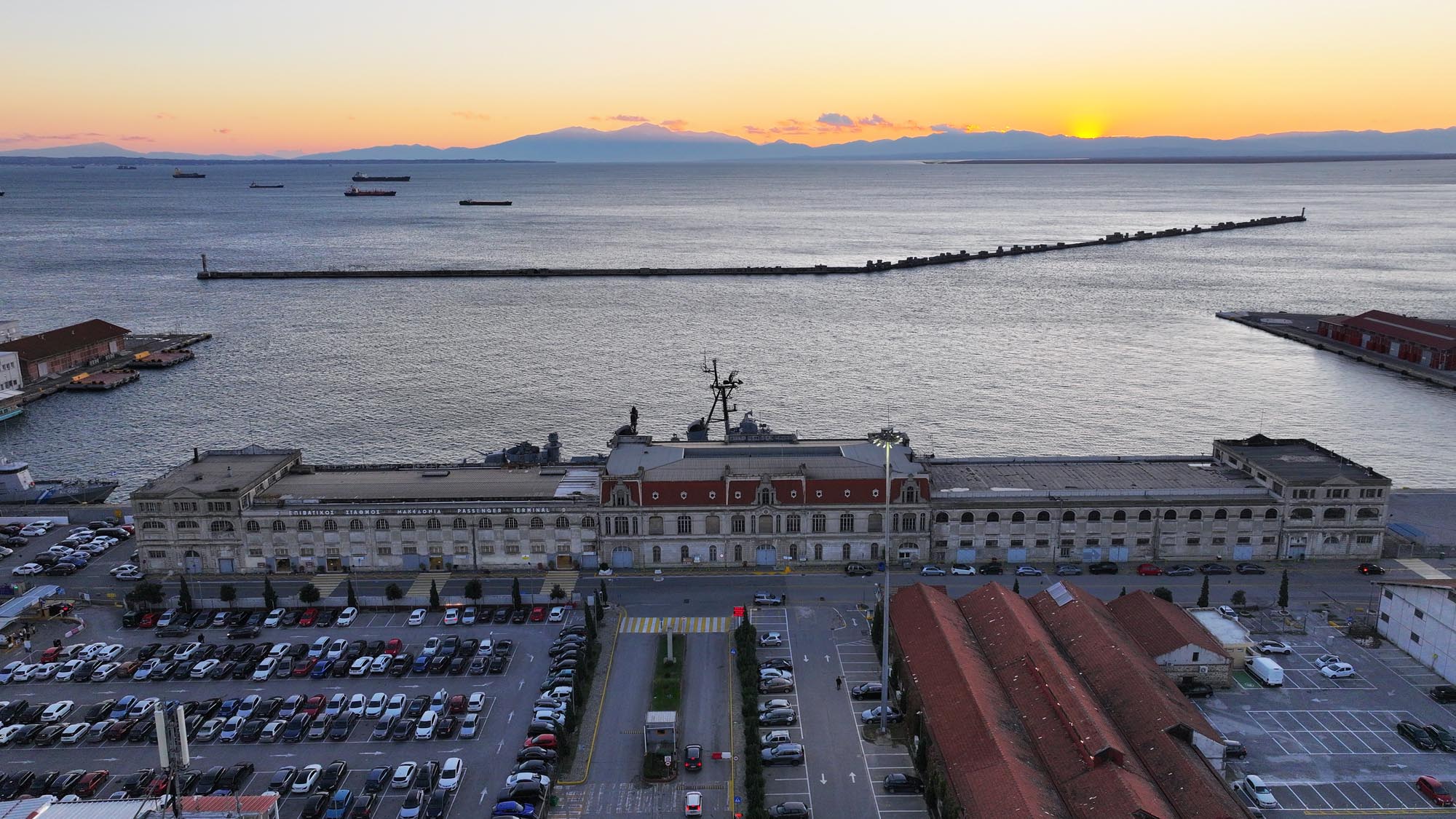
In the late 19th and the early 20th century the appearance of Thessaloniki changed, with the construction of a series of imposing public buildings. A representative example is the Customs House of the port, which was built as part of the Ottoman authorities’ efforts to modernise the city. In 1896 they commissioned the French company “Société Anonyme Ottomane de Construction du Port du Salonique” to build the city’s new port. The port became operational in 1903 and the Customs House was built between 1910 and 1912 by Eli Modiano, an engineer of Italian origin from Thessaloniki. Today, part of the ground floor of the long, large building houses the passenger terminal, while the rest of the building is used for storage. Another important building of this period is the city’s Government House, which was built in 1891 by the renowned Italian architect Vitaliano Poselli and now houses the Ministry of Macedonia–Thrace. Most of the large public buildings constructed by the Ottoman authorities in the city were influenced by Neoclassical architecture.

The industrial development of the city from the second half of the 19th century onwards led to the construction of numerous industrial complexes, such as flour mills, breweries and spinning mills. The Allatini Flour Mill on Georgiou Papandreou Avenue stands out. Designed by the Italian architect Vitaliano Poselli in 1900, it was one of the largest flour mills in the southeastern Mediterranean in the early 20th century.

Museums

Archaeological Museum (6 Manoli Andronikou St.)

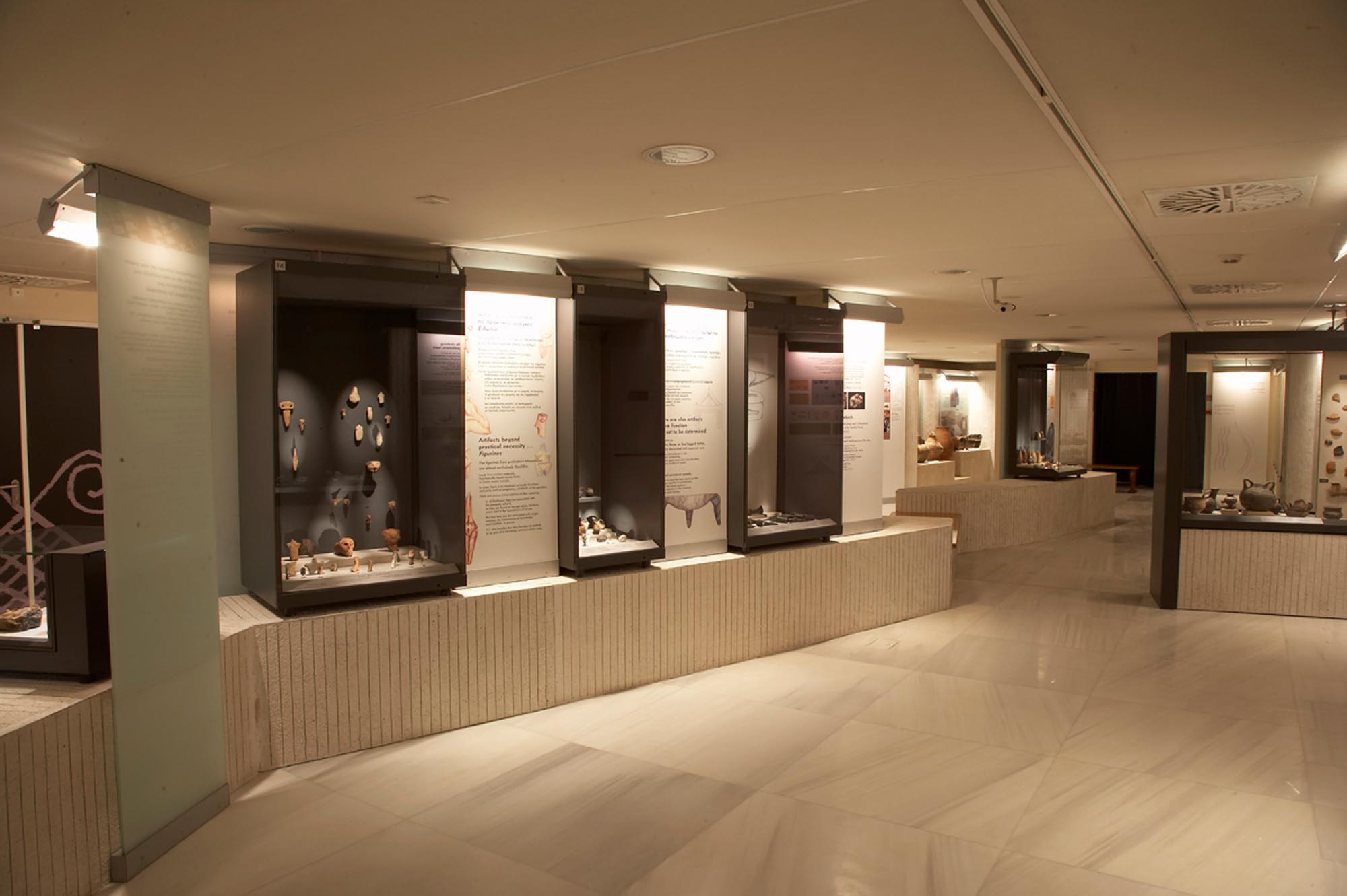
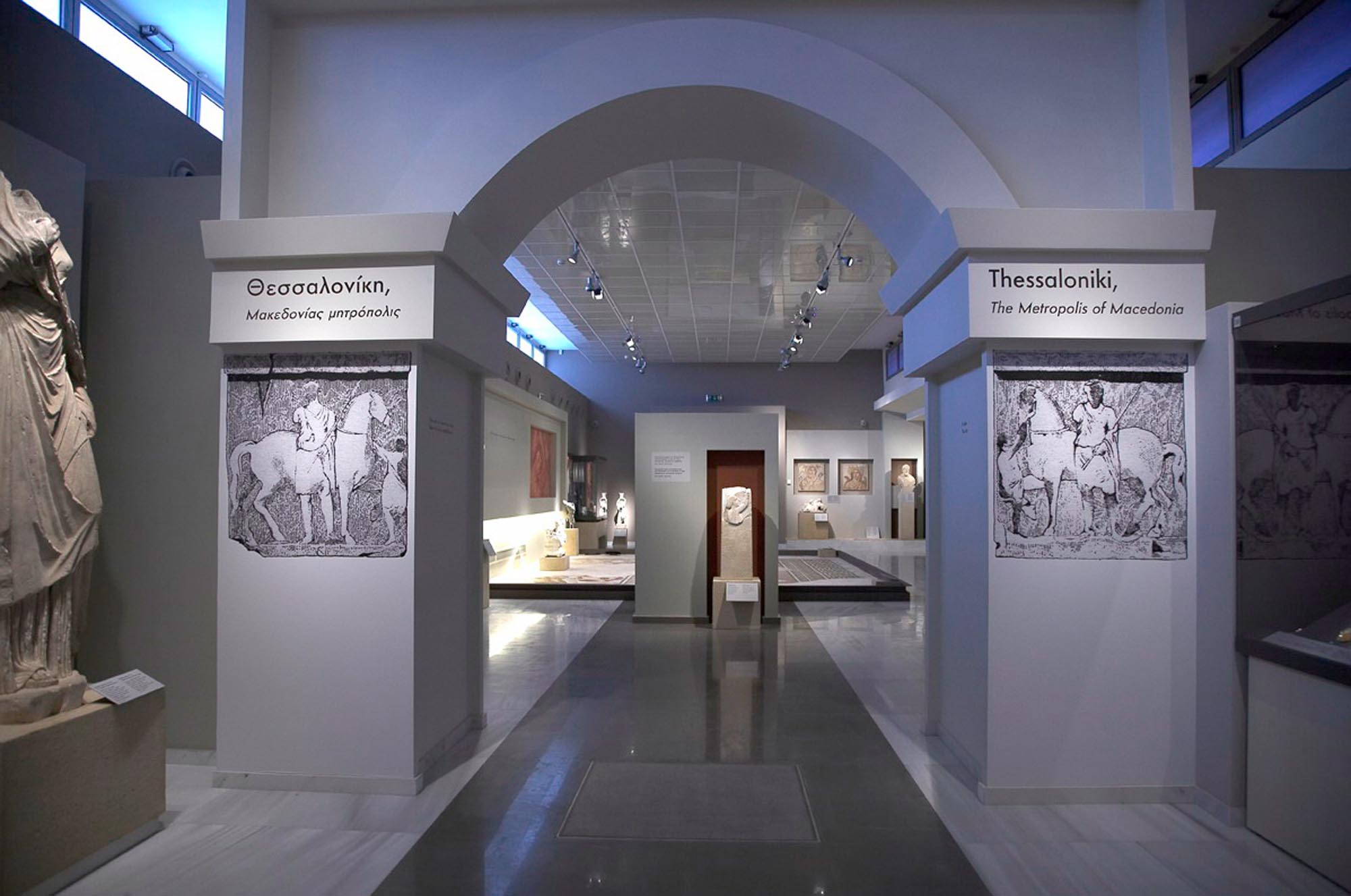
The Archaeological Museum of Thessaloniki is one of the largest museums in the country and the main museum of Northern Greece. Its permanent exhibitions include unique masterpieces of ancient Greek art dating from prehistoric times to Late Antiquity.

At the Museum of Byzantine Culture, visitors experience the world of Byzantium through 46,000 objects and works of art, dating from the 2nd to the 20th century AD. The works are mainly from Thessaloniki but also from the rest of Macedonia.

The Museum provides a fascinating overview of aspects of the history of Thessaloniki from its founding in 316/5 BC to the present day.

Λευκός Πύργος
Λευκός Πύργος

The Museum presents the main phases of the history of Macedonia in the 19th and early 20th century.

Housed in the one of the few Jewish-owned buildings that survived the Great Fire of 1917, in the city centre, it presents the history of the city’s Jewish community.

The Museum presents modern works of art from a significant number of collections and is responsible for the promotion of contemporary art and the study of its trends in Greece and abroad.

Since its establishment in 1972, with the donation by Nestor and Aliki Telloglou, it has been a venue for a wide range of cultural events. Its main collection includes works of art by major Greek and European artists of the 19th and 20th centuries.

The Municipal Art Gallery is housed in the Casa Bianca, also known as the Villa Fernandez, which belonged to the merchant and banker Dino Joseph Fernandez Diaz, an Italian national and a leading member of the city’s Jewish community. It presents a remarkable collection of artworks from 1898 to the present day.

The Museum is housed in the early-20th-century mansion known as the Villa Modiano after its original owner, the Jewish banker Jacob Modiano, or the Old Government House, after it was used as the official residence of the Governor General of Northern Greece during the interwar period. Through a rich collection, it presents the culture of recent centuries in Northern Greece.

The Museum is part of the Thessaloniki International Film Festival and presents the history of Greek cinema, from the first efforts of the early 20th century to contemporary Greek production.

The founder of the modern Turkish Republic, Mustafa Kemal Atatürk, was born here in 1881. The building was presented as a gift from Greece to Turkey in 1937 and opened its doors to visitors as a museum in November 1953.

Through its exhibits, the museum highlights the history of sports and the Olympic Games.

The Museum houses one of the largest and most valuable photographic archives in Greece and aims to promote the art and technique of photography. Its priority is to connect the public with cultural heritage and historical memory through the photographic lens.

Other stops in the Regional Unit of Thessaloniki

error: