Metsovo
Metsovo, the picturesque market town of Pindos
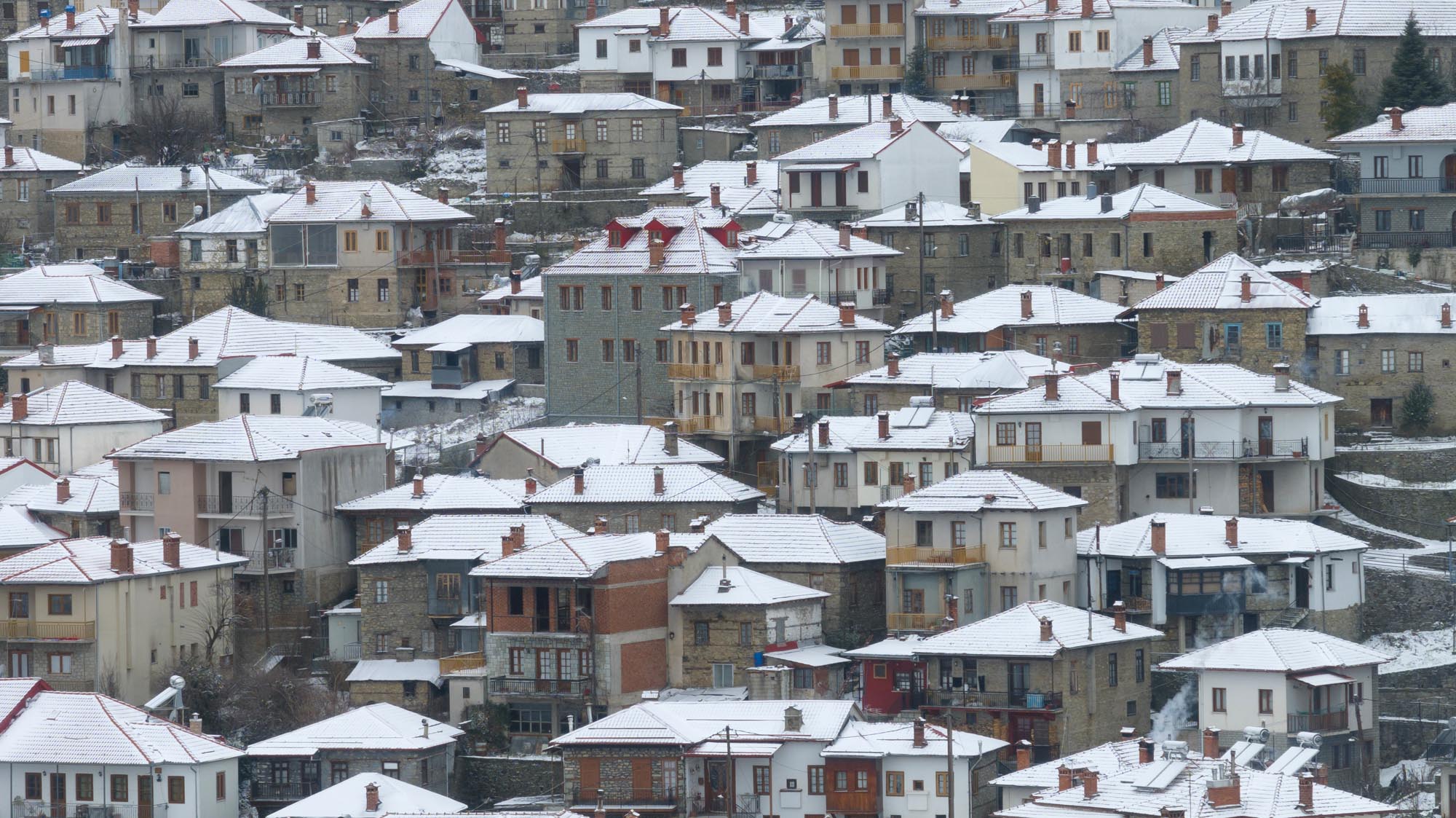
The small town of Metsovo, the seat of the municipality of the same name of the Regional Unit of Ioannina, stands on the border between Epirus, Thessaly and Western Macedonia. It is one of the most picturesque towns and most popular tourist destinations of Epirus today, designated a traditional settlement thanks to its distinctive architecture, with the characteristic stone houses built by the famous Epirote stonemasons. Lying at an altitude of 1,156 m above sea level in a landscape of stunning natural beauty, Metsovo is surrounded by the high mountaintops of the Pindos range, Katara, Zygos and Peristeri, from where the entire river system of Central Greece springs. Near Metsovo flows the rushing River Metsovitikos, creating a long, narrow, fertile mountain valley south of the town.
During the Ottoman period, Metsovo became one of the most important economic, commercial and industrial centres of Epirus, famed for the great Metsovite benefactors, who used their wealth to create major public works. The generosity of the wealthy Metsovites, especially Michael Tossizza, Nikolaos Stournaris and Georgios Averoff, was not limited to their place of origin but extended to the Greek capital, their sizeable donations funding the construction of important schools and other charitable foundations. Metsovo, together with the surrounding villages of Anilio, Anthochori (formerly Derventista), Votonosi, Milia, Koutsoufliani (formerly Platanisto) and Malakasi, formed a sort of federation, the “Chora Metsovou” or “Chorion Metsovou”. Of the six villages, only the first four belong to the Municipality of Metsovo today; on the incorporation of Thessaly into the Greek State in 1881, Koutsoufliani and Malakasi, east of Metsovo, were administratively detached from it and now belong to the Regional Unit of Trikala. Metsovo, called Minciou or Aminciu in Vlach, and the surrounding villages were one of the largest and most prosperous centres of the Vlachs or Aromanians, a Latin-speaking population group who were originally nomadic pastoralists. From the beginning of the 17th century, when they gradually began to make their presence felt in the Balkans, the Vlachs also produced able warriors (armatoles and klephts), and prosperous merchants and craftsmen who engaged in significant intellectual activity.
The development of Metsovo was primarily determined by its key strategic position, near the Mount Zygos Pass, the most important pass between Epirus and Thessaly, vital to trade and the provision of supplies to travellers and troops. The construction of the Egnatia Motorway has now ensured safe, fast connection between the region and Central and Northern Greece.
History
Little is known about the history of the area in antiquity. It has been argued that Mount Pindos formed the eastern border of Molossia, the land of the Molossians, one of the most important Greek-speaking tribes of Epirus along with the Thesprotians and Chaonians. The size and borders of Molossia, like those of the other Epirotic tribes, are difficult to determine precisely, but the prevailing view is that they coincide for the most part with the administrative boundaries of the present-day Regional Unit of Ioannina, centred on the basin of Ioannina around Lake Pamvotis (Lake of Ioannina). According to the historian Nicholas G.L. Hammond, the territory of a smaller continental tribe, the Kelaithi, was located in the Metsovo area. At the Vlachoi Beratori or Beratoria site, on a high plateau 1,350-1,400 m above sea level, near the source of the River Aoos, Hammond identified the only archaeological remains in the Metsovo area known to date: two fortified enclosures apparently belonging to a fortified settlement. However, this is difficult to date due to the absence of finds. Finds of the prehistoric period and antiquity have been discovered in the surrounding villages, the most important being the hoard of bronze vessels of the 5th-4th century BC from the Votonosi area.
The place-name Metsovo is first mentioned in the Late Byzantine period. It is recorded as “Pindos now Metsovon” in a marginal note in a 13th- or 14th-century manuscript of the Book of Histories or Chiliades, a verse chronicle by the 12th-century Byzantine scholar John Tzetzes. The Chronicle of Ioannina, a 15th-century text recording the history of Ioannina in the second half of the 14th century, mentions the Abbot of Metsovo, the hieromonk Isaias, who was arrested and blinded for reasons unknown by the Serbian ruler of Ioannina, Thomas Preljubović (1366-1387).
In 1430, on the surrender of Ioannina to the Beylerbey (governor) of Rumelia, Sinan Pasha, and the Ottoman conquest of most of present-day Epirus, the area of Metsovo was included in the Sancak (administrative region) of Trikala. A few years after the conquest, in the mid-15th century, according to an Ottoman register of 1454/5, the Chora Metsovou, i.e. Metsovo and the surrounding villages, was a timar (fief) of Omer Bey, the governor of the Sancak of Trikala. It had 700 taxable families, 41 widows and 52 unmarried individuals, a higher population than the larger towns of the sancak such as Trikala and Larissa. During the Ottoman period, the Chora Metsovou became one of the most important derbends of the region. The inhabitants of Metsovo and the surrounding villages formed the derbendji corps, whose mission was to guard the important Zygos Pass and ensure the smooth passage of military troops, state officials and merchants. In return, the Ottoman Empire granted the Metsovites tax exemptions and the right to govern their own territory. The 19th-century Epirote scholar Ioannis Lambrides mentions that in 1480 the inhabitants of Malakasi were placed under the protection of the Valide Sultan, the sultan’s mother, who again secured them tax relief and political privileges. However, the first official granting of privileges to the Metsovites by a firman (imperial decree) of Sultan Mehmed IV dates from 1659. After that, the Metsovites managed to secure the Sultan’s favour by new firmans at least until the beginning of the 19th century. The firman of 1659 also confirmed the establishment of the Patriarchal Exarchate of Metsovo, an ecclesiastical district that included all the surrounding settlements and was directly subject to the Ecumenical Patriarchate of Constantinople, without being part of the metropolitan system -until then. Metsovo was under the jurisdiction of the metropolitan see of Stagoi (modern Kalabaka). The Patriarchal Exarch of Metsovo was the highest ecclesiastical, spiritual, administrative and judicial authority of the region.
Up to 1659, Metsovo had a predominantly pastoral economy, the main occupation being transhumant herding, with flocks of sheep and goats being moved to different grazing areas over the course of the year. The inhabitants also engaged in farming, which, due to the high altitude and local climate conditions, was mainly limited to viticulture and the cultivation of maize and, to a lesser extent, wheat, oats and barley. From the second half of the 17th century onwards, however, Metsovo was gradually transformed from a mountain pastoral settlement into one of the most important mountain towns of Epirus, with highly developed commerce and significant craft production. An important group of merchants, one of the most prosperous in the Balkans, emerged in Metsovo. Besides nearby Ioannina and the other large markets of Epirus, they developed contacts with the great trading centres of the Balkans, Europe and even Russia, Egypt (Alexandria) and the East Mediterranean (Cyprus, Damascus), in many of which they maintained important trading houses. The active and adventurous agogiates (caravan masters, also known as caravanarides, kiratzides or keratzides, from the Turkish kiraci), and pramateutades (traders) of Metsovo, whose skill is praised by foreign travellers, crisscrossed the Balkans with their caravans. Through the ports of Epirus, especially Sagiada, they sent their products to the markets of Italy and the rest of Europe. Organised in guilds, they gradually became the ruling social group of Metsovo and accumulated great wealth.

During the same period, handicraft production boomed, especially the famous handwoven textiles of Metsovo, made from the wool abundant in the region. Metsovo attracted the interest of the foreign consuls who had established themselves in Arta and Thessaloniki mainly in order to obtain wool, the raw material necessary for the industrialisation of Italy, then in its infancy, and subsequently that of France and Britain. During the reign of Louis XIV (1643-1719), a warehouse was constructed in Metsovo to gather local products destined for export to Europe.
Woodcarving was another craft in which Metsovo excelled. Metsovite taliadoroi (woodcarvers) were much in demand, travelling to many parts of Greece and the Balkans, mainly to decorate churches. Alongside woodcarving, another important sector of Metsovo’s economy was the exploitation of the rich forests of Mount Pindos for building timber. Others were harness-making and coopering, which included the manufacture of barrels and wooden household containers of all kinds. Carpentry, too, boomed, with the Metsovite davatzides, artisans involved in the whole range of building-related woodwork, even being employed on the construction of Ali Pasha’s sarays in Ioannina. Metsovo also produced excellent builders and masons, silversmiths and blacksmiths.
Alongside this economic and commercial development, the Metsovite merchants, coming into direct contact with the ideological currents of Western Europe, were particularly zealous in nurturing the intellectual life of their homeland. Some researchers place the founding of the first Greek School in Metsovo after the middle of the 17th century. In 1759, a Greek School was officially founded in Metsovo with a bequest by the Metsovite benefactor Stergios Stanos. Initially housed in the monks’ cells of the church of St Paraskeve, it moved in 1817 to the building funded by the Metsovite benefactor Dimitrios Zamanis, an important member of the Philiki Etaireia. The building burned down along with its valuable library in 1840. During the 19th century, five more schools operated in Metsovo, supported by the continuous contributions of wealthy benefactors, while the surrounding villages also had schools. “Metsovo, friend of letters and commerce” produced important scholars and teachers such as Parthenios Katzioulis, Nikolaos Tzartzoulis (Zerzoulis or Zortoullios), Tryphon Vardakas and Dimitrios Vardakas, active participants in the intellectual renaissance of Epirus during this period, centred on Ioannina.
In 1795, the notorious Ali Pasha of Ioannina leased the mukataa (tax district) of Chora Metsovou, imposing significant tax burdens on the inhabitants. In 1831, Metsovo became a nahiye (municipality) officially included in the Pashalik of Ioannina, after almost 400 years as part of the Sancak of Trikala.
In 1854, Metsovo suffered a major disaster, the “Destruction of Grivas”, when a fierce three-day battle was fought between the Turkish forces and Theodoros Grivas, the leader of the revolutionary movement that broke out in Epirus during the Crimean War (1853-1856). One of the tragic consequences of the battle was the destruction of 400 homes in Metsovo. A decade later (1864-1867), a castle was built in Metsovo, which housed the Ottoman administration and included a mosque. After 1912, it gradually collapsed and was covered with earth, creating the hill now known as the “Kastro”. In 1875, as part of the administrative reforms of the Ottoman Empire (Tanzimat) and the establishment of the Eyâlet of Ioannina (1864), the region of Metsovo was promoted to a kaza, becoming the seat of both a kaymakam (deputy governor) and a kadi (judge).
In the second half of the 19th century, with the rise of Balkan nationalism, the Koutsovlach Question arose: Romania claimed the Vlach populations of the Ottoman Empire living in the regions of Epirus, Macedonia and Thessaly as fellow nationals. In the context of Romania’s claims, a Romanian school was founded in Metsovo in 1891 with a bequest from the Metsovite Dimitris Kazakovich.
On 31 October 1912, after the decisive victory of the Greek Army, Metsovo was annexed to Greece. The control of Metsovo was key to the subsequent operations of the Greek Army and the capture of Ioannina (1913). In 1924, the Exarchy of Metsovo was abolished and the metropolitan see of Metsovo established until 1929, when the town was attached first to the metropolitan see of Grevena and then, in 1932, to the metropolitan see of Ioannina, to which it is still subject today.
In the post-war period, the Baron Michael Tossizza Foundation contributed decisively to the evolution of Metsovo from a village of herders to a model of development, implementing a wide range of public benefit projects. One of the Foundation’s visions was the Tossizza Cheese Factory, which, continuing the local cheese-making tradition, produces various types of cheese including the famous Metsovone. The Foundation also made great efforts to revive the old winemaking tradition, cultivating vines on the abandoned slopes of Mount Pindos and establishing the Katogi Averoff Winery, now one of the best-known wineries in Greece. The vineyard and wine traditions of Metsovo are inscribed on the National Inventory of Intangible Cultural Heritage of Greece.
Monuments
Traditional town – Mansions
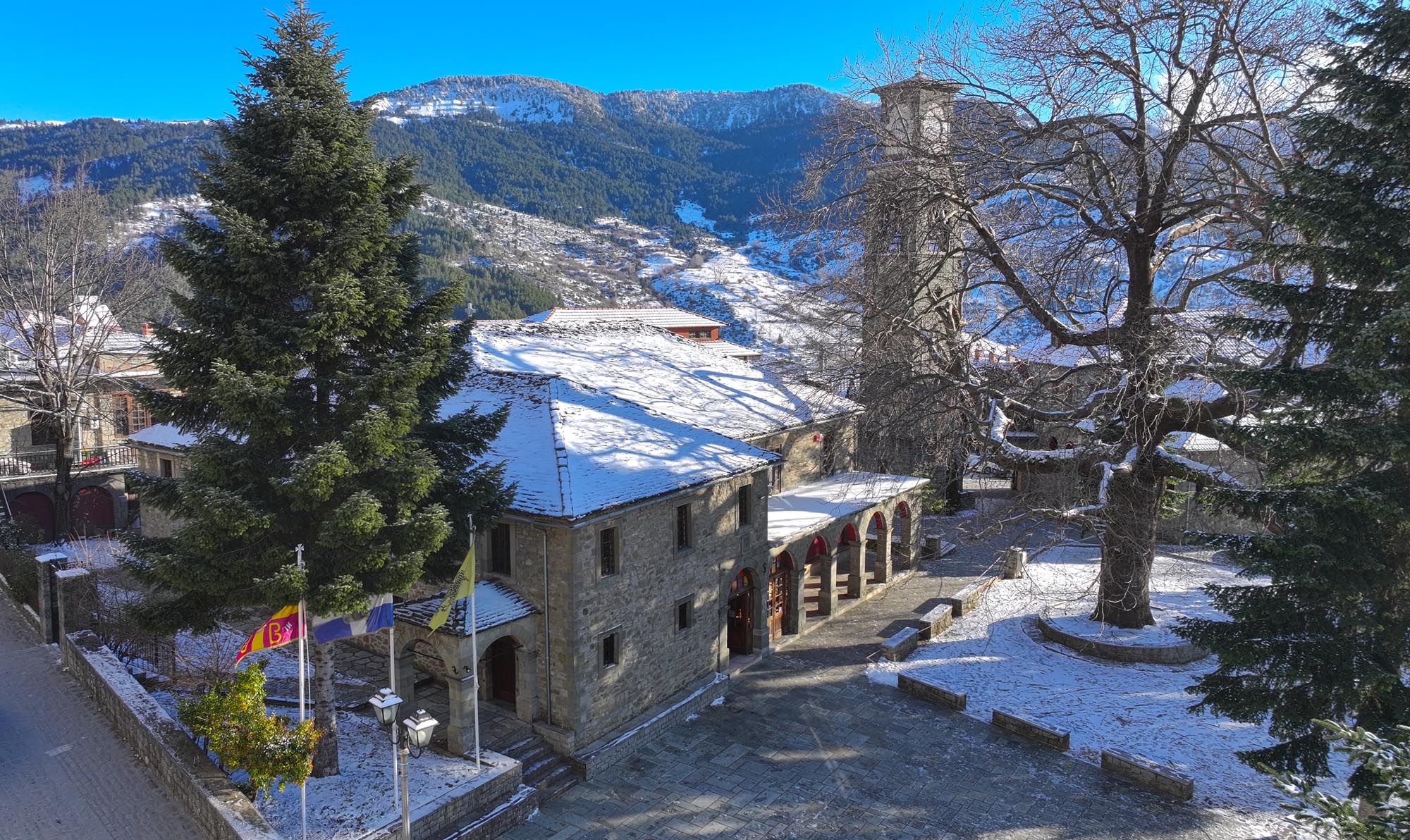
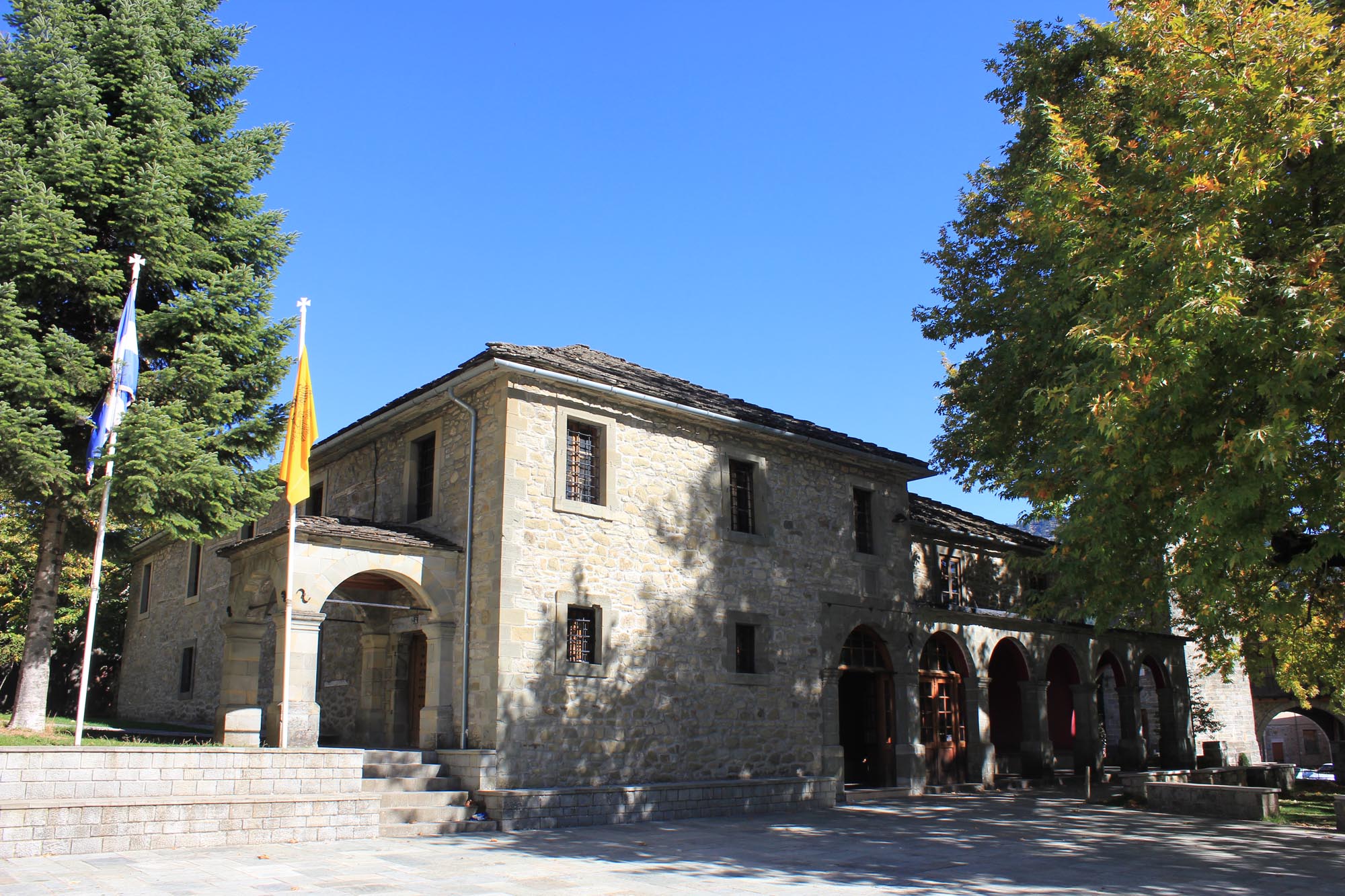
The traditional town of Metsovo is divided into Upper and Lower Metsovo, with the individual districts of each centred on their respective parish church. In the heart of the town is the main square, one of the most famous in the mountains of Epirus, with its centuries-old trees, numerous shops, the Cathedral of St Paraskeve and the Town Hall, originally built in 1878 as an old people’s home funded by the benefactor Triantafyllos Tsoumagas (Tsioumagas).
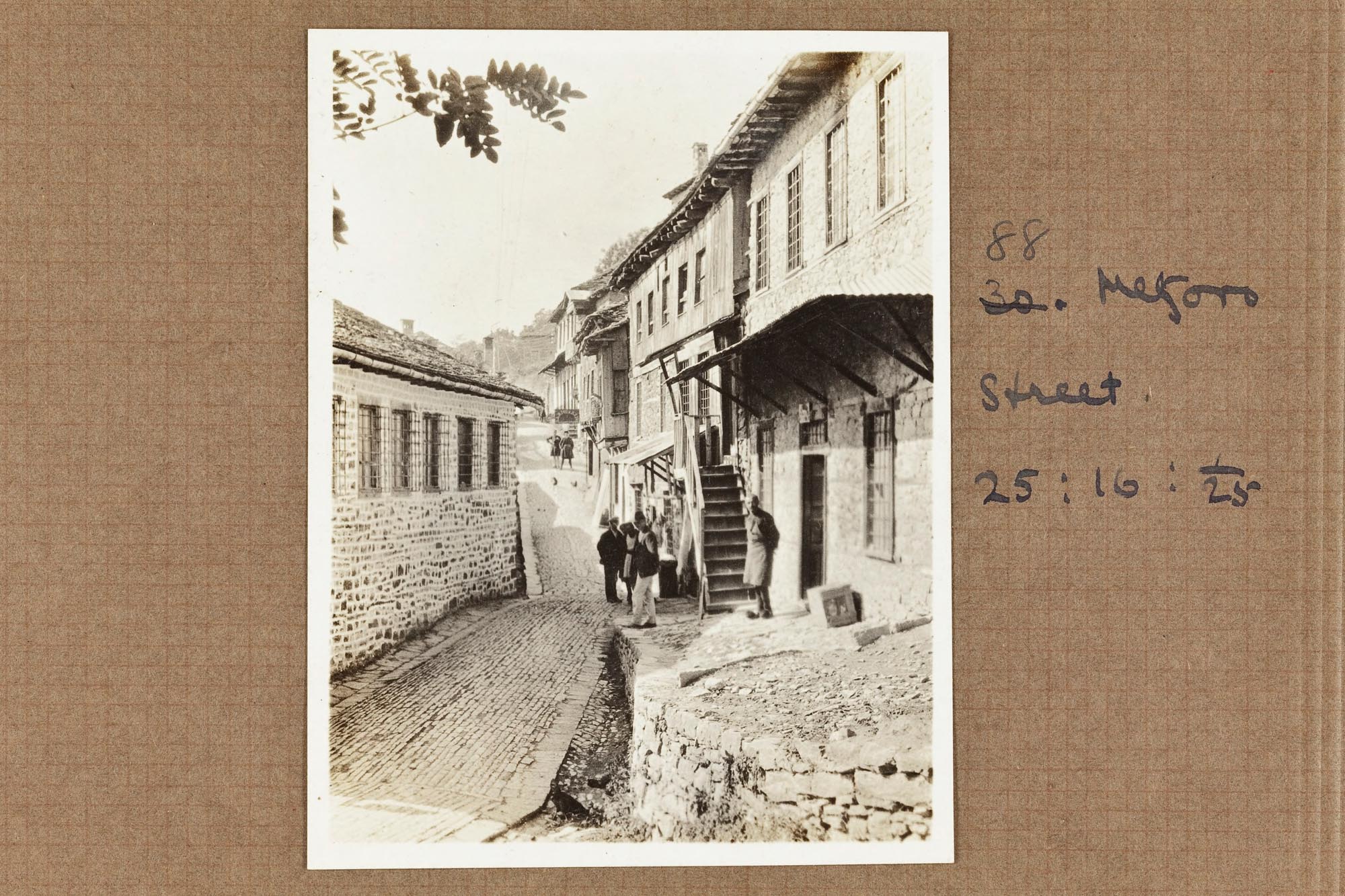
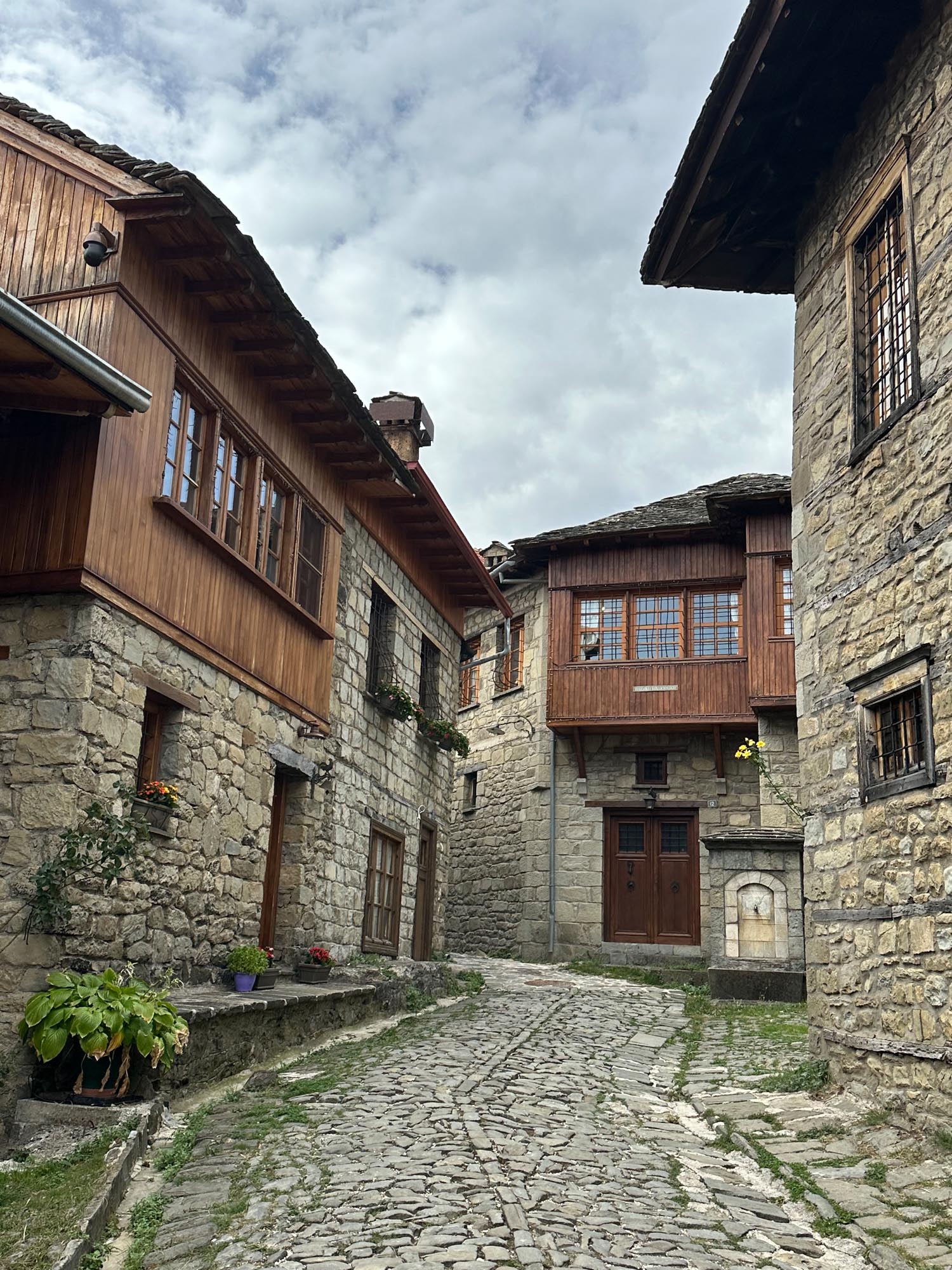
The cobbled streets of the town, with the exception of the main streets (Tsoumaga, Averoff and Tossizza Streets), are narrow and winding, 2 to 4 m wide. Flanked by high house walls along most of their length, they give the impression of an enclosed space, heightened by the densely built-up layout.
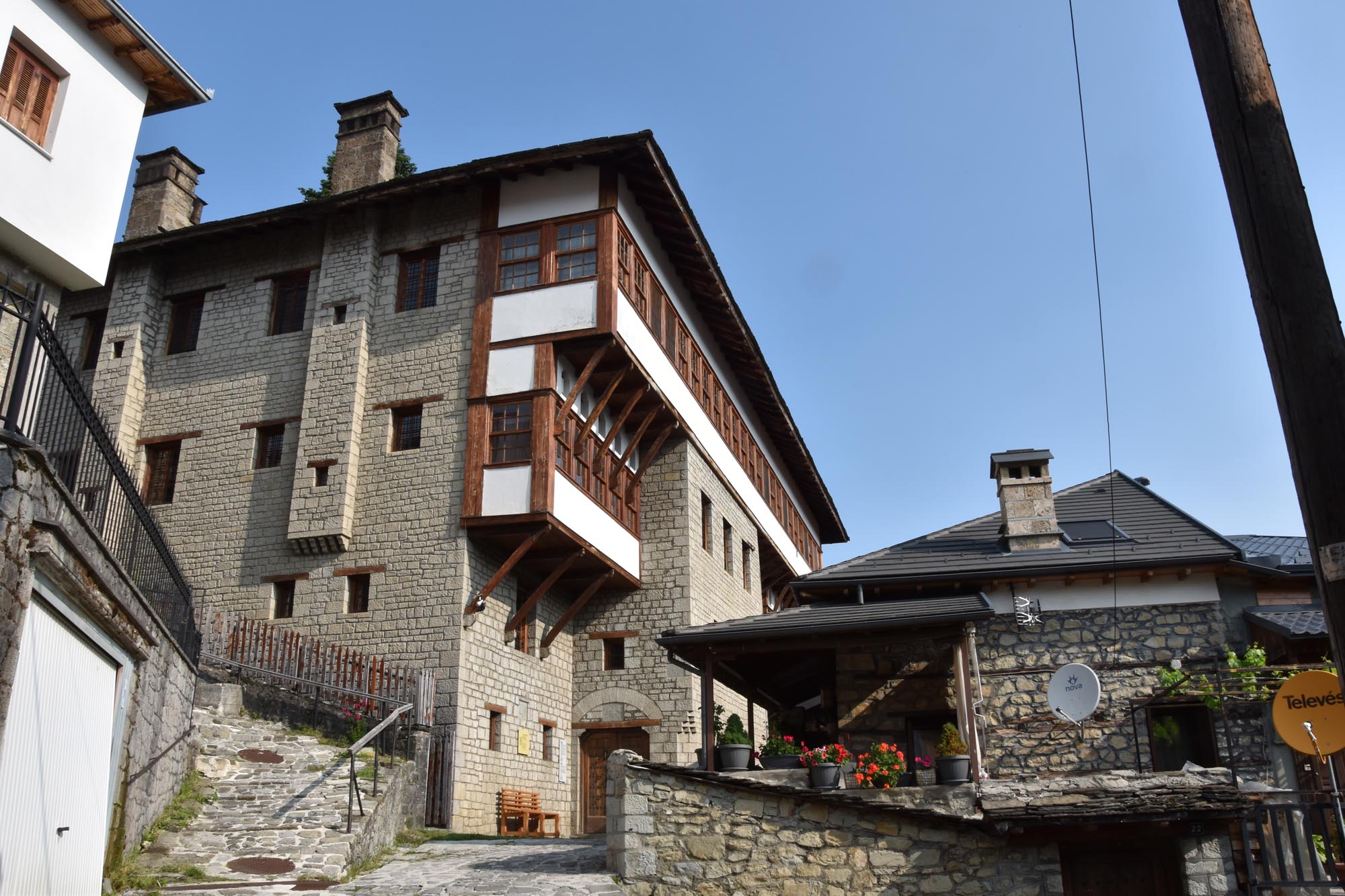
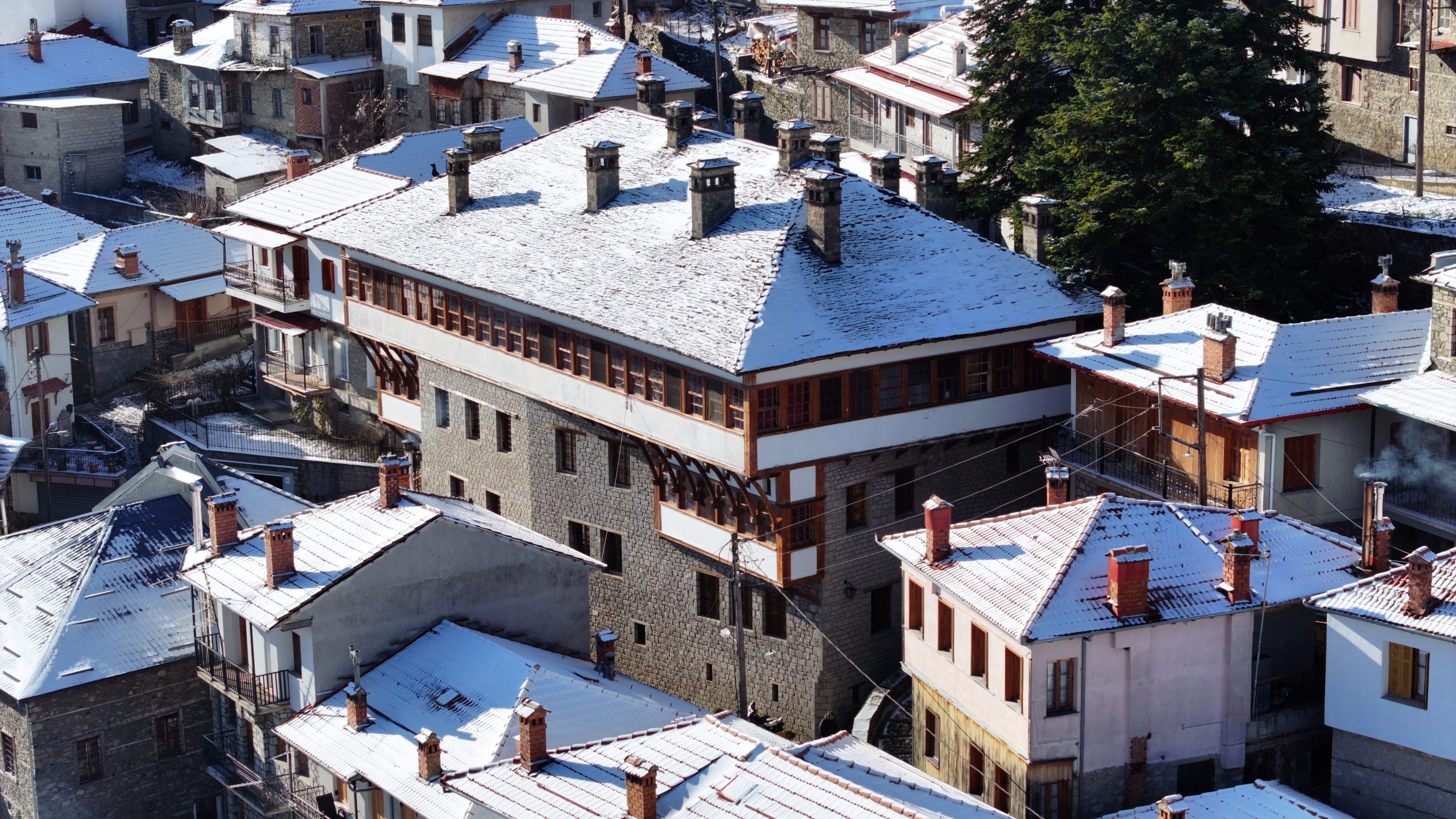
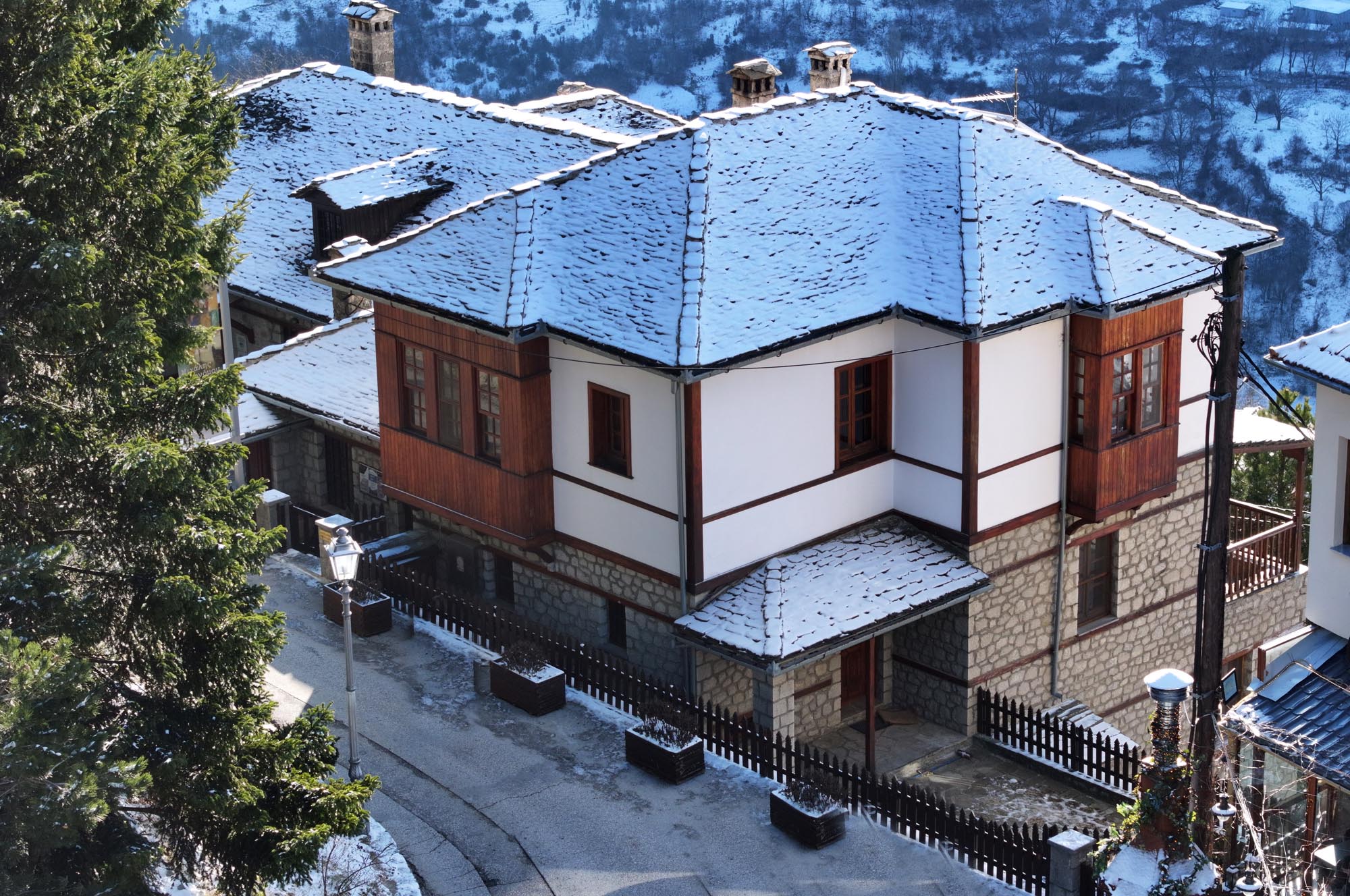
The houses of Metsovo share the basic features of the traditional architecture of Epirus and are divided into two main categories: the three-room, wide-fronted vernacular house and the four-room mansion. Both types have two storeys and are surrounded by courtyards enclosed within high walls with characteristic roofed gates. The family living quarters are on the first floor and the auxiliary rooms on the ground floor. The defining feature of the houses of Metsovo, like those of the surrounding villages, is their local grey-brown or grey-green stone. Distinctive grey-green slate is used for the floors and roofs, although most of the renovated stone houses today have tiled roofs. Only the kepegia, the equivalent of the traditional Macedonian şahnişins, the overhanging covered balconies at the ends of the sarayia, the reception rooms on the upper floors, are made of wood.
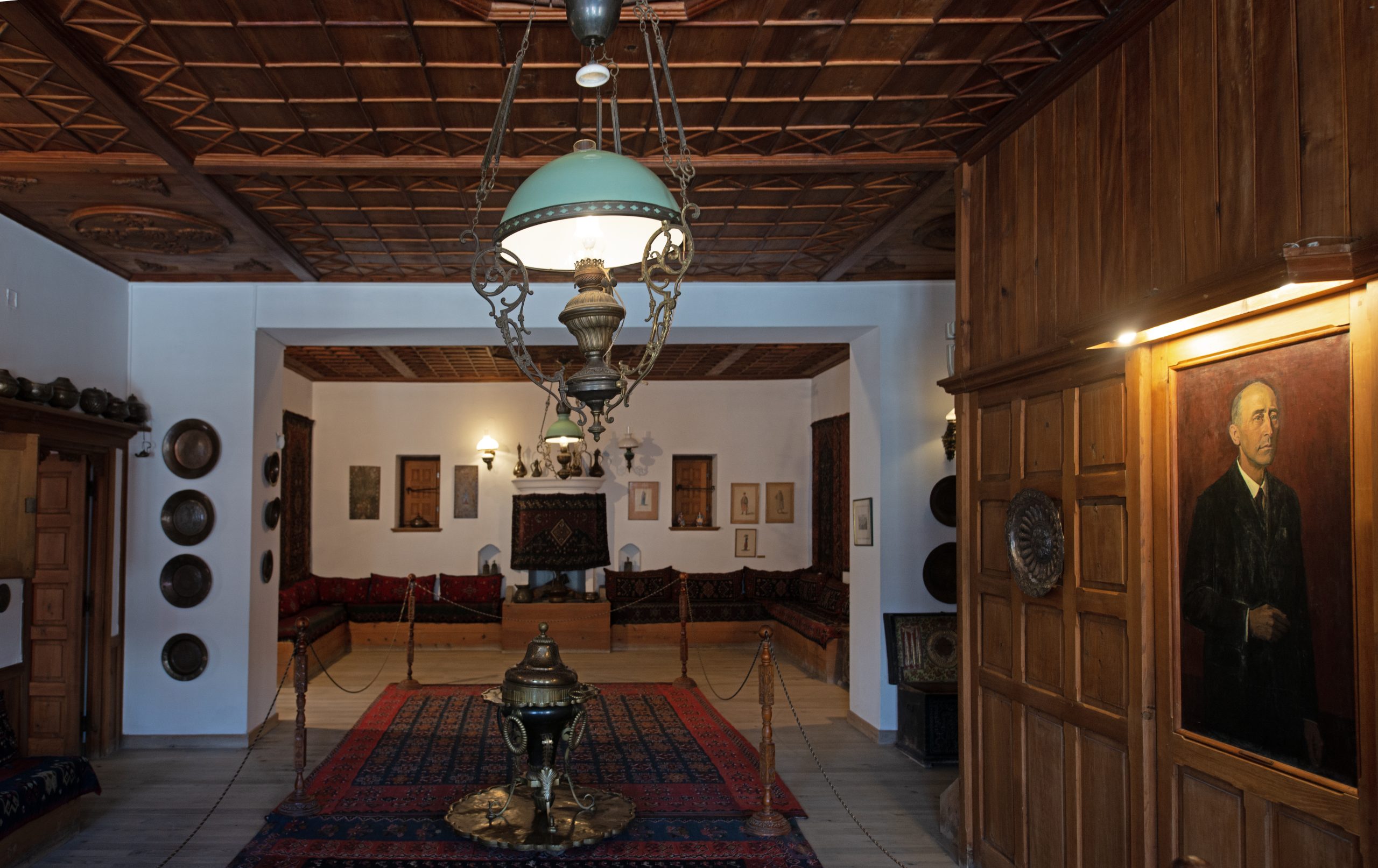
The mansions of Metsovo bear witness to the town’s prosperity after the middle of the 17th century. In contrast to their plain, austere exteriors, to which only the chimneys on the roofs and the kepegia, the large windows and the transoms on the upper floor add a certain lightness, their interiors are a bright, colourful and richly decorated world, composed of ornate wooden ceilings, painted mesandres (wooden wardrobes) and the famous Metsovo woollen fabrics in a wide variety of colours and designs. The carpets on the floors, the hramia on the walls and the boucharopodies hanging above the fireplaces both decorate the upstairs rooms and protect them from the cold. The cushions and bedding on the basia, the characteristic wooden structures around the walls, which were used as a sitting area, a place to eat during the day and a bed at night, are also richly made. An interesting feature of Metsovo architecture is the small hatch in the fireplace, said to allow people to keep an eye on their cooking.
Fountains
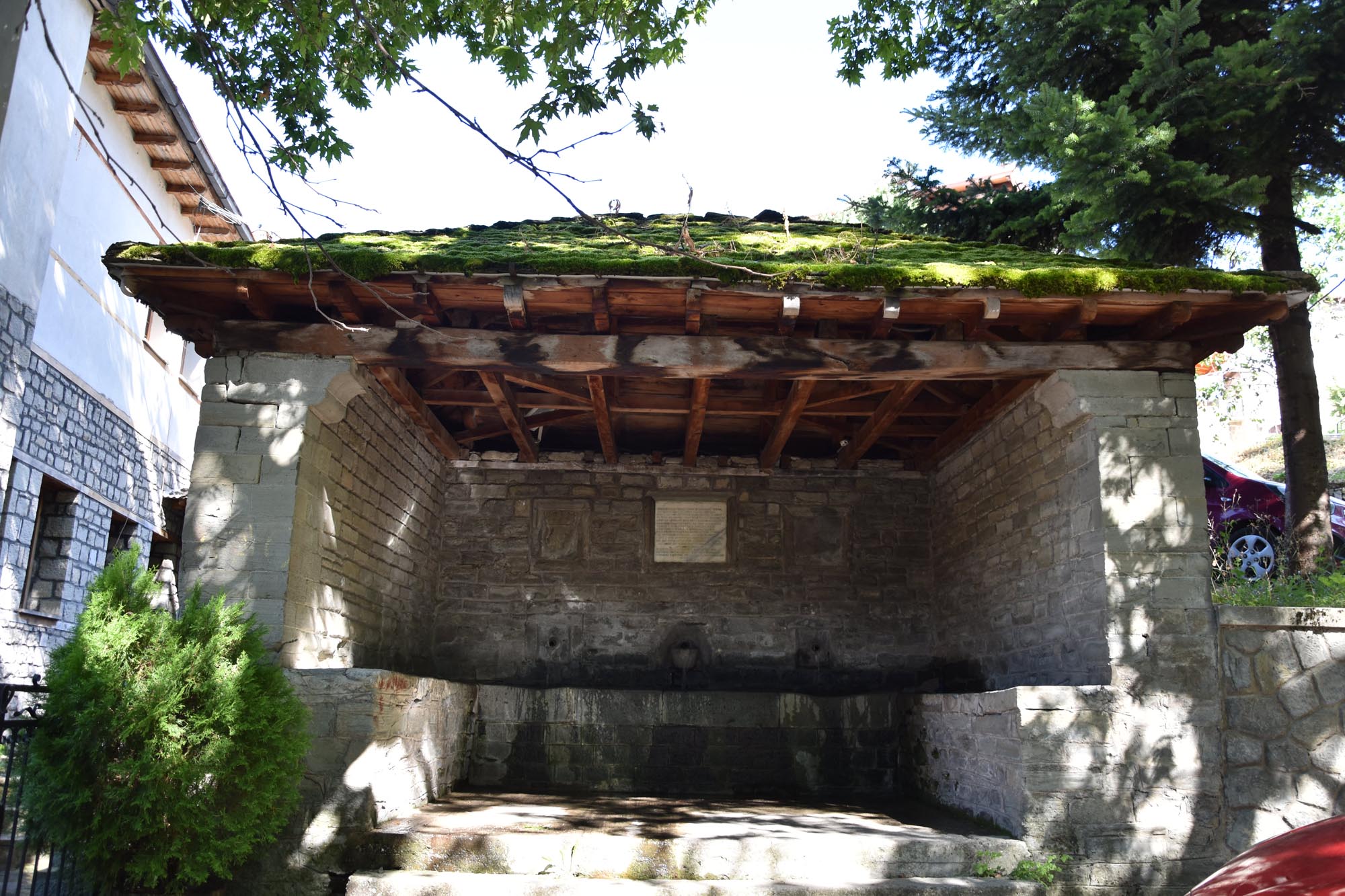
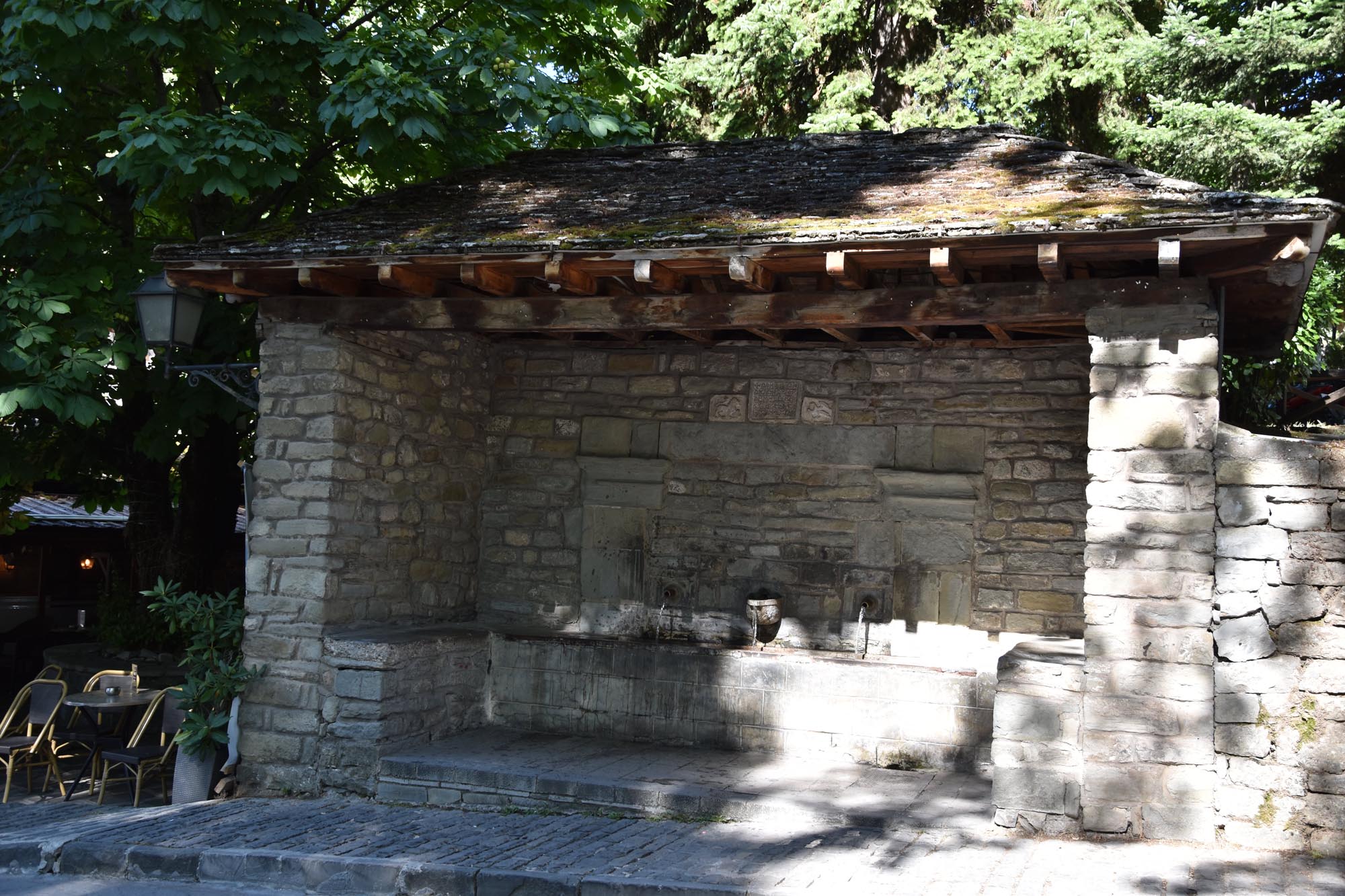
The public fountains which once served the households play a prominent part in the residential fabric of Metsovo, as only the wealthy mansions, such as that of the Averoff family, had wells on their own property. Many of Metsovo’s fountains, like those in the main square, are roofed and elaborately constructed with interesting sculptural decoration.
Averoff Garden
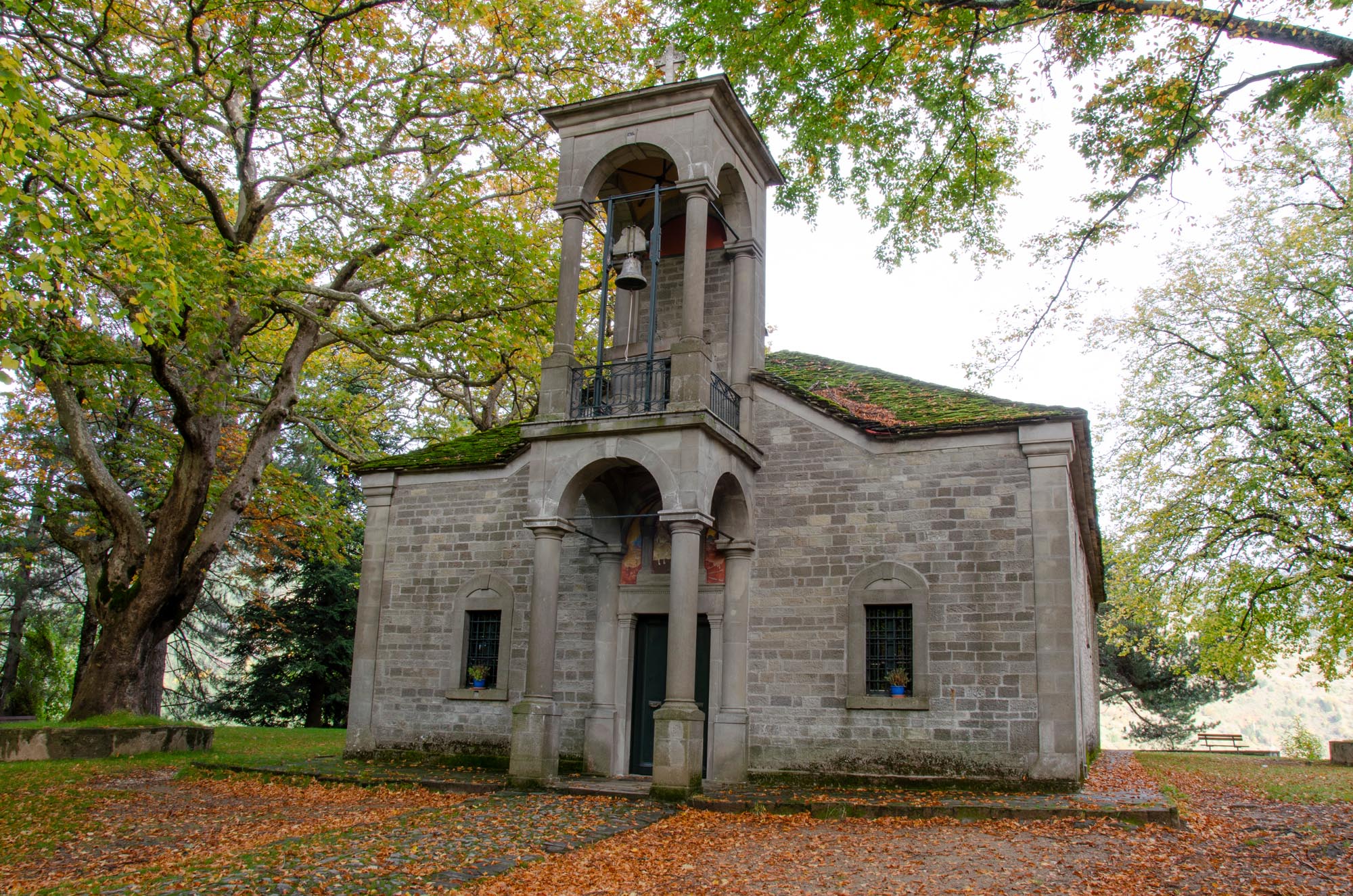
This is a beautiful park of about one hectare with a magnificent view of the surrounding mountains, planted with representative plant and tree species endemic to Pindos. It was created in 1840 in the north of the town at the expense of the benefactor Georgios Averoff. He also saw to the renovation of the church of St George in the park; this, according to an inscription, was built on the site of an earlier monastery.
Churches
Many churches are preserved in Metsovo and the surrounding villages, most of them built or renovated from the ground up during the 19th century, thanks to wealthy local benefactors. Frescoes only survive in a relatively few churches. The most important were painted in 1743 and 1748 in the parish church of St Demetrios by the skilled Metsovite religious painter Stergios Papagiannis. Most of the templons, pulpits and bishop’s thrones of the churches of Metsovo are richly carved by local wood-carvers. Many of the churches house valuable relics and fine portable icons.
Cathedral of St Paraskeve
The large three-aisled basilica in the main square was the exarchic church of the Chora Metsovou, where the patriarchal exarchs celebrated services. It is dedicated to three saints: St Paraskeve and probably SS George and Charalambos. The information that the church had monks’ cells which later housed the famous Greek School has led to the reasonable assumption that it was formerly a monastery. The date of its construction is not known, but is believed to be before 1511, which is recorded as the year of its first renovation. Its present form is the result of extensive building work in 1759 and 1894. The 1894 renovation was carried out at the expense of Georgios Averoff, who also had the imposing 25-metre-high bell tower built in 1887.
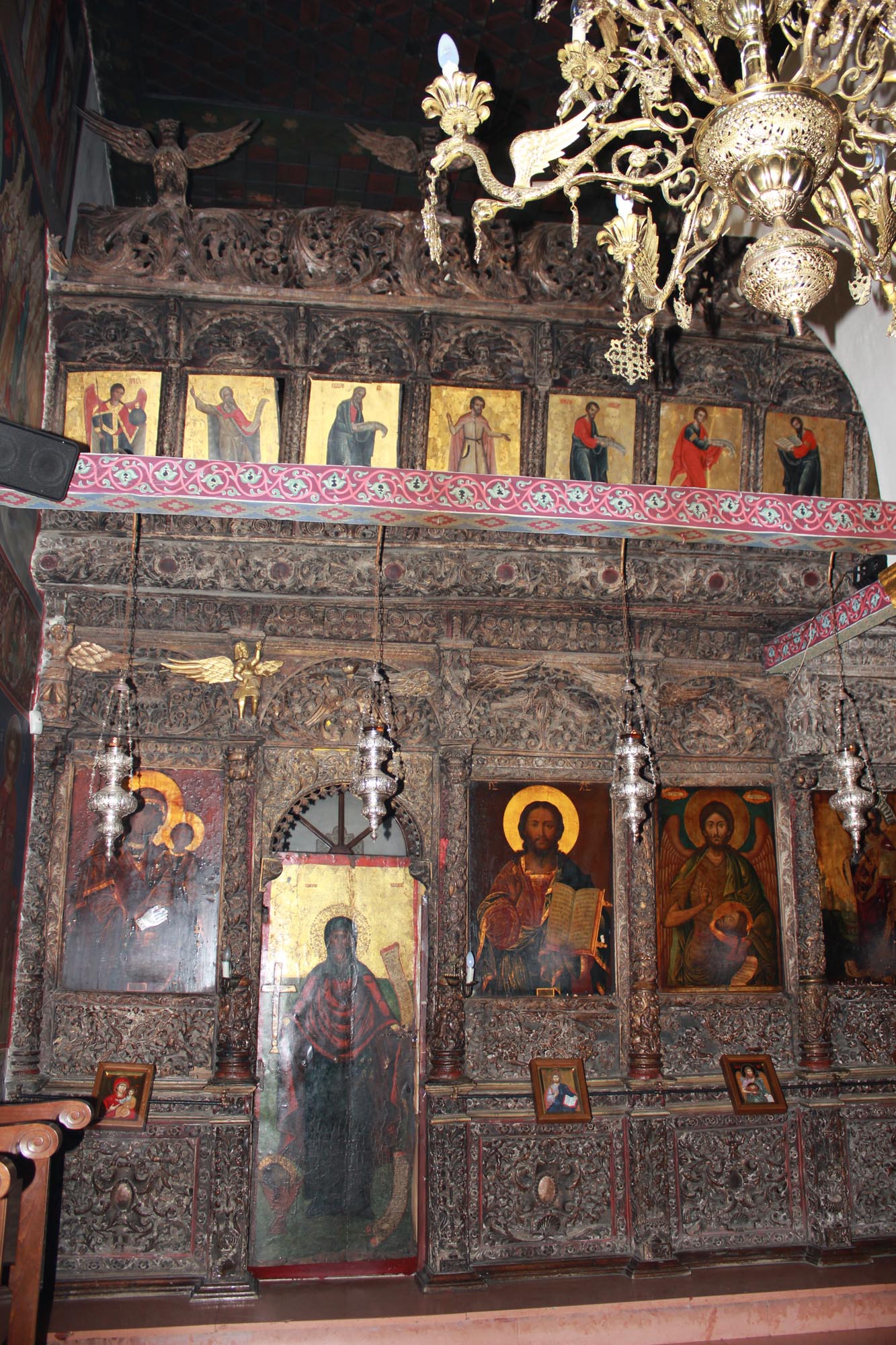
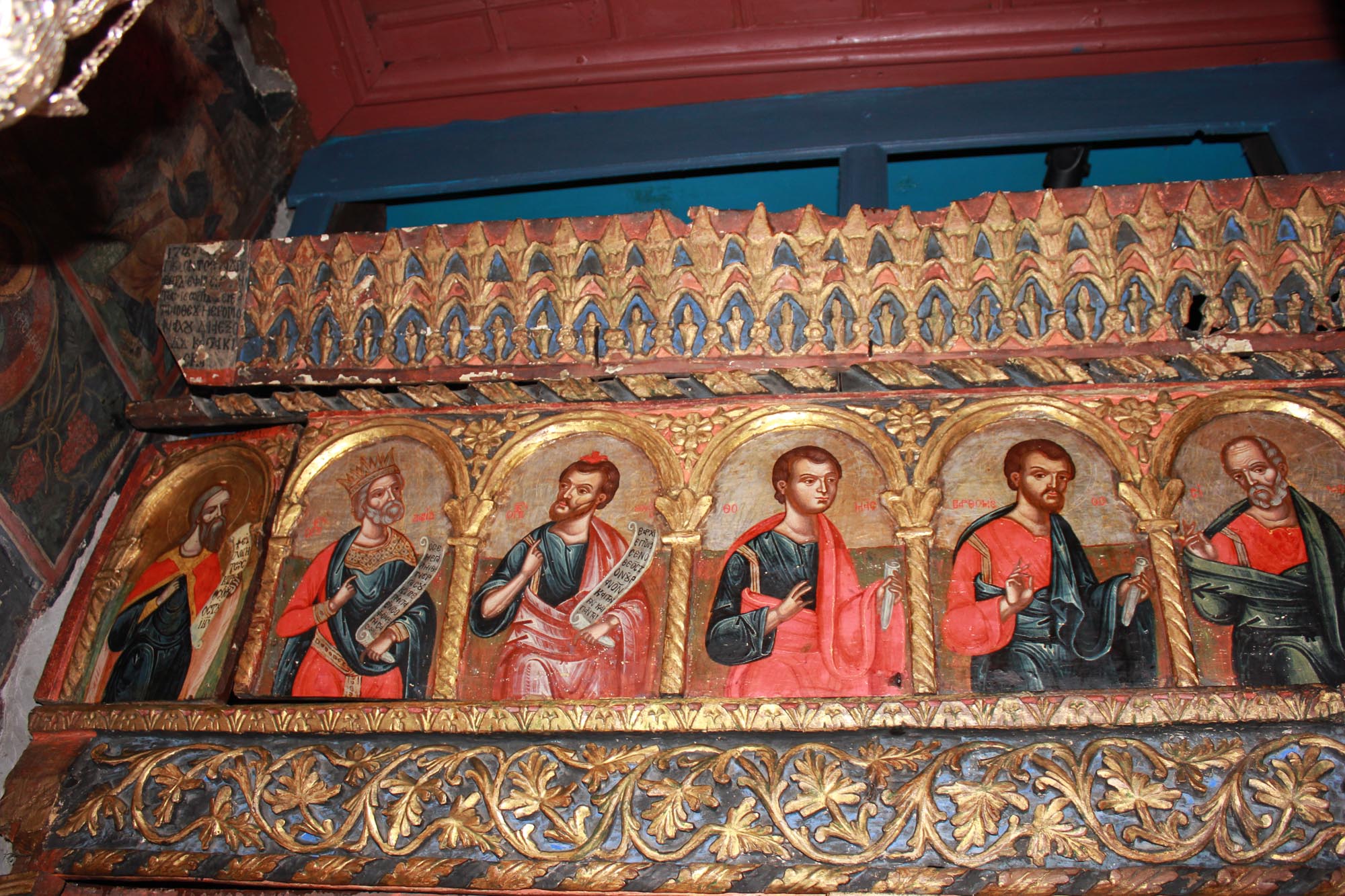
The impressive carved and gilded wooden templon, 12.10 m long, is a masterpiece produced, according to the prevailing view, by craftsmen from Metsovo between 1750 and 1760. The carvings of the proskynetarion, the two pulpits and the bishop’s throne are just as beautifully carved.
According to tradition, the “great teacher of the Nation” St Cosmas of Aetolia preached twice under the ancient plane tree in the church courtyard.
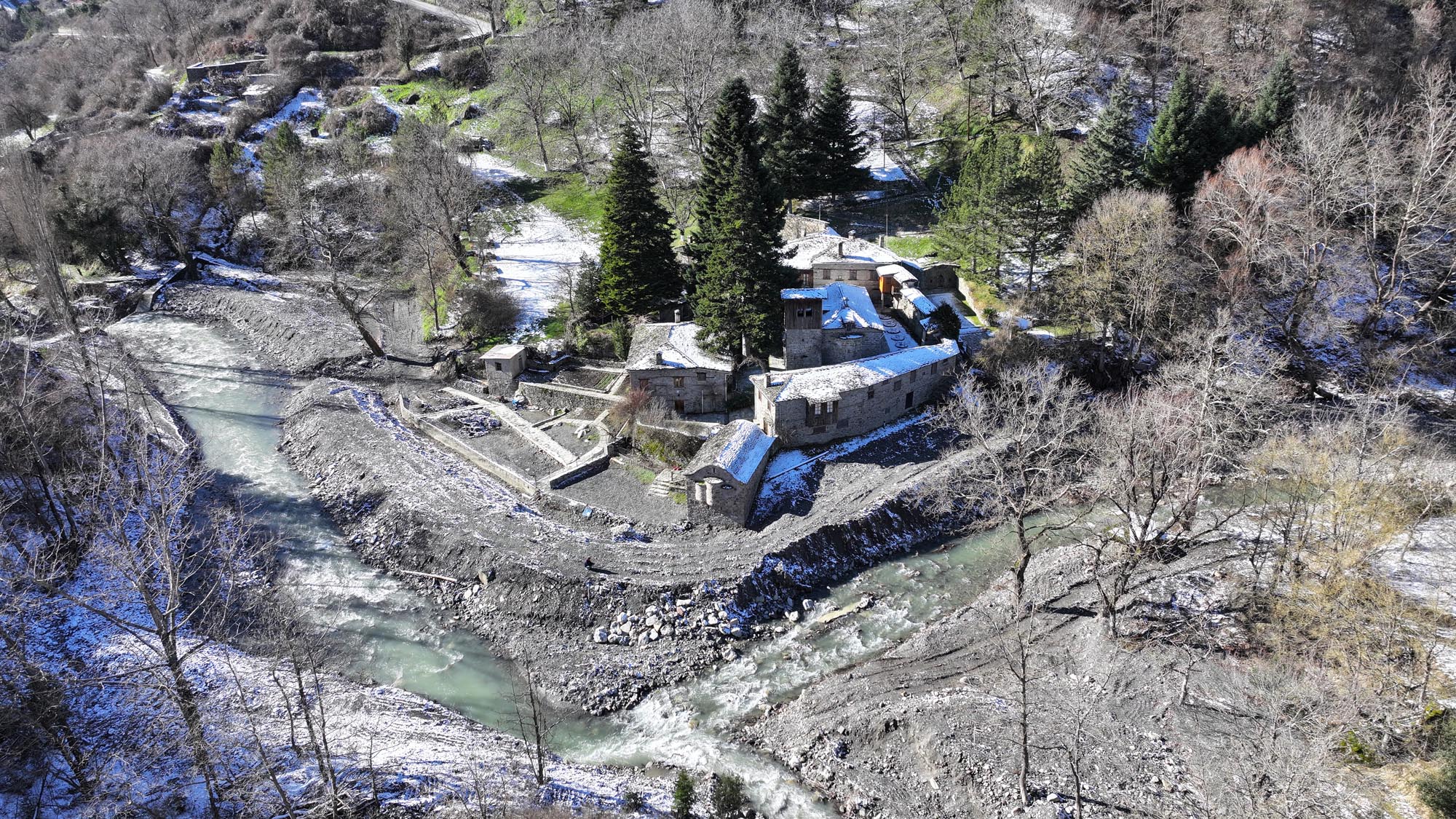
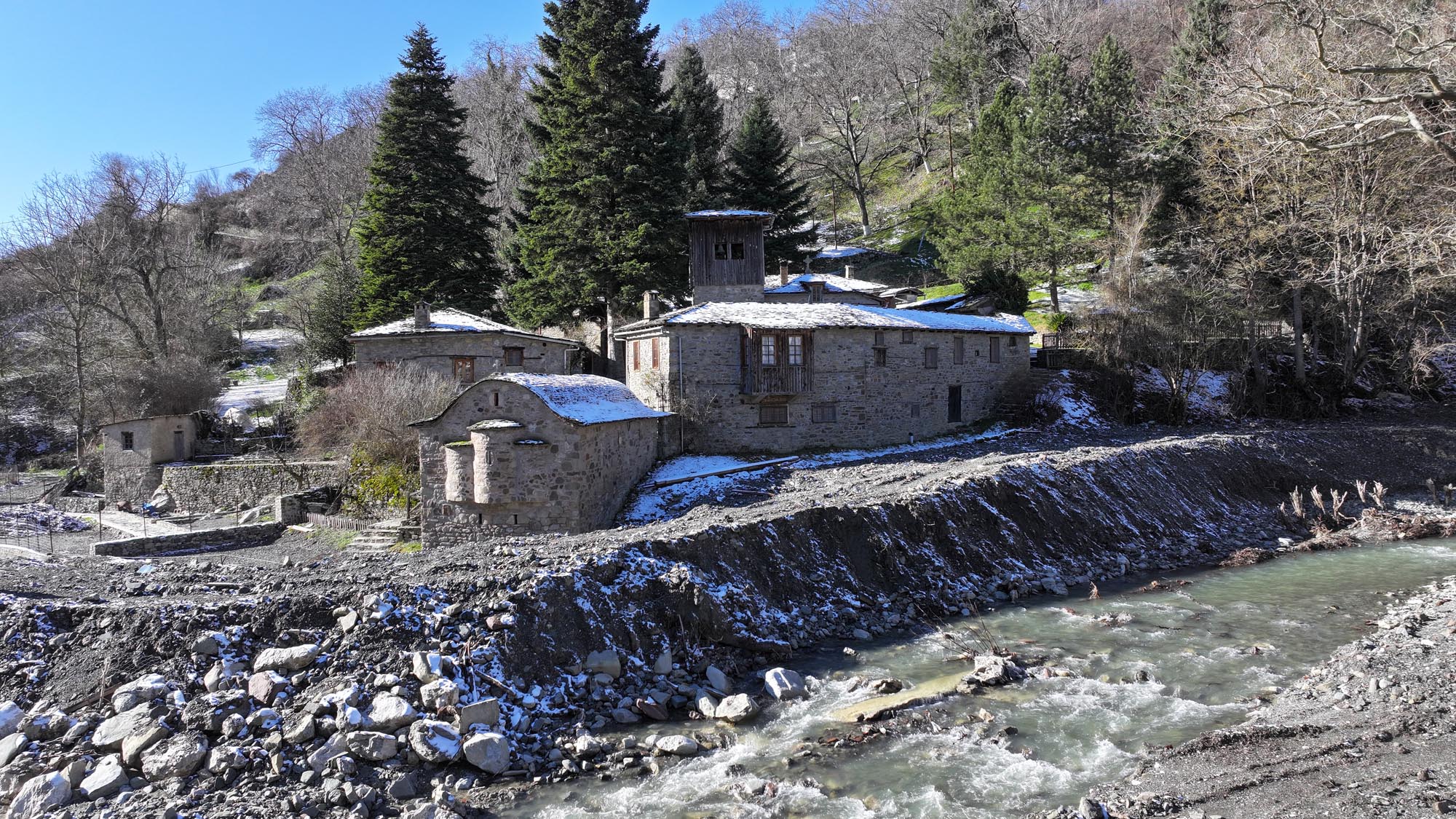
Monastery of the Dormition of the Virgin
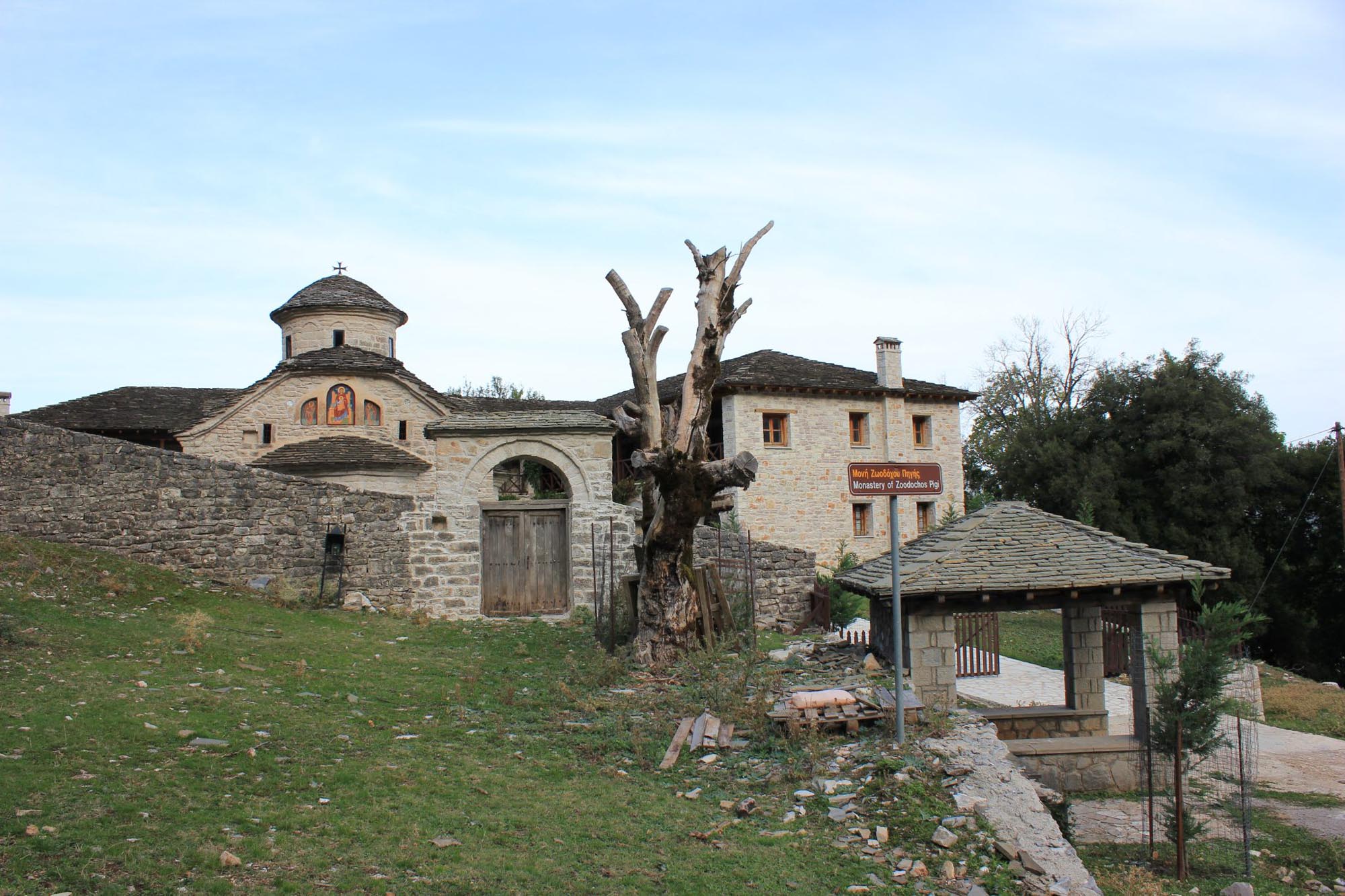
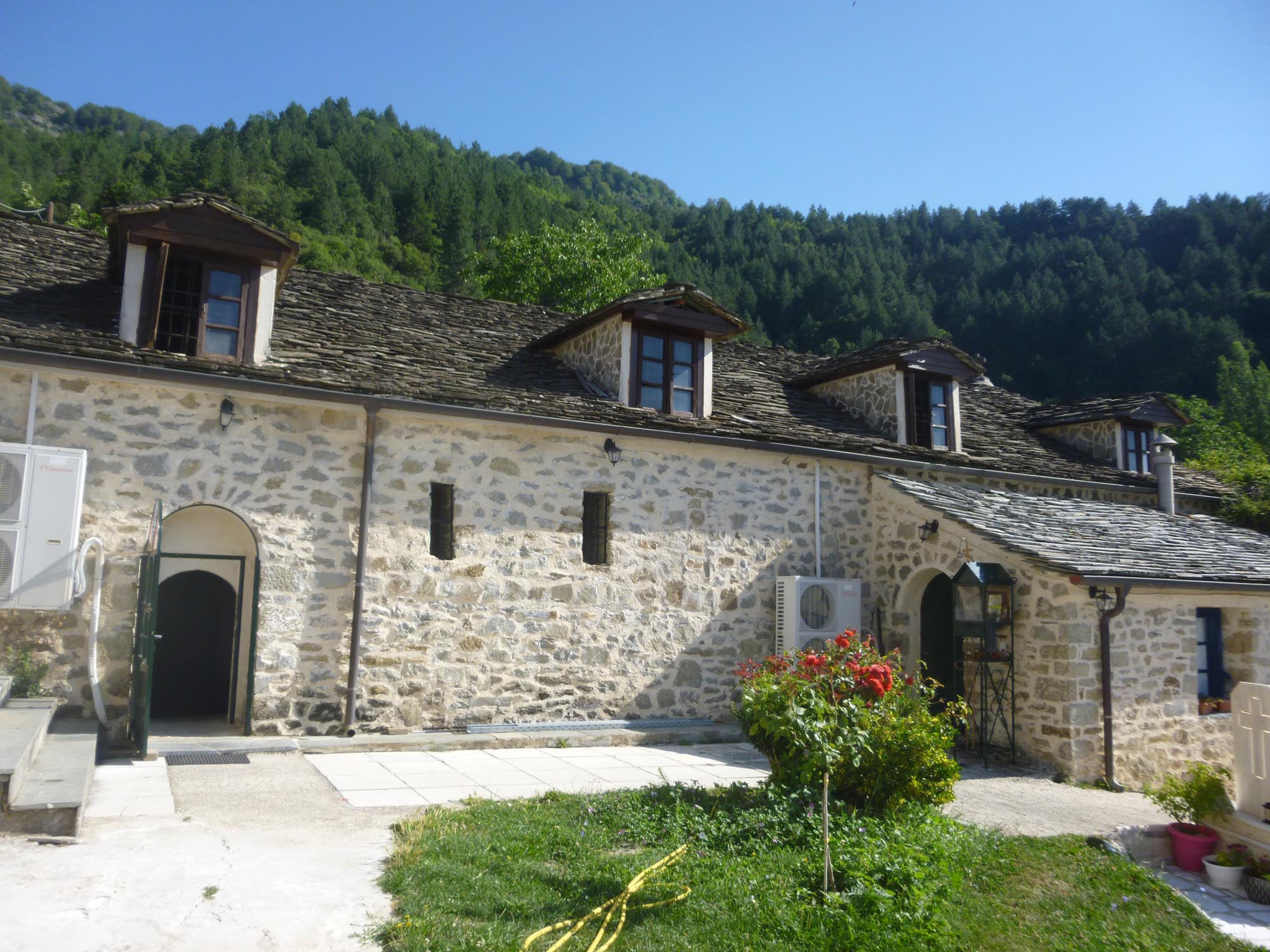
Now a convent, the fortress-type building, surrounded by a high wall, was originally a male monastery. It is located just east of the town of Metsovo, near the confluence of the Metsovitikos and the Aniliotikos. It is also referred to in ecclesiastical documents as the Monastery of Katothen Chora, Kato Politeia or Kato Potamos.
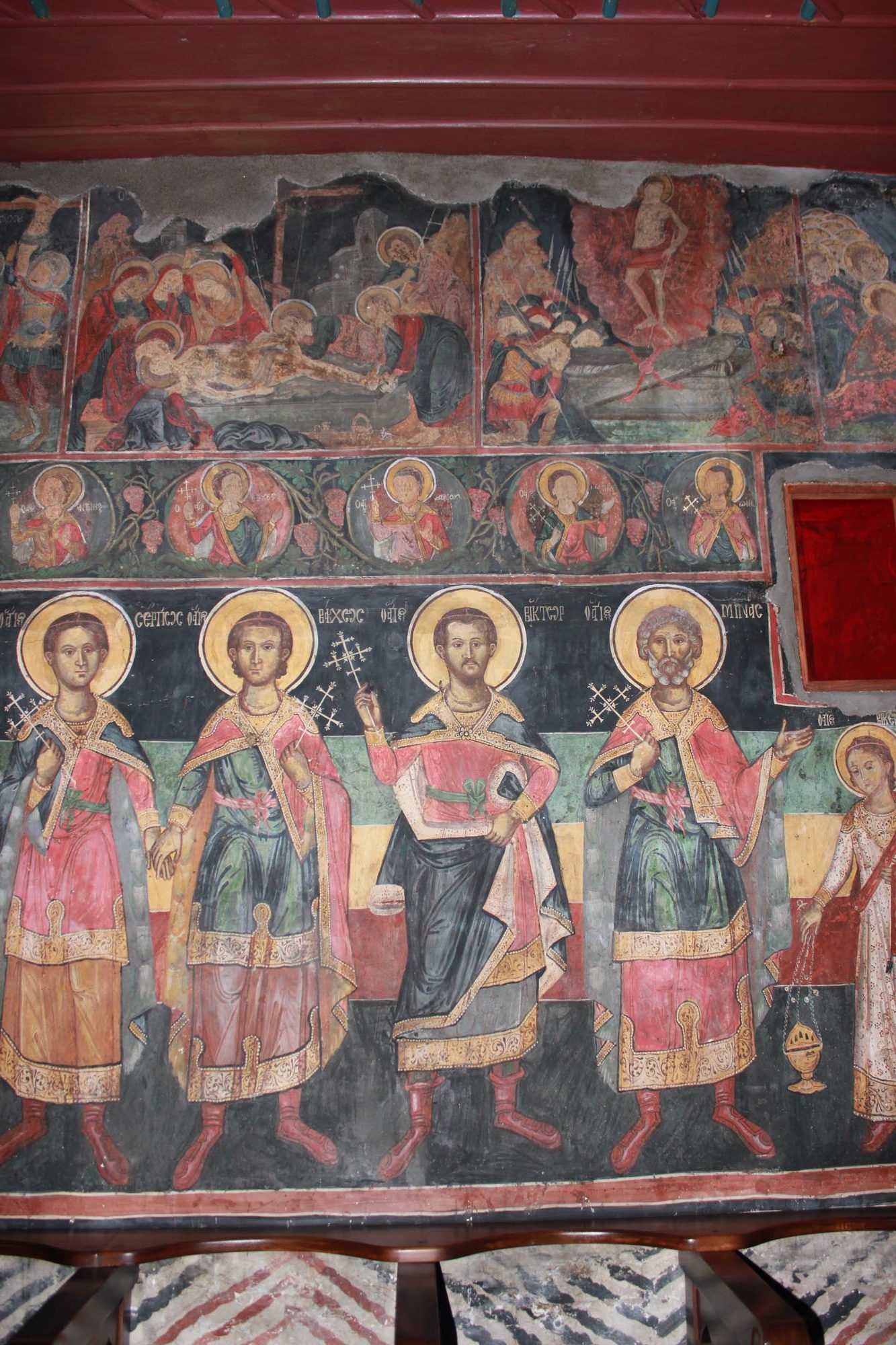
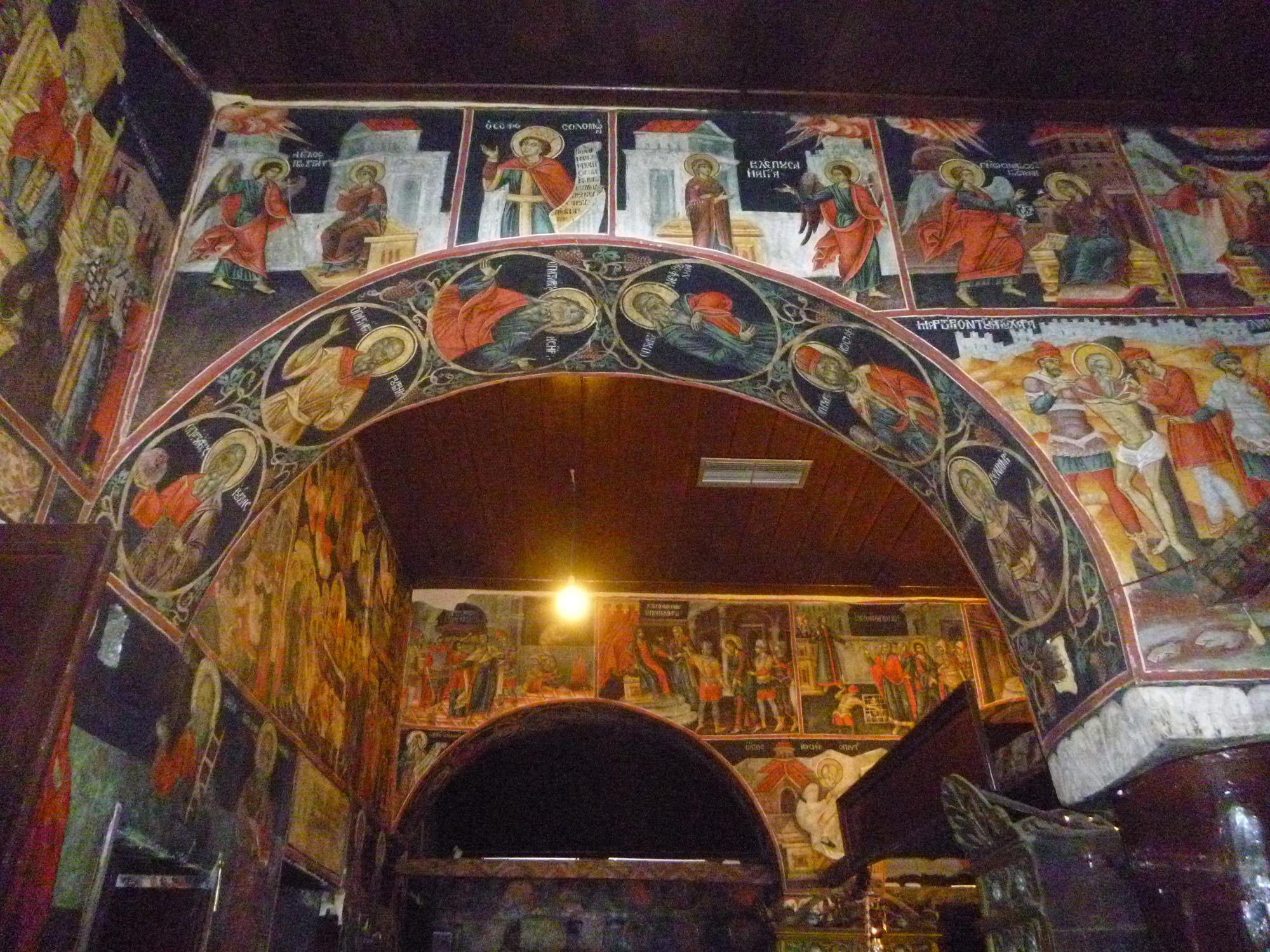
The precise date of foundation of the monastery is unknown. The katholikon, a single-nave timber-roofed church with a narthex on the west and a porch on the south, was built and painted with frescoes in 1754, according to the two surviving dedicatory inscriptions. The frescoes in the sanctuary are dated by an inscription to 1875. According to oral tradition, the narthex, also frescoed, is a later addition after 1867. The upper part of the carved wooden templon with its beautiful portable icons is dated to 1782. The lower part was completed in 1978, after the monastery reopened in 1977. Of the other monastery buildings, the impressive bell tower, of stone below and wood above, with a bell cast in Ioannina in 1870, is worth noting. The portable icons and relics kept in the sacristy are particularly important examples of their kind.
Monastery of St Nicholas
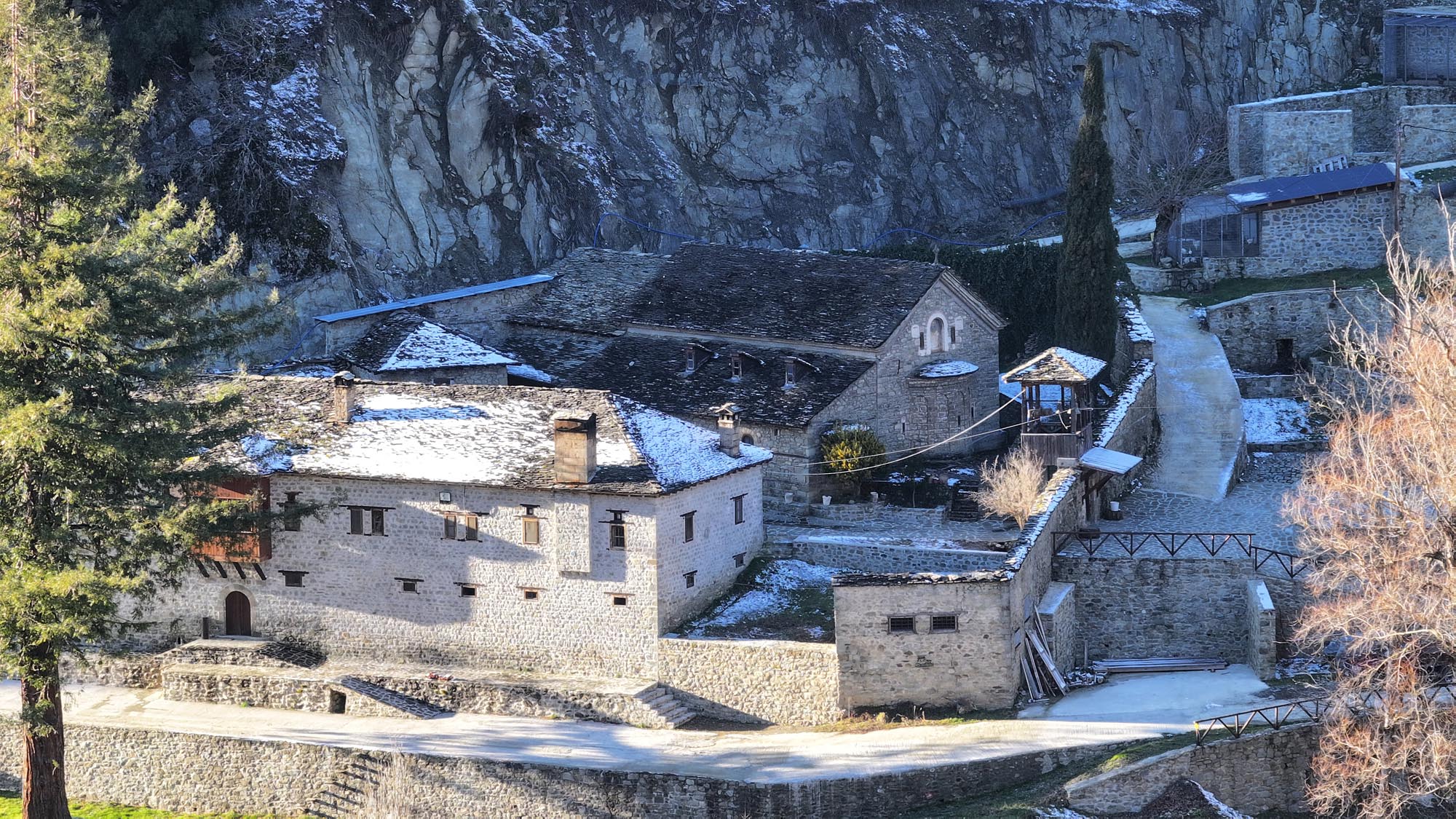
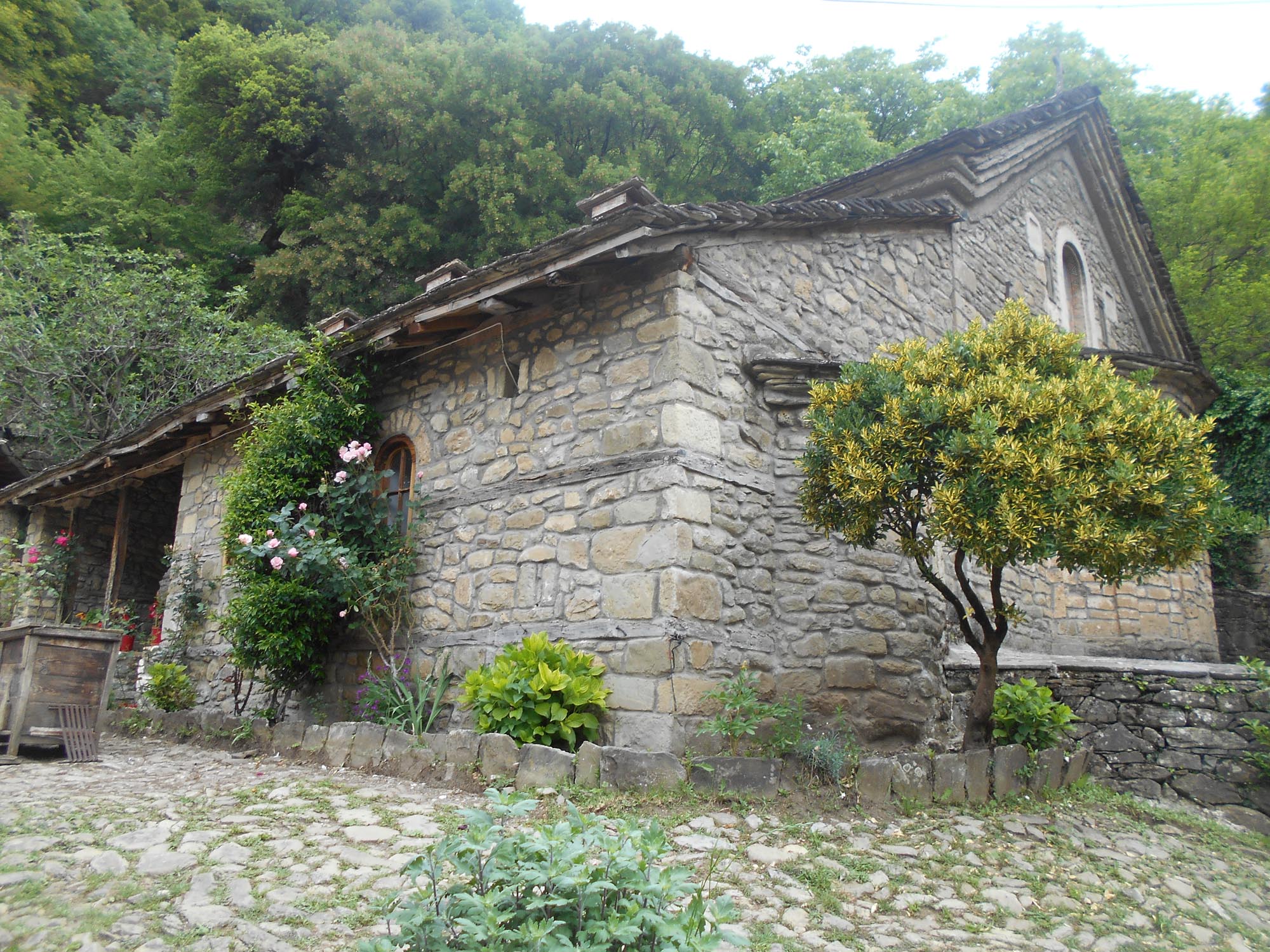
The former male monastery, now defunct, stands near the River Metsovitikos, a little lower than the Monastery of the Dormition of the Virgin, just southeast of the town. In its heyday it was one of the richest and most important monasteries in the region, very active in social affairs and charitable works. There is no information on its date of foundation, but it is considered the oldest in the region and some researchers link it to Abbot Isaiah of the second half of the 14th century, who is mentioned in the Chronicle of Ioannina. An incised inscription with the date 1700 is thought to refer to one of the renovations of the monastery.
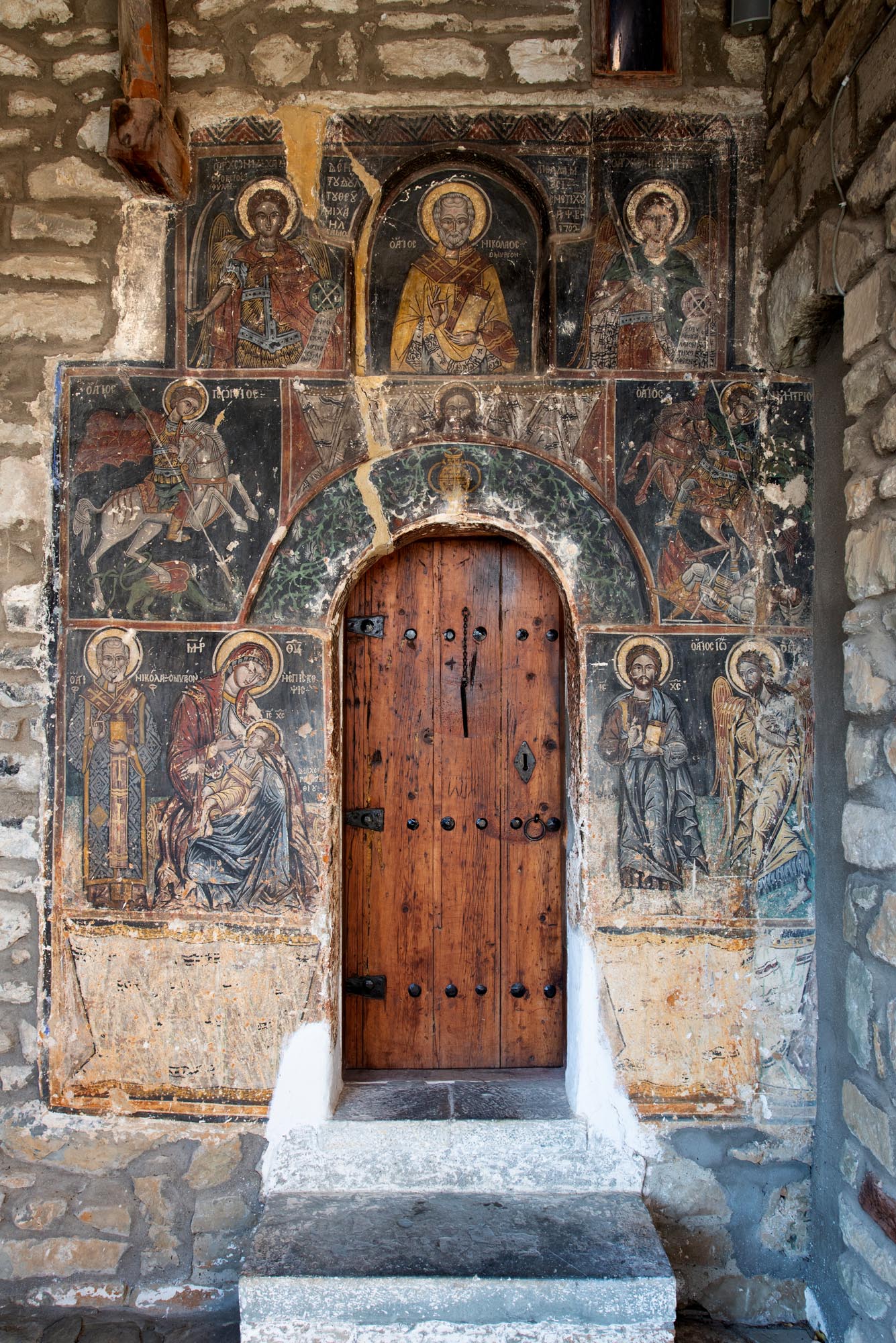
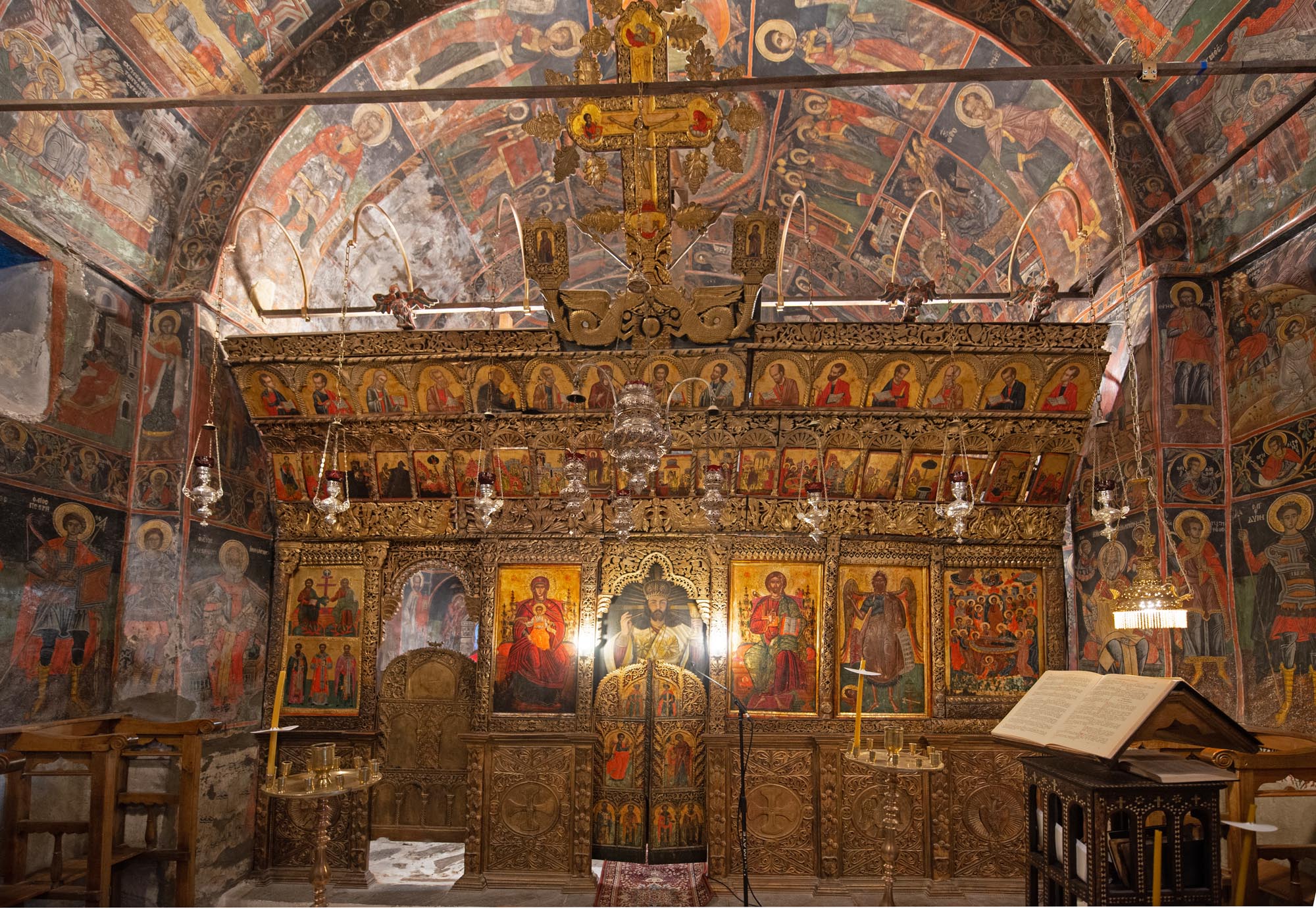
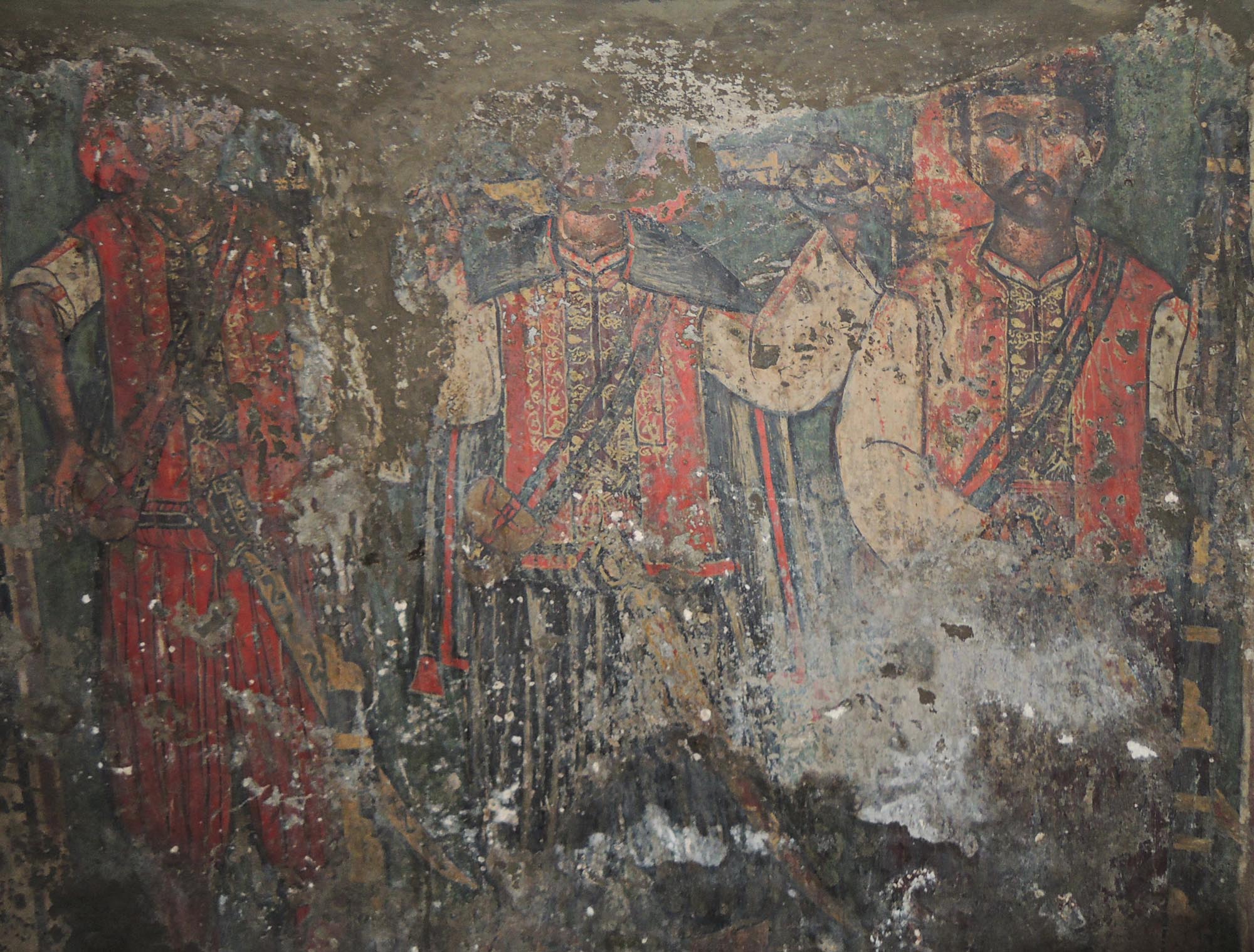
The large katholikon is a single-nave barrel-vaulted basilica with a narthex on the west. On the south side, where the main entrance is located, there is a porch terminating on the east in a chapel dedicated to St Nicholas of Metsovo, a neomartyr very popular in the area. The interior of the church is extensively decorated with frescoes, some of which were painted, according to an inscription, by the painter Eustathios in 1702. However, other layers preceding or following the 1702 phase are also identified. Frescoes are also preserved on the south exterior side of the church. The gilded wooden templon is beautifully carved. The chapel of St Nicholas is also adorned with frescoes, including a secular depiction of the town of Metsovo. The associated inscription tells us that it was executed by the folk painter Dionysios Maresos in 1800.
In the narthex of the katholikon, the chains formerly used to bind those believed to be possessed by demons are still preserved today. The gynaikonitis (women’s gallery) of the katholikon has now been converted into an exhibition space with the important portable icons and relics of the monastery.
Monastery of the Fountain of Life (Kokkini Petra), Anthochori
The historic monastery, also known as Kokkini Petra in Greek and Kiatra Rosia in Vlach, both meaning “Red Rock” due to the red rocks nearby, lies near the village of Anthochori, on the northern slopes of Mount Peristeri. It was probably founded in the 17th or early 18th century and suffered great destruction and looting at various times. It was a male monastery, but nuns are also mentioned as living there. It is surrounded by a high wall. The cells and the katholikon, of the Athonite type (a complex cross-in-square tetrastyle church with two side conches), with a narthex and hayat (portico) on the west, are still preserved. Above the main door of the katholikon is a dedicatory inscription by Stergios Dafos dated 1732, associated by researchers with the addition of the later narthex. Inside the church are preserved frescoes of two different phases, dated 1765 and 1844. The 19th-century carved wooden templon is noteworthy, incorporating the surviving parts of the original templon, which was destroyed by fire in 1840. Externally, the configuration of the apse is interesting: it is adorned with shallow arches, and the conch at the top contains an image of the Virgin Fountain of Life flanked by archangels. South of the monastery, on a small hilltop, is preserved the 17th-century chapel of the Transfiguration of the Saviour.
Monastery of the Dormition of the Virgin or Chrysovitsa
The monastery, also known as Our Lady of Kousiovitsa, Koursovitsa, Kosvitza or Chrysovitsa, stands in the centre of the village of Chrysovitsa, west of Metsovo. It was built in the place where, according to tradition, the icon of the Virgin, associated with various local legends and miracles, was miraculously found. The monastery, formerly male, although nuns are also reported as living there, was one of the richest monastic institutions in the region, particularly popular for its annual festival (14 August). The fortress-type monastery is surrounded by a high wall, with the katholikon in the centre: the church is a three-aisled, timber-roofed basilica with a narthex and portico on the west. There is no information on the date of foundation of the monastery. An inscription preserved in the narthex of the katholikon probably refers to the renovations carried out, together with the painting of frescoes, during the term of office of Metropolitan Clement of Ioannina (1680-1715). The reference to the metropolitan bishop is due to the fact that the village of Chrysovitsa, unlike the other villages of Metsovo, was not subject to the Patriarchal Exarchy but to the Metropolitan See of Ioannina. A second inscription informs us that the frescoes of the church were painted in 1781 by the brothers John and George the priest, from Kapesovo in Zagori. According to the same inscription, the wooden pulpit and the bishop’s throne with their remarkable carved decoration were crafted in the same year. The templon is also carved in wood. Today the monastery katholikon is the parish church of the village.
Museums
Folk Art Museum – Tossizza Mansion (27 Tossizza St.)
The Museum, donated by the Baron Michael Tossizza Foundation, is housed in the renovated three-storey mansion of the famous family of Metsovite benefactors, which was built in 1661 but has undergone various renovations over the centuries. With the philosophy of the “open museum”, visitors are offered the experience of touring the various rooms of the old mansion, where everyday objects are exhibited in their natural environment. In addition to its rich folk collection, the museum also has extensive collections of coins, portable icons and metal artefacts.
Tsanaka Folklore Museum (1 Grigoriou Tsanaka St.)
The Museum opened in 2014 and is housed in the old stone mansion of the Veneti family in the Agios Georgios area. The museum exhibits present aspects of the art of the Vlachs and the folk history of Metsovo.
E. Averoff Museum
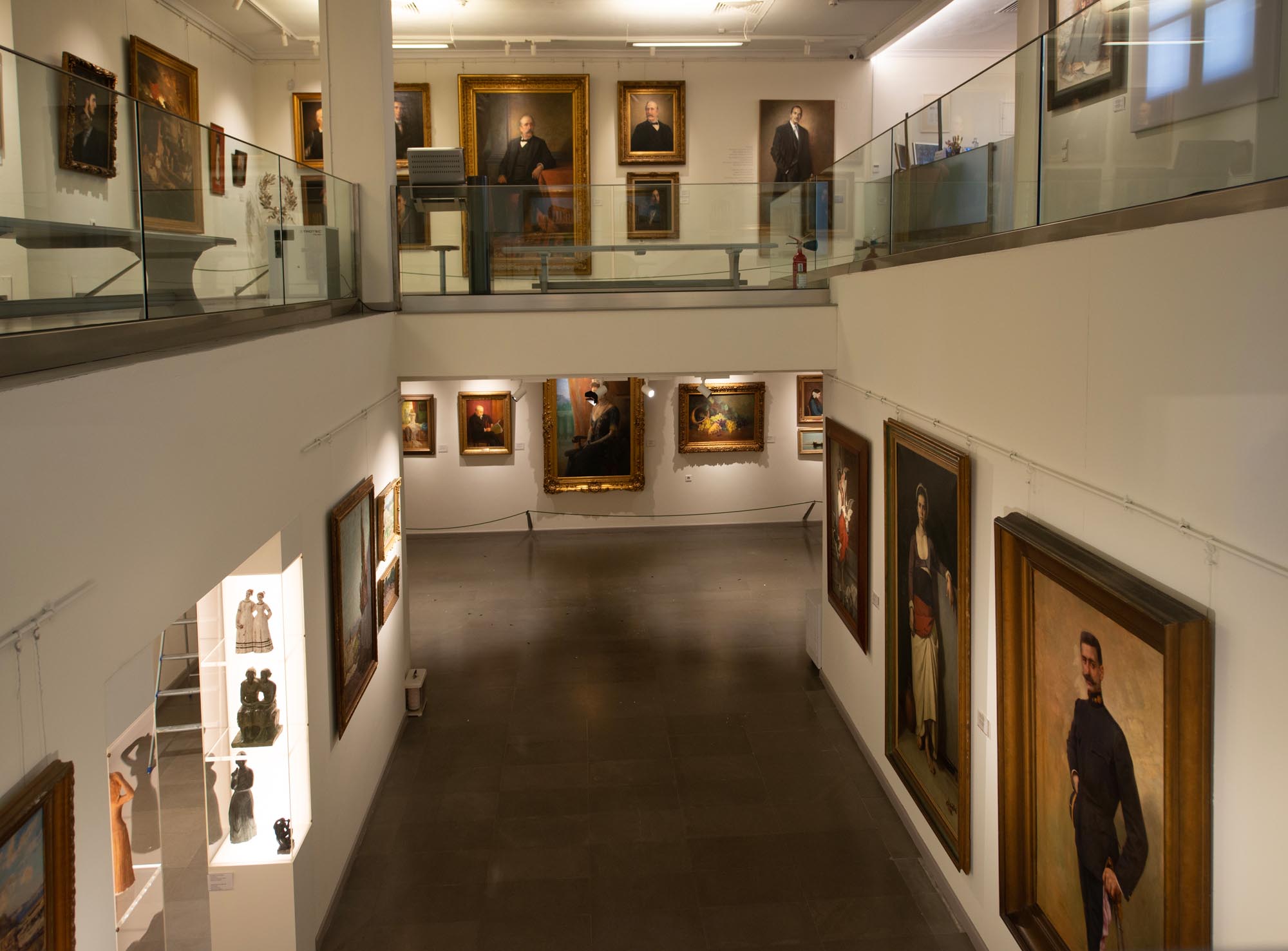
Near the main square of Metsovo is the E. Averoff Museum, in a three-storey building donated by Evangelos Averoff-Tossizza to the foundation of the same name, in order to house his personal collection of works by Greek artists of the 19th and 20th centuries. In addition to the permanent and now enriched exhibition, the Museum organises temporary exhibitions, conferences and symposia, educational programmes, creative workshops and other events.
Open-air Water Power Museum, Anthochori
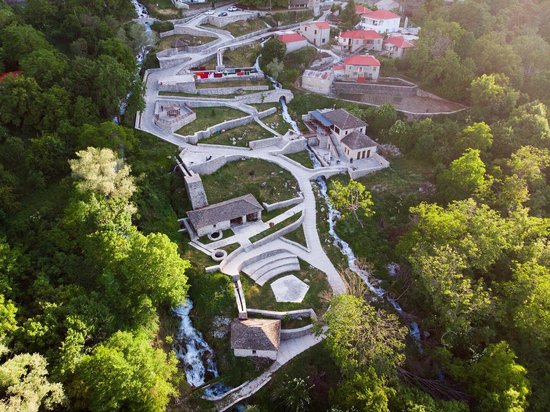
In the community of Anthohori, southwest of Metsovo, in an area of outstanding natural beauty with plentiful flowing water even in summer, is preserved the stone complex dating from the second half of the 18th to the early 19th century. It includes a fulling mill (dristela), where clothes and heavy fleecy blankets (velentzes or hourges) were washed, a watermill, mainly used to grind maize, and a mandani or bandani, where woollens were cleaned using water power. The buildings are now an open-air museum that highlights the importance of water power in pre-industrial societies. Many water-powered installations are preserved around Metsovo today, including sawmills for cutting timber from the dense forests of Mount Pindos.