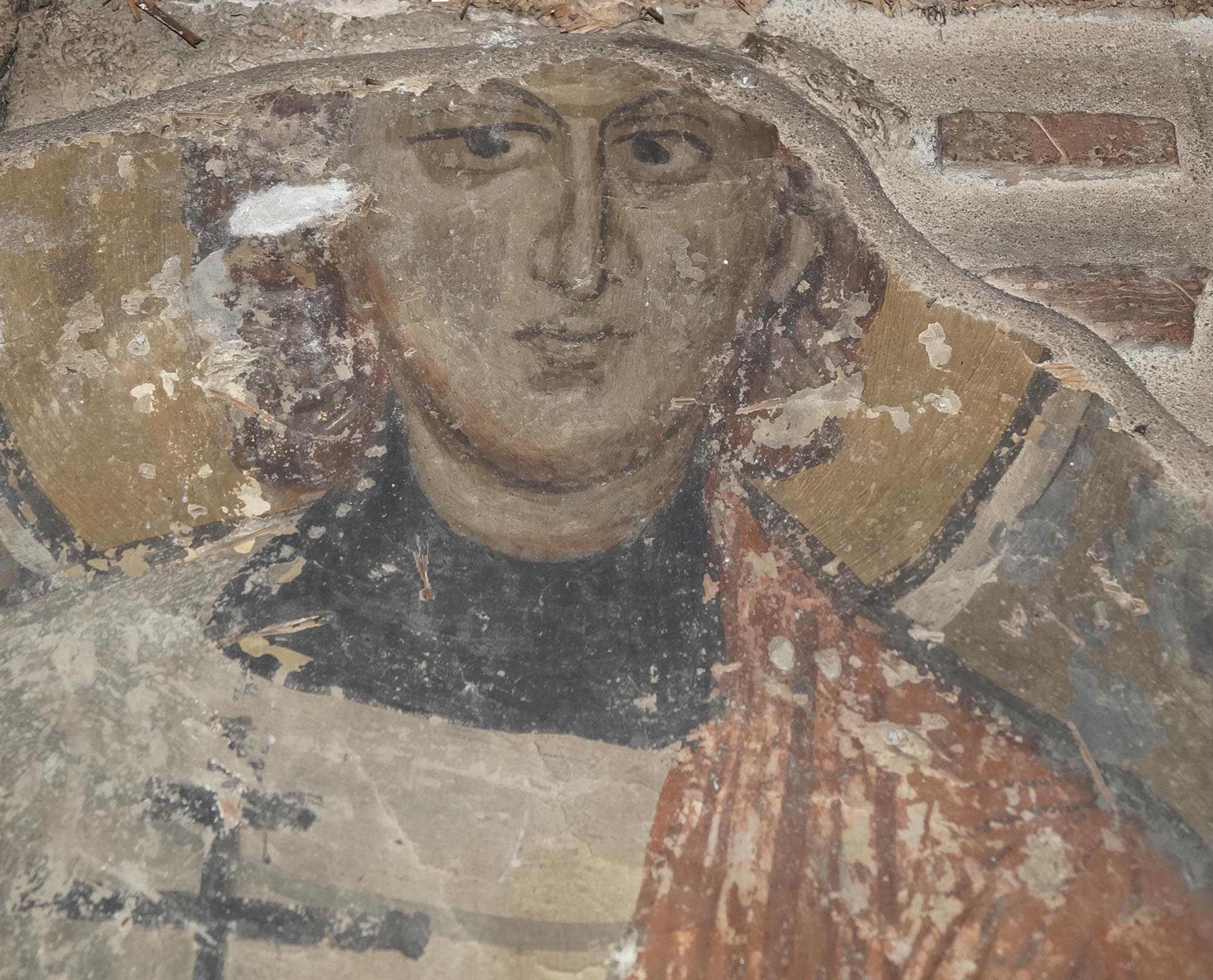
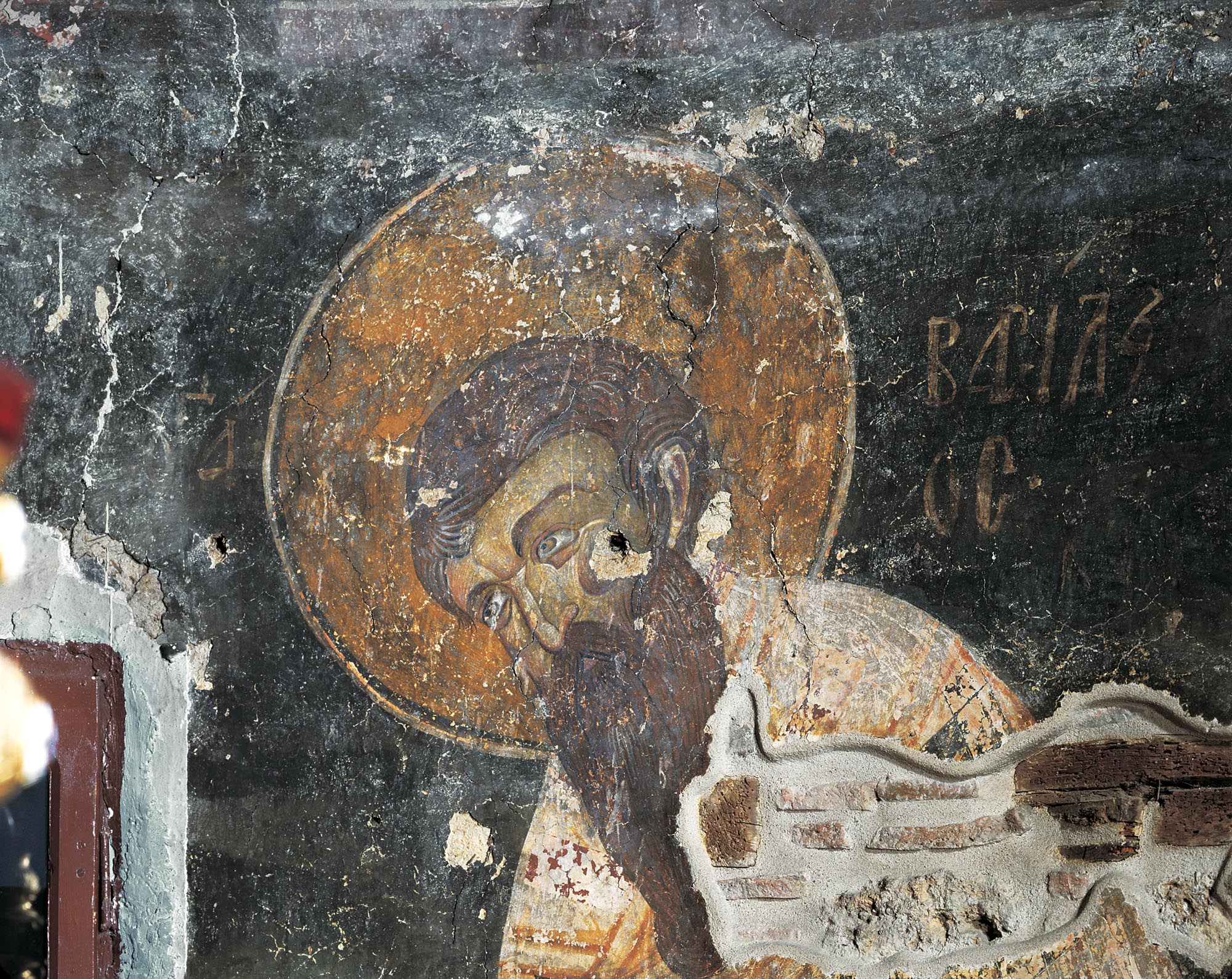
Veria
Veria, “a large and populous city of Macedonia”
Veria (ancient Beroia), now the capital of the Regional Unit of Imathia, is the first major city one comes to after Thessaloniki when driving along the modern Egnatia Motorway. Built in the eastern foothills of Mount Vermio and enclosed by the slopes of the Pierian Mountains and the River Haliacmon, the city has been continuously inhabited since antiquity, retaining its name almost unchanged and its urban character for two and a half millennia.
The ancient city of Beroia flourished in the Hellenistic and especially the Roman period, remaining the religious and political centre of the region for more than 400 years. The city owed its prosperity to its large chora or territory and its fertile lands with rich crops and abundant waters. The source of life for Veria was the River Tripotamos (Gyftikos or Vassilikos) which runs along its western side, forming an impenetrable natural barrier that reinforced the defences of the strong fortifications that the city once boasted. The city continued to flourish in Byzantine times, while during the lengthy Ottoman period it was one of the most populous Macedonian cities and an important administrative and economic centre of the region.
In contrast to the monuments of its ancient past, of which only some sections of the walls are visible today, Veria is fortunate enough to preserve a significant part of its historic centre. Here, Byzantine and post-Byzantine churches, monuments of the Ottoman period, traditional houses and rich mansions coexist harmoniously, bearing witness, together with the water-powered mills and industrial buildings on the banks of the Tripotamos, to the historical continuity and multiple identities of the city. The numerous churches, in particular, which have earned the city the nickname “Little Jerusalem”, with their remarkable interior fresco decoration, combined with the large collection of icons exhibited in its Byzantine Museum, reflect the strong artistic tradition of the city as a regional ecclesiastical centre of Macedonia.
The development of Veria over the centuries is primarily due to its key position on the road network of Macedonia, attested both by the Roman itineraria that mention the city and by the eight milestones in the Archaeological Museum, which were once placed along the roads that passed through it. The city was connected to the Via Egnatia by two roads. The first led northeast across the Macedonian plain south of Lake Loudias, the now-drained lake of Giannitsa, and crossed the Via Egnatia at either Pella or Allante, an ancient city in Nea Chalkidona in the Regional Unit of Thessaloniki. The second road led northwest to the westernmost section of the Via Egnatia, at the height of Edessa, following the foothills of Mount Vermio, via Mieza.
History
The earliest historical reference to Beroia is found in a passage by Thucydides, which, although viewed by scholars as controversial, describes the Athenians’ unsuccessful attempt to besiege the city in 432 BC, during the Peloponnesian War. However, the transformation of Beroia from a simple settlement into an organised urban centre seems to have occurred during the reign of Philip II (359-336 BC). Important finds, mainly funerary, of this period have come to light. From then onwards, new mentions of the city appear in literary sources and inscriptions. Beroia is referred to for the first time with the legal status of a city on a marble votive stele of the second half of the 4th century BC, dedicated to Hercules Kynagidas (“the Huntsman”).
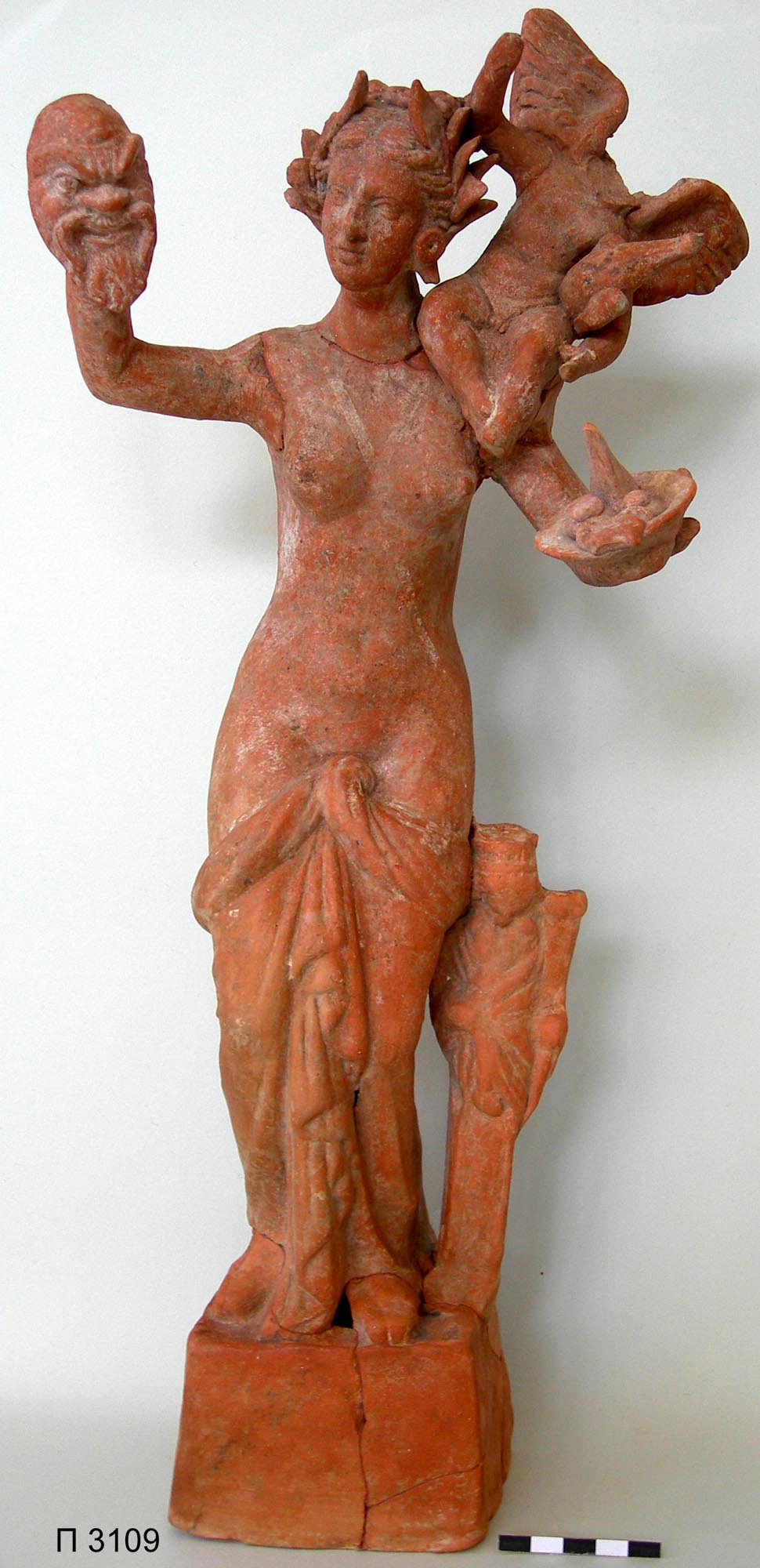
During the Hellenistic period, Beroia became the second most important city of Macedonia after Pella, mainly due to the interest shown in it by the long-lived dynasty of the Antigonids, whose founder, Antigonus Monophthalmos (306-301 BC), was a native of the city. The wealth of literary and epigraphic evidence, taken together with the archaeological finds, provide a picture of a fully developed urban centre protected by strong walls and containing important secular buildings (agora, gymnasium, stadium and theatre) and numerous sanctuaries. The abundance and variety of grave goods accompanying the dead in the Hellenistic cemeteries, and the costly rock-cut chamber tombs, testify not only to the presence of a prominent social class, but also to the significant growth of the city’s population. The four built Macedonian tombs discovered to date, evidence of the adoption in the city of this typical Macedonian type of magnificent funerary architecture, also point in this direction. In the Late Hellenistic period, large numbers of vases and terracotta figurines were produced by local pottery and coroplastic workshops, which continued to operate in the years following the Roman conquest.
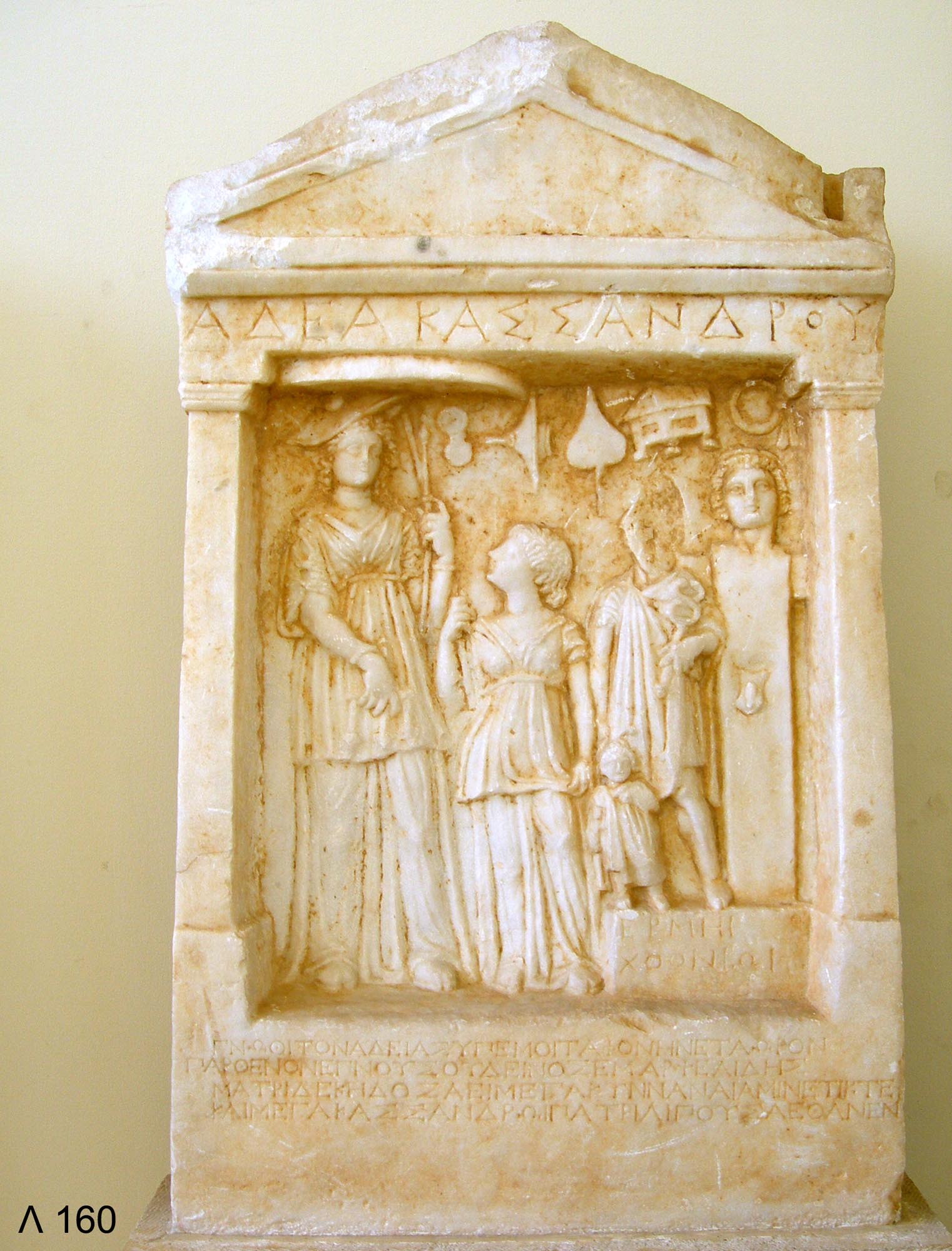
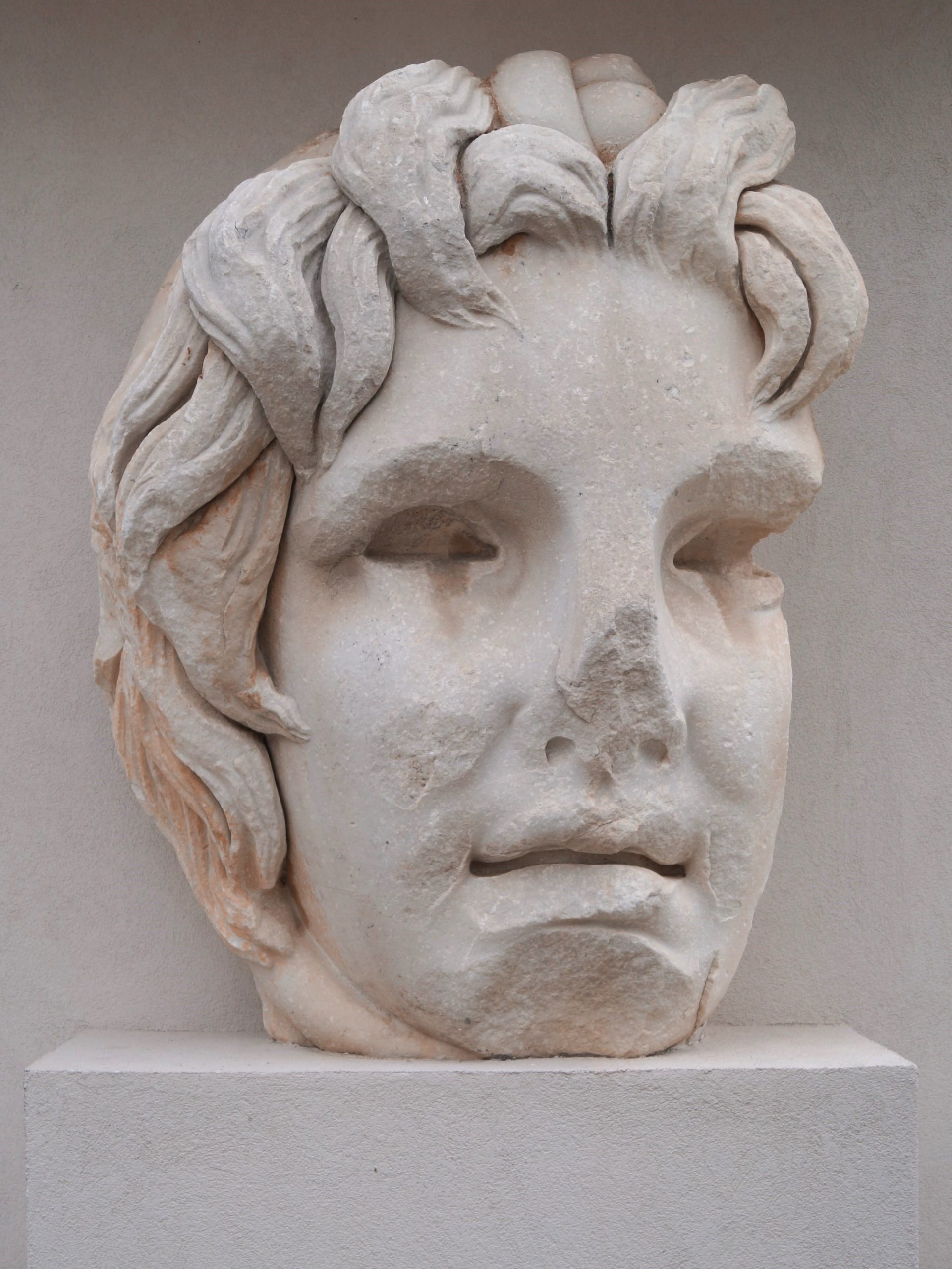
On the conquest of Macedonia by the Romans (168 BC), Beroia became part of the Third Meris of Macedonia, an administrative region with Pella as its capital. During the Roman imperial period (31 BC-330 AD) and the establishment of the Pax Romana, the city entered a new era of prosperity which was marked by its elevation to the seat of the Macedonian League and the bestowal on it of the official titles of metropolis and neokoros. It thus became a cult, religious and political centre of Macedonia, having the right to establish a temple of the Imperial cult and preside over the official religious ceremonies in honour of the emperor, which included a variety of spectacles, such as gladiatorial contests and wild beast fights. Rivalling Thessaloniki, the seat of the governor of the wider Roman Provincia Macedoniae, Beroia experienced a significant increase of its population with the arrival of Roman settlers and became a highly cosmopolitan city, something which is reflected in the spread of foreign religions and the establishment of the corresponding sanctuaries. Its flourishing intellectual and artistic life is evidenced by the many rhetoricians, actors, musicians and artists of all kinds who settled in the city, and by the development of the arts with the operation of local pottery, coroplastic and sculpture workshops. Sculpture was a particularly thriving field, with Beroia producing works superior even to those of Thessaloniki, and boasting sculptors who gained fame in other cities beyond Beroia itself. As its inhabitants multiplied, the city expanded significantly around its Hellenistic nucleus, laid out in a regular grid according to the Hippodamian Plan. The major roads, the well-organised water supply and sewage system, and the many public buildings – often luxurious and decorated with elaborate mosaic floors – that have come to light in excavations, all attest to the city’s prosperity during this period.
An important milestone in the history of Beroia was the major raids of the Goths and the Heruli (in 254 and 268 AD respectively), which led to the radical decline of the sanctuaries and all the city’s institutions. This turbulent period is reflected in the fortifications of the city, whose walls were hastily repaired using spolia from earlier buildings and funerary monuments.
During the Early Christian period, the new Christian religion (which had been established by the Apostle Paul himself, who visited the city twice in the middle of the 1st century BC) gradually took root in the city. This led to the establishment of the city’s first Christian Church, which was joined by Jewish and Greek inhabitants, including the local saint Sosipater and Onesimus of Philemon, the city’s first bishop (61-106). The episcopal see of Veria is then attested in the first half of the 4th century, while later sources and inscriptions give names of the city’s clergy. The city remained an important administrative and military centre in which senior officials were based. The remains of the mansions, the imposing secular buildings and the five Early Christian basilicas unearthed in excavations, often featuring remarkable sculptural decoration and luxurious mosaic floors and opus sectile (marble inlay), bear witness to its prosperity. The oldest ecclesiastical building in the city, the baptistery in the archaeological site of St Patapios, dates from the late 4th century. The extensive Early Christian cemeteries of the city include striking vaulted built tombs, the interior decorated with frescoes, mainly of human figures and crosses, accompanied by inscriptions.
During the Byzantine period, Veria, now a typical castle-city of the time, was restricted to the southern, higher parts of the city, as the previously inhabited northern lowland areas, on either side of what is now Venizelou Street, were abandoned. As early as the beginning of the 10th century, Veria was, together with Serres, one of the most important cities of Byzantine Macedonia, its history generally following the fates of Thessaloniki. At the end of the century, like many other Macedonian cities, it was conquered by the Bulgarian Tsar Samuel (997-1014), while in 1001 it was recaptured by Basil II Boulgaroktonos (the Bulgar-Slayer) (976-1025). The latter repaired and strengthened its walls and subordinated its episcopal see, along with those of other Macedonian cities, to the archiepiscopal see of Ohrid, although for at least some periods thereafter the bishops of Veria seem to have remained under the jurisdiction of the metropolis of Thessaloniki.
In the early 11th century, according to most researchers, Veria became the seat of an extensive theme, delimited to the east by the River Axios, to the north by the southern slopes of Mount Paikos, to the west by Mount Vermio and to the south by the northern regions of Pieria.
After the death of Basil II, in the 11th and 12th centuries, Veria suffered many raids by foreign forces attempting to enter Macedonian territory, including the Bulgarians (1040-1041) and the Normans (1082, 1185). Despite the foreign invaders, the city enjoyed great prosperity and a cultural efflorescence during these two centuries. Senior ecclesiastical and secular officials settled there and maintained close ties with the ecclesiastical and political authorities of Thessaloniki and Constantinople. A shining example of the art of this period is the Old Metropolis (Middle Byzantine phase). Excavations have also brought to light parts of the Byzantine cemeteries of the city, which continued to be used in the following centuries. Among the secular buildings of the city, the discovery of what is probably a local pottery workshop (12th-15th c.), is particularly important.

After the Fourth Crusade (1204), Veria initially formed part of the holdings of the Latin Kingdom of Thessalonica, ruled by Boniface of Montferrat. In 1215/6 it was conquered by the ruler of the Despotate of Epirus, Theodore Komnenos Doukas. He remained in the city until 1224, when he took Thessaloniki from the Franks and was crowned emperor there. Due to the importance of Veria, he paid special attention to the city’s administration and repaired its fortifications. During the same period, the city produced remarkable works of art, as the excellent frescoes of the Old Metropolis attest.
In 1246, during the fierce confrontation that followed between the Despotate of Epirus and the Empire of Nicaea, Veria was occupied by the Emperor of Nicaea, John III Doukas Vatatzes, who entrusted its administration, along with that of Thessaloniki, to Grand Domestic Andronikos Palaiologos. His successor Theodore II Laskaris Vatatzes appointed the important historian George Akropolites head of the western provinces of the empire. Akropolites met the envoys of Pope Alexander IV in Veria in 1256, in order to discuss the union of the Eastern and Western Churches. In 1261, on the fall of the Latin Empire of Constantinople to the forces of Nicaea, Veria was definitively incorporated into the restored Byzantine Empire.
The reign of Michael VIII Palaiologos (1261-1282) and his successor Andronikos II Palaiologos (1282-1328) was for the most part a particularly peaceful time for the city. A considerable number of monuments were built or renovated and painted with frescoes, the most important being the church of the Resurrection of Christ. The high-quality artistic production of the period is associated with the elevation of the episcopal see of Veria, initially to an archiepiscopal see (before 1274) and then to a metropolis (first 20 years of the 14th c.), and with the activity of important figures of the time, such as Patriarch Niphon I of Constantinople (1310-1314), a native of Veria, Abbot Ignatios Kalothetos and the important painter Georgios Kalliergis.
The 14th century was marked by constant civil wars and clashes. In 1346, the city was captured by the powerful Serbian ruler Stefan Uroš IV Dušan, who took particular care to strengthen the fortifications by building two citadels and a strong transverse wall, dividing the city into two large sections. In 1350, Veria was reconquered by Emperor John VI Kantakouzenos but was very quickly retaken by the Serbs, who retained it for an undetermined period of time in the 1350s. Veria then returned to the Byzantine Empire for a few years.
The artistic production of the city continued to flourish in the period following the reign of Andronikos II Palaiologos (1328) and throughout the turbulent 14th century. This is attested by a remarkable number of icons and frescoes, including those of the churches of St Blaise and St Sabbas of Kyriotissa, which follow the dominant trends of the major artistic centres of the period such as Kastoria, Ohrid and especially Thessaloniki. The 14th century is Veria’s greatest period of prosperity, marked by prominent figures including the Byzantine official and scholar Demetrios Kydones, the cleric and scholar Gregory Akindynos, an opponent of Hesychasm, but also the most important representative of that spiritual movement, Saint Gregory Palamas, who lived for a short time as a hermit in the Skete of Veria, near the historic Monastery of St John the Baptist a few kilometres south of the city.
Veria was first conquered by the Ottomans in 1387, if not earlier (1373/4). A turbulent period followed until the city’s final capture under Sultan Murad II, probably in 1433. To its name was added the adjective kara, meaning “black” (Karafergie/Ḳarąferyę, Black Veria); various explanations have been proposed for this, for example that it refers to the dark forests that surrounded the city. In the early years of the conquest (15th-early 16th c.), Veria was the seat of the sancak and later the kaza of the same name, subject to the Sancak of Thessaloniki. The Kaza of Veria was densely populated and had a large number of villages – 188 are recorded around 1543 – some of which were vakıfs (charitable endowments) whose tax revenues were intended for the maintenance of charitable institutions. At the beginning of the 16th century, Veria was referred to as a ziamet (fief), while there were hâss (estates) of the Sultan and other senior officials of the Ottoman administration in the wider region. In 1686, the city, together with the surrounding villages, was a hâss probably belonging to Gevherhan Sultan, the daughter of Sultan Ibrahim I (1640-1647).
Since Veria surrendered peacefully to the new rulers, the Christian population was treated favourably, outnumbering the Muslims during the first centuries of the Ottoman conquest. Later, mainly due to conversions to Islam and an influx of settlers, the Muslim population of the city increased significantly and there were as many Muslim quarters as Christian ones, if not more. During the Ottoman period, the city expanded outside the fortifications for the first time. The Muslims mostly settled in the higher areas on the south side of the city, outside the walls, with only a few living in the south part of the fortified city. The urban area within the fortifications was mainly divided into Christian quarters. The Christians also settled in the east and north parts of the city. Veria also had a thriving Jewish community living outside the western walls, along the River Tripotamos (Barbouta District).
Veria enjoyed great economic and commercial prosperity during this period. Besides the development of the primary sector thanks to its rich hinterland (animal husbandry and cultivation of crops including rice, flax, hemp, cotton, wheat, fruit and vegetables), this prosperity was based largely on the exploitation of the driving force of the waters of the river and the development of the textile industry. Evliya Çelebi, who visited the city in the late 1670s, refers with admiration to the city’s 300 watermills and its “skilfully made” textiles, such as bathing cloths, napkins and silk bed sheets, which were even sent as gifts to the Sultan. In later centuries, there were many fulling mills (batania or matania), flour mills, olive mills and tanneries along the River Tripotamos, while at the beginning of the 20th century the exploitation of the city’s water resources led, as in the two neighbouring cities of Edessa and Naoussa, to the establishment of large industrial buildings, such as the Vermion spinning mill (1902) and the textile factory of the Chatzinikolakis Brothers (1906).
On the arrival of the Ottomans, many public and religious buildings were erected in the city, only three of which are preserved today (the Orta Mosque, the Madrasa Mosque and the double hammam). In the late 1670s, Evliya Çelebi recorded seven mosques and nine mescits, three madrasas (religious schools), two schools, five tekkes (dervish houses), five double and 70 single hammams, three imârets and 15 rich hans. The centre of the city’s economic life was the market, which had 600 shops, and, like all thriving cities, a bedesten (covered market), roofed with six domes.
The Christian population of the city retained important privileges. The Metropolis of Veria continued to operate normally. The Old Metropolis remained a Christian church until the late 16th or early 17th century, when it was converted into a mosque and the metropolitan seat was transferred to the nearby church of the Apostles Peter and Paul. Of the city’s many churches, two more were also converted into mosques: the church of St Paul the Apostle (Madrasa Mosque) and the now-demolished church of St Paraskeve (Frintzis Mosque). The city’s self-governing Christian community was very active in the field of education and produced important scholars such as Ioannis Kottounios (1572-1657) and Metrophanes Kritopoulos, later Patriarch of Alexandria (1636-1639). Several notable Greek schools operated in Veria, the first of which was founded around the middle of the 17th century by the scholar hieromonk Kallinikos Manios. At the same time, the Christian inhabitants of the city engaged in considerable sponsorship activity, funding the construction or renovation of many churches and having them painted with frescoes. The artistic production of the city throughout the period of Ottoman rule was remarkable, with local painters or workshops, many of them significant.

From 1804 to 1820, Ali Pasha of Ioannina, who had conquered a large part of Macedonia, owned çiftliks in the Veria region. The Greek rebel leaders of Veria were active participants in the Greek Revolution of 1821, while many of the villages in the wider region were razed to the ground by the Ottomans, along with the city of Naoussa, in April 1822. Veria changed significantly, especially after the great fire of 1864 which destroyed much of the city. At the end of the 19th century, when the city was connected to the Thessaloniki–Monastir railway line (1894), its urban fabric was transformed with the construction of large factories and Ottoman administrative buildings such as the Court House and the large school in Orologiou Square.
The city was incorporated into the Greek State in 1912. In the period following the end of the Balkan Wars (1913) and the Asia Minor Catastrophe (1922), the city received a large influx of refugees from Asia Minor, Thrace, the Black Sea and the Caucasus, who settled either in the Muslim districts, as the Muslims left the city in the exchange of populations, or in newly established neighbourhoods. Shortly afterwards, during the German Occupation (1943), Veria lost almost all of its Jewish population.
Monuments
Fortifications
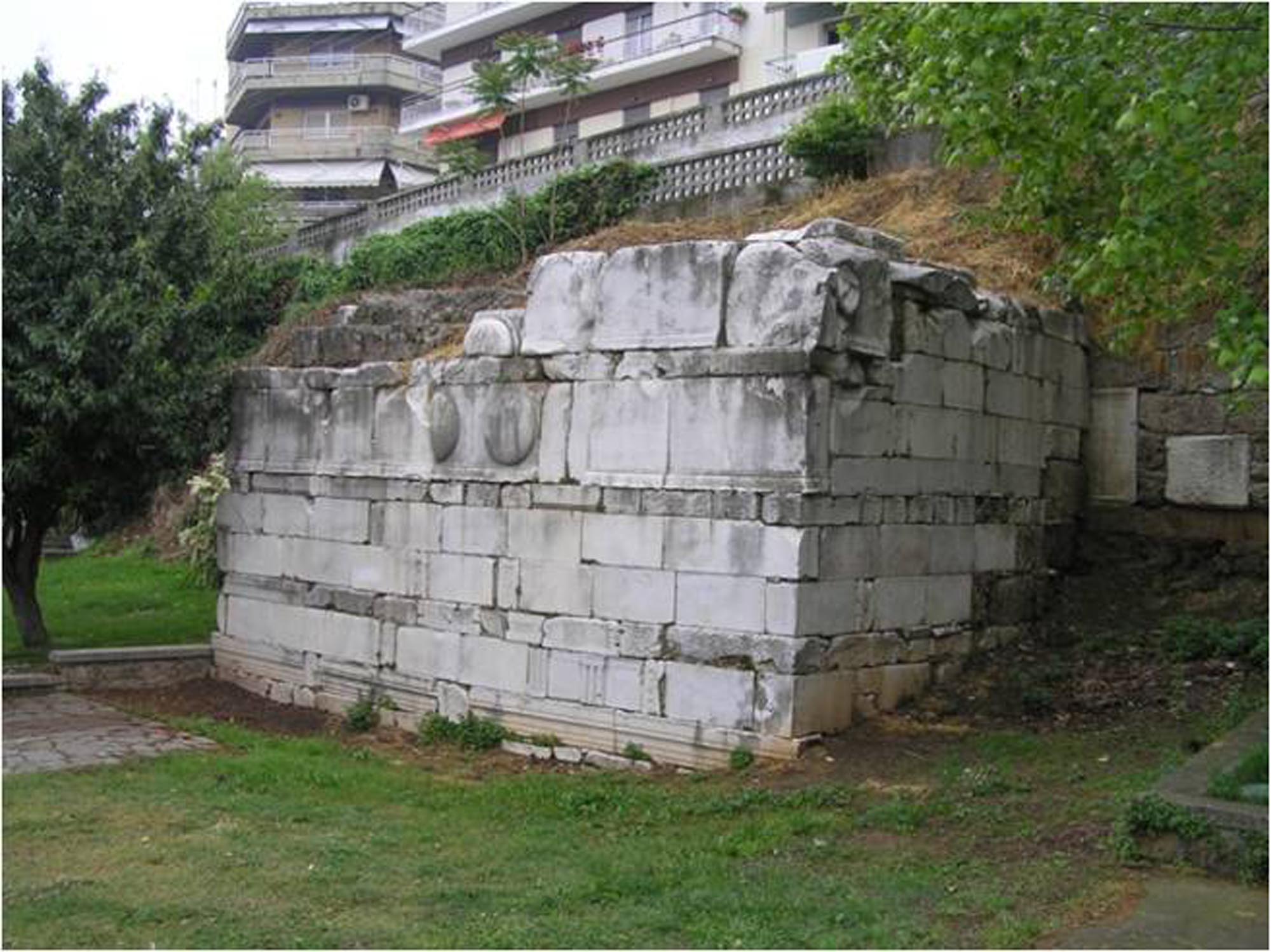
Of the strong fortifications of the ancient city, the course of which is reasonably well known thanks to rescue excavations, few sections survive today, mainly on the southwest and southeast sides. The fortifications have been reinforced and repaired repeatedly over the city’s long history The oldest parts date from the late 4th century BC, while the repair phase of the second half of the 3rd century AD is easily identifiable: older building material was extensively used to reinforce the walls due to the raids by the Goths and Heruli. The city walls, 2.40-2.80 m thick, are meticulously constructed in pseudo-isodomic masonry of elongated limestone ashlars and reinforced at intervals by semicircular, square and triangular towers. Three of the gates of the fortifications, the Royal Gate (north), the Opsician Gate (southeast) and the Euiastic Gate (southwest), have been tentatively identified based on the excavation finds and written sources.
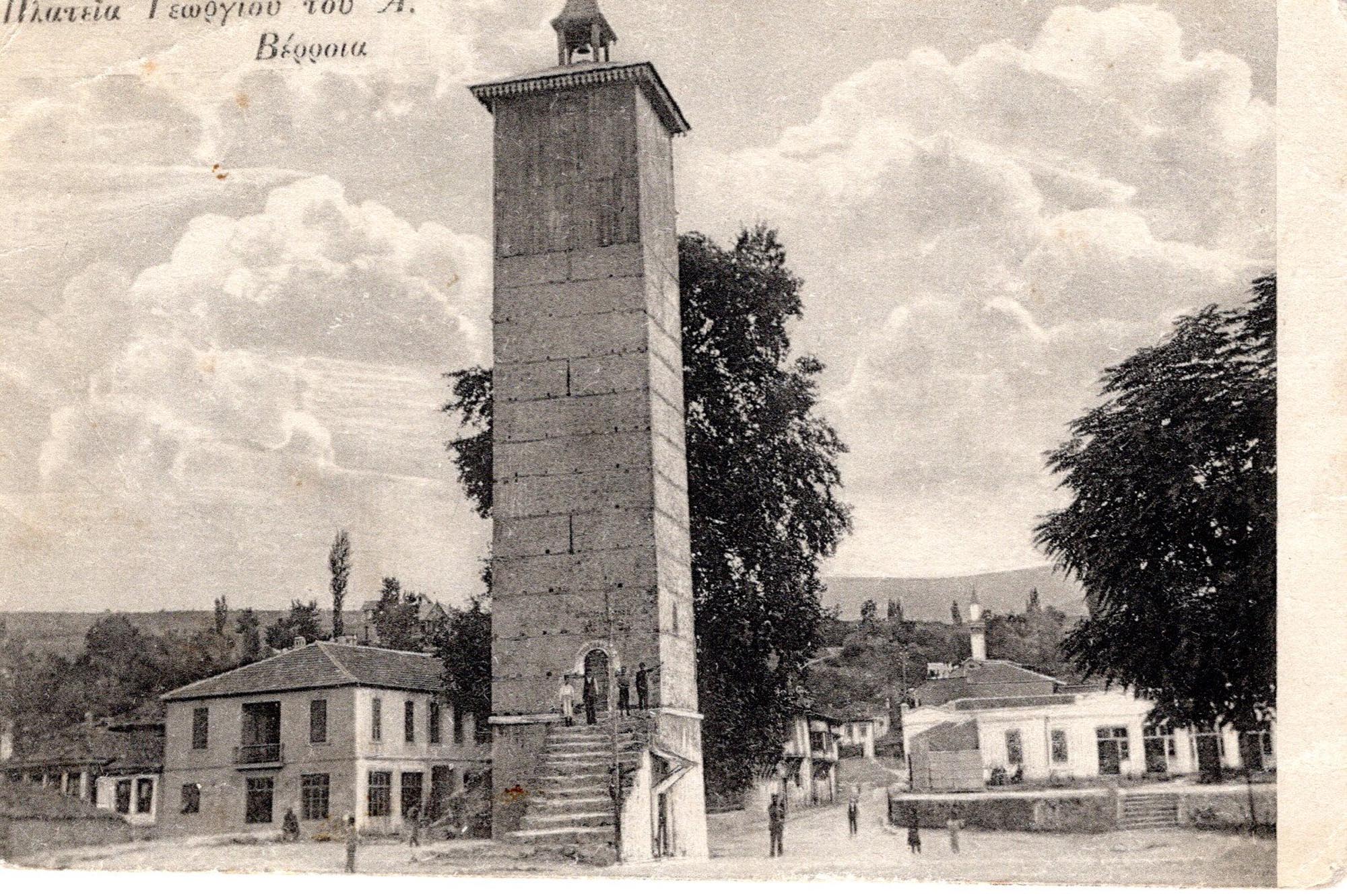
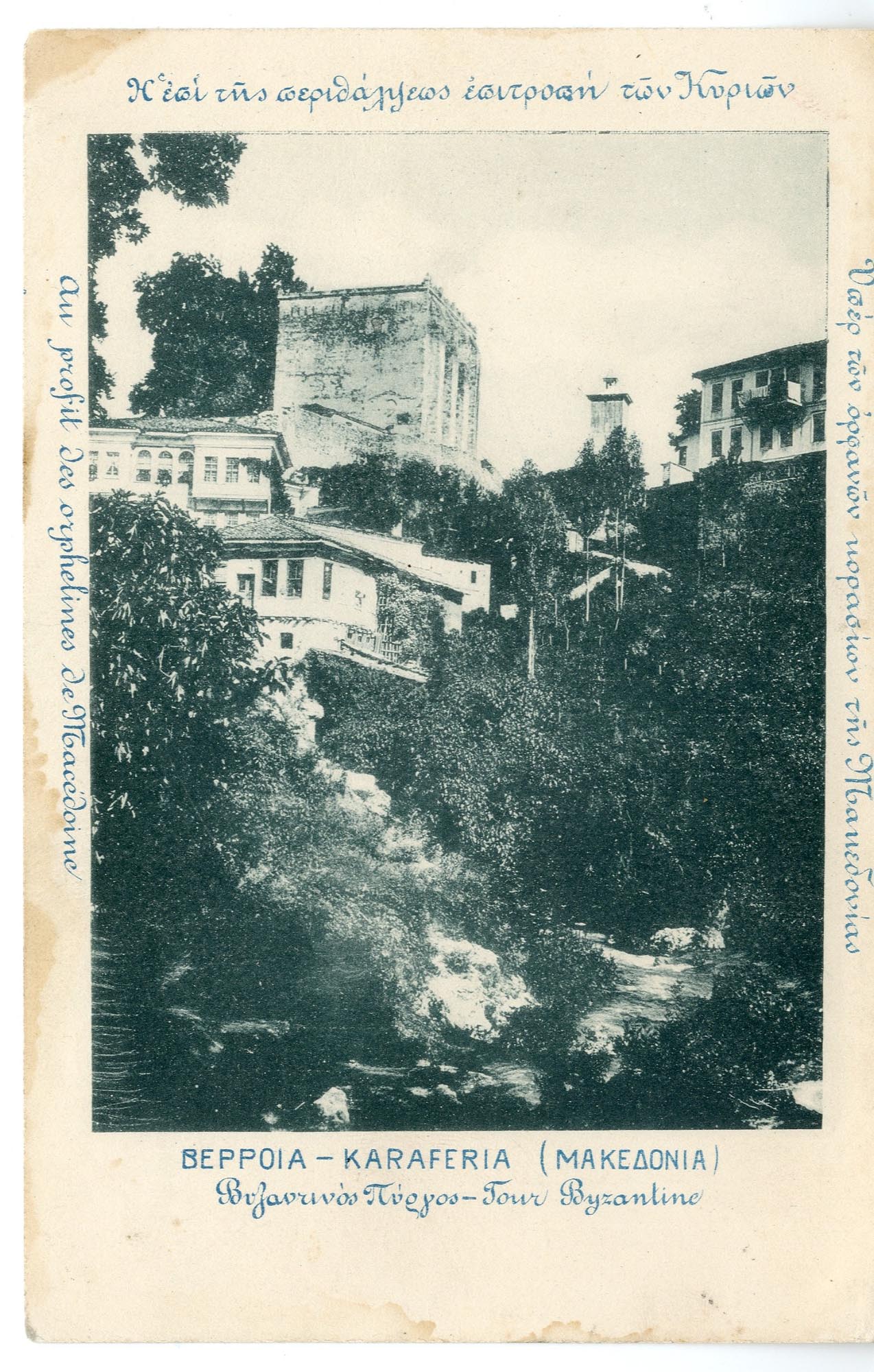
Of the Byzantine fortifications of the city, which, according to two notes in manuscripts, had a perimeter of around 3,500 or 3,900 m, it is mainly parts of the southwest citadel built by Stefan Uroš IV Dušan in the mid-14th century (behind Orologiou Square) that are visible today. The lower part of the strong rectangular Tower of Virginia or Queen Vergina, which was 11-14 m high, is also preserved in the area of the citadel. The tower, linked to local legends, was preserved intact until 1909, after which it was gradually demolished.
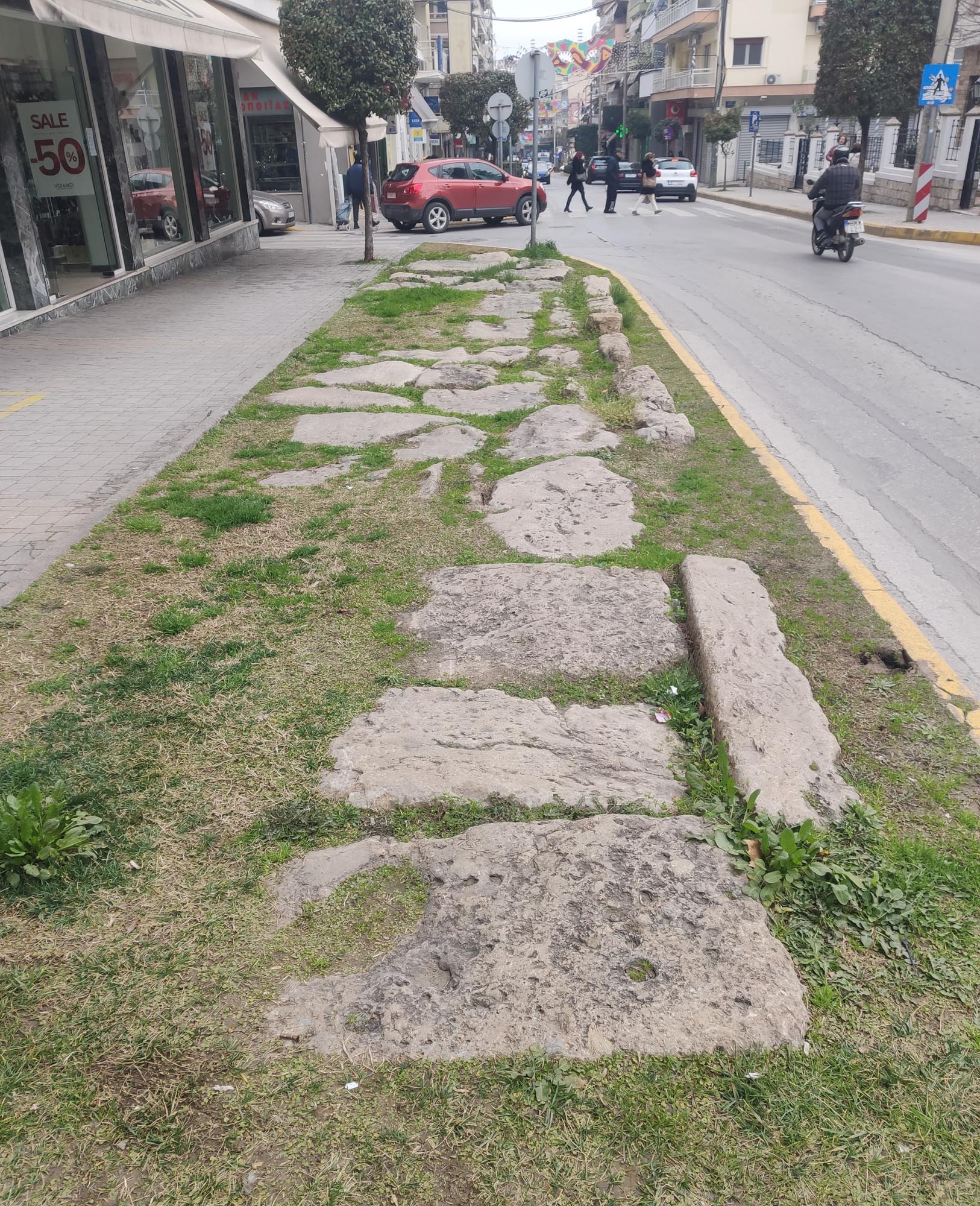
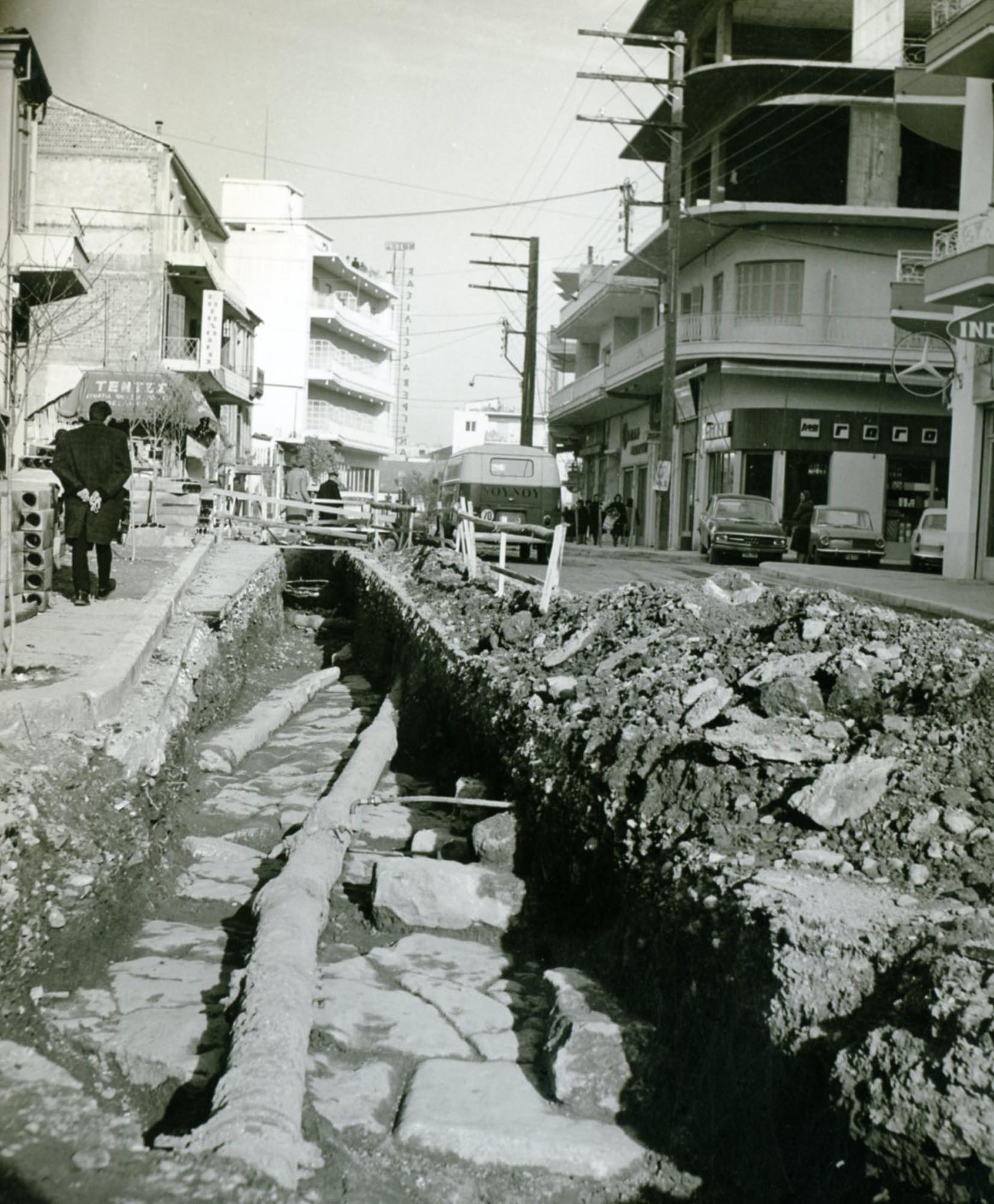
Roman road on Mitropoleos Street
It is impressive to note that the centre of the modern city of Veria, which is built on the site of the ancient city, follows the same urban plan, meaning that its main roads have remained the same from at least Roman times down to the present day. Thus, under what is now Mitropoleos Street and running in the same east-west direction, lies one of main Roman roads of the city (2nd half of the 2nd c. AD), which ran through the centre of the city to the southwest Euiastic Gate. The street, which was probably lined with porticos (via colonnata), is 4.00 m wide and 515 m long, the same length as Mitropoleos Street. The pavement is made of massive marble slabs, which in some places still retain the ruts made by the wheels of chariots and carts. The city’s advanced drainage and water supply network includes the built drainpipe running under the surface of the street, while clay water pipes ran along the kerbs, with access holes for cleanings set at regular intervals. A large part of the Roman road has now been excavated, while some sections are preserved in the basements of blocks of flats.
Archaeological site of St Patapios
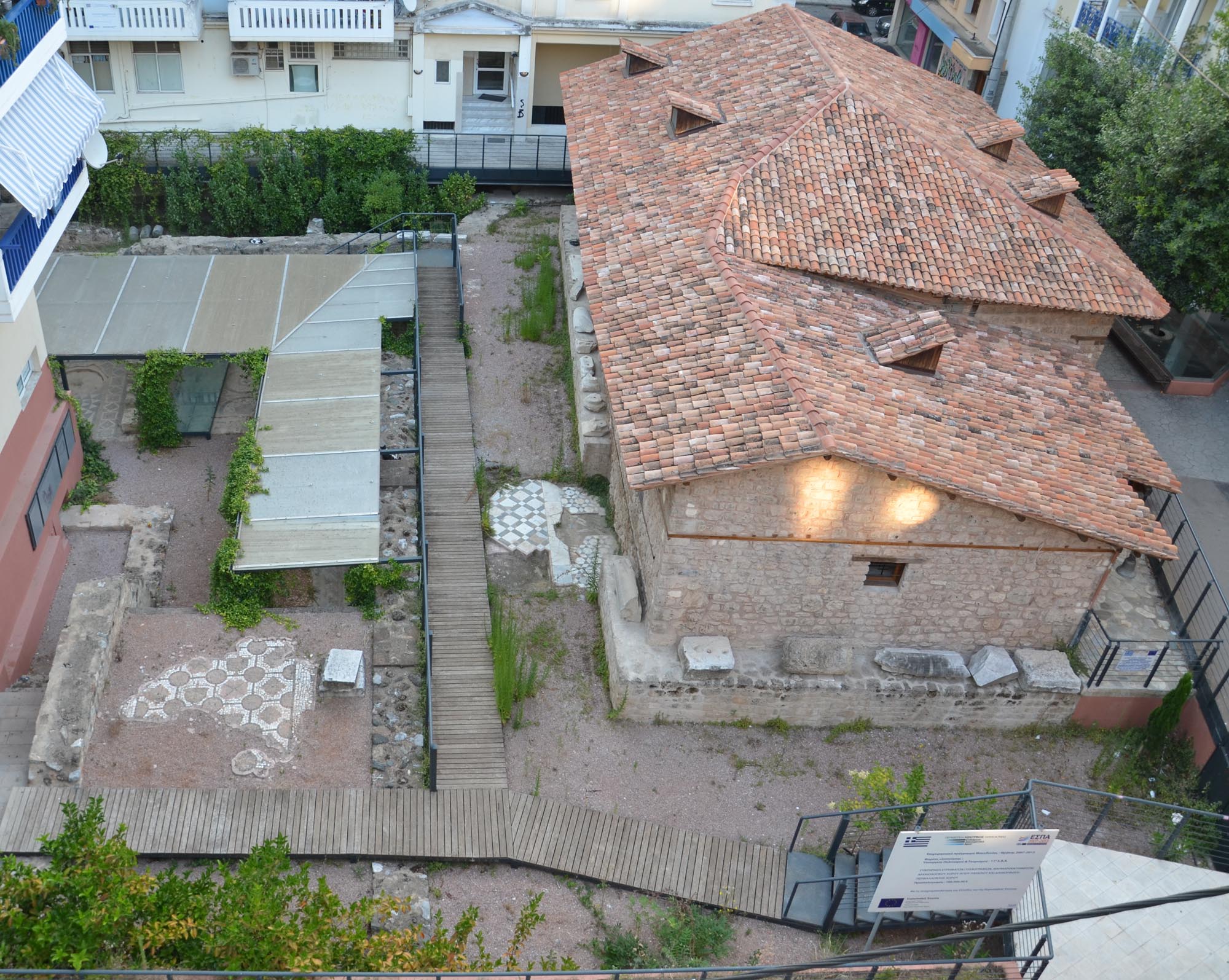
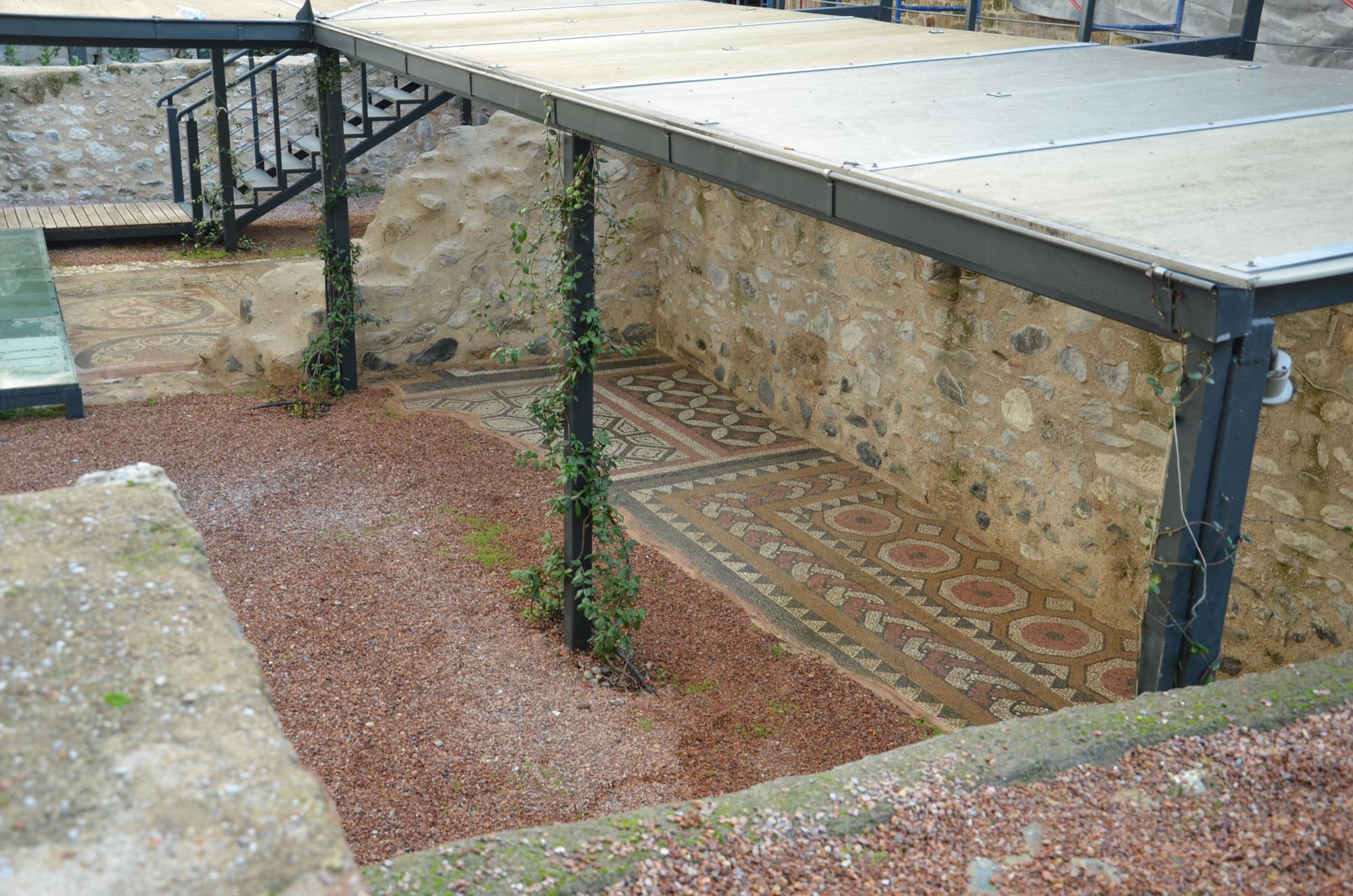
The only currently “open” archaeological site of Veria is in the area around the post-Byzantine church of St Patapios, in the heart of the modern city. It lies along Venizelou Street, under which the second most important Roman road of the city passed in the same direction (N-S), leading to the north gate of the fortifications (Royal Gate). Here the excavation has brought to light the remains of important Early Christian ecclesiastical buildings of the city, which have been consolidated and restored so that they can be visited by the public. Although only fragmentarily preserved, they impress with their monumental dimensions, their elaborate construction and their decoration with marble revetment, opus sectile (marble inlay) and remarkable mosaic floors, attesting to the high quality of art in Veria in the Early Christian period. The oldest of these buildings is a large baptistery dating from the reign of Emperor Theodosius the Great (379-395 AD). A religious building directly connected to the use of water, it was erected on the site of earlier buildings of the Roman period including a fountain house. The excavation has identified the outer domus of the baptistery, where the exorcisms of the catechumens and other pre-baptismal rites took place, as well as the photisterion or inner domus, where converts were baptised. The photisterion has a tetraconch plan with a built octagonal kolymbethra (baptismal font) in the centre.
In the 5th century AD, a large three-aisled basilica with a double transept was erected on the site of the baptistery. The basilica seems to have been the main church of Early Christian Veria and the seat of the local bishop before the founding of the Old Metropolis. This view is supported by the discovery of a series of annexes to the basilica, including an imposing two-part, probably two-storey building with an apse, identified as an episcopal see. The basilica was in use until the early 7th century, when the site was occupied by an extensive cemetery. Later, in the Middle Byzantine period, a small church, of which only a small part has been uncovered, was built in the east part of the basilica. Lastly, the continuous use of the site is completed by the church of St Patapios, which, based on the original layer of frescoes preserved within it, was built in the late 15th or early 16th century on the remains of earlier buildings. In its present form, the result of successive building interventions, it has three aisles with two semicircular conches on the east and a narthex on the west, while the fresco decoration includes three further layers dated between the late 16th and the early 18th century.
Traditional districts of Makariotissa (Kontogeorgaki), Kyriotissa and Panagia Dexia
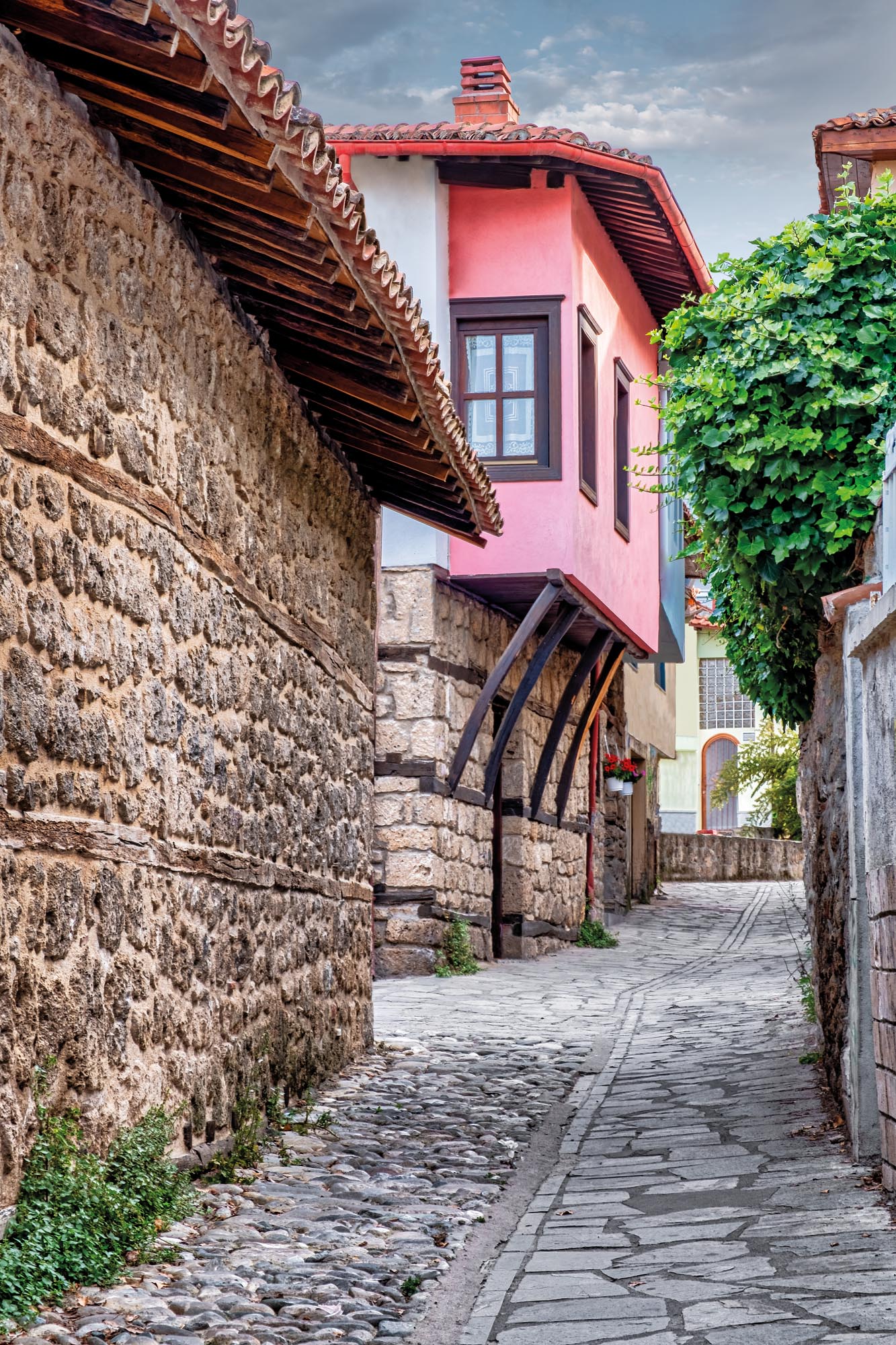
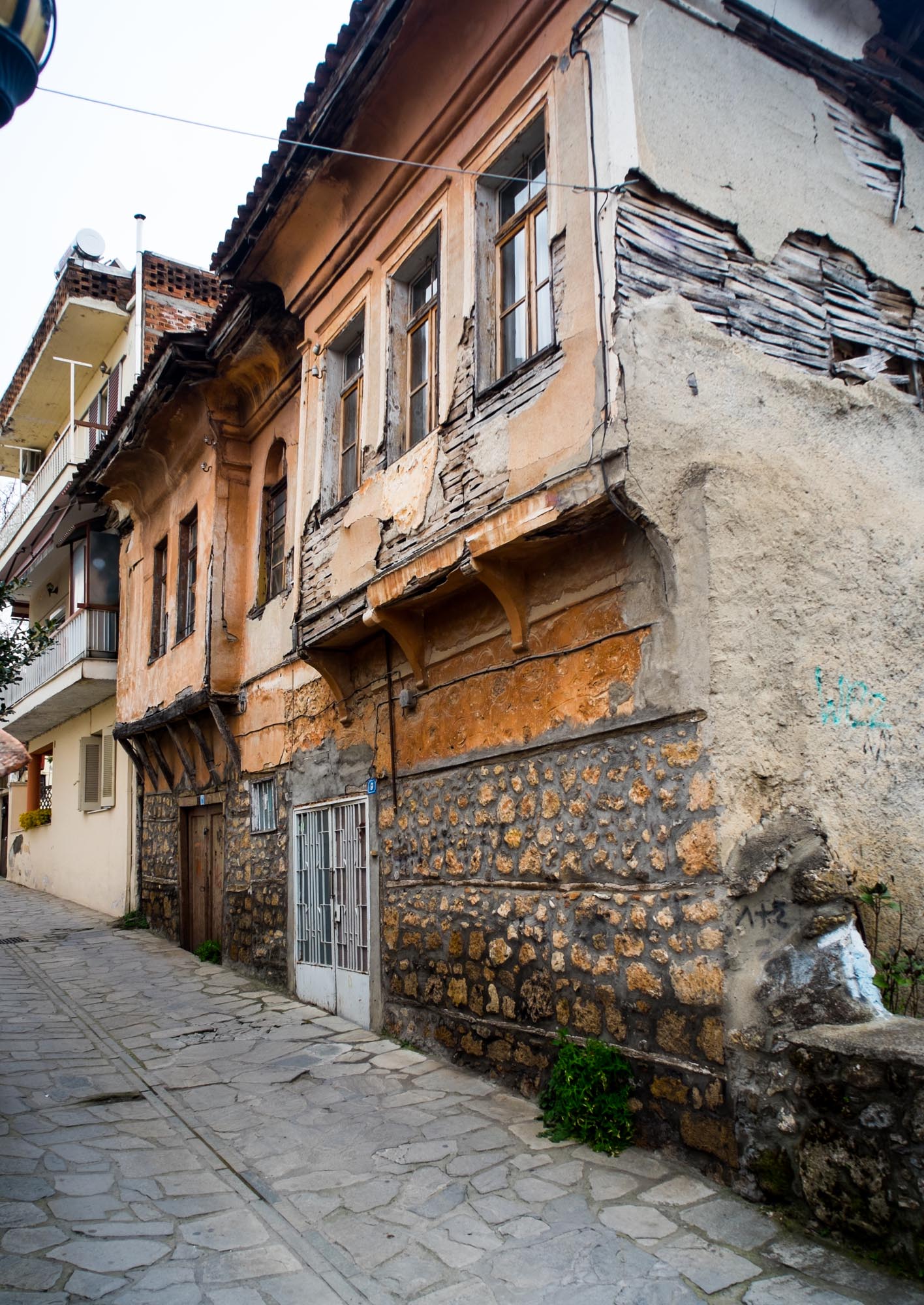
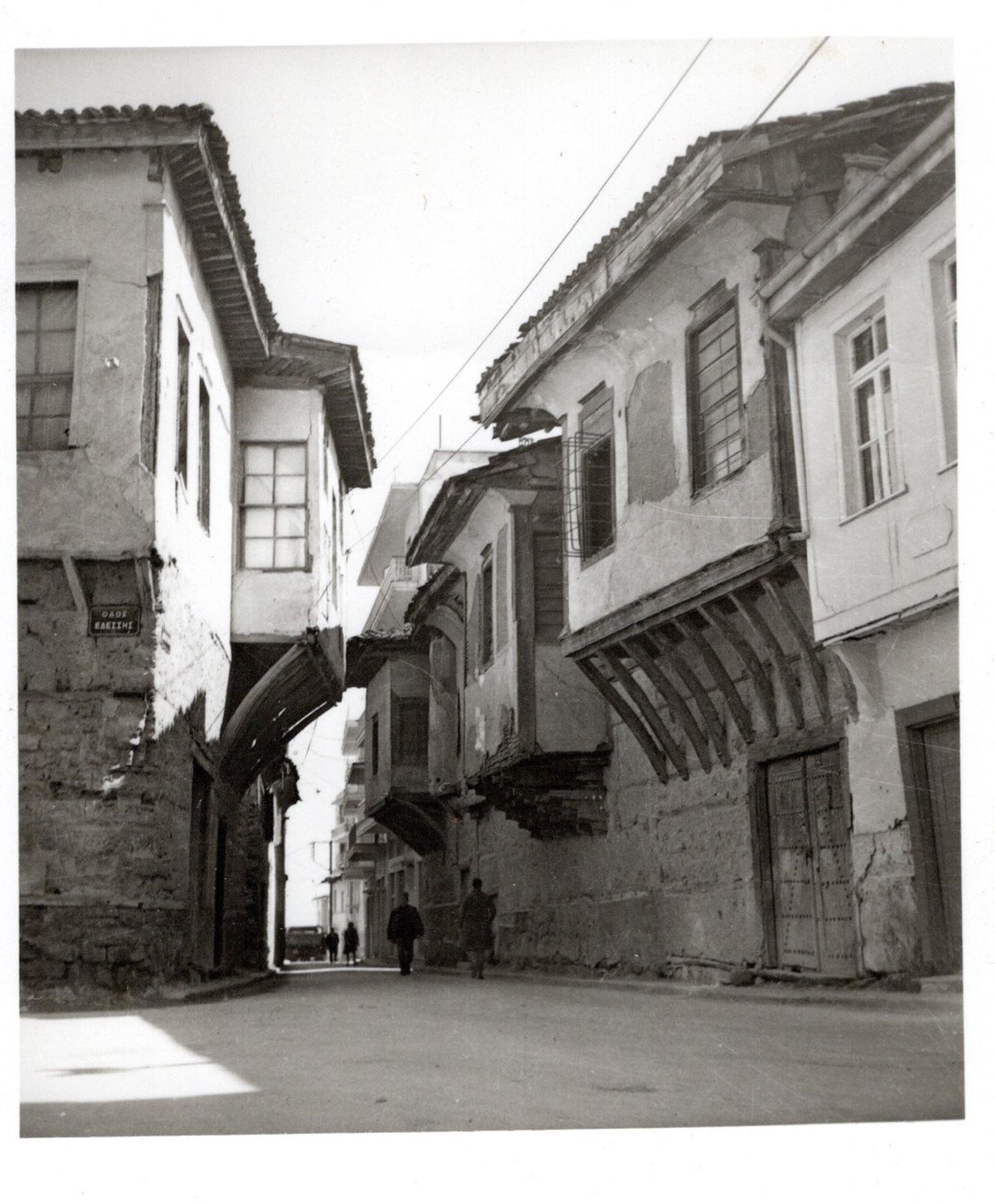
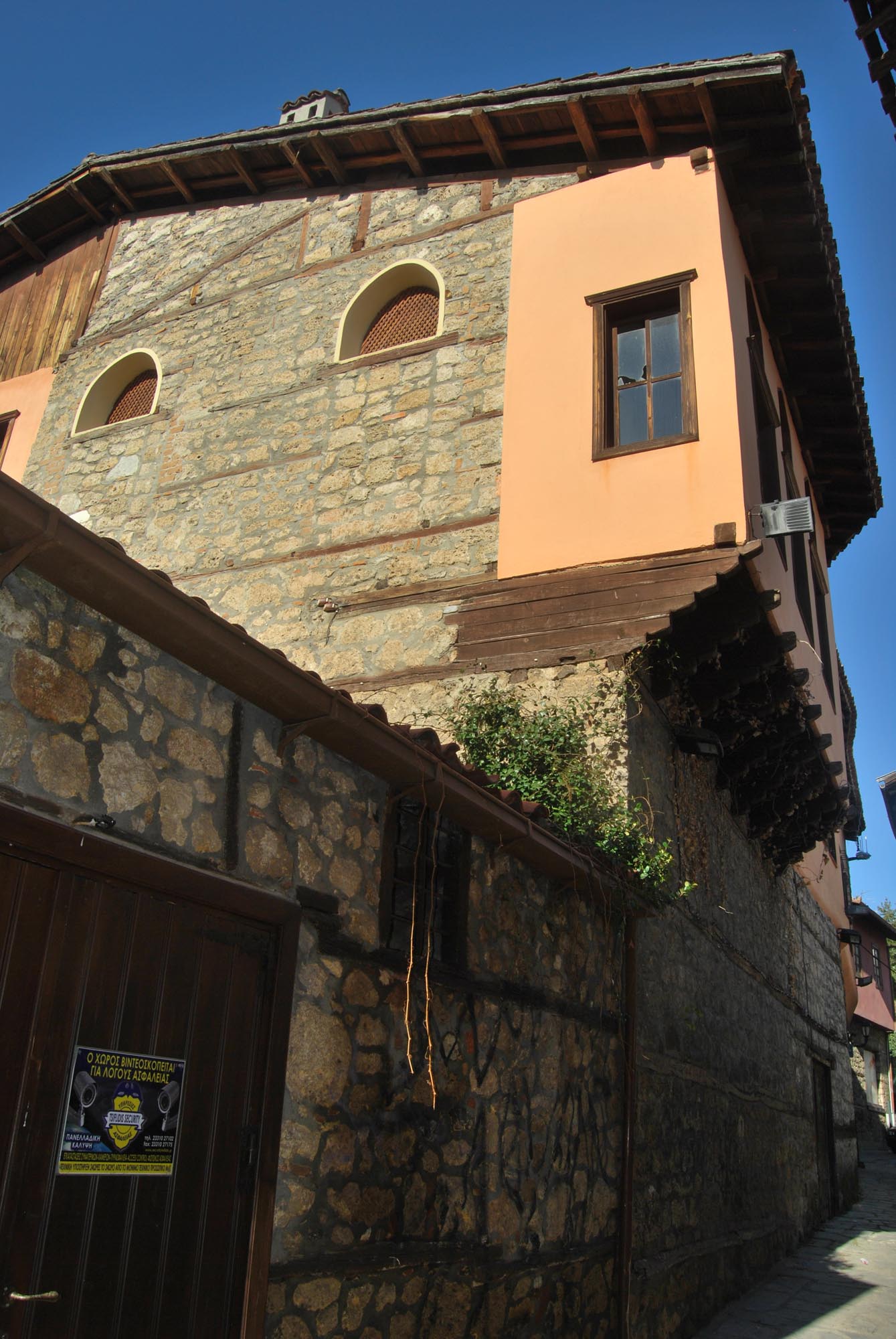
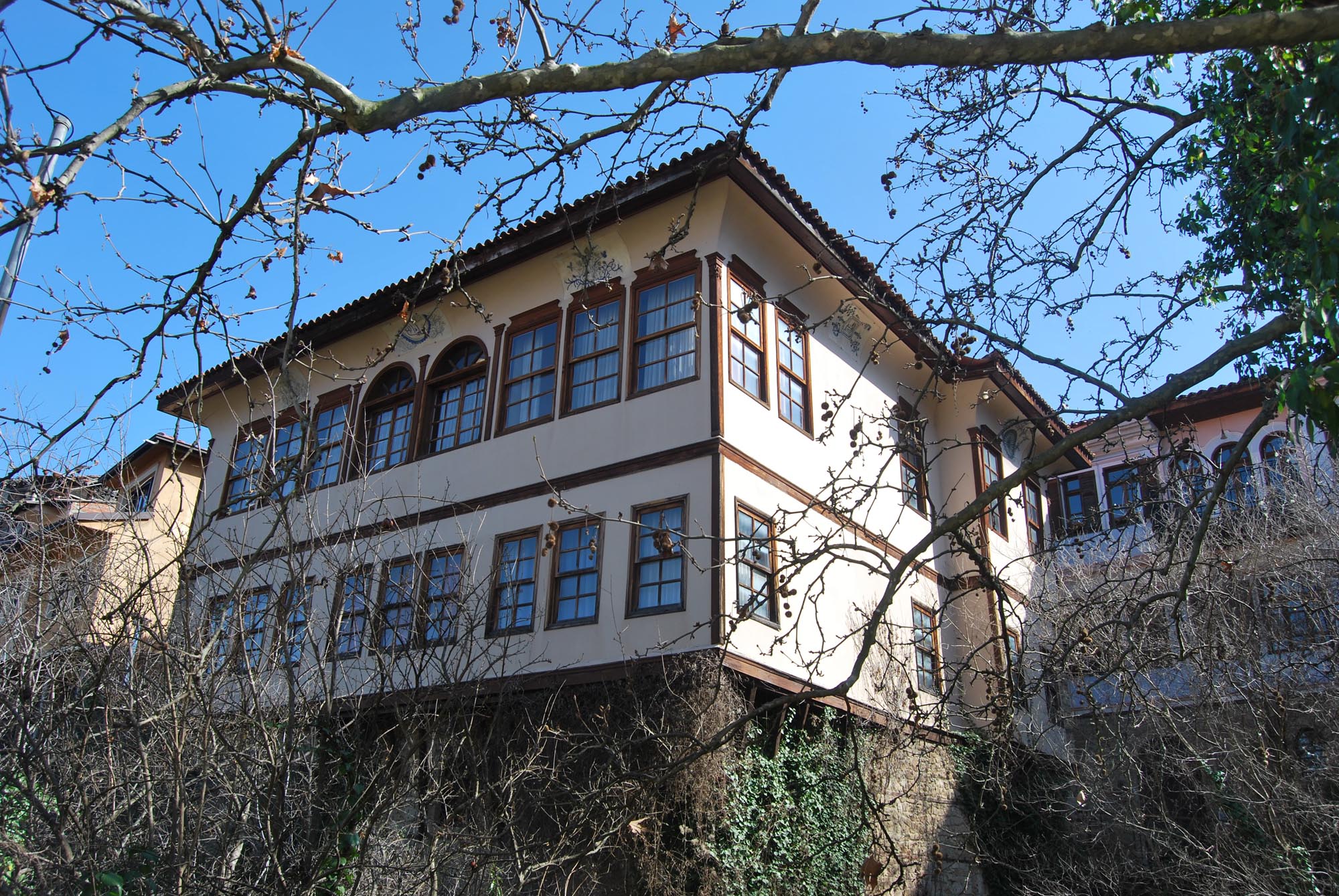
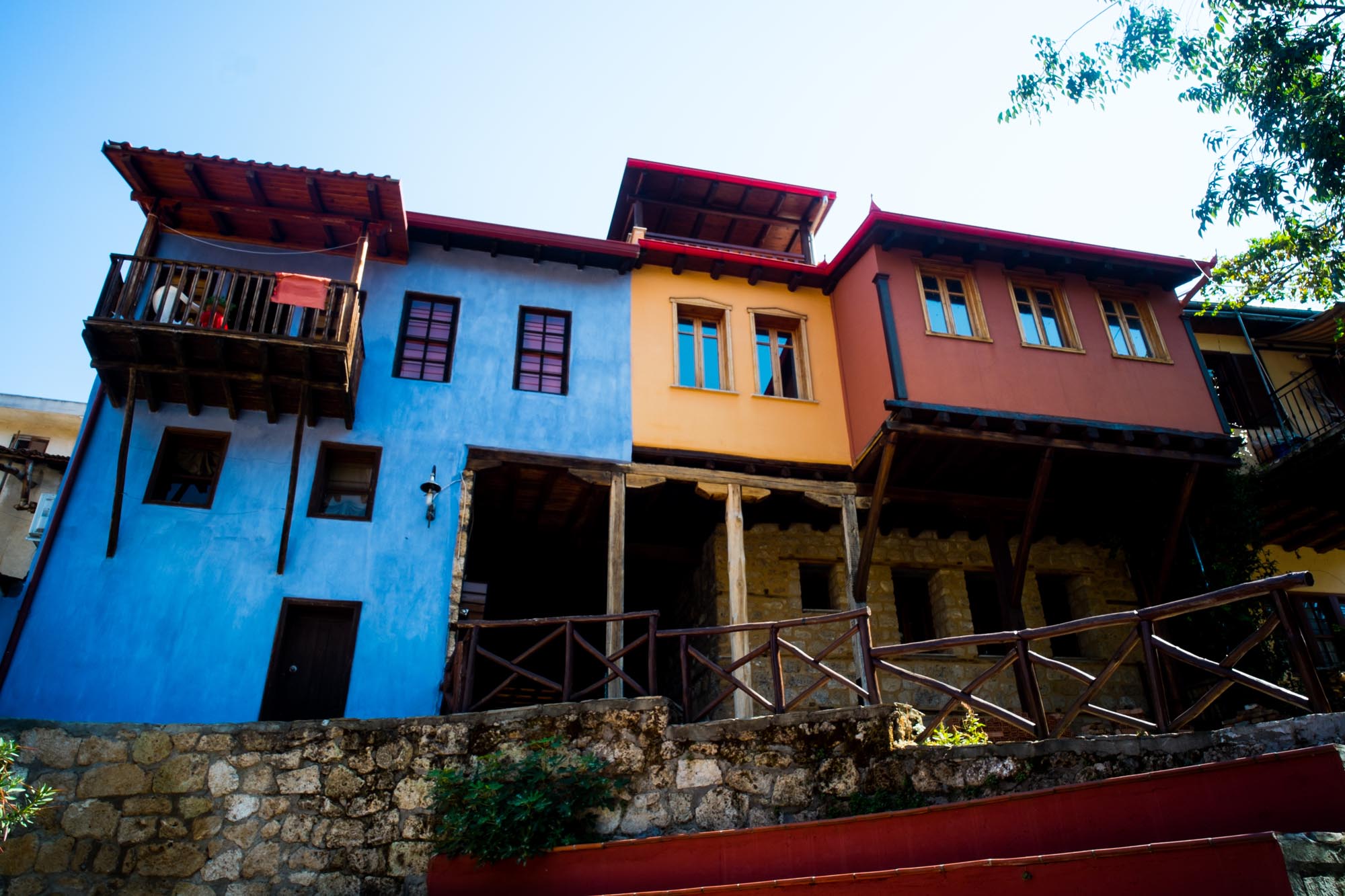
The three neighbouring districts, which once formed one of the central Christian nuclei of Veria and are located in the southwest part of the walled city, have been classified as historic preservation sites, because they retain much of the urban fabric of the Ottoman period. The old houses rise above the narrow cobbled streets of the three districts, typical examples of the traditional architecture that developed in Macedonia from the 18th to the early 20th century. They are mainly two-storey houses, with a stone-built ground floor and a timber-framed upper floor, from which protrude the brightly painted şahnişins (overhanging covered balconies). The houses are built side by side in a row, with few or no openings on the ground floor, creating a group of buildings closed off from the street. In the centre there is usually a church, well-hidden from the eyes of passers-by. Around the church are arranged the paved courtyards of the houses, with hayats (open balconies or porticos) on their rear, inner side, bounded by high walls and communicating with each other via apanoixes (low side gates). Today, many of the listed houses of Veria have been restored and converted into recreational spaces and entertainment venues.
Mansions of Veria
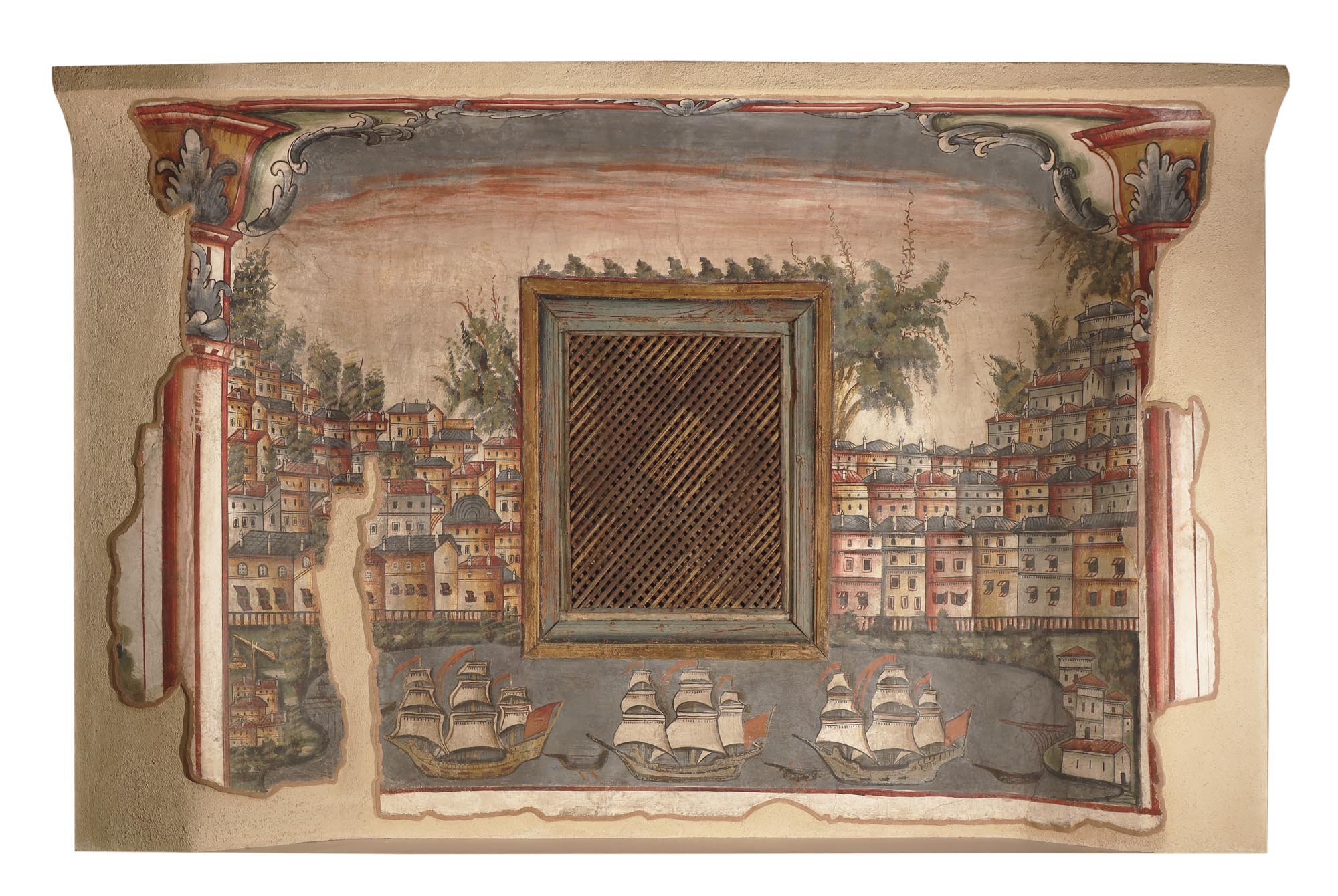
In the districts of Kyriotissa and Makariotissa are some of the most impressive mansions of the city, reflecting its prosperity from the 18th century onwards. In terms of their architectural form, they have the same features as other traditional houses, but are distinguished from them chiefly due to their size, their greater height and their rich decoration of wall paintings, plaster transoms with window panes, and wood-panelled ceilings, wardrobes and doors. One of the most striking, built in the mid-18th century, is the Sarafoglou Mansion in the Kyriotissa district. As was the case with some of the city’s churches, several important mansions of Veria were demolished after the war due to the expansion of the city. A typical example is the Mansion of Sior Manolakis with its elaborate painted decoration (1829-1833), part of which is on display in the Byzantine Museum of Veria.
Old Market of Veria
Next to the district of Panagia Dexia, along Kentrikis Street and in the adjoining parallel and cross-streets, lies the old market of the city, which was rebuilt after the devastating fire of 1864. The architecture of this particular part of the city, known as the “Teneketzidika” (Tinsmiths’ Quarter), is made up of small, usually one- or two-storey shops and workshops mainly selling household goods.
Barbouta Jewish Quarter
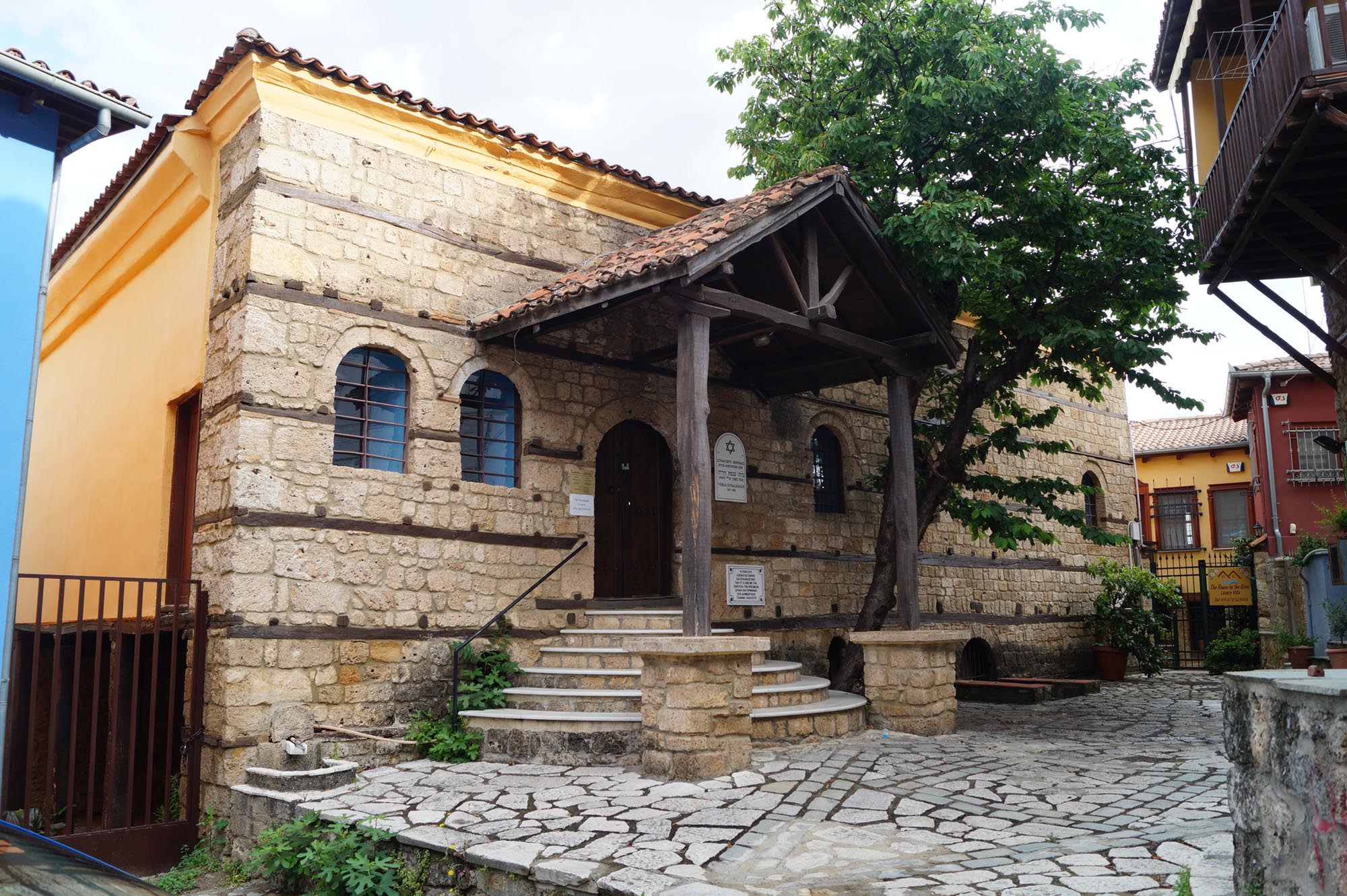
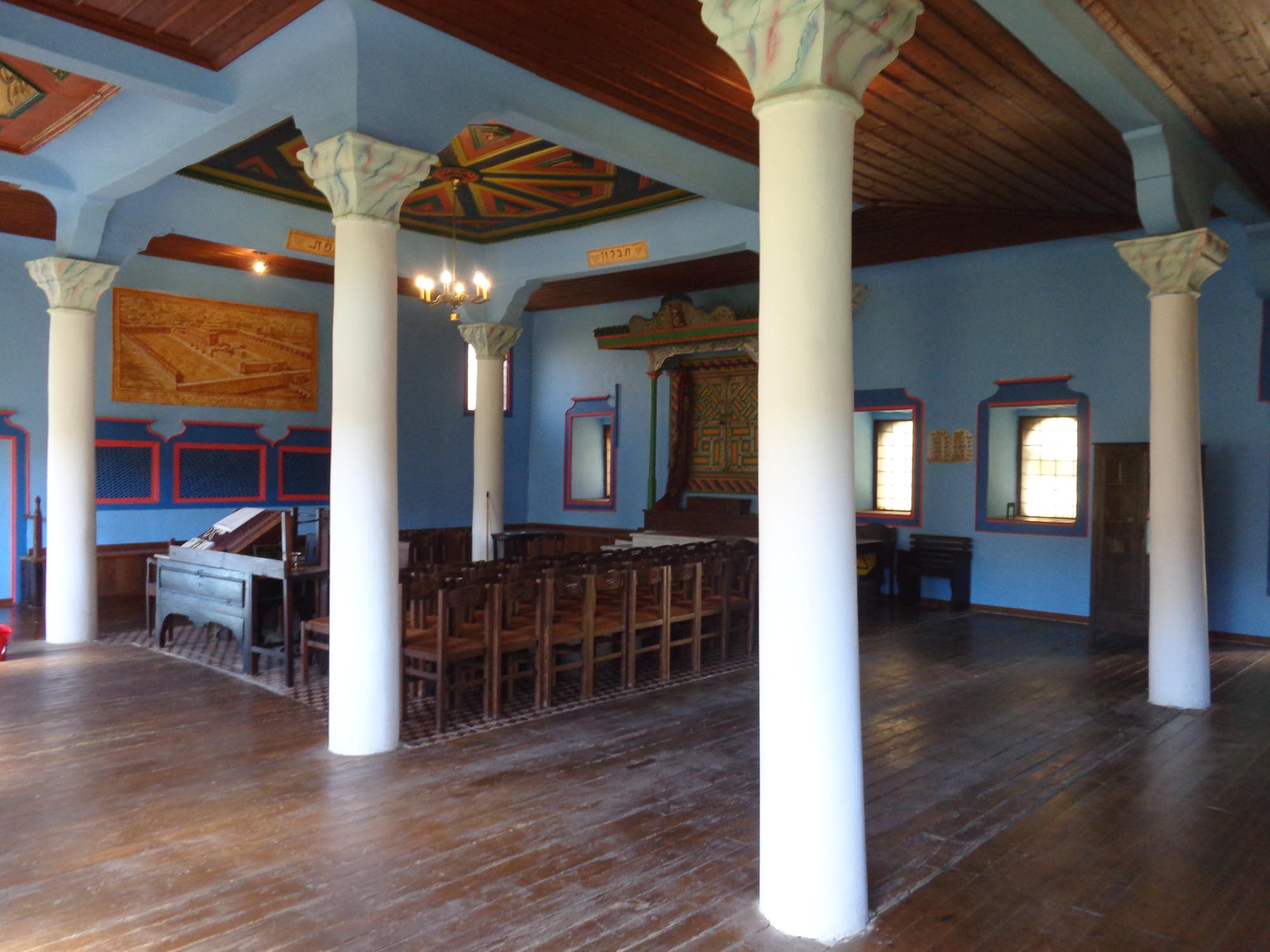
The Jewish Quarter, next to the banks of the River Tripotamos, is a small, closed, triangular building complex with a strongly defensive character, generally matching the layout and architecture of the Christian quarters of the city. Access to the quarter was formerly controlled via two passageways closed by strong double gates, one on what is now Merarchias Street and the other on the side of the river. The houses of the district represent all social classes, ranging from small, modest buildings to imposing mansions built according to the principles of traditional Macedonian architecture, although with more European influences. The Bekas, Tsartsanis, Olganos and Anastasiou mansions stand out. On Olganou Street is the Jewish Synagogue, which was renovated from the ground up under a Sultan’s firman (decree) in 1850. This and the Monastir Synagogue in Thessaloniki are the only the synagogues in the cities of Macedonia that were not demolished after the Second World War and survive to this day.
Orologiou Square (Raktivan) with the two Ottoman public buildings and the historic plane tree
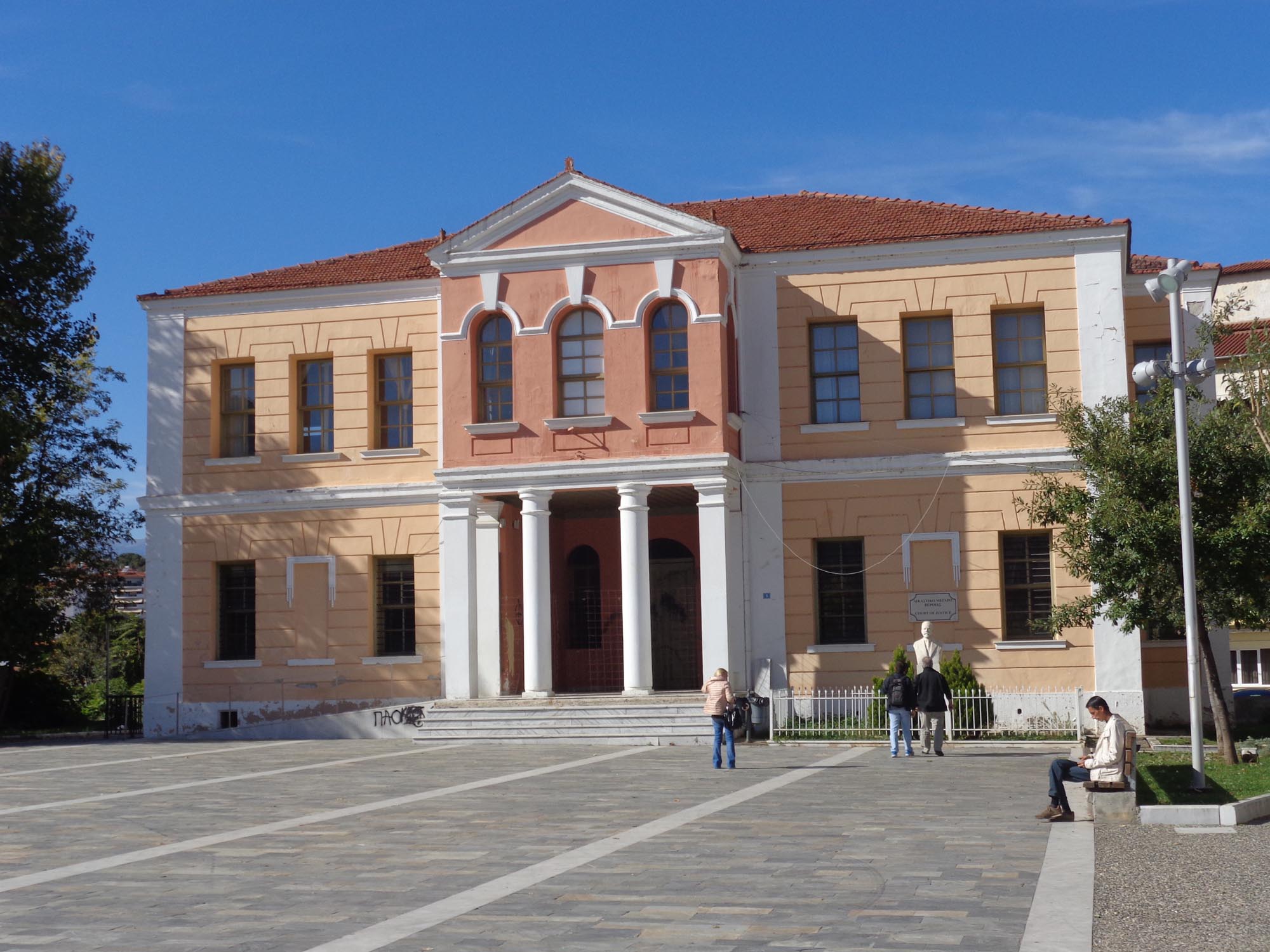
On Mitropoleos Street is one of the most central and historical squares of Veria, where the surrender of the city by the Turkish governor to the Greek Army took place (16 October 1912). It has had many names over the years, but its current name is due to the tall stone Clock Tower (Orologion), a city landmark which, however, was demolished in 1928. It is also called Raktivan Square after the Veria jurist and politician Konstantinos Raktivan (1865-1935), who, like his father Dimitrios Raktivan (1827-1893), is considered a benefactor of the city. On the northwest side of the square rises the imposing two-storey building which was erected at the end of the first decade of the 20th century as the Ottoman Government House building and then served, until early 2013, as the city Courthouse. During the same period, the Ottoman authorities built the three-storey school, still used as a primary school today, opposite the square on Botsari Street. In the square itself stands the plane tree, declared a listed natural monument in 1977, from whose branches the Ottomans hanged the Naoussa armatolos (irregular soldier) Zisis Karademos and his two sons Vasilios and Dimitris in 1705 to make an example of them.
St Paul’s Tribune
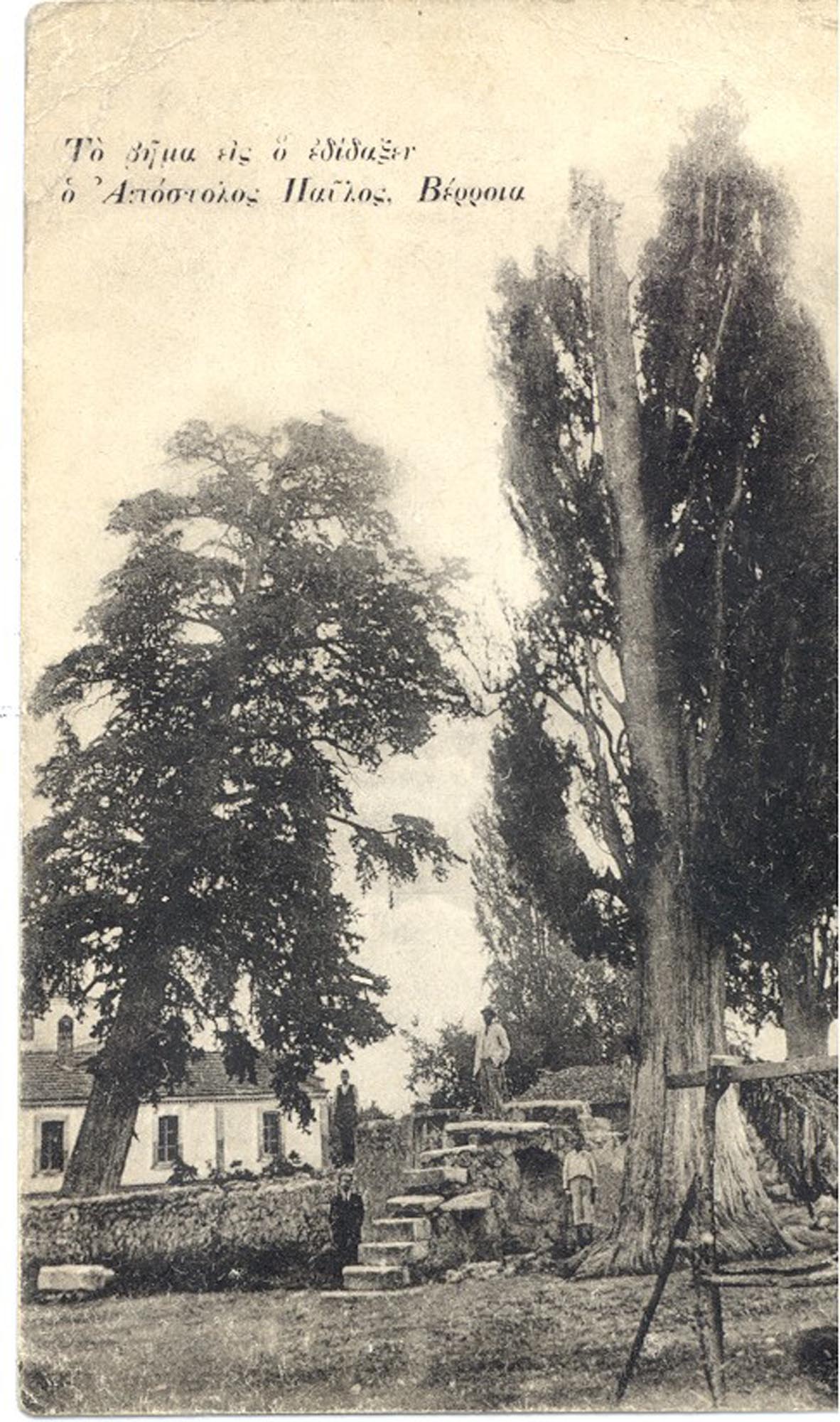
St Paul the Apostle’s visit to Veria is commemorated by the monument erected in the early 1960s on the site near Orologiou Square where, according to tradition, the founder of the “apostolic” church of Veria preached. Here, on the afternoon of the Apostle’s feast-day (29 June), a solemn Inter-Orthodox vespers service is held, concluding the Pavleia Festival, a series of cultural and artistic events in honour of the Apostle organised by the Holy Metropolis of Veria, Naoussa and Campania.
Orta Mosque (Leonidou and Themistokleous Streets)
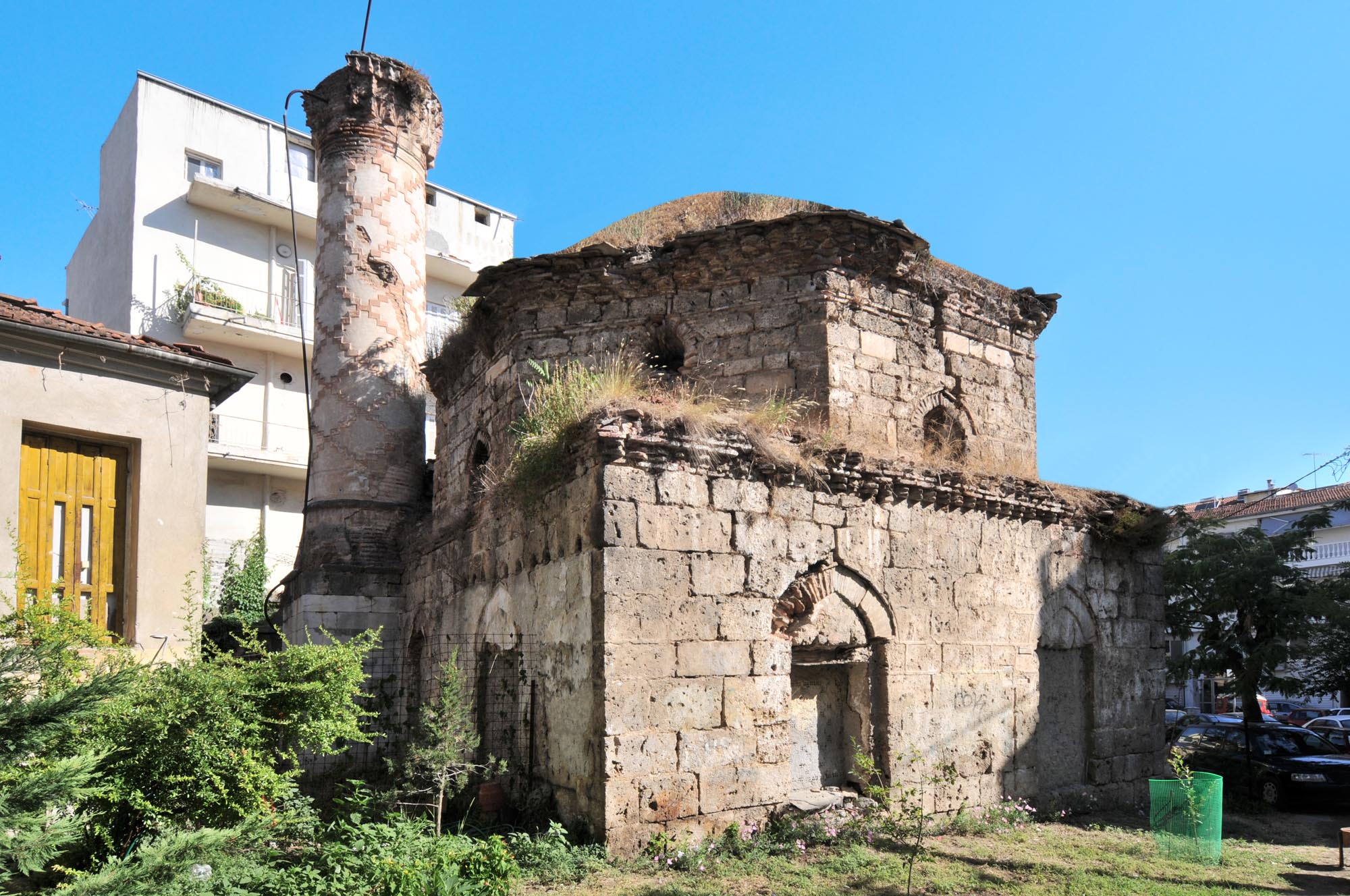
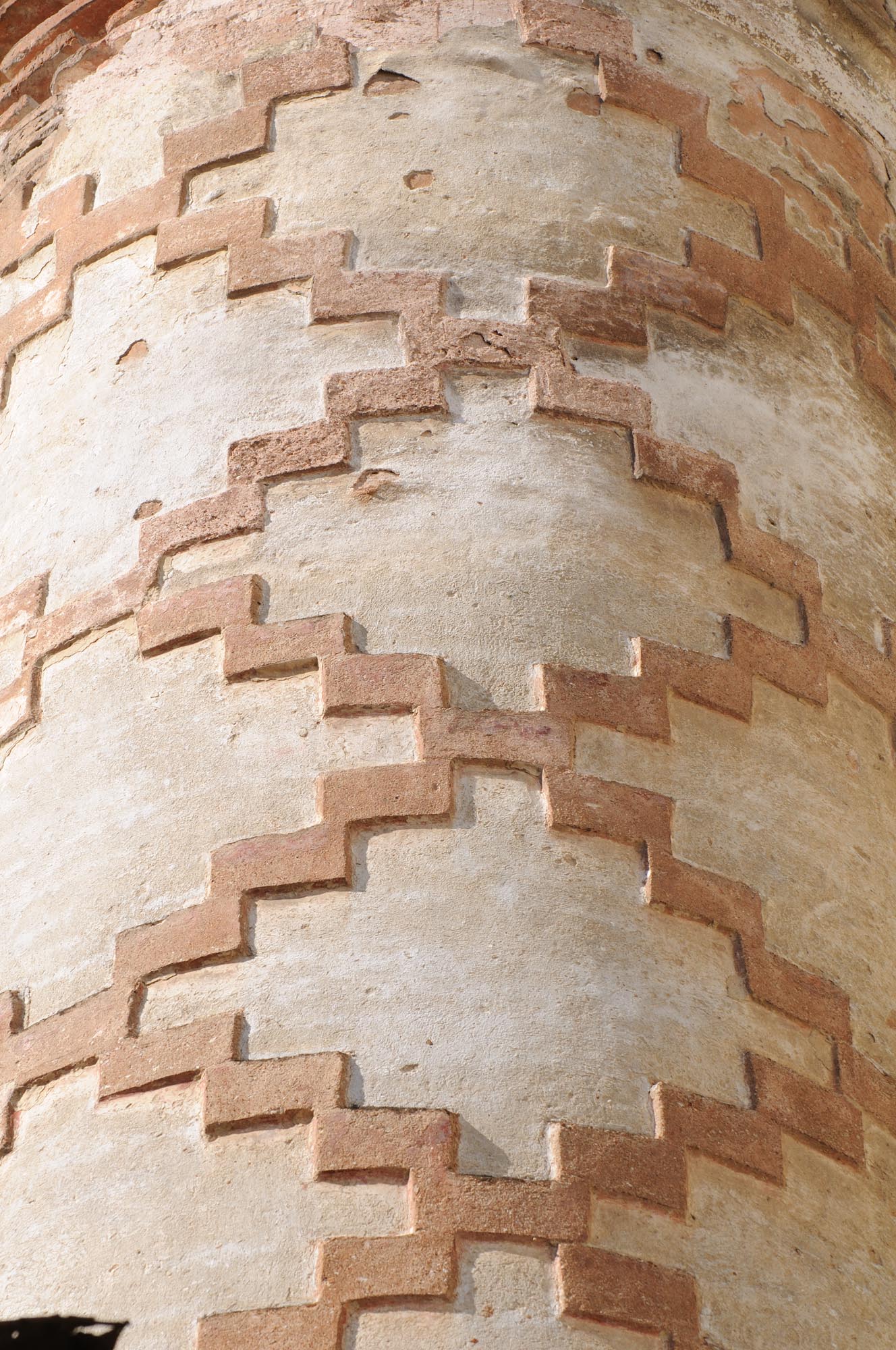
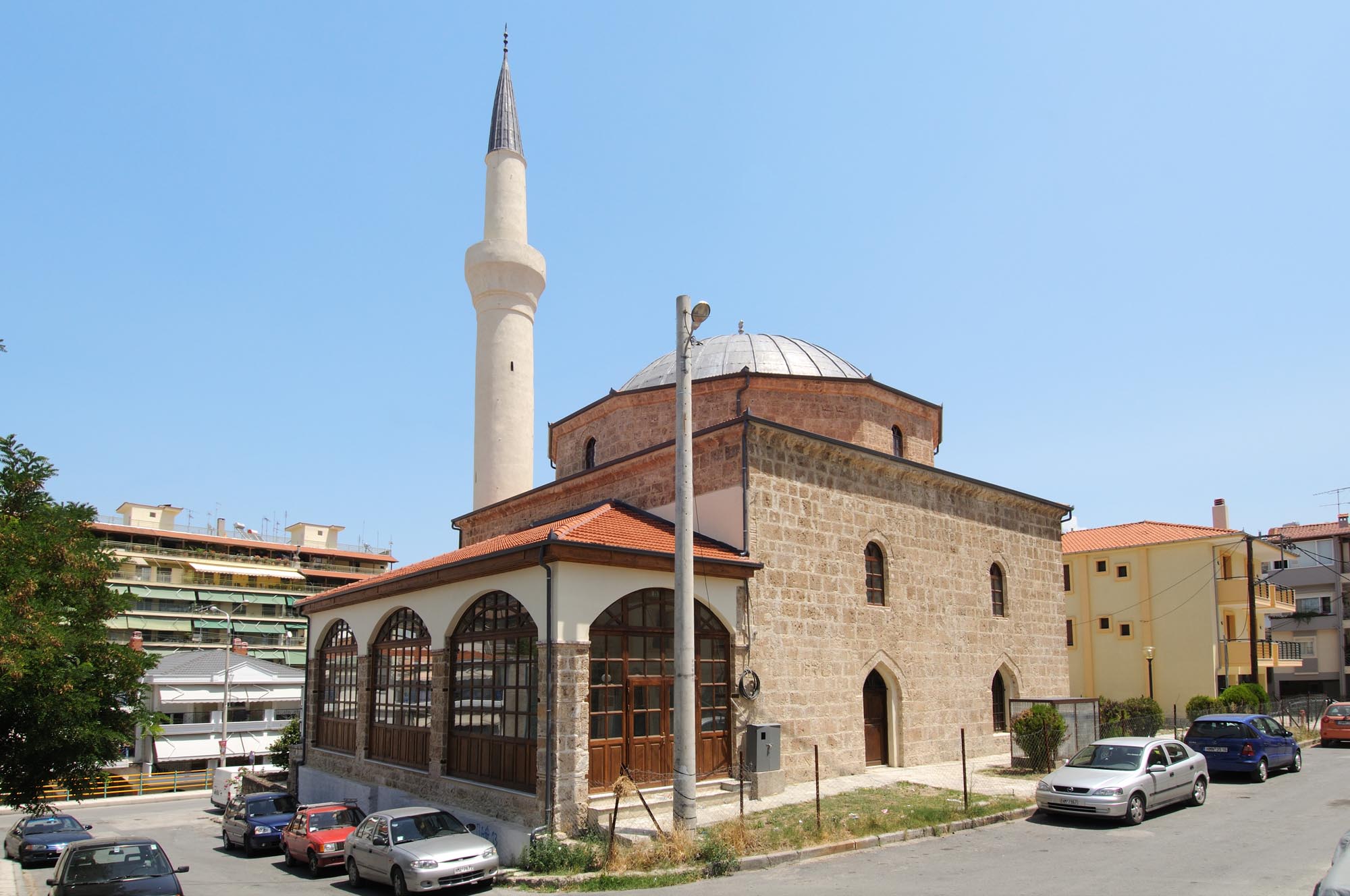
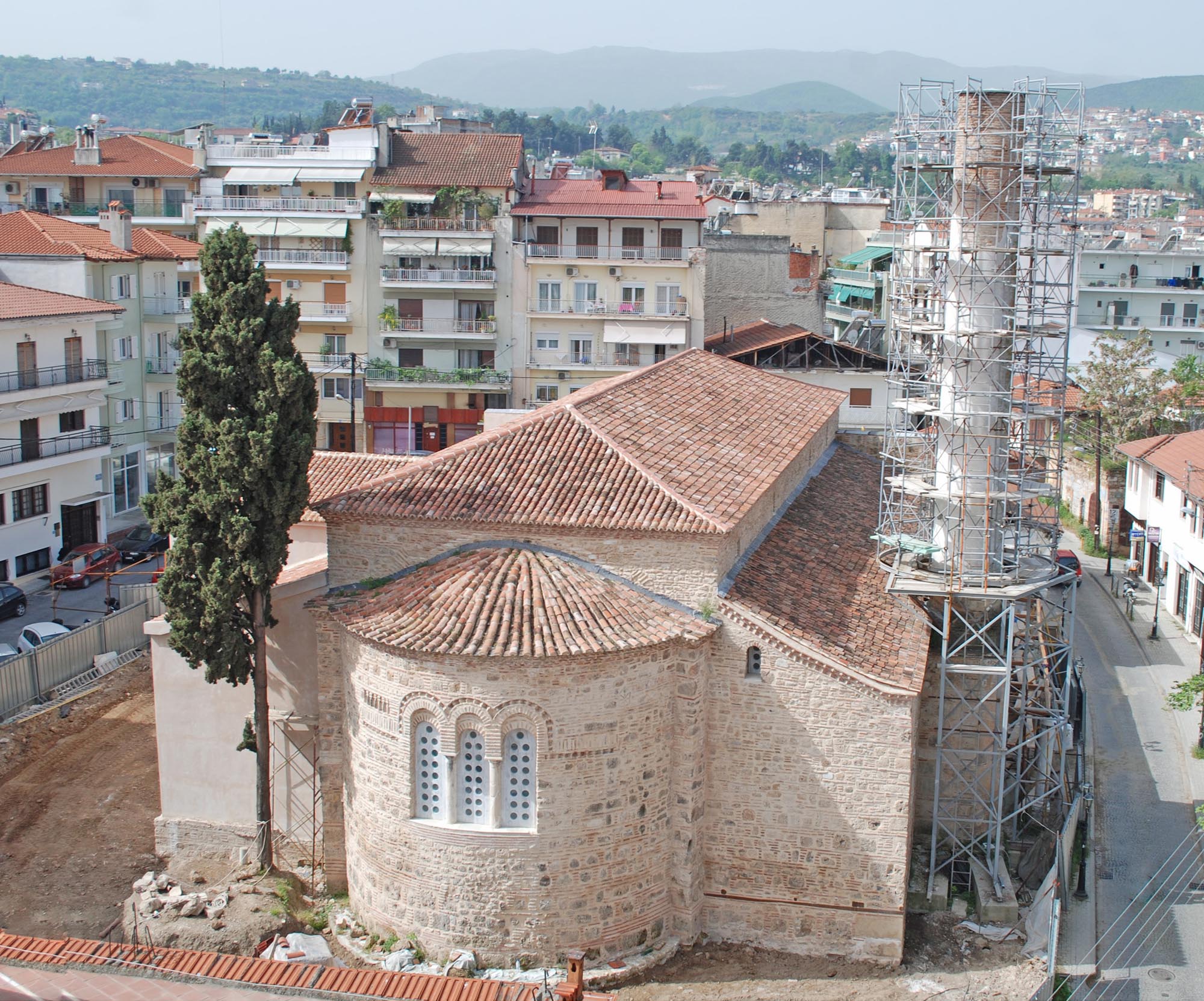
The “middle” mosque stands, as its name indicates, in the centre of the city, in the area that once lay within the walls, between the Byzantine citadel and the Old Metropolis. It is identified as the Çelebi Sinan Bey Mosque, which Evliya Çelebi mentions as one of the seven mosques of the city in the late 17th century. According to him, there was an inscription above the entrance with the year 1491/2, which corresponds to the date of the monument’s construction, as an examination of its architectural and morphological features shows. It is a simple building, square in plan, with an area of 104.23 m2, roofed with a large dome which was once covered with lead. The masonry of the mosque is highly elaborate, made of limestone ashlars with interposed rows of bricks at intervals and two rows of a dentil cornice. The northwest entrance features a tripartite colonnaded porch of which only a small part survives today, while in the west corner of the mosque rises an ornate minaret, its upper part decorated with stalactites, while its cylindrical body is decorated with small ceramic tiles forming continuous rows of rhombuses in a chequerboard pattern. The interior of the mosque has been decorated with wall paintings including passages of the Qur’an and floral motifs.
Madrasa Mosque (junction of Markos Mpotsaris and Apostolou Pavlou Streets)
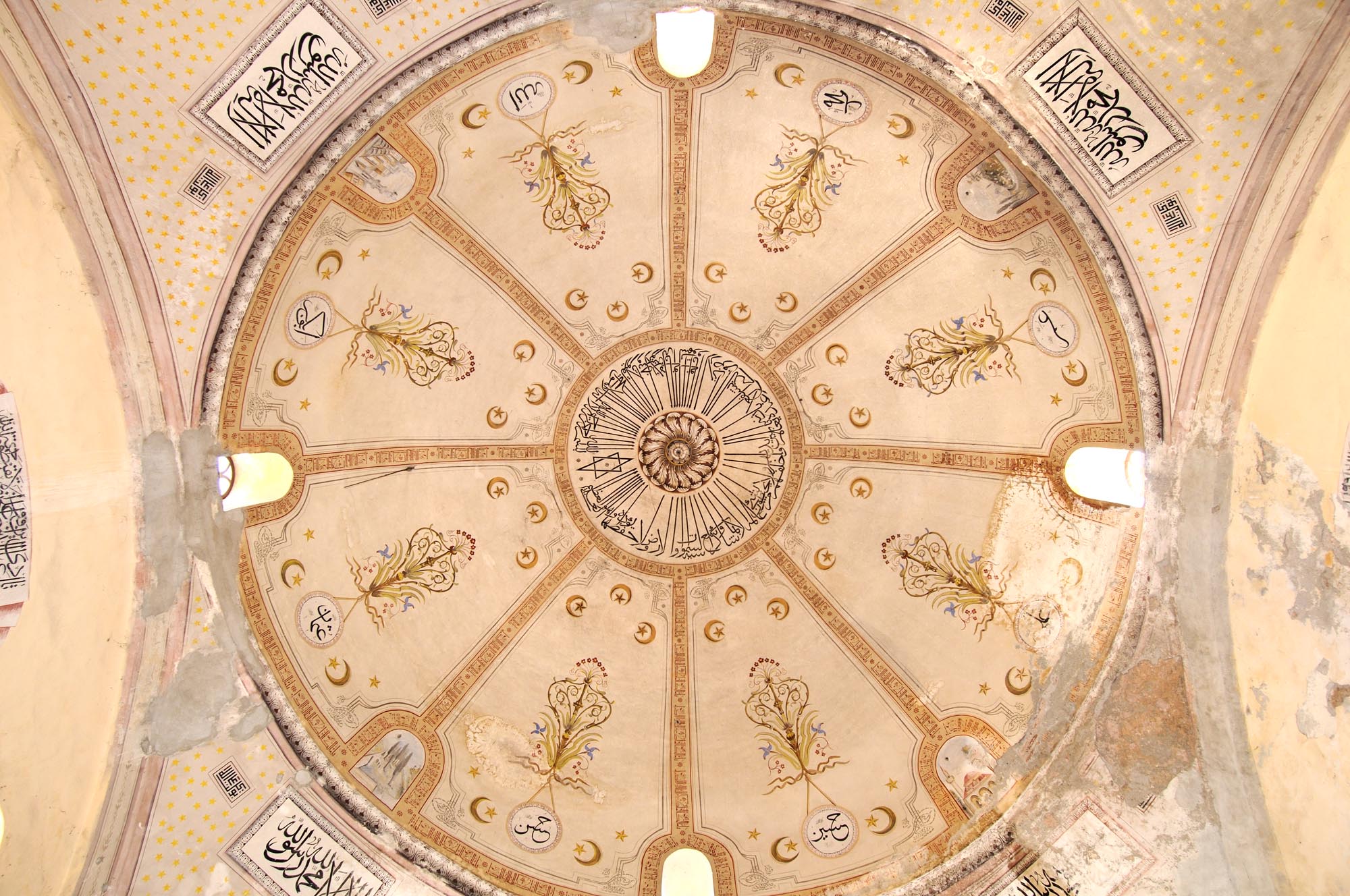
Built, probably in the 16th century, on the southeast side of the city just outside the walls, next to St Paul’s Tribune today, the mosque formed part of an extensive madrasa (religious school) complex which operated at least until the end of the 19th century. It is identified as the madrasa vividly described by Evlija Çelebi, who was impressed both by the beauty of the surrounding landscape and by its spiritual fame, as prominent scientists and scholars of the city gathered here. The monument, built entirely of regular courses of limestone ashlars in isodomic masonry, is square in plan, measures 12.50 x 12.50 m and is roofed with a large dome 12 m in diameter. On the east side is the minaret, while on the north side is a rectangular porch. Of particular interest are the wall paintings on the interior of the dome, which date from the first half of the 19th century and include four paintings depicting landscapes and mosques of Veria. The monument is now the property of the Holy Metropolis of Veria, Naoussa and Campania and operates as the Pauline Cultural Centre.
Double Ottoman Hammam (Tuzci Hammam) (junction of Loutrou and Eleftherias Streets)
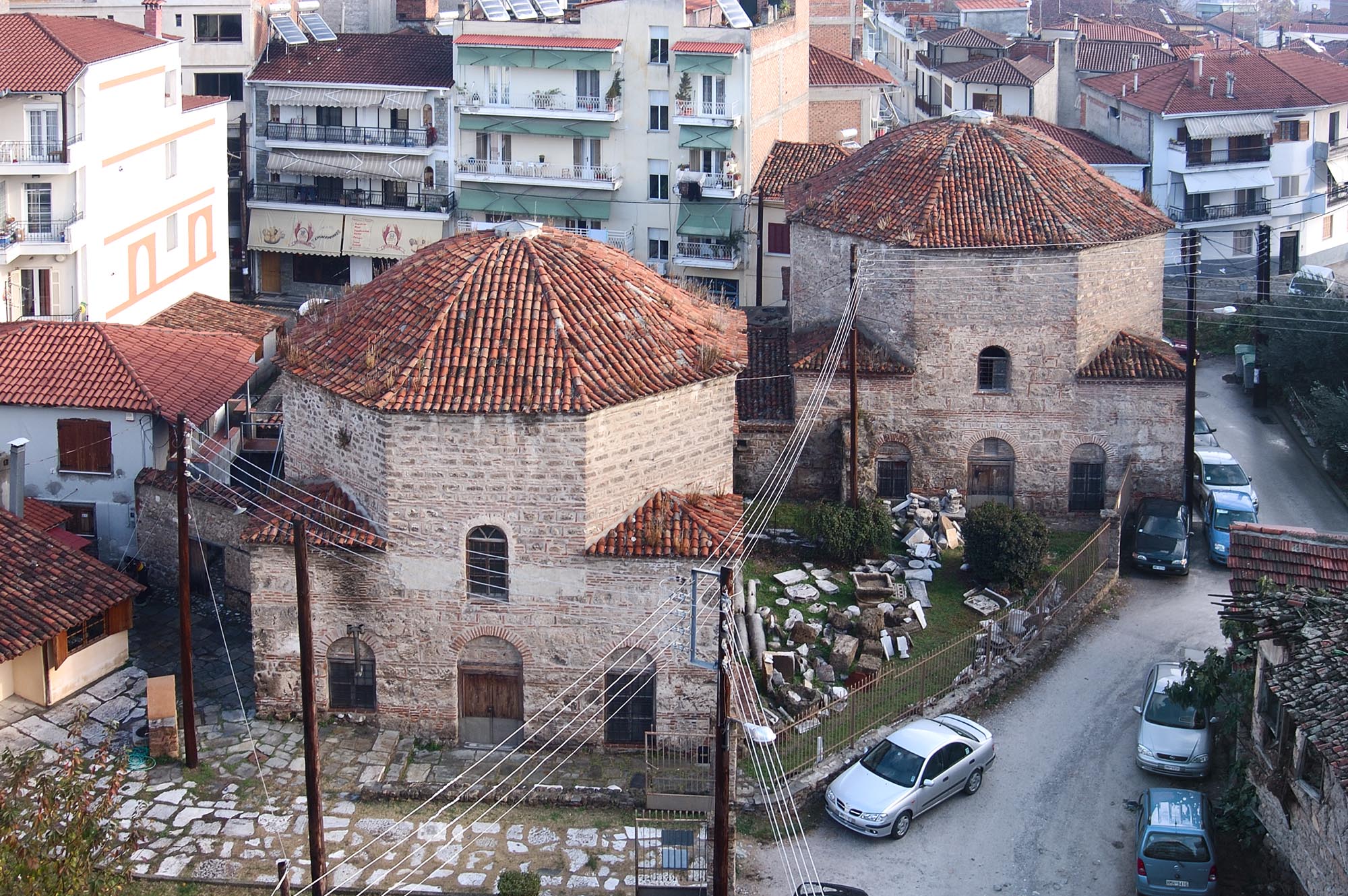
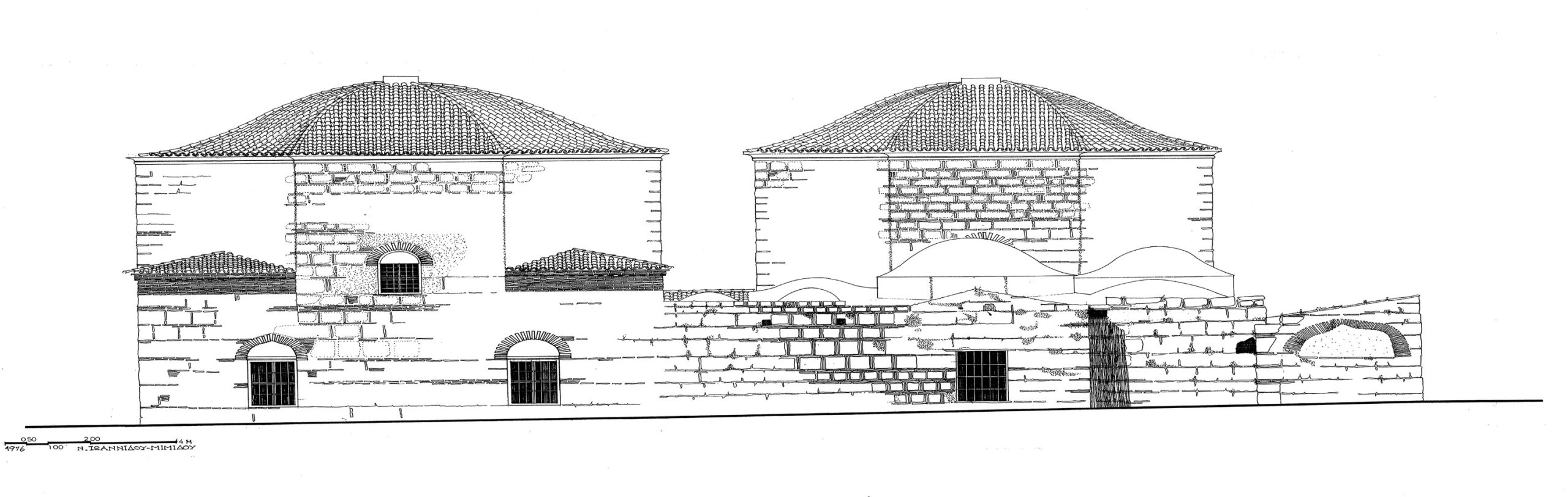
In the city centre, south of Mitropoleos Street, stands the Tuzci Hammam (Salt Merchant’s Baths), also mistakenly called the “Tsis Hammam”, which is identified with the Hammam of Sinan the Salt Merchant mentioned in the late 17th century by Evliya Çelebi as one of the five double hammams of the city. Based on its architectural and morphological features, it dates from the late 15th century and was probably part of the külliye (charitable foundation complex) of Sinan Bey, who is recorded in an Ottoman register of 1500 as having endowed the city with a bedesten (covered market) and perhaps a mosque with a school. The hammam is a large building with elaborate masonry, with a total area of about 545 m2, consisting of two sections (male and female), which do not communicate with each other and are arranged transversely, so that the whole complex has an L-shaped plan. Each section of the bath consists of three parts (changing room, tepid and hot room), with the two changing rooms of each section being roofed by large, high domes that rise above the monument. The other rooms are lower and covered with small perforated domes or vaults with lean-to or saddleback roofs. Besides its remarkable architectural features, the monument also stands out for its rare wall paintings which have so far been revealed mainly in the men’s changing room, the dominant theme being a hunting scene and exotic animals (elephant and giraffe).

Karahmet Bridge
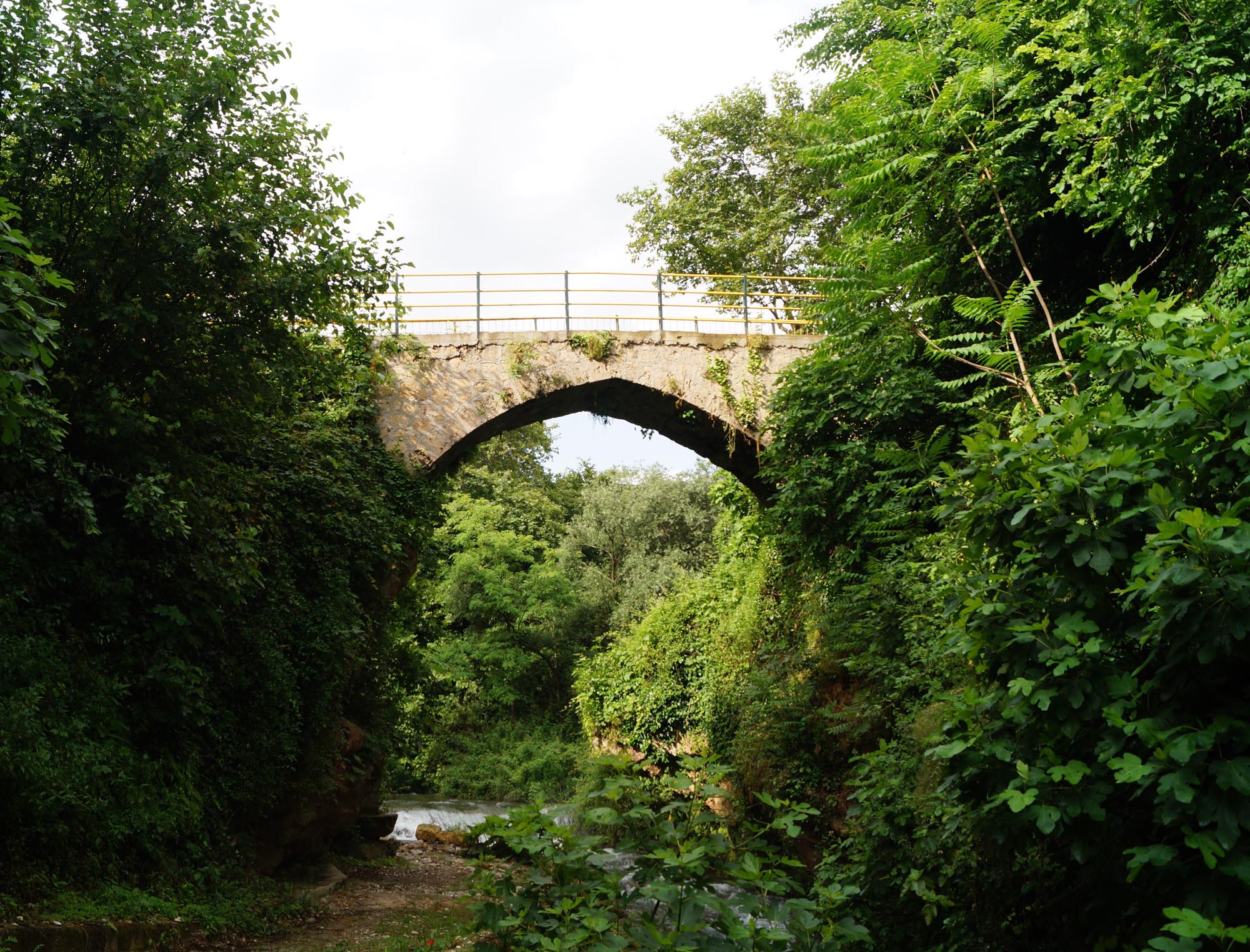
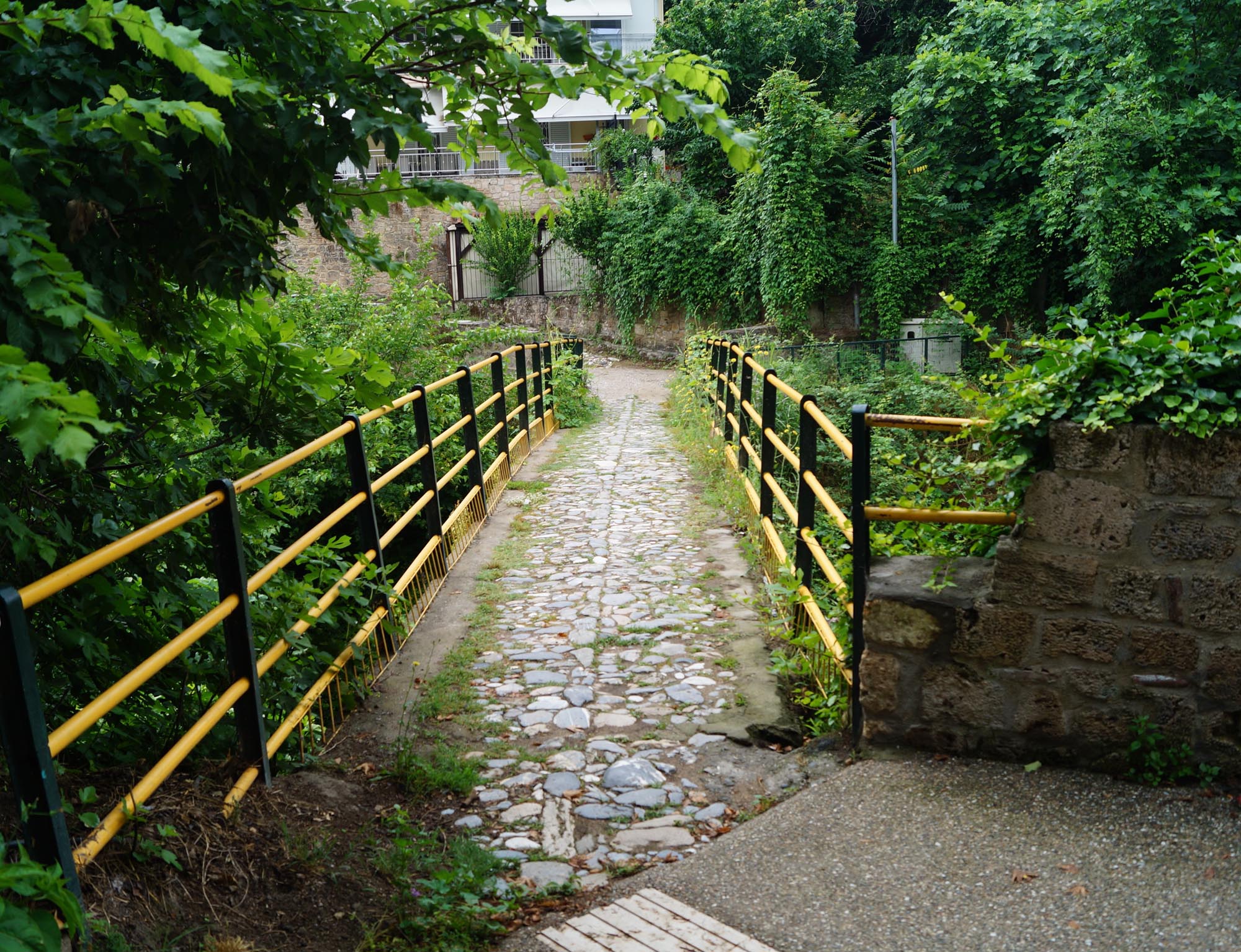
This the only surviving one of the stone and wooden bridges that once spanned the River Tripotamos. The others were washed away in a major flood in 1935 and have been replaced by modern concrete bridges. The stone bridge of the Ottoman period is a single-arch bridge 20 m long, 2.20 m wide and 10 m high from the level of the riverbed. Various theories have been proposed concerning its name, for example that it is that of the sponsor who paid for its construction. Some scholars identify it with the “ornate” single-arch bridge, like a “high rainbow”, admiringly described by Evliya Çelebi, who says it was built in 1586 by Sinan Bey, probably a different person to the Sinan Bey to whom the city’s double hammam is attributed.
Byzantine and post-Byzantine churches of Veria
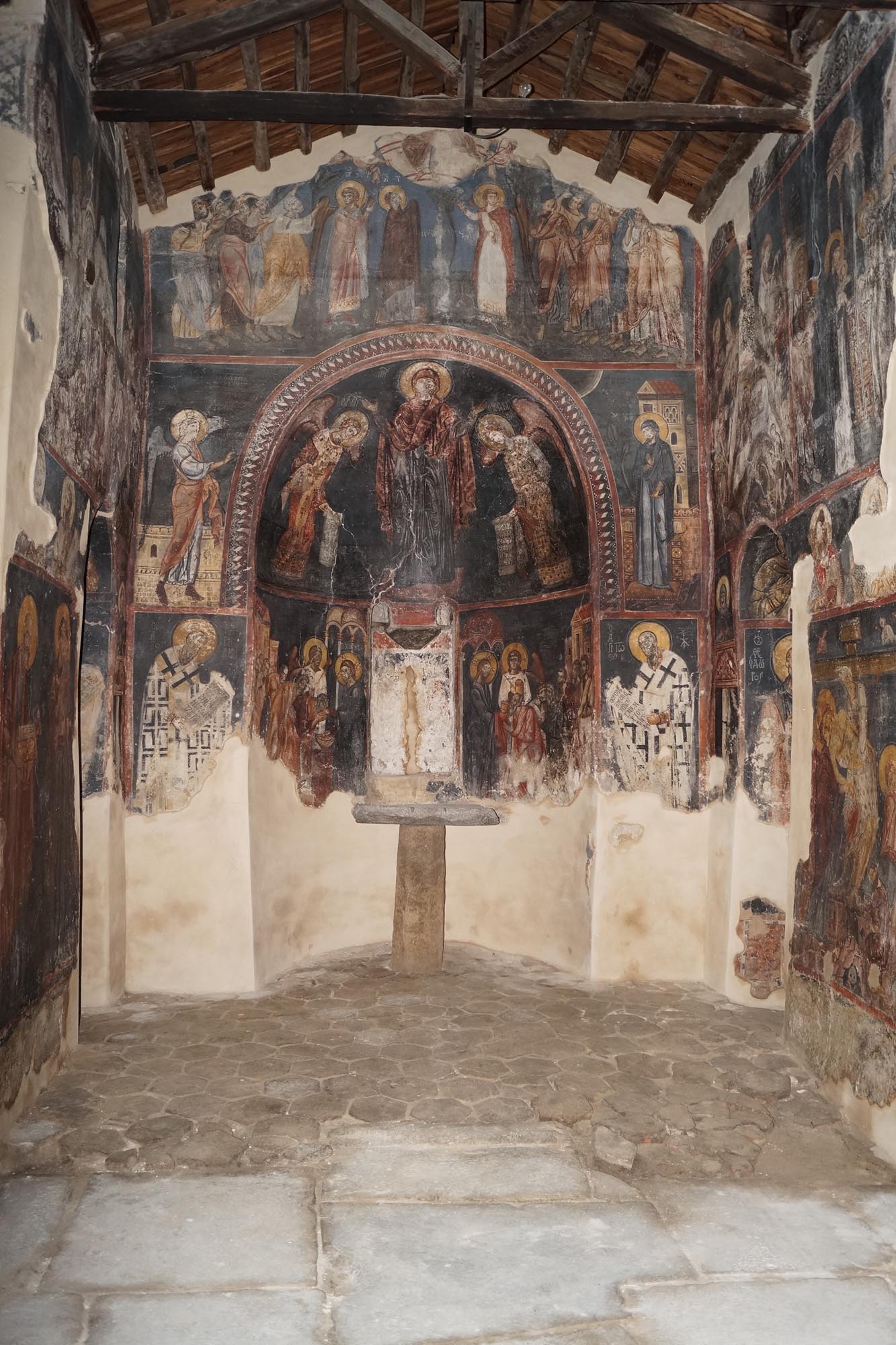
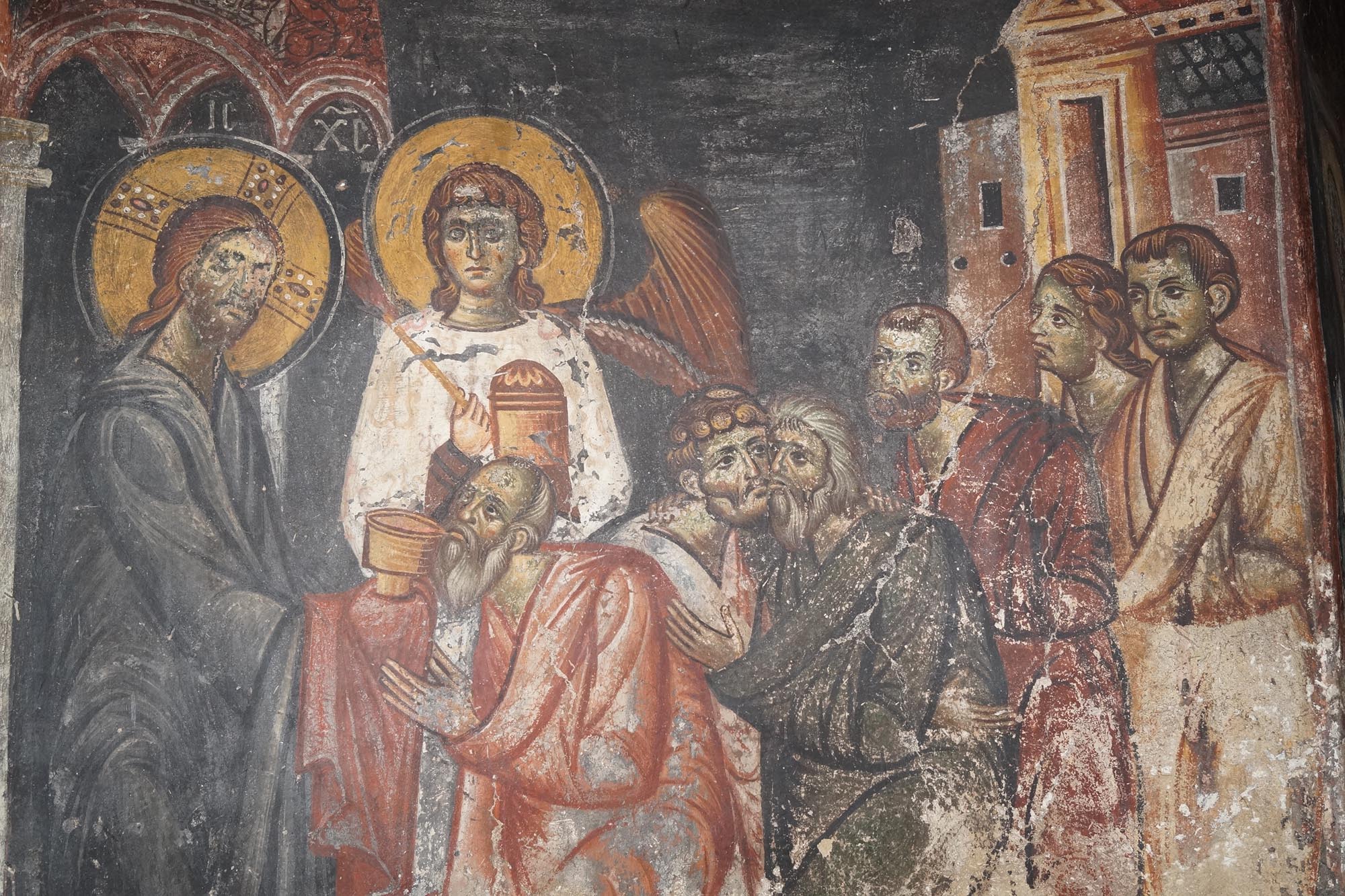
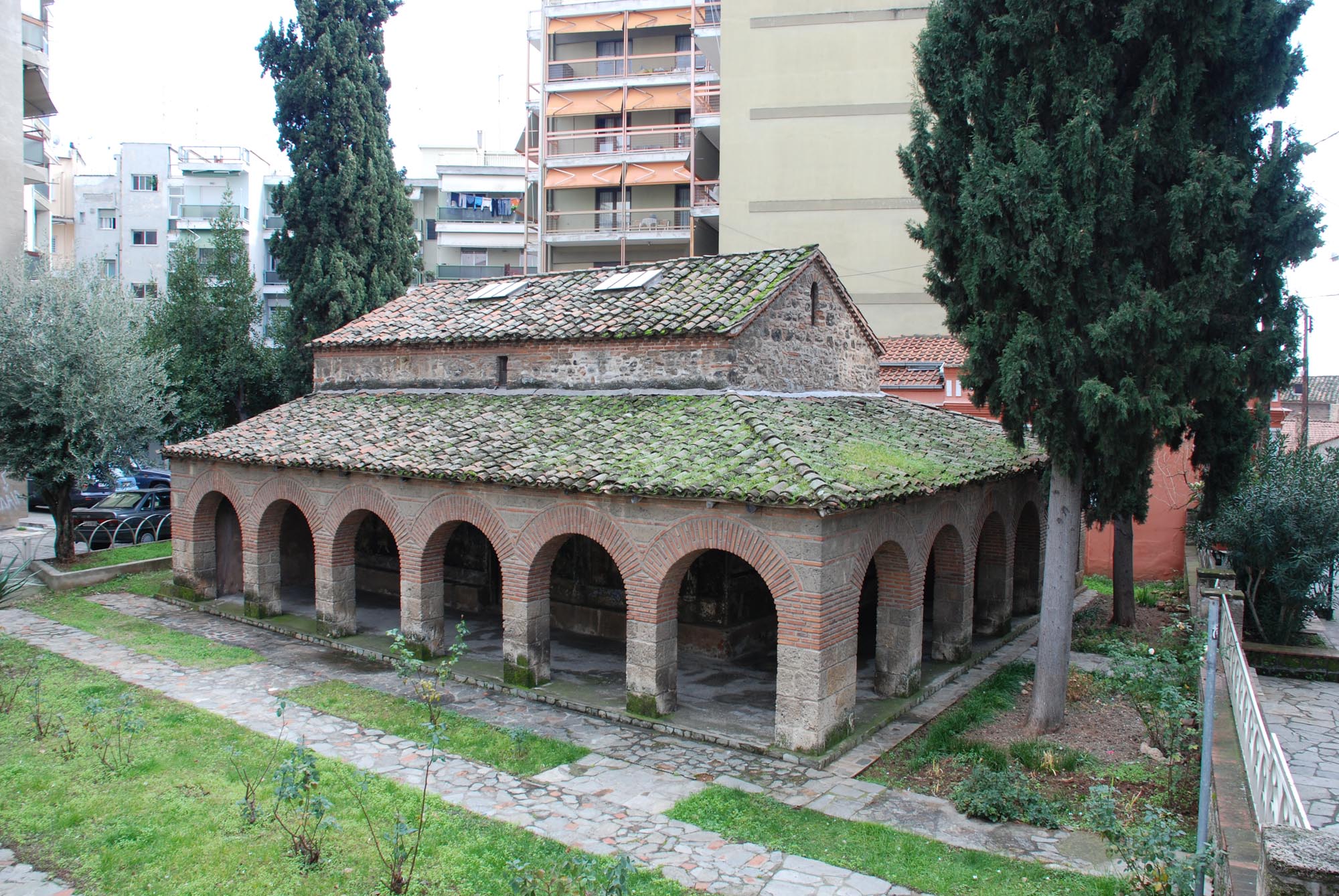
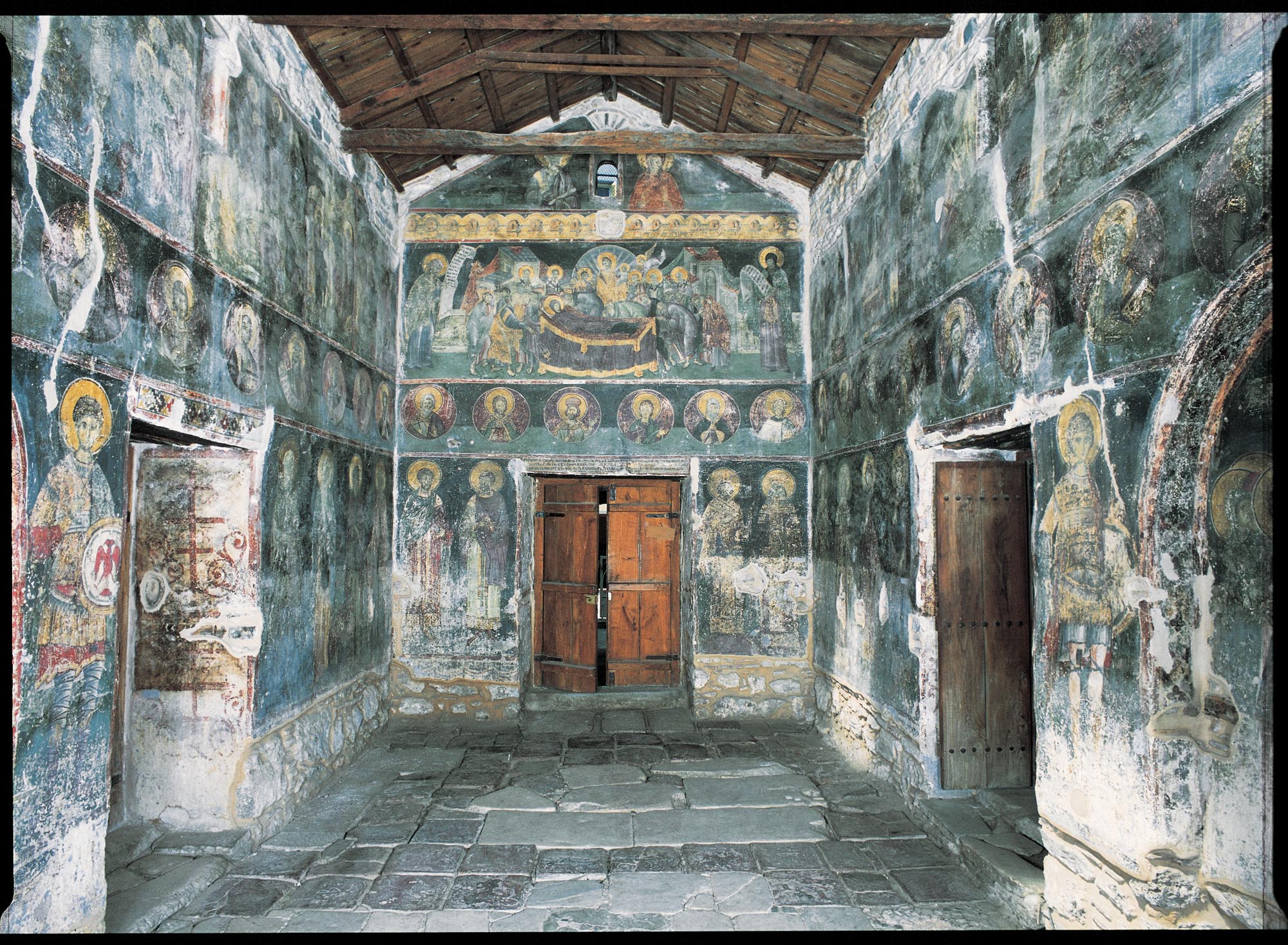
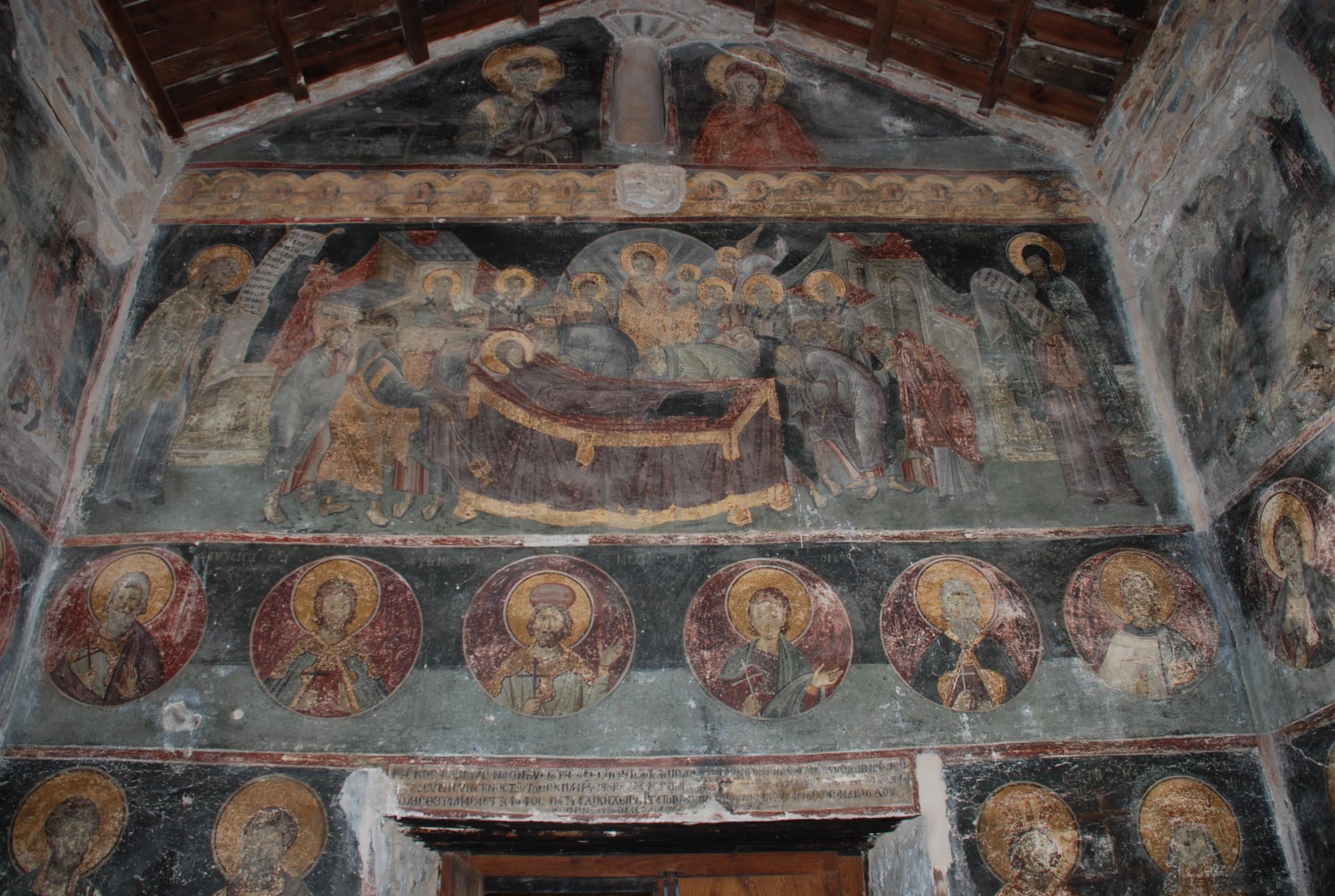
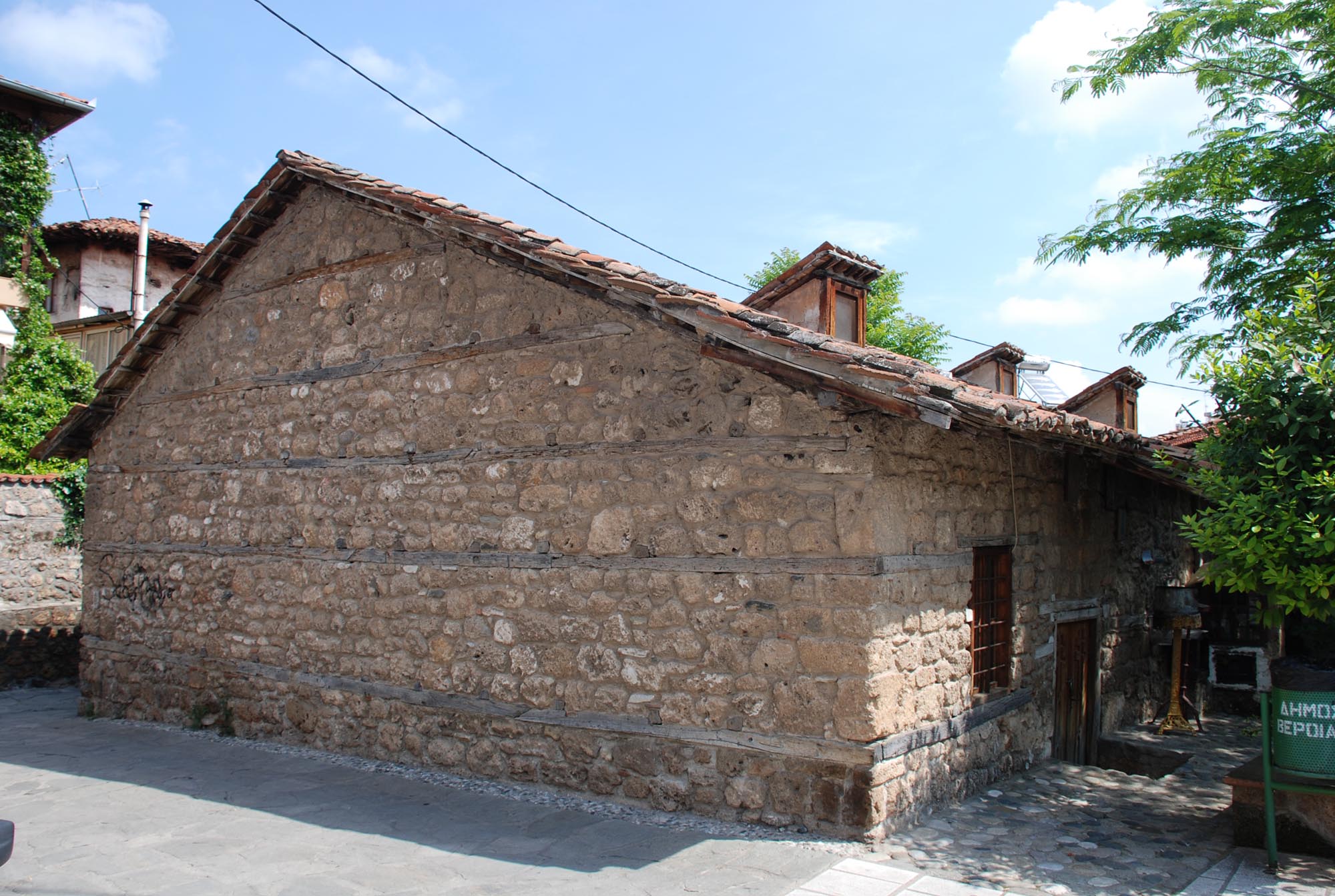
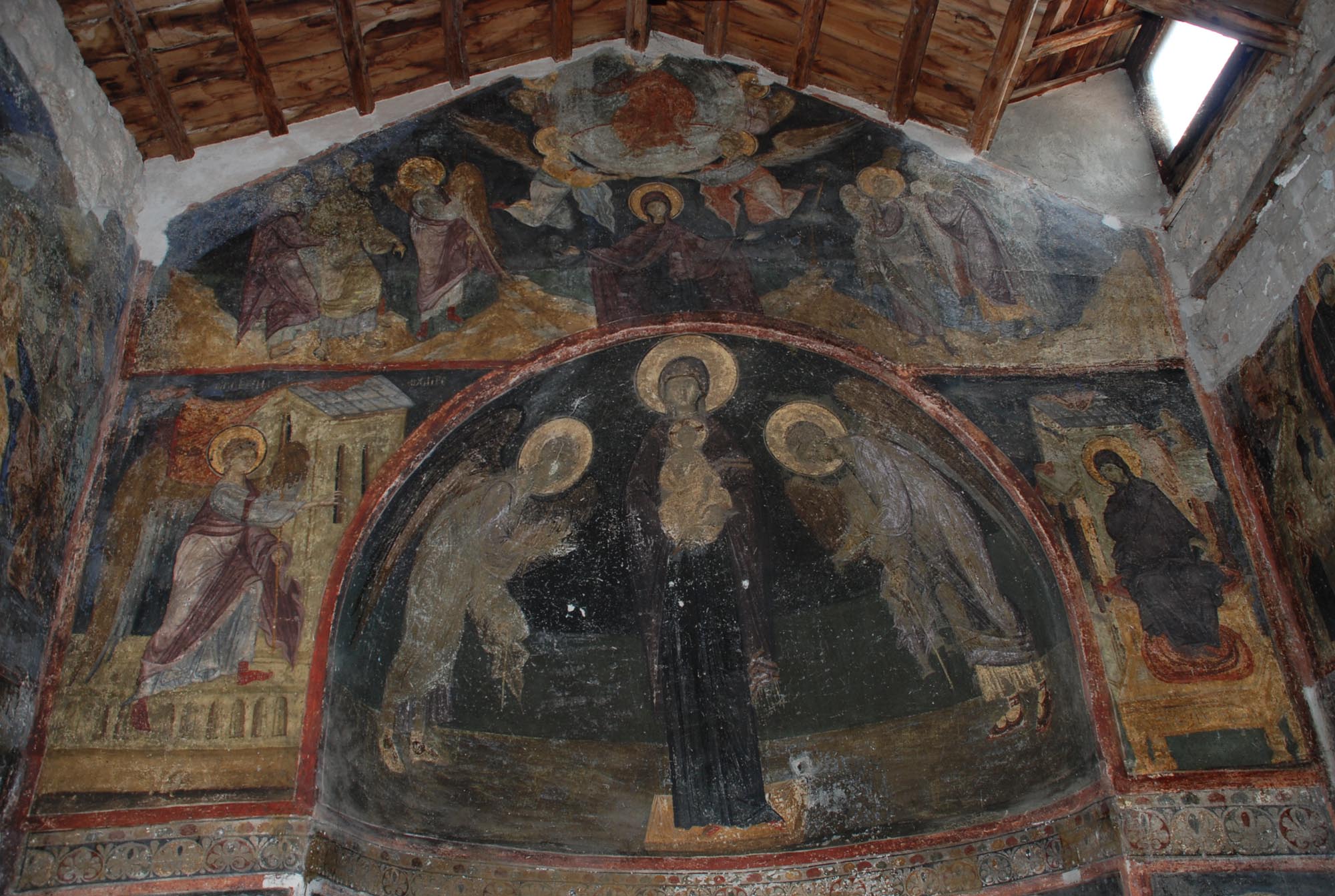
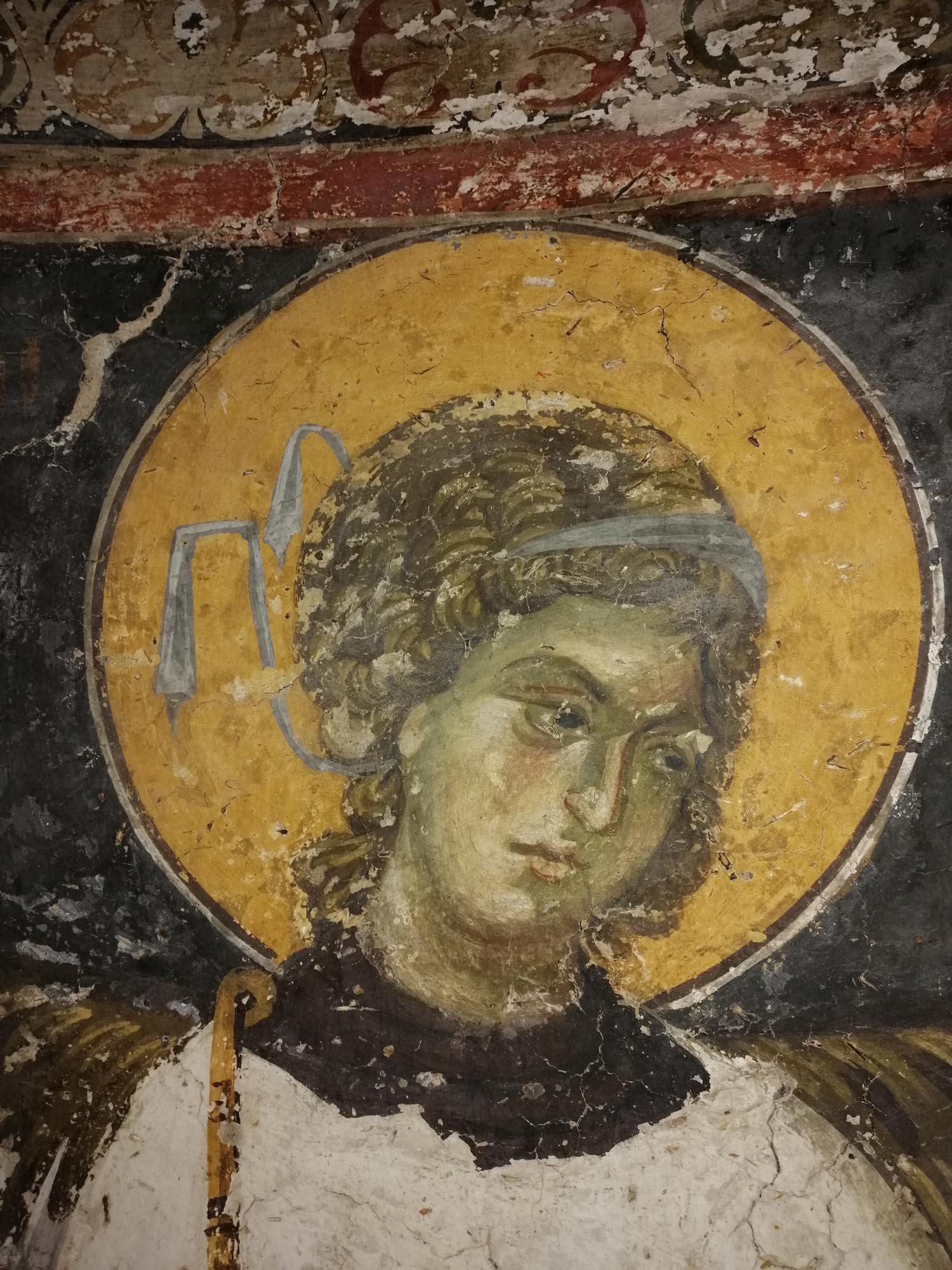
On its incorporation into the Greek State in 1912, Veria boasted an impressive number of 72 Byzantine and post-Byzantine churches, of which 48 are preserved today. Most are found in the two traditional districts of Kyriotissa and Makariotissa. The extensive post-war rebuilding of the city systematically ignored the unique features of its urban fabric, with the result that, due mainly to the opening of new roads, many of the city’s churches were demolished after 1950. With the exception of the Old Metropolis, which stands out for its size and architecture, the churches are mostly relatively small, low buildings with plain exteriors. They are limited to just two types, the three-aisled basilica and the single-nave church, with a single exception (SS Kyrikos and Julitta). Most of the churches of Veria are dated after the 14th century, while they have undergone various interventions over the centuries, usually with the addition of ambulatories or galleries to their original nucleus, with the result that almost none of them preserves its original architectural form intact. They are richly painted on the inside with frescoes which, due to the continuous operation and use of the churches and the constant alterations and renovations, usually do not belong to a single period but form a series of successive layers of different eras. In the monumental art of Veria, the development of Byzantine and post-Byzantine painting is followed uninterruptedly from the 12th century, to which the oldest examples belong (Old Metropolis), up to the 19th century.
Some of the most important churches of the city are presented below in chronological order.
Old Metropolis (34, Kentriki St.)
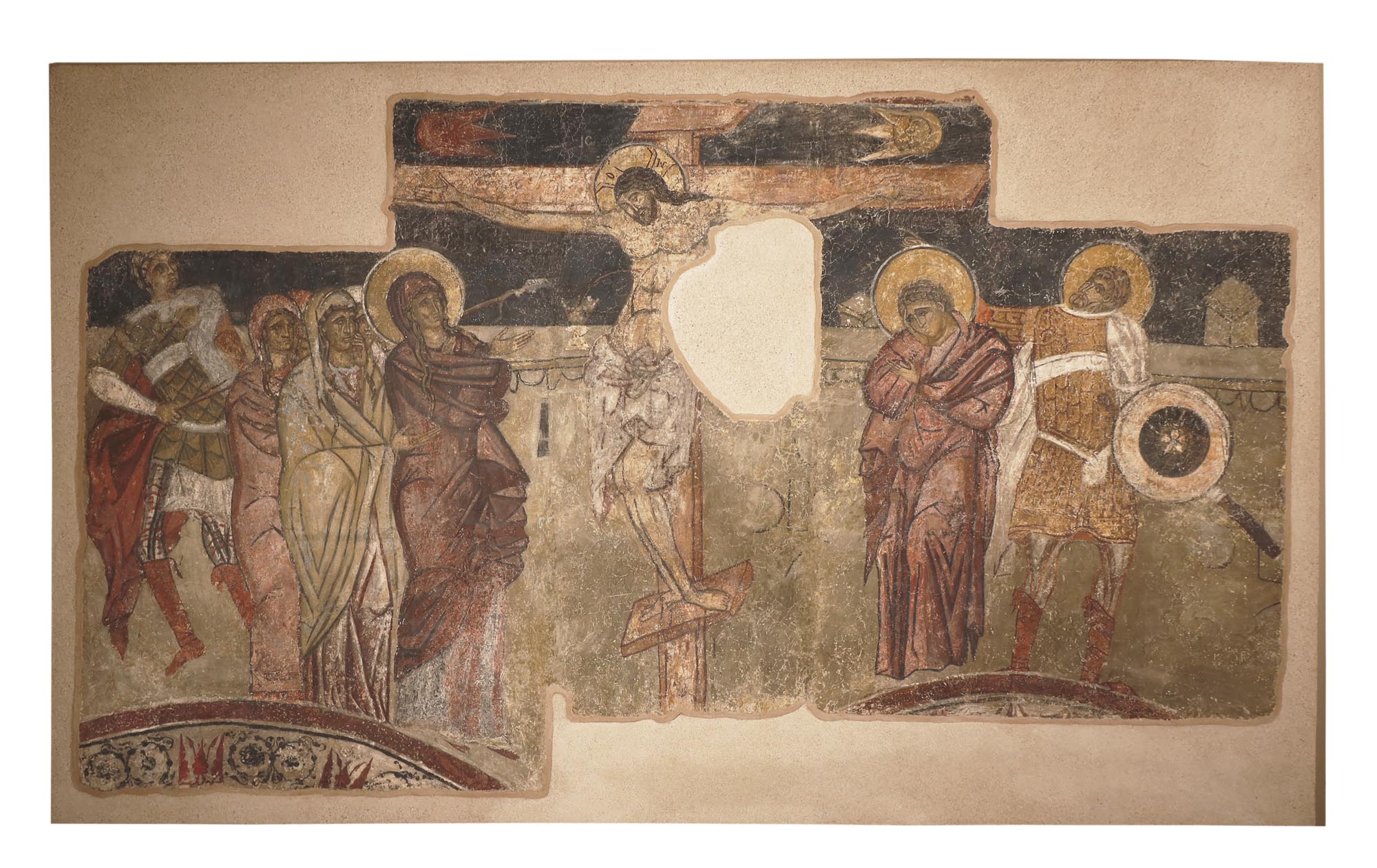
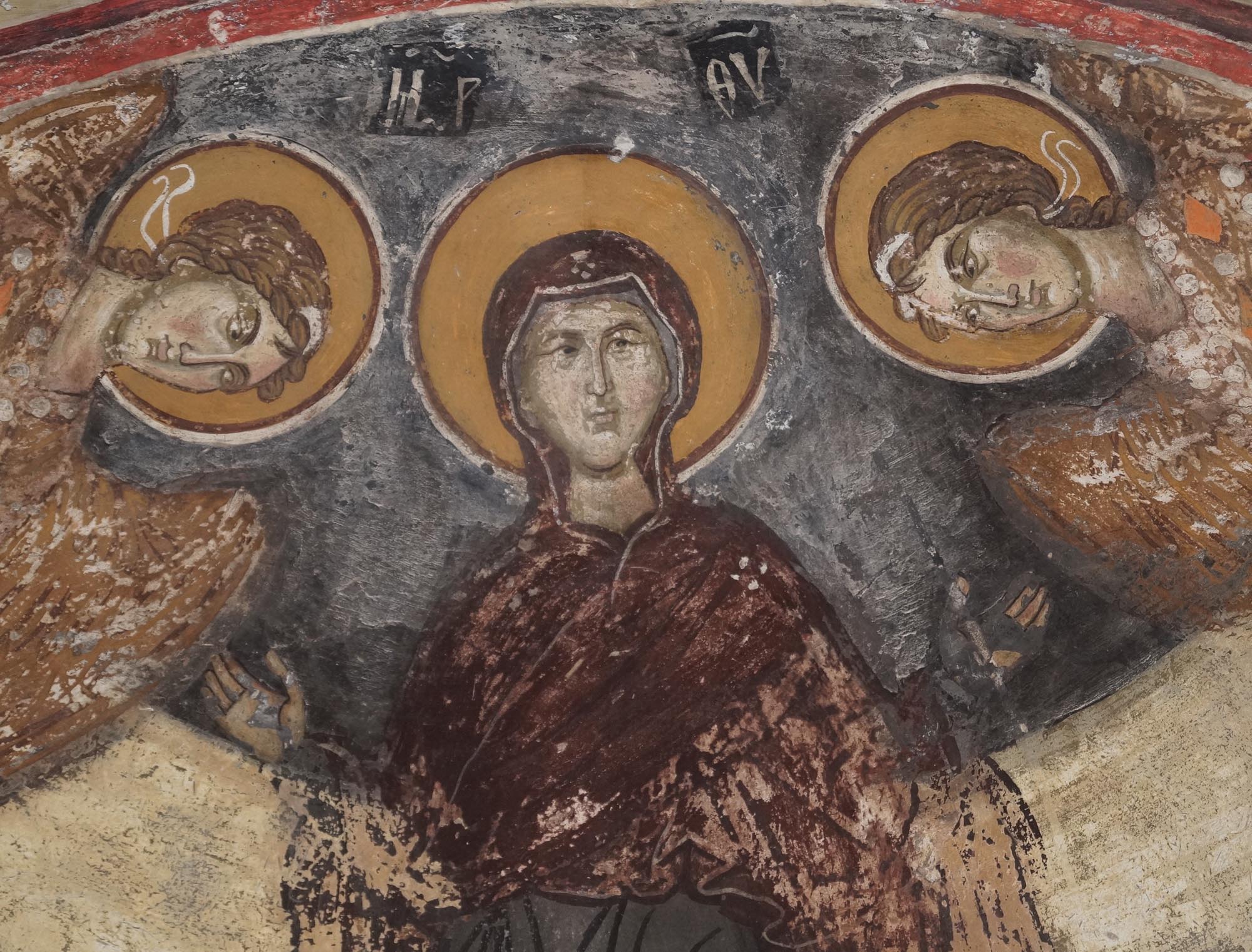
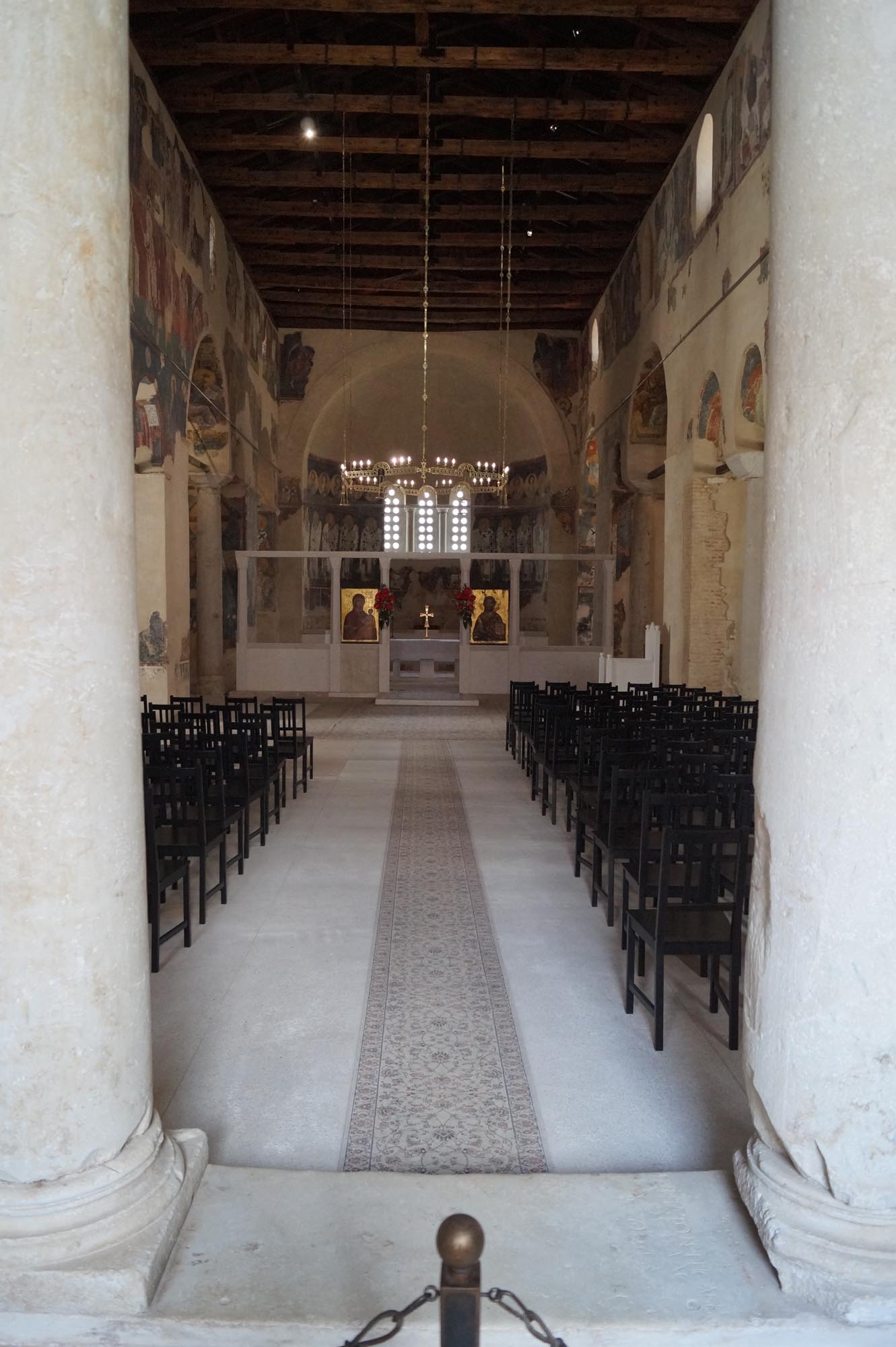
The church is located in the southwest part of the old town, on Kentrikis Street. A three-aisled basilica with a narthex and transept, it is the most important monument of Veria and one of the most significant in the Balkans, primarily due to its size, its architectural form and the high quality of its sculptural and painted decoration. For centuries it was the metropolitan church of the city, probably dedicated to the Virgin and the leading Apostles Peter and Paul. Over the years it has undergone extensive building interventions, of which the initial one, visible only in the foundations and the lower walls, dates from the 7th-8th centuries. Later, in the late 11th to early 12th century, the church was rebuilt at the expense of Nikitas, the bishop of Veria. The form of the monument was altered significantly after its conversion into an Ottoman mosque (the Hünkar Mosque) in the late 16th or early 17th century. During its long period of operation as a mosque, its south aisle collapsed or was deliberately demolished, and a minaret and an open gallery were added on the north side.
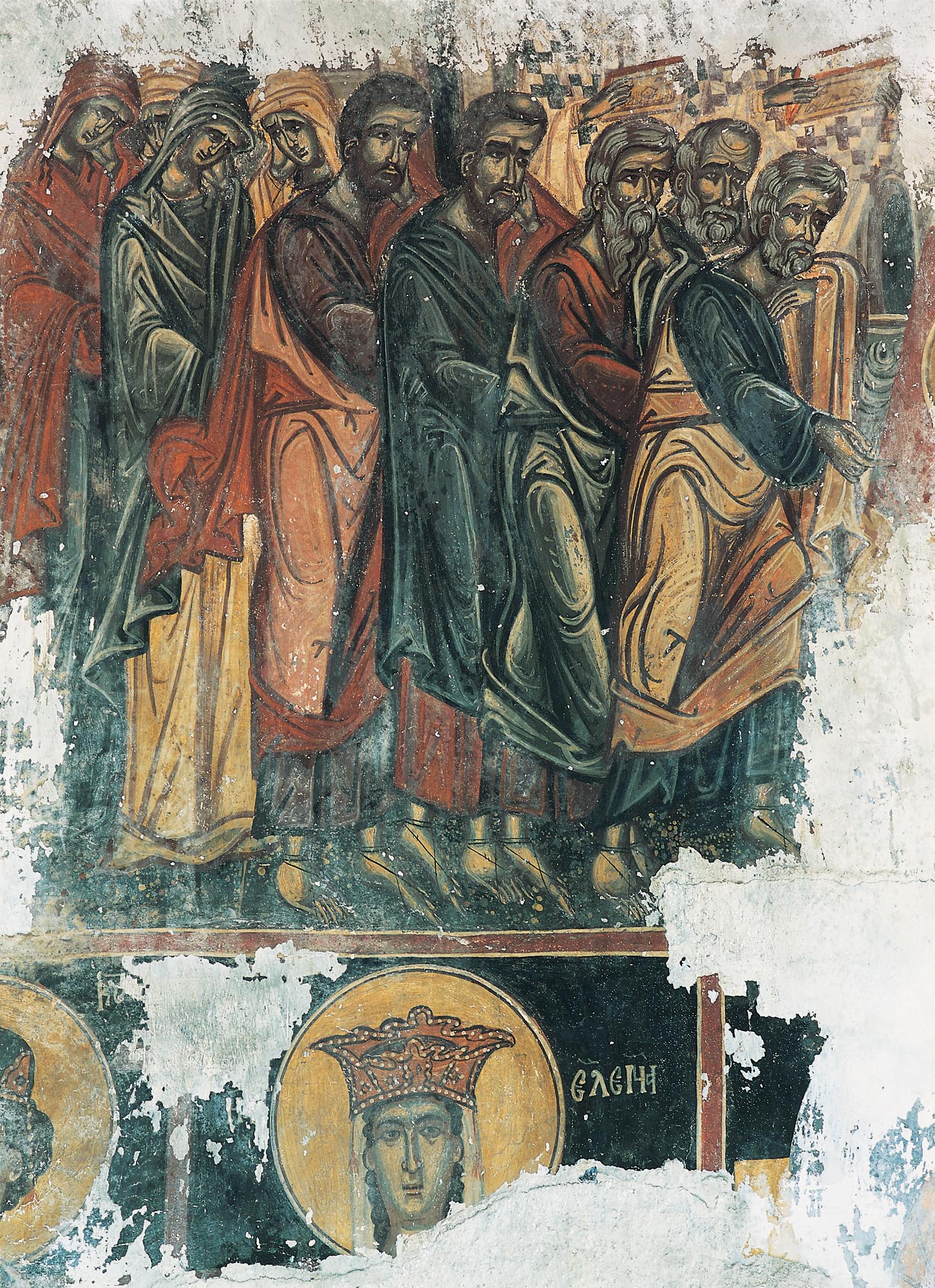
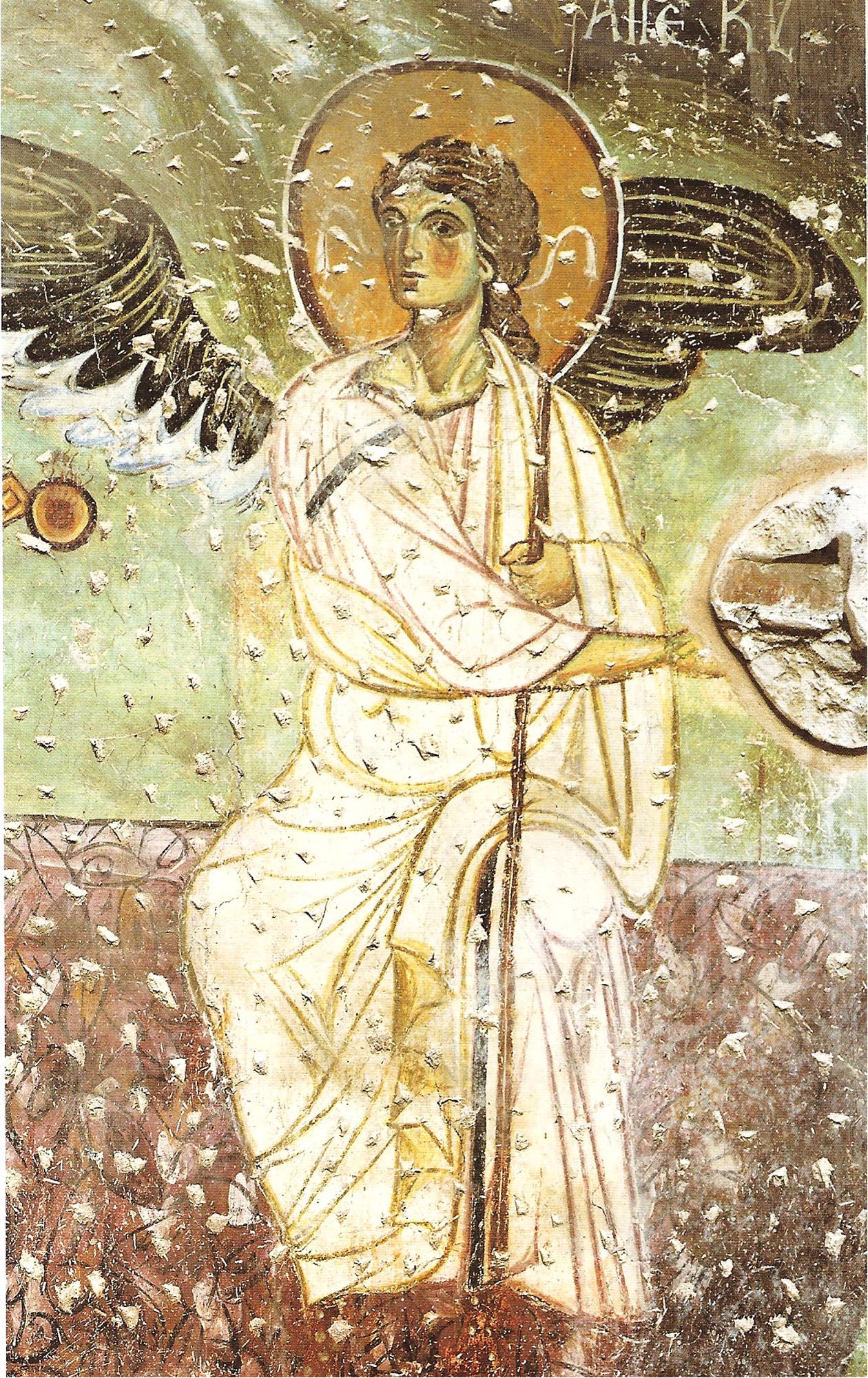
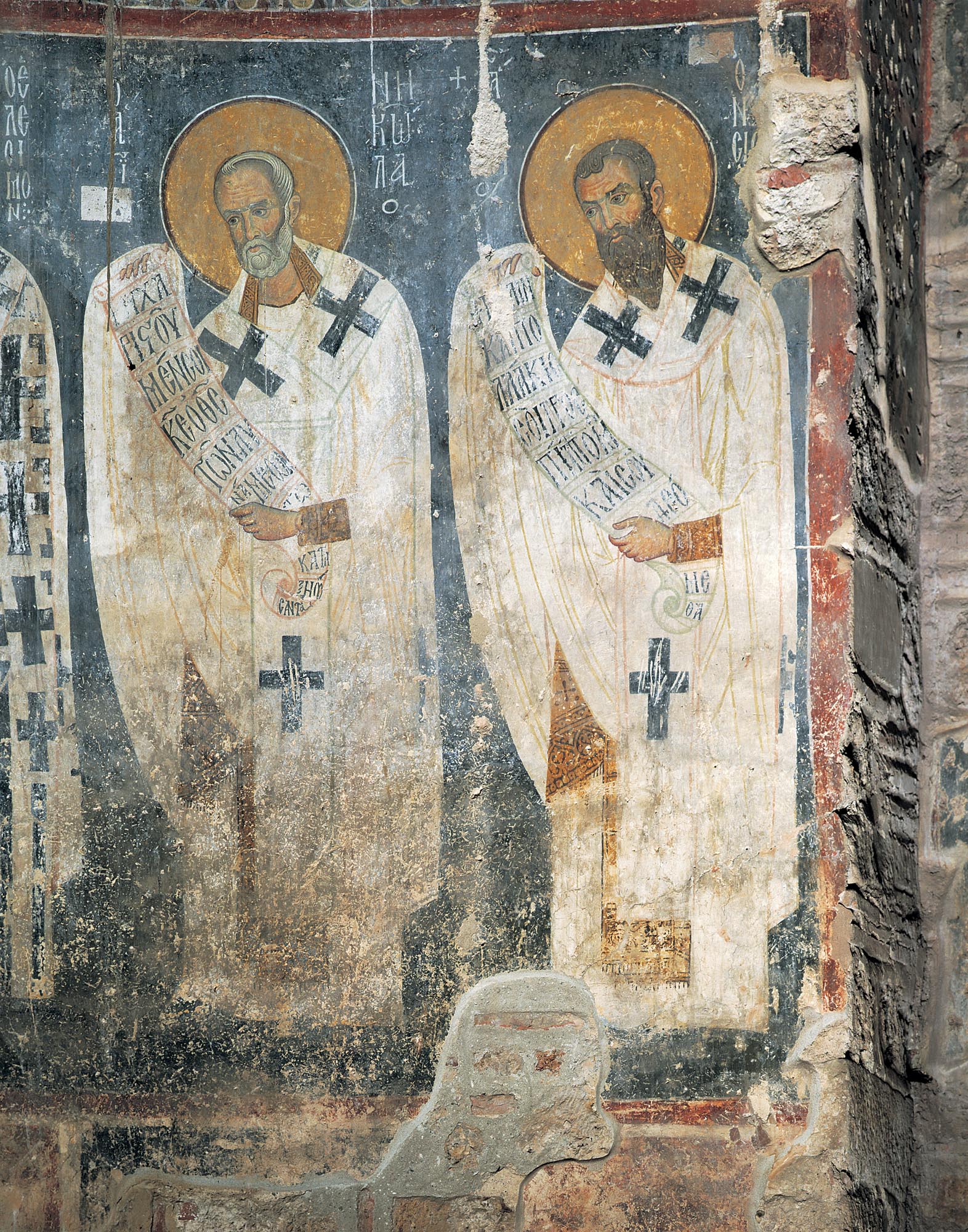
The frescoes inside the monument range from the early 12th to the early 14th century. Most of them belong to the layer dated between 1220 and 1229, during the reign of the ruler of the Despotate of Epirus, Theodore Komnenos Doukas. The exceptional frescoes, which have been linked to those in the katholikon of the Mileševa Monastery in Serbia (1222-1228) and echo the official art of Thessaloniki, express through well-chosen allegories the ambitions of the ruler of the Despotate, in a turbulent time, to regain Constantinople, lost in 1204.
Church of St John the Theologian
The church, a three-aisled timber-roofed basilica with a saddleback roof, is preserved in the north part of the old town. It is one of the most important monuments in Veria thanks to the original frescoes in the sanctuary, and is dated by most researchers to the third decade of the 13th century. According to another view, however, the frescoes probably date from the last decades of the same century, as they are closely related to the layer of the same period in the Old Metropolis. Only the sanctuary belongs to the original building phase of the church, while the rest of the building was probably constructed at the beginning of the 17th century, when the wooden templon was added and part of the prothesis was painted with frescoes.
Church of the Resurrection of Christ (Christ the Saviour) (1 Kontogiorgaki St.)
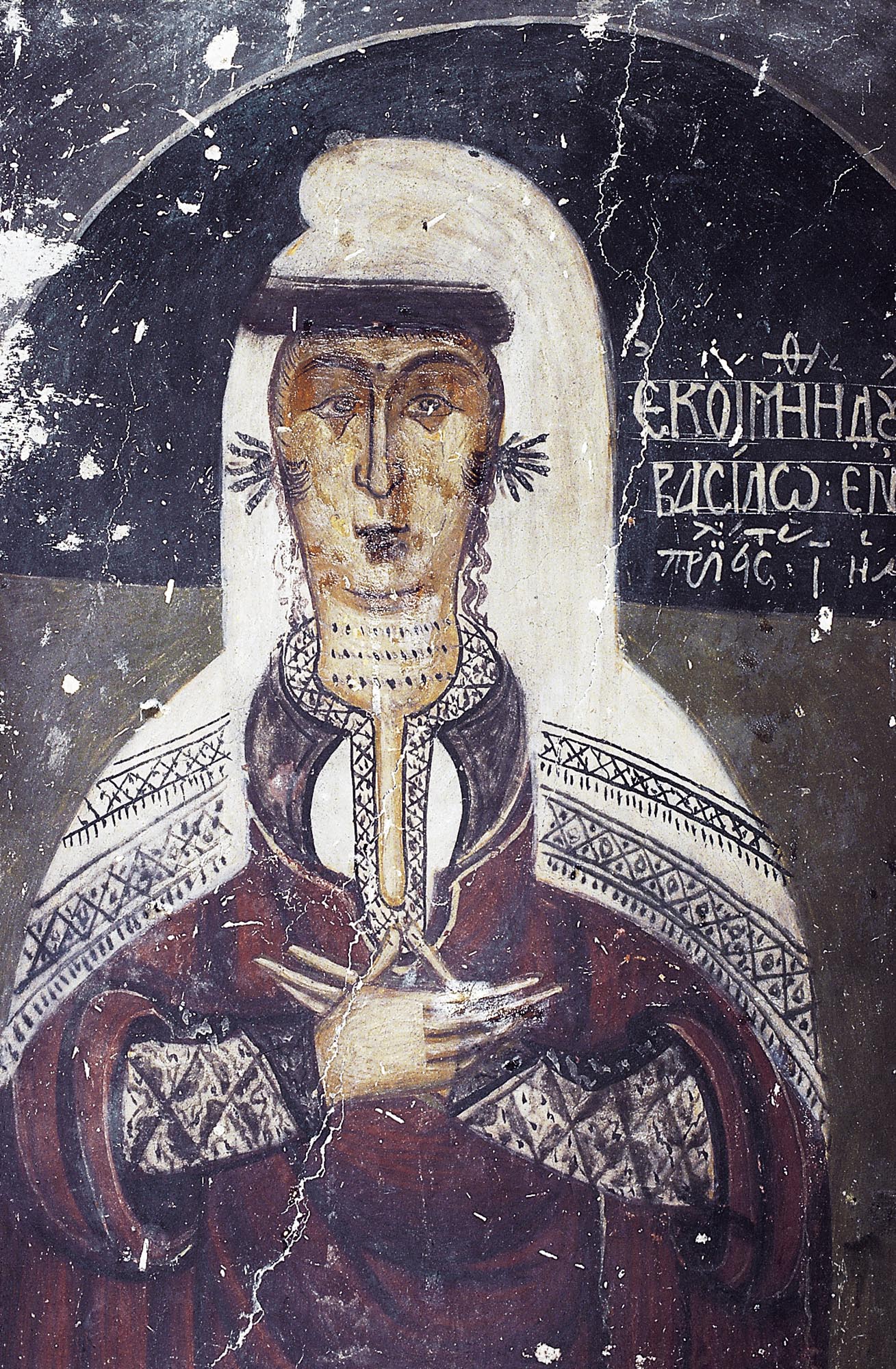
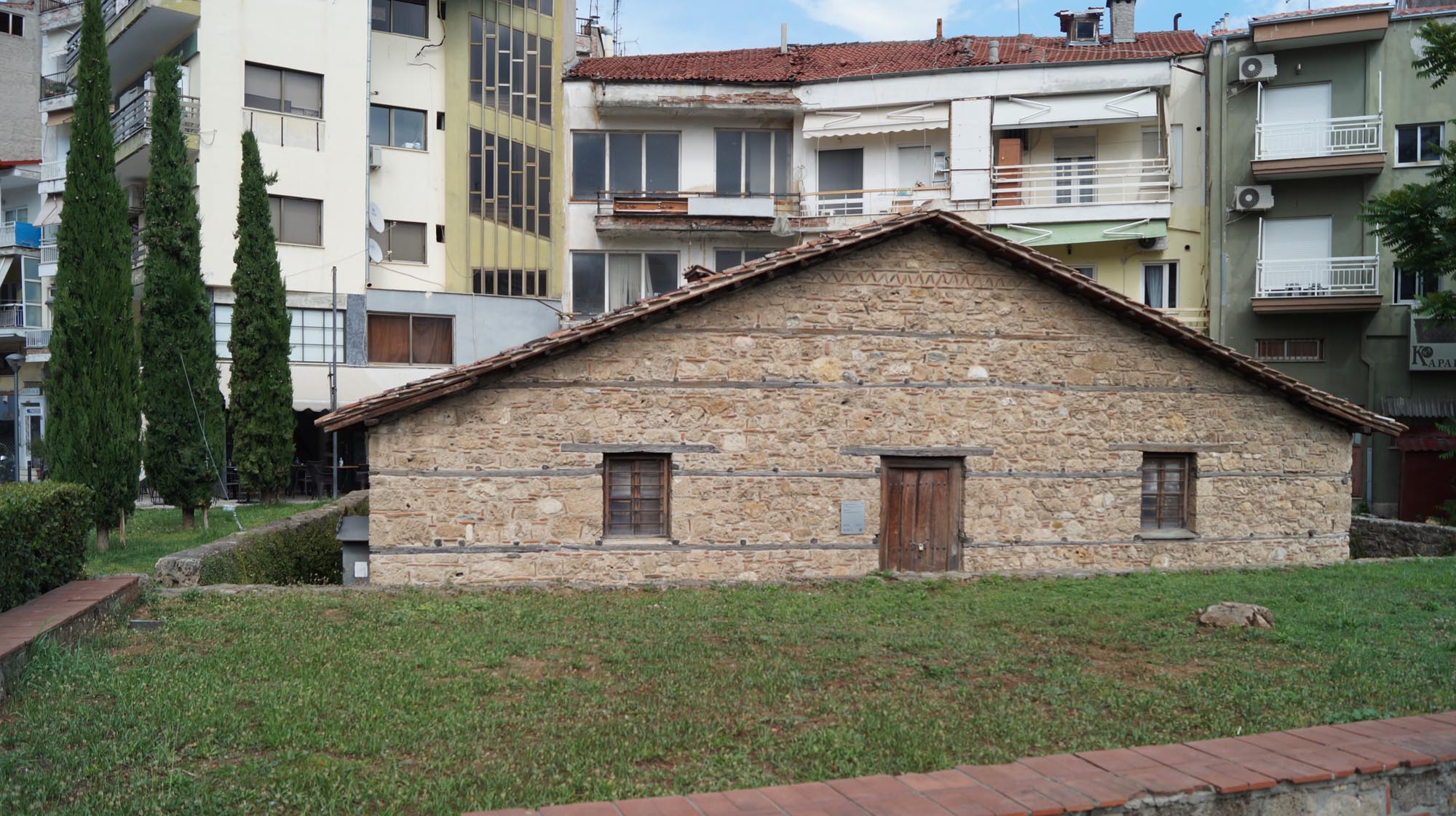
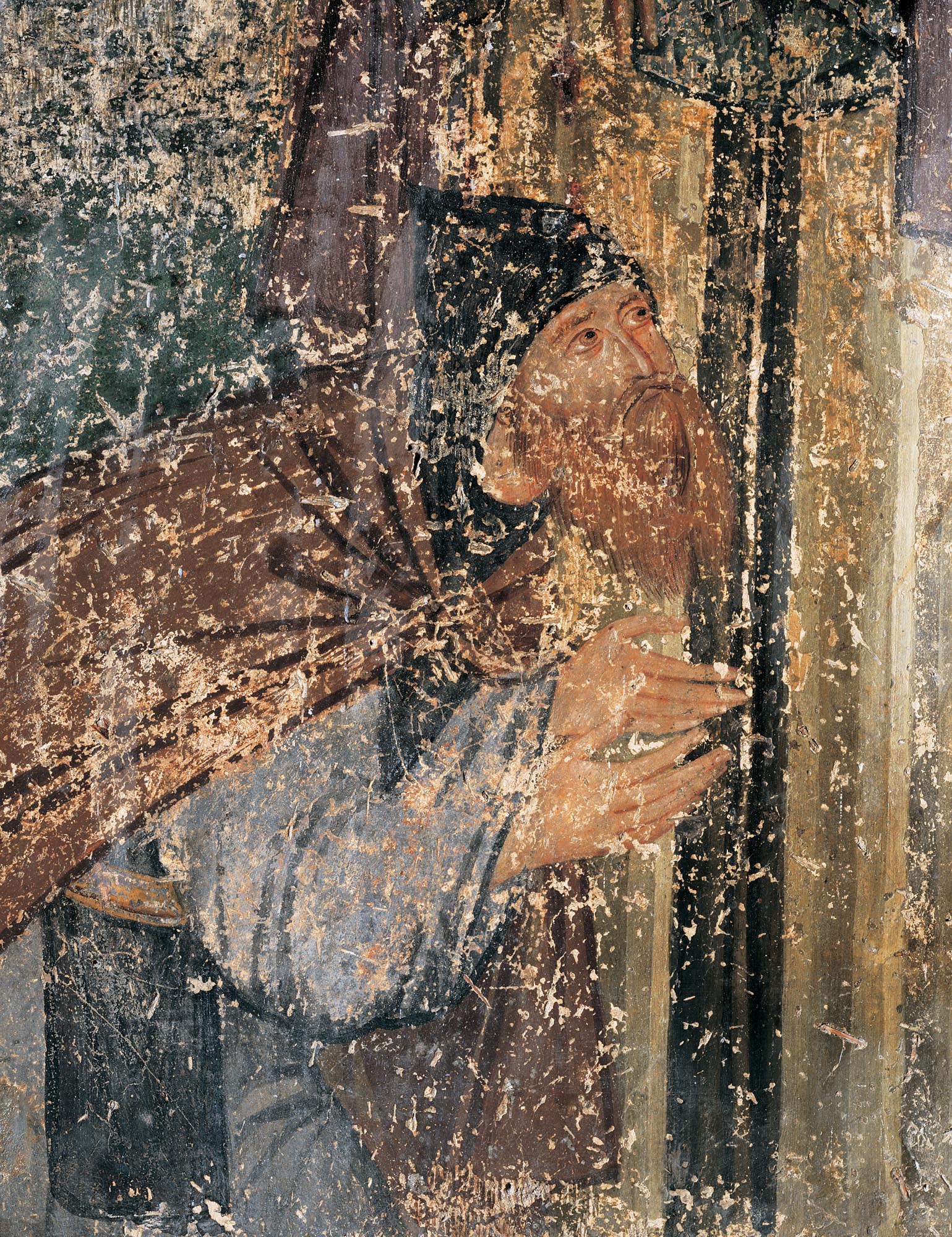
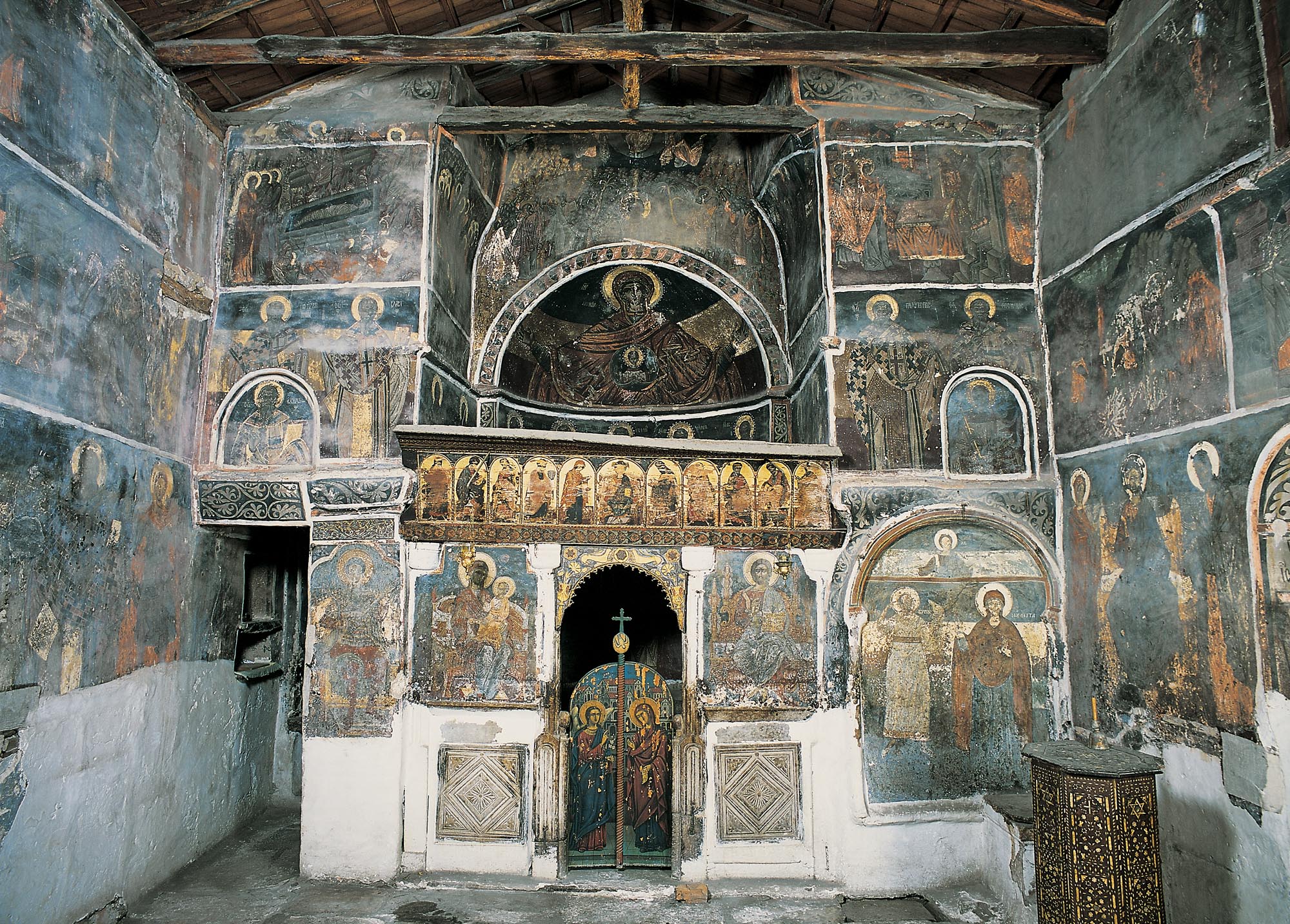
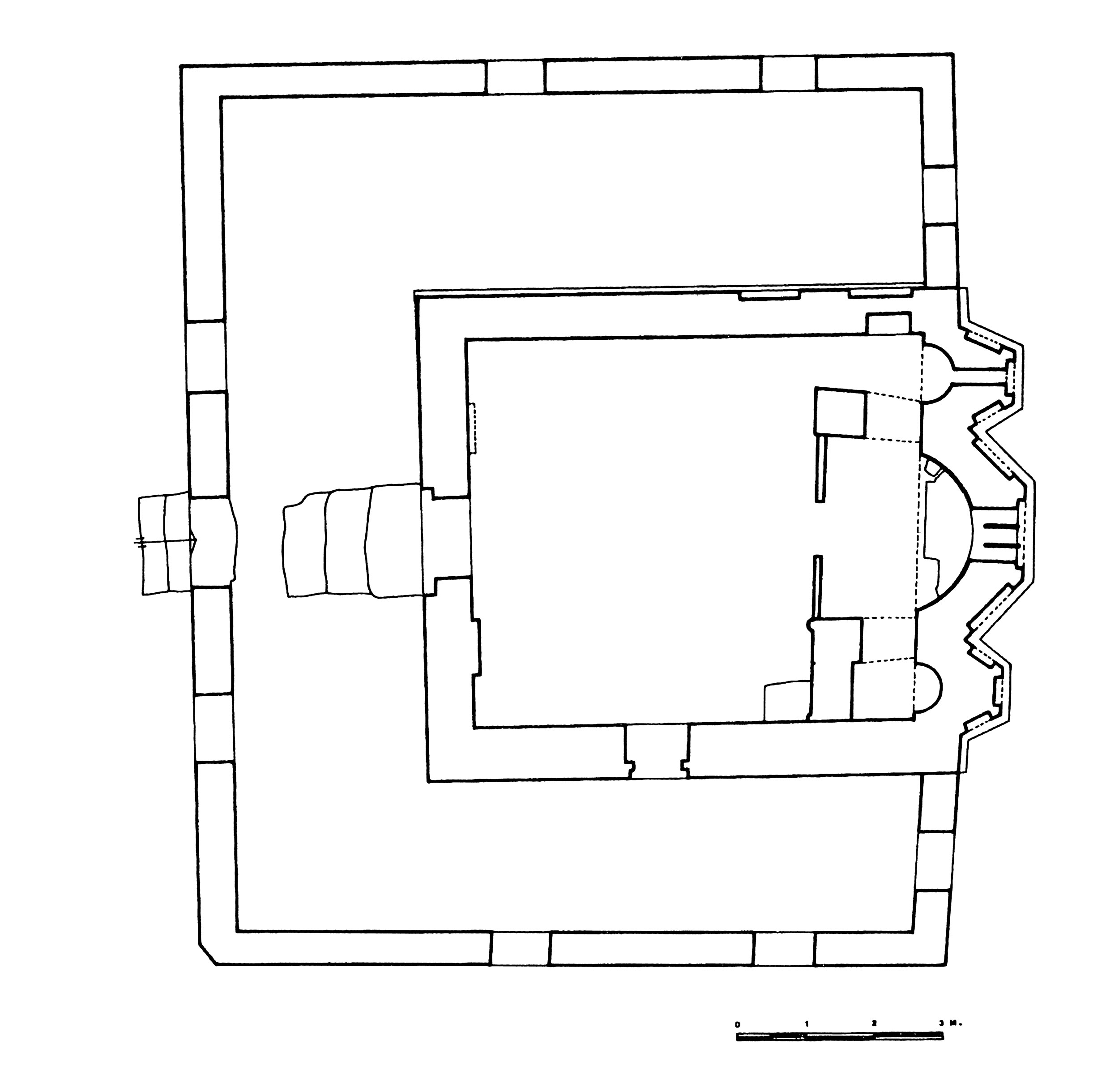
The church is located in the Makariotissa district. Although it is not a particularly splendid building from an architectural point of view, being a simple single-nave timber-roofed church with a later ambulatory (early 18th c.), it is one of the most important monuments of the Palaiologan period, because its high-quality fresco decoration is preserved intact. According to the surviving dedicatory inscription in verse, the church, which was dedicated to the Resurrection of Christ, was erected in 1314/5 at the expense of Xenos Psalidas (who is otherwise unknown) and his wife Euphrosyne. Its frescoes were executed by the “excellent”, as the inscription calls him, painter Georgios Kalliergis (Kallergis), one of the main exponents of the revival movement in painting in the early 14th century, who lived and was active around Thessaloniki. As the inscription also states, the church was consecrated by a patriarch, probably Niphon I, a native of Veria. The south wall of the church bears a portrait of a monk accompanied by a supplicatory inscription, in which the church is referred to as the katholikon of a stavropegic monastery, identified by researchers as the Monastery of Christ the Saviour known from written sources. In 1314 the monastery was granted by Andronikos II Palaiologos with an imperial chrysobull to Abbot Ignatios Kalothetos, an important figure of the time, who maintained close ties with the patriarchal circles of Constantinople. The exterior walls of the church include a depiction of five deceased 14th-century male and female donors in dress typical of the period. The fresco decoration of the church is complemented by the scenes on the external north wall and the ambulatory, which were executed in 1727, during the term of office of Metropolitan Joachim of Veria.
Church of SS Kyrikos and Julitta (Kontogiorgaki St.)
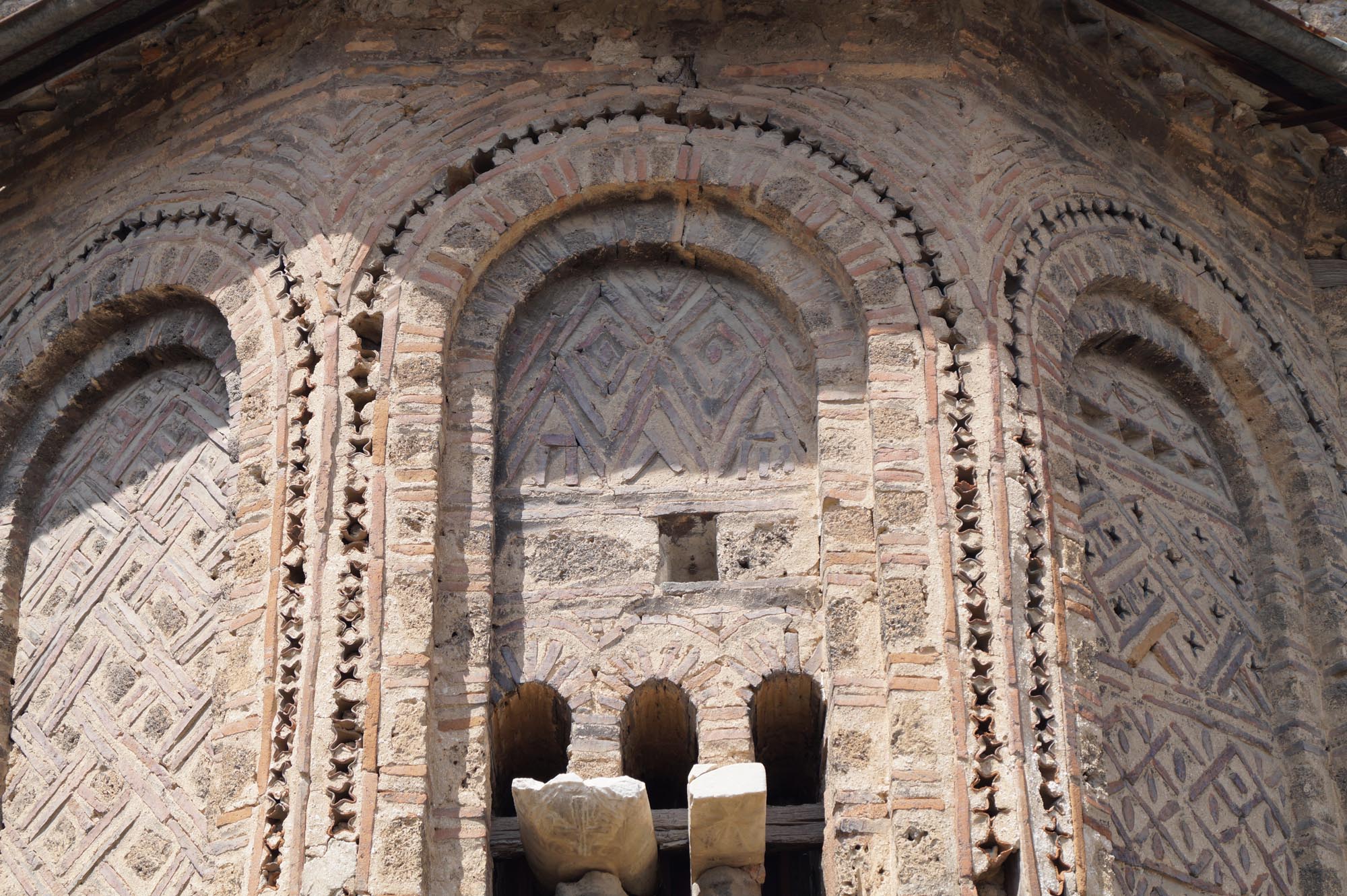
Near the church of Christ the Saviour, the only church in Veria belonging to the typical Byzantine architectural type of the cross-in-square church emerges from a cluster of houses. It was once the katholikon of a monastery and was probably founded in the mid-14th century, based mainly on the brick inscription included in the elaborate decorative brickwork on the exterior of the conch of the sanctuary. The inscription refers to Bishop Makarios, identified as the homonymous bishop of Kastrio or Campania, an episcopal see near Veria, known from contemporary written sources. The current form of the church is significantly altered, mainly due to the collapse of the dome and the addition in the 16th century of an ambulatory on three sides. According to the surviving dedicatory inscription, the frescoes were executed in 1589, at the expense of the lord Kyr Kostis, by a local painter whose work is also seen in other churches in Veria. Two earlier layers of the mid-14th and late 15th century are preserved in the monument, while the depictions of Christ and the Virgin on the original marble templon of the church were created in the mid-17th century.
Church of St Blaise
In the Kyriotissa district is preserved what was originally a single-nave timber-roofed church of the early 14th century. It has undergone extensive building interventions and is now surrounded by an ambulatory, giving it the external aspect of a three-aisled church. Four layers of frescoes survive inside, dated between the 14th and 18th centuries. The frescoes of the first layer (second decade of the 14th c.) are considered particularly important and believed to have been executed by a local workshop inspired by the paintings of Georgios Kalliergis. The frescoes of the third layer (mid-16th c.), the work of a skilled painter who also worked on other churches in Veria during the same period, are also noteworthy.
Church of St Sabbas of Kyriotissa (Mytileka St.)
The modern form of the large three-aisled basilica with a narthex and saddleback roof in the Kyriotissa district is the result of 19th-century interventions. Only the east part of the original church, one of the most interesting Palaiologan buildings of Veria, is preserved, decorated with frescoes dating from the third quarter of the 14th century. The rich decorative brickwork of the three-sided external apse stands out. It includes the cypher of the name Palaiologina, probably that of the nun Xene Palaiologina, who, according to a document of 1344, owned a large estate in the area.
Museums
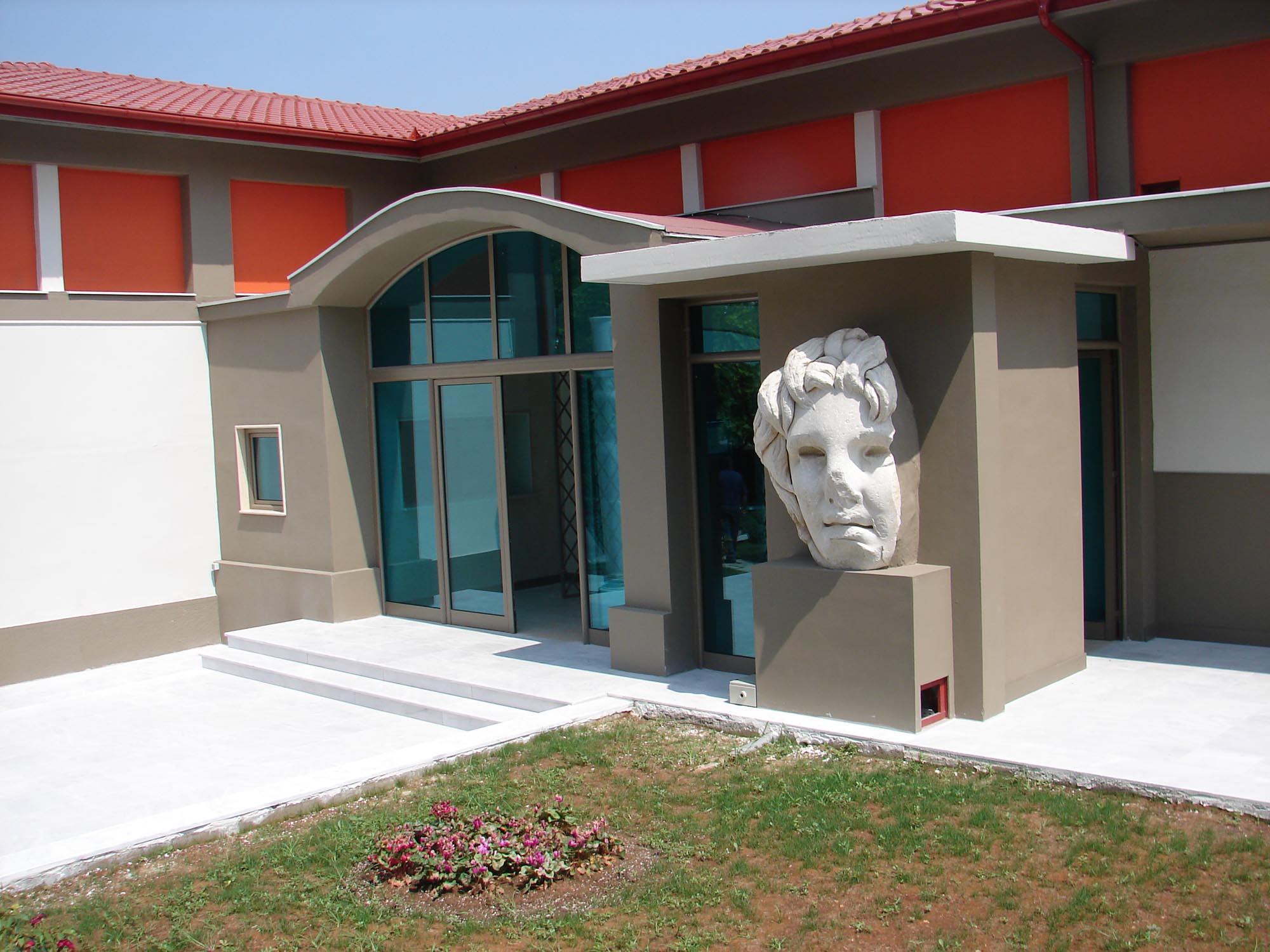
Archaeological Museum of Veria (47 Anoixeos Ave.)
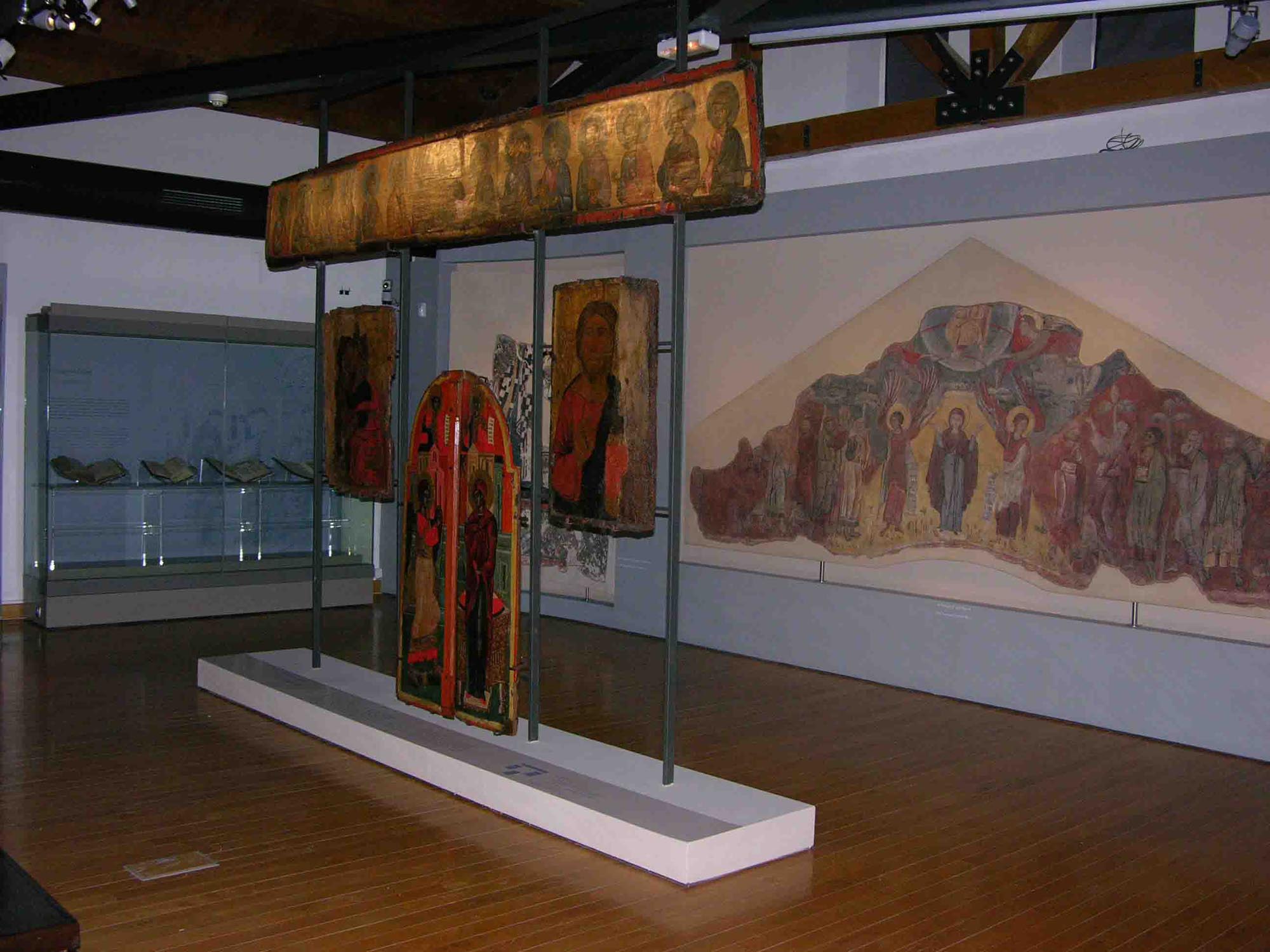
Byzantine Museum of Veria (26 Thomaidou St.)
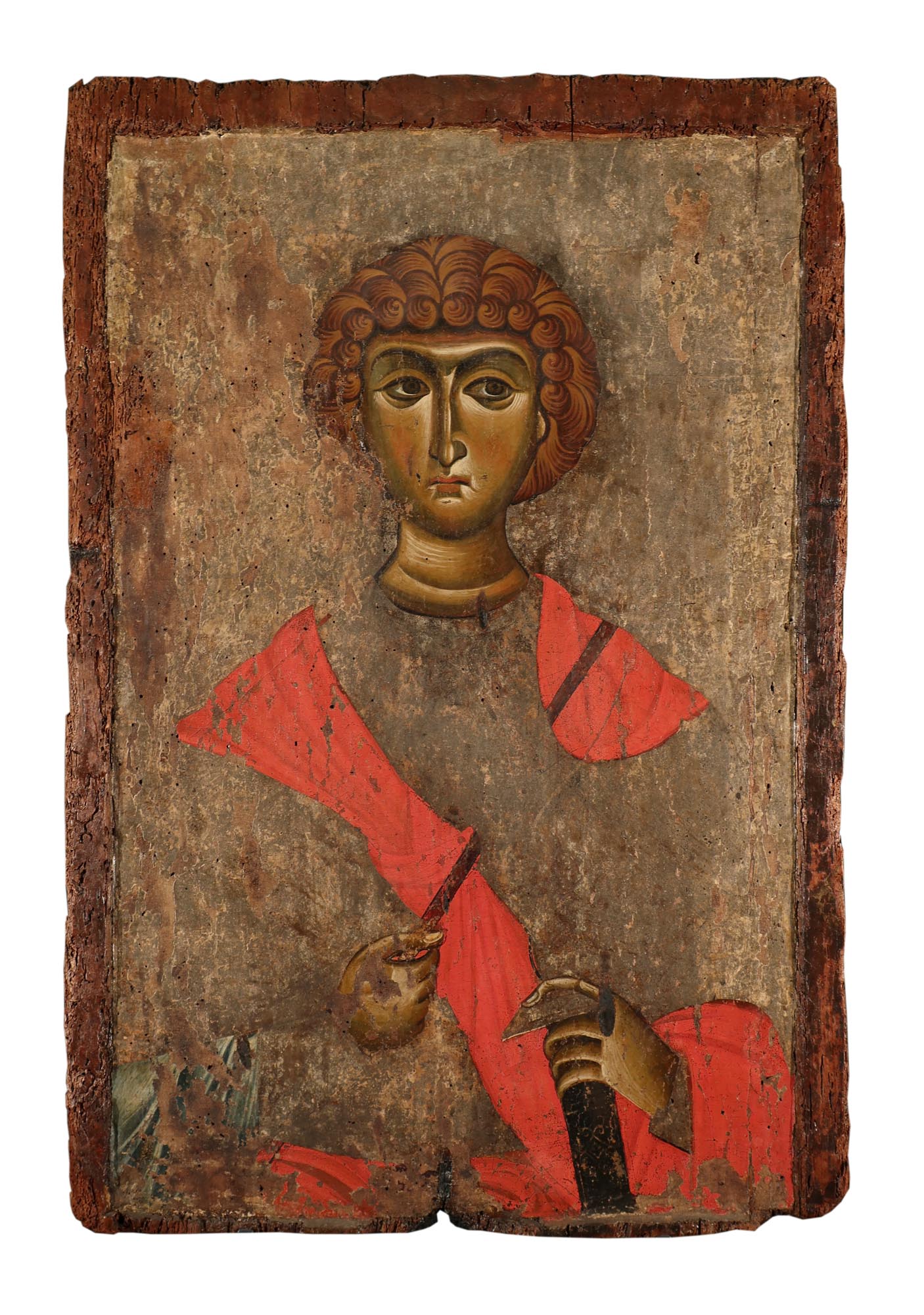
Located in the preserved Kyriotissa district, the Museum is housed in the early-20th-century water-powered flour mill of Stergios Markos. Its exemplary restoration has been awarded by Europa Nostra, the pan-European federation for the protection of Europe’s cultural and natural heritage. The Museum’s rich holdings, which include a particularly noteworthy collection of icons, reconstruct the various aspects of the city’s history and art from the Early Christian period to the present day.
Vlach Folk Museum (Verois and 1 Evraion Martyron Streets)
Housed in the Bozoglou Mansion near Orologiou Square, it presents to the public various exhibits from the rich cultural heritage of the Vlachs.
Vlachogianneio Museum of the Macedonian Struggle (86 Anoixeos Ave.)
The museum is housed in a listed building donated by the Vlachogiannis family to the Holy Metropolis of Veria, Naoussa and Campania, which is responsible for its design and operation. It is located on the “beach” or “balcony” of Veria, a recreational area centred on Elia Park and the pedestrian walkway along Anoixeos Avenue. The museum houses the collection of military uniforms of the collector Kanellos Dodos and presents aspects of modern Macedonian history through texts, photographs and a series of exhibits.
Paulian Relic Repository of the Holy Metropolis of Veria, Naoussa and Campania, Monastery of Panagia Dovra (Koukoumitriotissa)
In a verdant spot in the eastern foothills of Mount Vermio, just a few kilometres northwest of Veria, is the historic monastery that played a key role in the Greek Revolution, which was declared in the region in 1822. The exceptional collection of the Holy Metropolis is exhibited in the monastery’s relic repository, which contains rare works and relics from all the areas under its jurisdiction.