Kleidi

An impressive bridge in the fields near the village of Kleidi

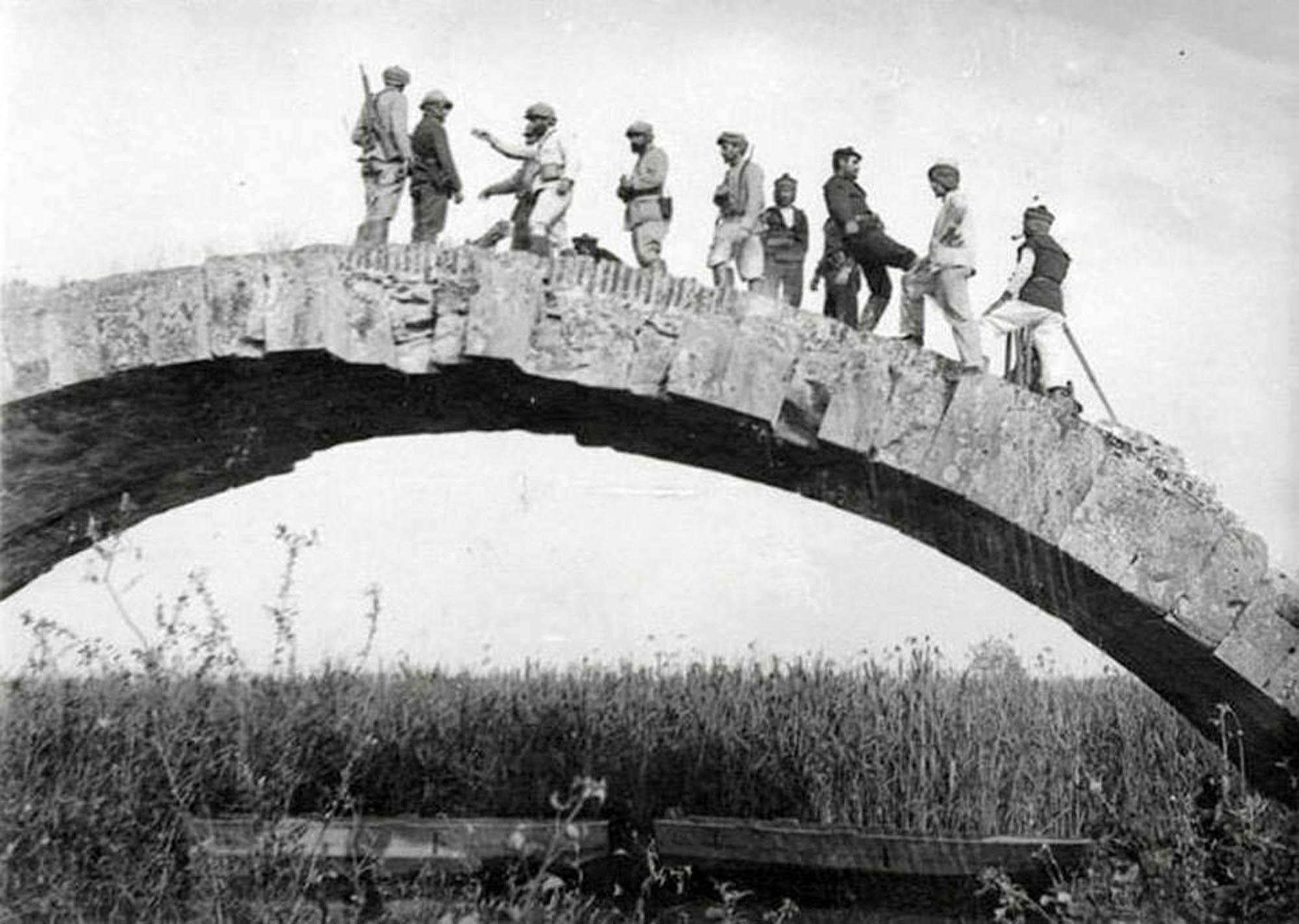
The bridge, known to locals as the “Bridge of Alexander the Great” or “Kamara” (meaning “Arch”), is located about 3 km east of the village of Kleidi in Imathia, just a few metres north of the modern Egnatia Motorway, at the point where it meets Highway 1 (Athens–Thessaloniki–Euzonoi), which runs up the country, connecting the capital Athens with the regions of Thessaly and Macedonia. As it stands among cultivated fields today, about 200 m west of the current course of the River Loudias, people who see it often do not realise that it is a bridge. It is distinguished by its size (16 m span, 10 m high and 6 m wide) and its particularly elaborate construction of large limestone ashlars in courses of equal height. The masonry is also interspersed with bricks and mortar.

The bridge, which appears to have been built parallel to the coast, bears witness to the major environmental changes that occurred on the coast of the large plain between Thessaloniki and Giannitsa in antiquity. According to the findings of the geoarchaeological survey carried out around the bridge in 2008, in the Archaic and Classical periods (7th-4th c. BC) the area was under the sea. During this period, the sea penetrated a large part of what is now the plain. Pella, the capital of the Kingdom of Macedon, had a harbour that was reached by navigating up the River Loudias, which was very wide and particularly deep.

Σχεδιαστική αποτύπωση / drw Alfred Delacoulonche (Mémoire sur le berceau de la puissance macédonienne des bords de l’Haliacmon à ceux de l’Axius, Paris 1858, p. 65 [= Archives des Missions Scientifiques et Littéraires 8 (1859), p. 129], ψηφιακή επεξεργασία ΔΒΜΑ / digital processing DBMA

Over the centuries, however, between the 2nd century BC and the 1st century AD, the silting of the Echedoros (Gallikos), Haliacmon, Loudias and Axios rivers gradually led to the shrinking of the bight of the Thermaic Gulf, expanding the plain to the south and east. A series of marshes and lagoons formed in the area of the bridge. Most researchers now accept that in the Late Roman period, taking advantage of the lowland area created by the silting up of the rivers, a new road was constructed along the coast, connecting Pydna and Pieria with Thessaloniki and, by extension, with the Via Egnatia. To serve this road, a series of major engineering works were carried out, including the construction of bridges.

The bridge near Kleidi, which would have spanned one of the lagoons or marshes formed by the River Loudias, is part of this road network. In fact, it has been argued that due to its great length it probably crossed not only the Loudias but also the Haliacmon. Based on the geoarchaeological survey, its construction is dated c. 300 AD.

According to the historian Nicholas Hammond, this coastal road probably remained in use into Byzantine times, based on the description of the battle fought near the River Axios in 1078 between the future emperor Alexios Komnenos (1081-1118) and the pretender to the throne Nikephoros Basilakes (Basilakios). The latter’s army, which was in Thessaly, marched towards the Axios, moving through the hinterland without following the coastal road (the “straight road”).

It is not known when the bridge fell into disuse. Based on the geoarchaeological survey, the coastal road and the bridge were abandoned at some point after the mid-15th century, when the shifting of the course of the Haliacmon and the Loudias resulted in new geomorphological changes. The French diplomat in Thessaloniki Esprit Marie Cousinéry (1773-1793, 1814-1816), who published his impressions of the area in 1831, had seen the bridge covered by the silt of the Haliacmon, but was unable to ascertain whether it had other arches. In 1859, the French archaeologist Alfred Delacoulonche, a member of the École française d’Athènes, provided a detailed description of the bridge, with slightly different dimensions to today’s (a span of 17.14 m and a height of 6.52 m). Studying the surrounding remains, Delacoulonche observed that the surviving arch is the third or fourth of a large bridge, which originally had eight or ten arches and was 187 or 190 m long. The arches were of uneven size, their span gradually decreasing from the centre of the bridge towards either end. The impressive size of the bridge led the French scholar to compare it to the Alcántara Bridge in Spain. Local residents pointed out to him building material from the bridge that had been used in 1820 to construct the church of St Demetrios in the now-abandoned village of Kaliani. Archaeological research in the area has shown that stones from the bridge were also used in a church dated 1856 in the neighbouring village of Kleidi, while scattered material has also been identified in in the now abandoned village Kaliani.

The present bridge was probably preserved due to the belief of the local inhabitants, relayed by Delacoulonche, that anyone who removed building material from the bridge to build his house would die the following year. There was also a village legend about the “milk of the Kamara”, which echoed the belief widespread in the Balkans that a human sacrifice is required to build a difficult construction project. According to the legend, in order to set the foundations of the bridge at Kleidi it was necessary to sacrifice the wife of the master builder, who was with child. The stone on which she was sacrificed began to exude a milky white liquid, which the villagers believed to be her breast milk.

After Delacoulonche, the next scholar to visit the bridge was the German archaeologist Adolf Struck in 1903. He estimated that the bridge was even longer, with 13 arches and a length of 210 m.

Γάλλοι Στρατιώτες κατά τον Α΄ Παγκόσμιο Πόλεμο/ French soldiers during World War I, 1916 (France, Ministry of Culture, Médiathèque du patrimoine et de la photographie, no. APOR058899)

Other stops in the Regional Unit of Imathia

error: