Pella

Pella, the “greatest of the cities in Macedonia”

Pella is one of the most important archaeological sites in Greece. It is located south of the present-day town of Pella and about 1.5 km east of the village of Nea Pella. It was the capital of the Kingdom of Macedon for about three centuries, replacing Aigai at the end of the 5th century BC. It was the birthplace of King Philip II (359-336 BC) and Alexander the Great (336-323 BC), and remained one of the most important political, economic and cultural centres of antiquity until 168 BC. Its prosperity was due to its key strategic location, in a fertile plain in the bight of the Thermaic Gulf, which ensured easy communication with the rest of Greece by both by sea and land. In later centuries, the silting up of the Rivers Loudias, Haliacmon and Axios reshaped the area, with the result that today the ancient city is no longer on the coast. After the Roman conquest (168 BC), the city gradually began to lose its power, but it remained a thriving residential centre, boosted by the passage of the Via Egnatia, of which it was an important station. It was destroyed at the beginning of the 1st century BC, probably by an earthquake.

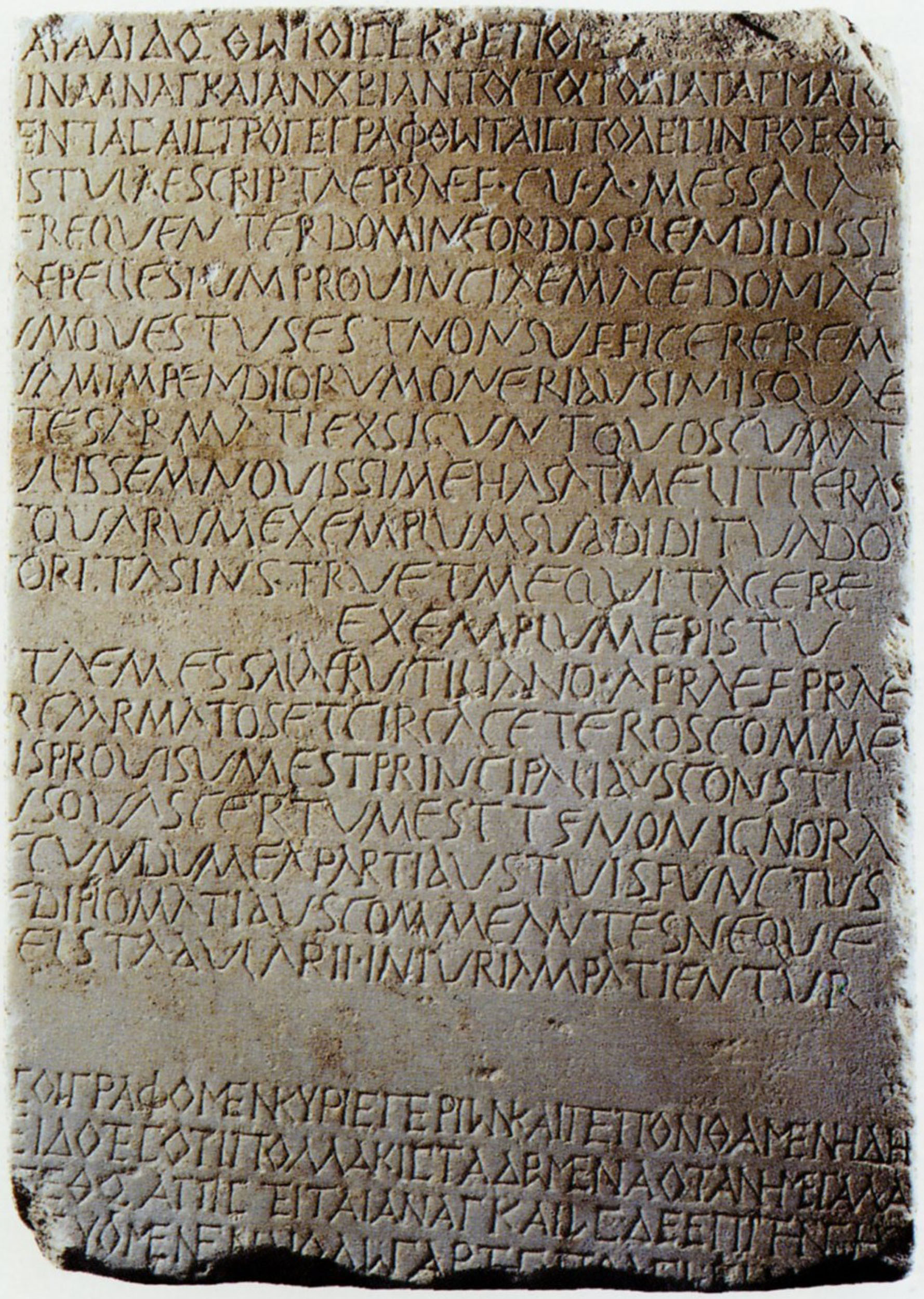
A few years later (30 BC), the Emperor Octavian Augustus founded a new Roman colony, the Colonia Pellensis or Colonia Iulia Augusta Pellensis or Colonia Pella, 1.5 km west of the ancient city, just east of today’s Nea Pella. The Via Egnatia, as in the case of Philippi, passed through this Roman colony, as we know from a milestone of 127 AD bearing a dedication to the Emperor Hadrian which was found northwest of the colony. Moreover, inscriptions on an ashlar of the mid-4th century AD from the city’s bouleuterion (assembly hall), found reused in the Early Christian basilica of Nea Pella, refer to the problems caused to the city by the passage of the Via Egnatia.

During the Ottoman period, the Sol Kol, the left branch of the Via Egnatia, passed between a watermill and a han in the area.

History

Excavations have confirmed that the once-coastal region of Pella was inhabited from prehistoric times, as finds of the Early and Middle Bronze Age (3rd-2nd millennium BC), the Iron Age (9th-7th c. BC), and the 6th and 5th centuries BC show. The city, which was part of the territory of ancient Bottiaia, first appears in ancient sources in the historian Herodotus, in the description of Xerxes’ campaign in Greece (480-479 BC). It is later mentioned by Thucydides, when he describes the situation in Central Macedonia during the Peloponnesian War (431-404 BC).

The capital of the Macedonian Kingdom was transferred from Aigai to Pella at the end of the 5th century BC, during the reign of Archelaus (413-399 BC), a time of peace and prosperity, or, according to other scholars, to the turbulent era that followed his assassination, under Amyntas III (393–368 BC). Pella from then on, emerged as an important cultural centre, gathering at the court of the Macedonian kings important artists and intellectuals, such as the famous painter Zeuxis, who is said to have decorated the palace of Pella, the musician Timotheus, the epic poet Choerilus and the tragedians Euripides and Agathon. Euripides actually spent the last years of his life in Pella, where he wrote a tragedy about Archelaus. During the reign of Amyntas III (393-370 BC), Pella is described by the historian Xenophon as the “greatest of the cities in Macedonia”. The city’s heyday came during the reign of Philip II (359-336 BC), who sought not only the domestic development of the Macedonian Kingdom but also the extension of his political power. Later, with the conquests of Alexander the Great (336-323 BC), the city’s fame spread across the known world.

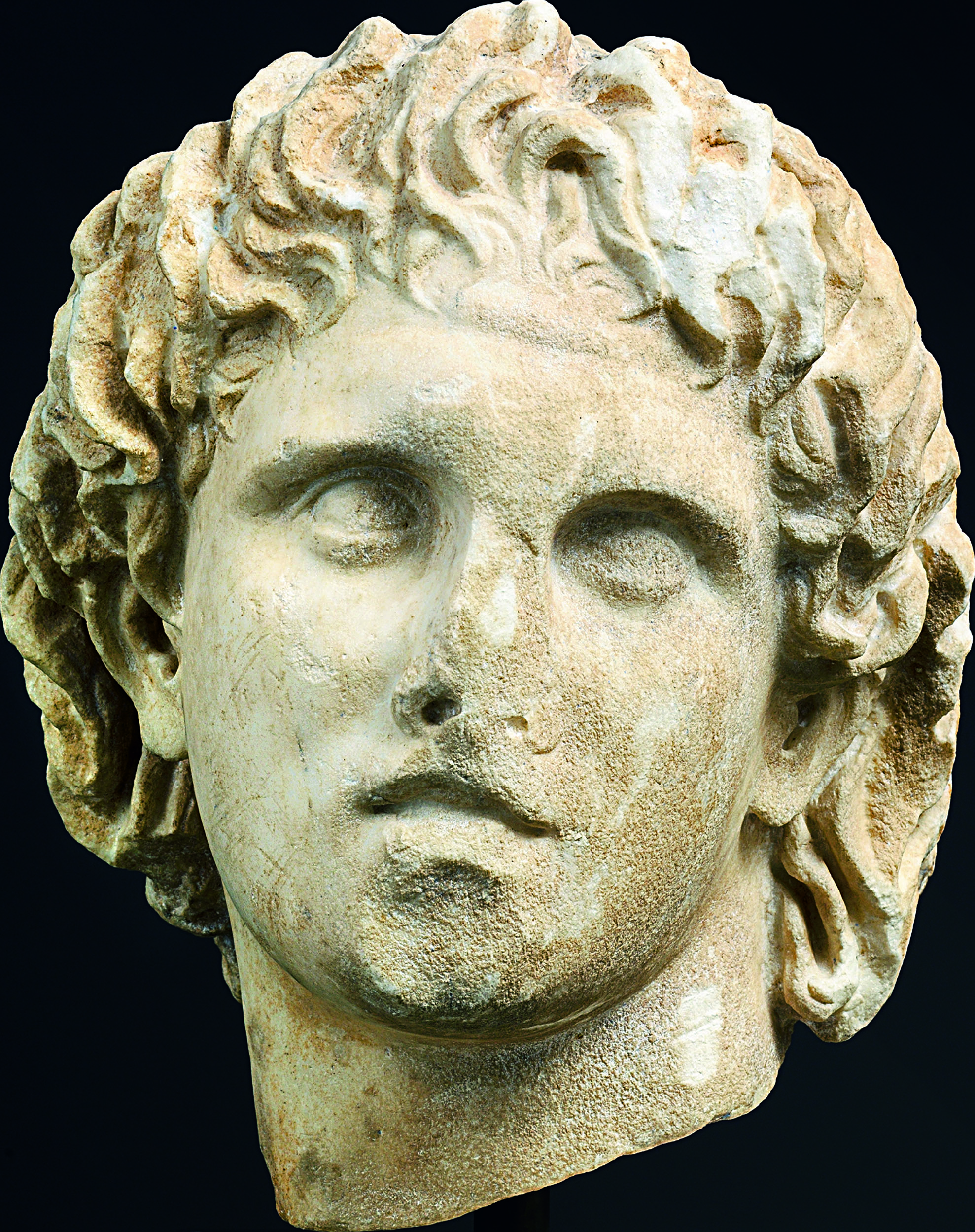
Κεφαλή Μεγάλου Αλεξάνδρου, Α. Μ. Πέλλας/ Male head identified as Alexander the Great, Archaeological Museum of Pella
Ελληνική και λατινική επιγραφή με αναφορά στην Εγνατία οδό (ΕΦΑ Πέλλας) / Greek and Latin inscription referring to the Via Egnatia (Ephorate of Antiquities of Pella)

During the reign of King Cassander (316-298 BC), Pella, strengthened by the huge financial resources secured by Alexander the Great’s campaign in Asia, doubled in size and acquired the form in which it is preserved to this day. Its great size and organised urban plan, the water supply and sewage facilities, the sanctuaries, the massive complexes of the palace, the Agora and other public buildings, the luxurious private residences, the abundance and variety of its funerary monuments, all testify to the city’s high standard of living and its flourishing economy. The presence of numerous philosophers, scientists and artists, such as the sculptors Lysippus, Leocharis and Pyrgoteles, the painter Apelles, the poets Melanippides, Niceratus, Pausanias, Plato and Aratus, the philosopher Euphraeus, and the most famous of all, Aristotle of Stagira, who tutored the young Alexander and lived at the court of Philip II, contributed to the city’s great intellectual and cultural flowering.

After the defeat of King Perseus of Macedon at the Battle of Pydna (168 BC), the Romans plundered the treasures of Pella and designated it the capital of the Third Meris (regio), one of the four administrative regions into which they divided Macedonia. Later, in 148 BC, Macedonia became a Roman province (Provincia Macedoniae) with Thessaloniki as its capital. By this time Thessaloniki had begun to emerge as the most important political and economic centre of the region, supplanting Pella.

The Hellenistic city was not completely abandoned after its destruction, probably by an earthquake at the beginning of the 1st century BC (90/80 BC), or after the establishment of the new Roman colony (30 BC). It continued to be inhabited until the 4th century AD, but was limited to its southern part, that closest to the Thermaic Gulf.

The new Roman colony was founded in 30 BC, near the modern village of Nea Pella, at a distance of approximately 1.5 km west of the ancient city. The site had been inhabited since prehistoric times. A Neolithic and Bronze Age settlement has been discovered north of the “Baths of Alexander”; it continued to be inhabited into historical times, during the Iron Age. In the Classical and Hellenistic periods, the area, with its rich vegetation and abundant springs, was a suburb of Pella outside the walls, with sanctuaries of the Nymphs and the Muses.

The founding of this new Roman city was completed in 25/4 BC, as has been argued on the basis of a bronze coin depicting the wall and main gate of the city. Veterans who had served under Augustus settled there, and even some of his political opponents, followers of Mark Antony, as well as Greeks from Italy. Τhe Roman city of Pella did not, however, manage to flourish as other Roman colonies in Macedonia (Dion and Philippi) did. The satirist of the 2nd century AD Lucian calls it a city with few inhabitants, which has nothing to do with the glory it enjoyed in the time of the Macedonian kings.

Christianity seems to have spread to Pella at an early date. It has been suggested that St Paul the Apostle visited the city on his way from Thessaloniki to Beroia along the Via Egnatia (49 and 56-57 AD). In the middle of the 4th century AD, the city appears in written sources as the seat of an episcopal see. The establishment of Christianity in the city is attested by the later construction of a basilica (second half of the 5th c. AD) in the area of Nea Pella.

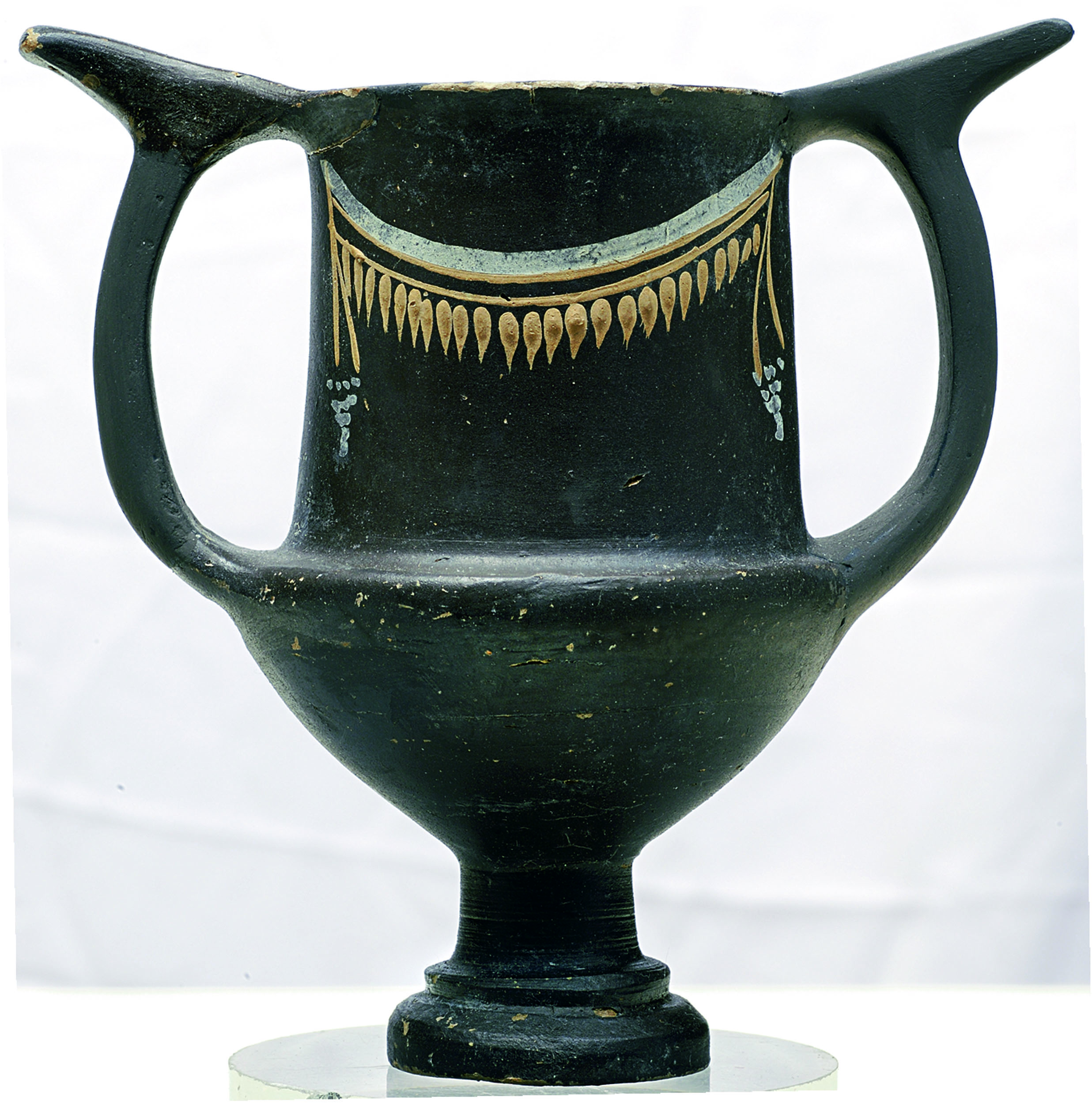
Αγγείο από την Αγορά της Πέλλας (ΕΦΑ Πέλλας) / Drinking vessel from the Agora of Pella (Ephorate of Antiquities of Pella)
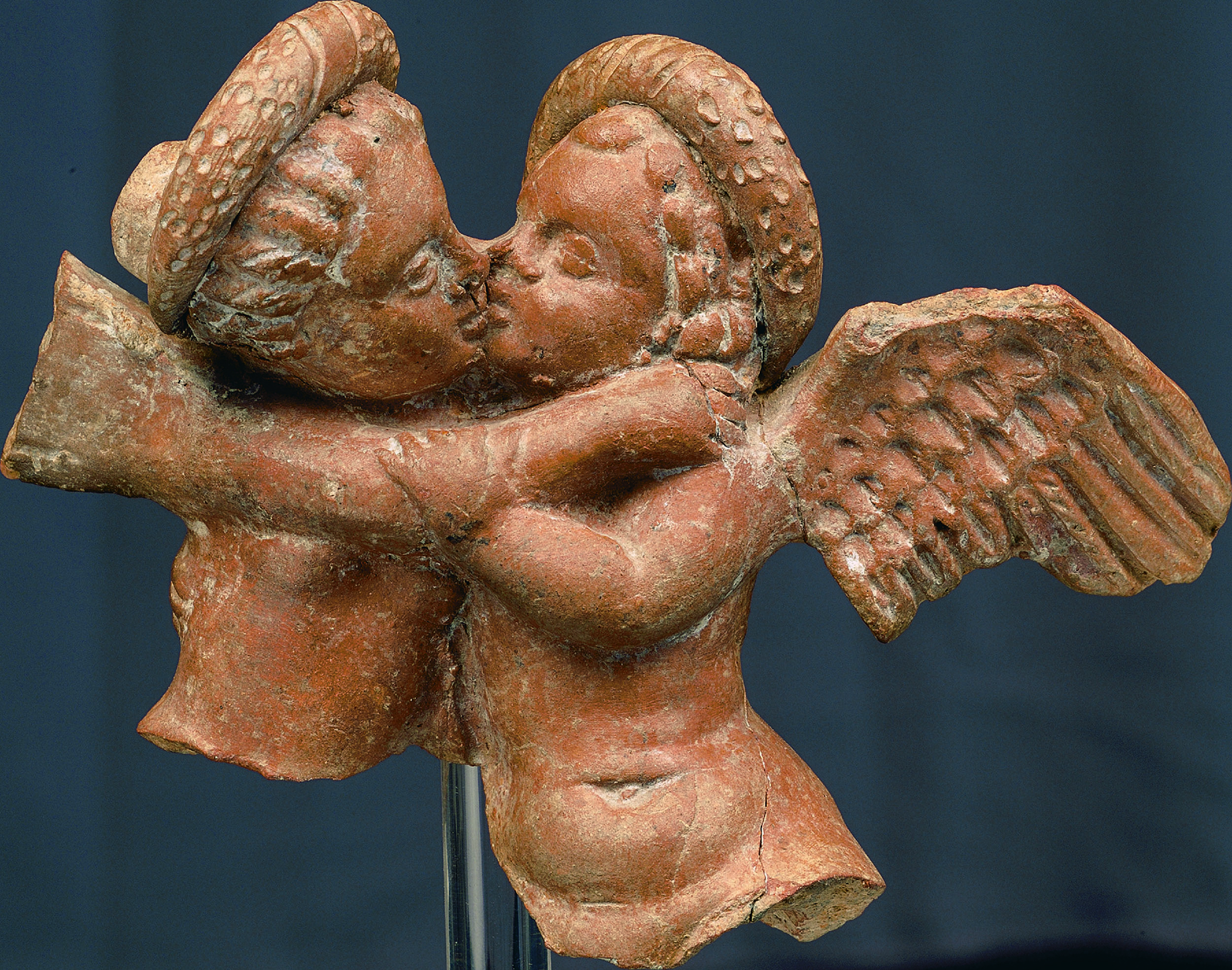
Έρωτας και Ψυχή, από την Αγορά Πέλλας (ΕΦΑ Πέλλας) / Eros and Psyche, from the Agora of Pella (Ephorate of Antiquities of Pella)

Under the Emperor Diocletian (284-305 AD), after the Gothic invasions (268 AD), Roman Pella seems to have been rebuilt from the ground up and renamed Diocletianopolis. However, this name did not prevail for long, since the old name reappears in later written sources. The construction of the Roman city wall, a small part of which has come to light in the northwest of the city, dates from the time of Diocletian.

In the 6th century AD, according to the Synecdemus of Hierocles (before 535 AD), Pella was one of the 32 cities of the province of Macedonia Prima, an administrative district of Illyricum. The destruction of the basilica in the early 7th century AD marks the decline of the city, which, however, according to written sources, survived into Byzantine times. During the so-called Dark Ages (7th-8th c. AD), Slavic tribes of Drogubites and Sagudates settled in the area. The settlement of Slavic tribes is confirmed by the excavation data: after the collapse of the basilica, makeshift mud-brick structures were erected in the central and south aisle, where “Slavic Ware” cooking pots and tableware were found.

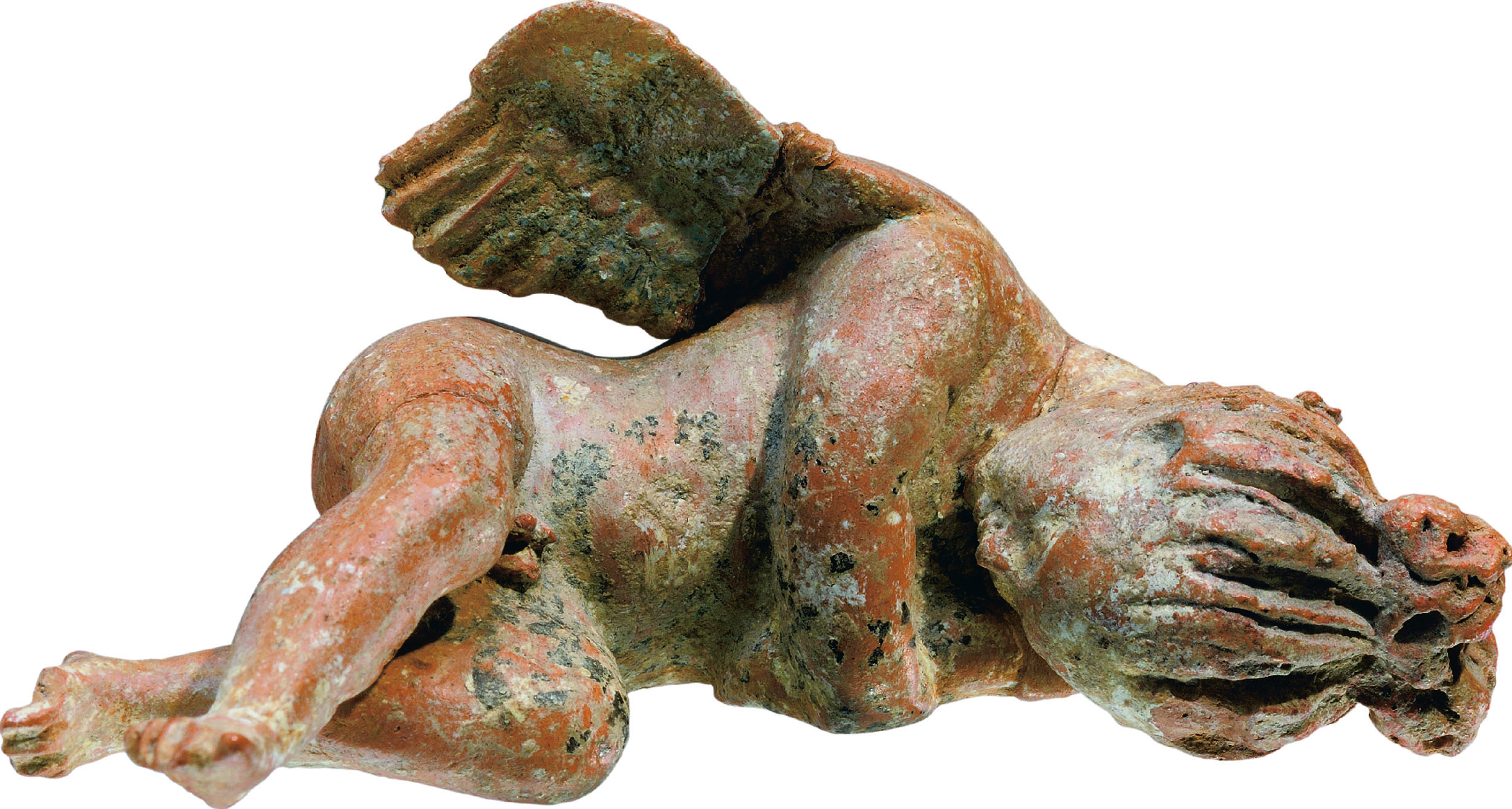
Ειδώλιο από το ανατ. νεκροταφείο (ΕΦΑ Πέλλας) / Terracotta figurine from the eastern cemetery (Ephorate of Antiquities of Pella)

Pella is mentioned as the seat of an episcopal see in the late 8th or early 9th century, while it was later included by the Emperor Constantine VII Porphyrogenitus (913-959) in the 32 cities of the Theme of Macedonia. Between the 9th and the 12th century, the episcopal see of Drogubitia was founded in the area. The city also appears in later written sources, for example in a text of the 12th-13th century, which mentions a bishop of “Slanitzi or Pella”. The episcopal see of Pella was merged after 1368 with that of Vodena (present-day Edessa).

The exact extent of the Roman, Early Christian and Byzantine city is not known, as the excavation data remain limited. Moreover, it is concluded that the city had shrunk significantly in Early Christian times and the population had settled north of the “Baths of Alexander”, with the result that the Egnatia Motorway now passes south of the city rather than through it. The architectural remains and movable finds of the Byzantine period are also very scarce. A small single-nave church of the Late Byzantine period was discovered in the northwest of the city. It was a funerary church, as burials of the same period have come to light in the surrounding area.            

Monuments - Ancient Pella (near the modern town of Pella)

Urban plan
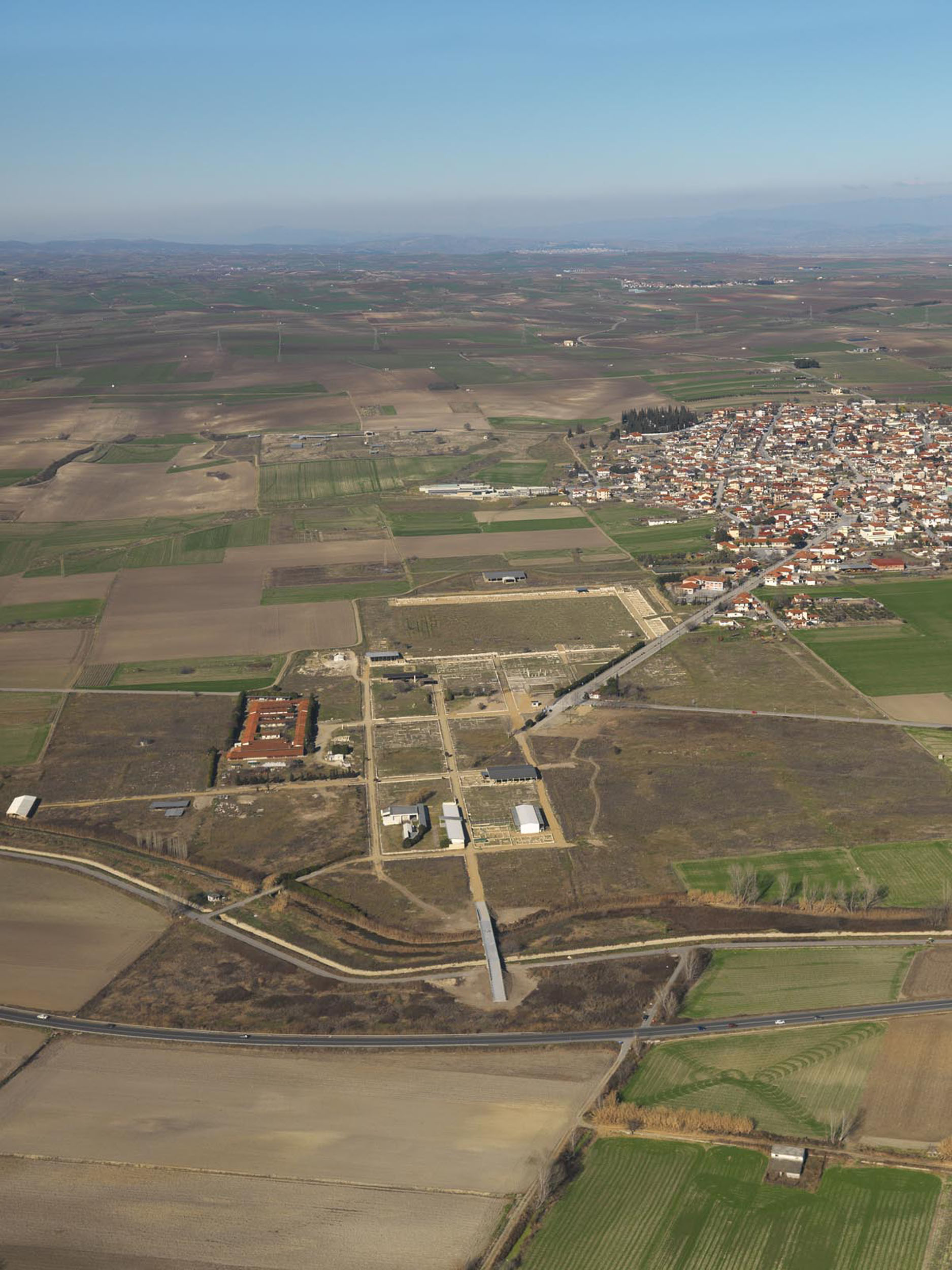
φωτ. ΕΦΑ Πέλλας / phot. Ephorate of Antiquities of Pella

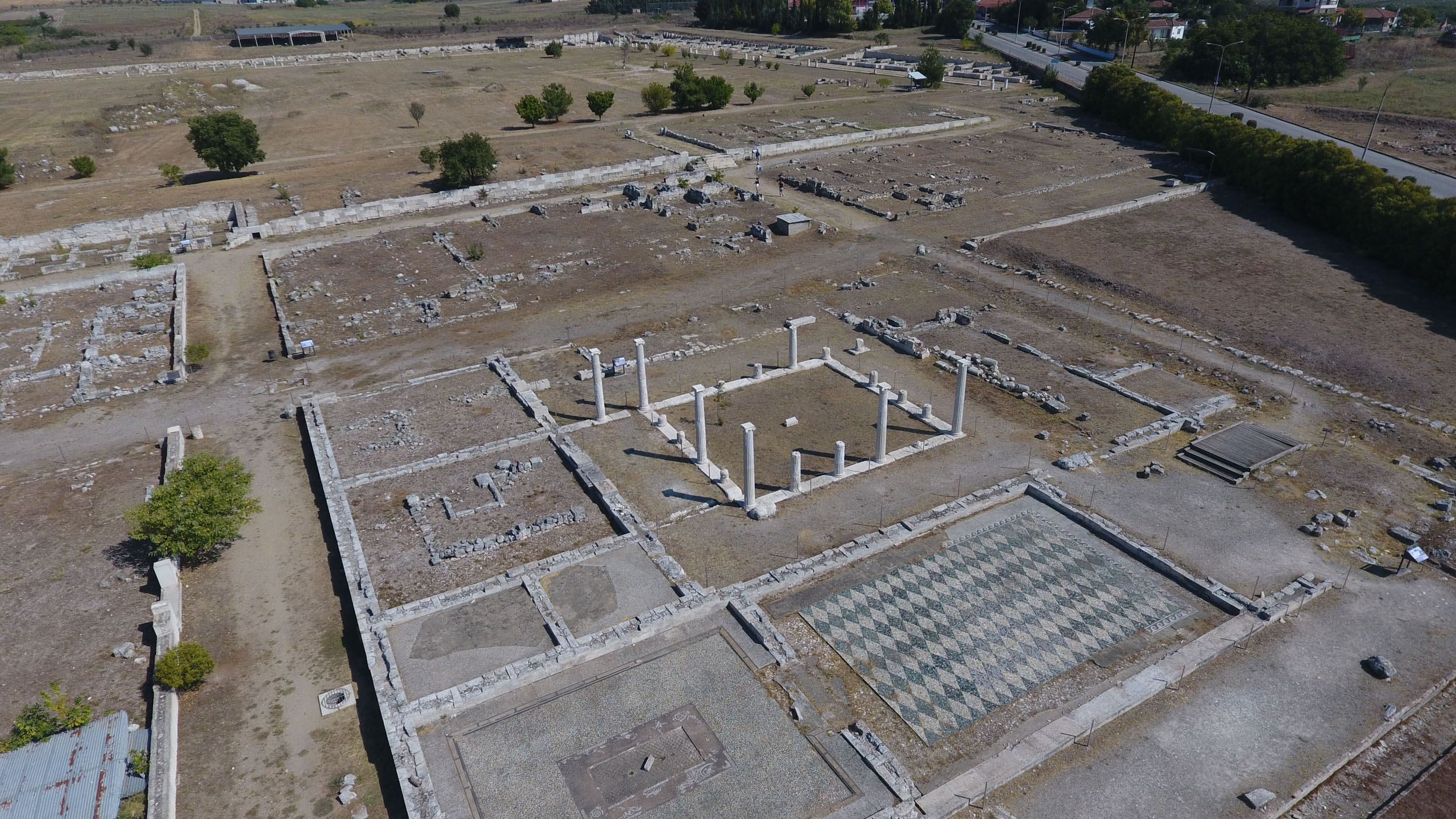
The city of ancient Pella acquired its present form in the Hellenistic period, during the reign of King Cassander (316-298 BC), when it expanded northwards with the removal of the north wall of the Classical period. Only a small part of the earlier Classical city (late 5th-late 4th c. BC) has been revealed. The systematic excavations carried out since 1957 have brought to light a large part of the Hellenistic city, sections of its fortifications, the palace, the Agora, sanctuaries, streets, private houses, workshops and parts of the cemeteries. The location of the south coastal wall of the city and its harbour is not yet known, but the fortified former islet of Phacos, not far from the south city wall, to which it was connected by a wooden bridge, has been identified. At Phacos, where, according to the sources, the Macedonian treasury was located, part of the fortifications, public buildings, and workshop and probably military installations have been discovered.

The ancient city, built on flat ground that rises slightly to the north, where it ends in three low hills, occupies a large area of about 400 hectares. Its urban plan, one of the most highly developed of antiquity, follows the Hippodamian Plan, with large regular insulae (building blocks) divided by straight horizontal streets 9-10 m wide, and narrower vertical ones 6 m wide. The centre of the city, where the Agora is located, is crossed by a monumental horizontal street 15 m wide. Two wider, paved vertical streets, 9 m in width, were leading from the harbour to the Agora and from there to the palace. The palace is built on the hill of the acropolis, the middle one of the three hills to the north of the city, in a key strategic position controlling the whole surrounding area. Pella had a dense water supply and sewage network, consisting of clay pipes and large built ducts with access holes for cleaning at regular intervals, which supplied drinking water to the city’s buildings and carried wastewater to the sea. Together with the wells, fountains, reservoirs, private and public baths, the network attests to the high living standards of the inhabitants.

Pella had strong fortifications as early as the end of the 5th century BC, when it was designated the capital of the Kingdom of Macedon. With the expansion of the city during the reign of King Cassander (316-298 BC), new fortifications were built, of which only parts have been discovered north of the palace and at the eastern and western ends of the city. The wall, 3.30 m wide, is made of mud-bricks set on a stone foundation and is reinforced at regular intervals with four-sided towers.

The large building complex of the palace, with a total surface area of 75,000 m2, five times the size of the palace of the old capital of Aigai, remained the main political and administrative centre of the Macedonian Kingdom throughout the Hellenistic period. Besides being the residence of the royal family, it housed various administrative, military and financial services, while it also had athletic facilities, a mint, storehouses, workshops, stables and a number of other auxiliary rooms necessary for its operation.

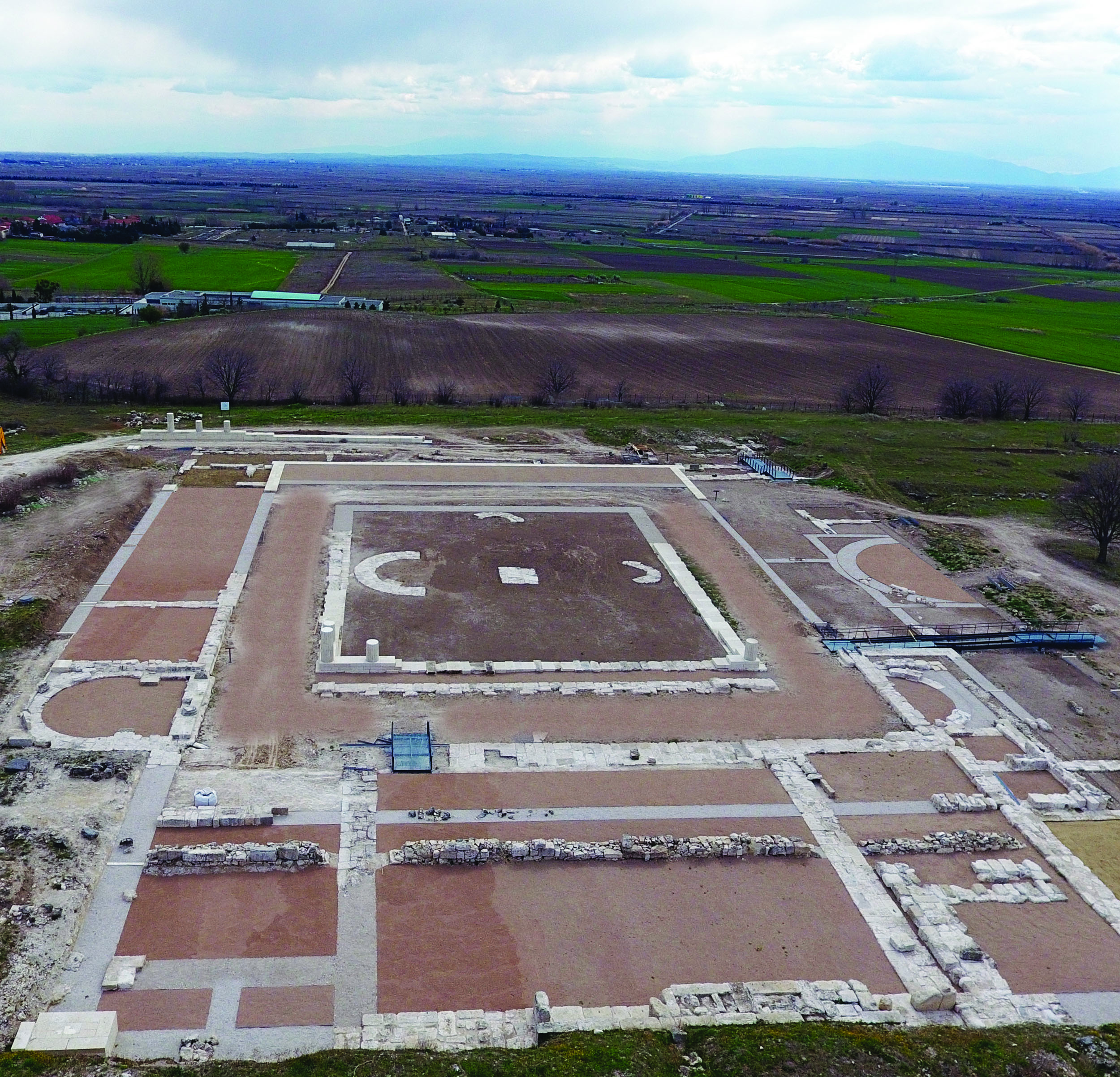
The palace is oriented north to south and its 160-metre-long façade is on the south, facing the main residential nucleus of the city. The free space between the city and the palace was planted with gardens and groves. The palace is entered through a monumental propylon of impressive size and design, 16 m wide, flanked by two Doric porticos, with 17 columns on the east and 21 on the west side. North of the palace is the north city wall with the monumental Royal Gate, 17.5 m long and 14 m wide, with three successive entrances, allowing the king direct access to the royal apartments.

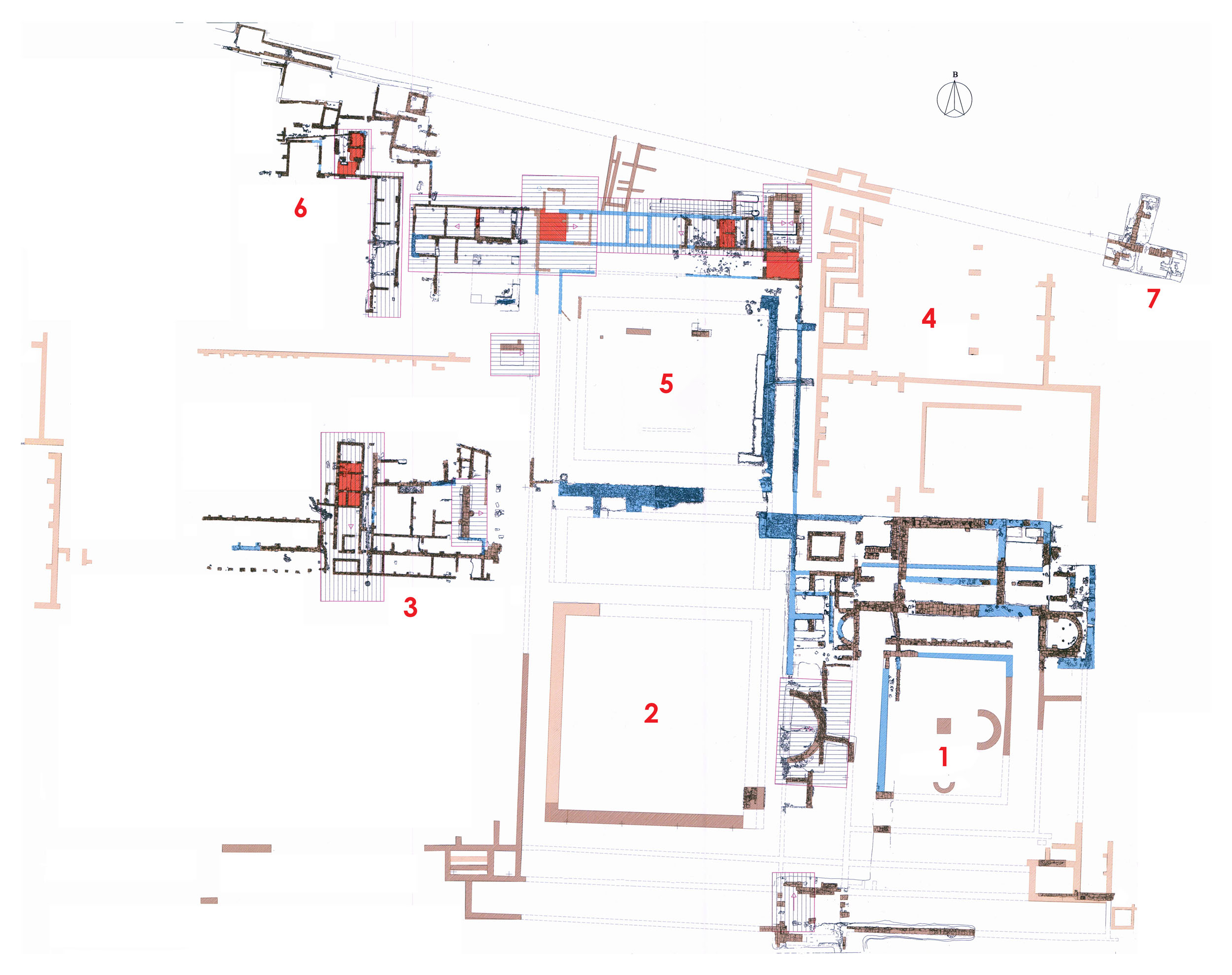
The palace consists of seven individual building units set on stepped terraces. Each unit has large peristyle court with stoai (porticos) surrounded by a row of buildings. Building Unit V, in the northeast part of the complex, was the palaestra, which was incorporated into the palace. The palaestra had a total area of 4,875 m2, with a large peristyle court surrounded by what was probably a wooden colonnade. In the west part of the palace is preserved a large swimming pool with an area of 37.5 m2.

The palace complex took shape over the centuries, with successive additions and repairs. It is believed to have been built during the reign of Philip II (359-336 BC), on the site where the palace of Archelaus (413-399 BC), decorated by the famous painter Zeuxis of Heraclea, originally stood. The palace complex was extensively altered during the reign of Demetrius Poliorcetes, one of the successors of Alexander the Great, and even more during the reign of Antigonus Gonatas (277-239 BC). In 168 BC the palace was looted and destroyed by the Romans, but its buildings remained in use until the destruction of the city, probably by an earthquake, in the 1st century BC.

Ground plan of the Palace complex: 1. Building I 2. Building II 3. Building III 4. Building IV 5. Building V (Palaestra) 6. Building VI 7. Royal Gate – Tower

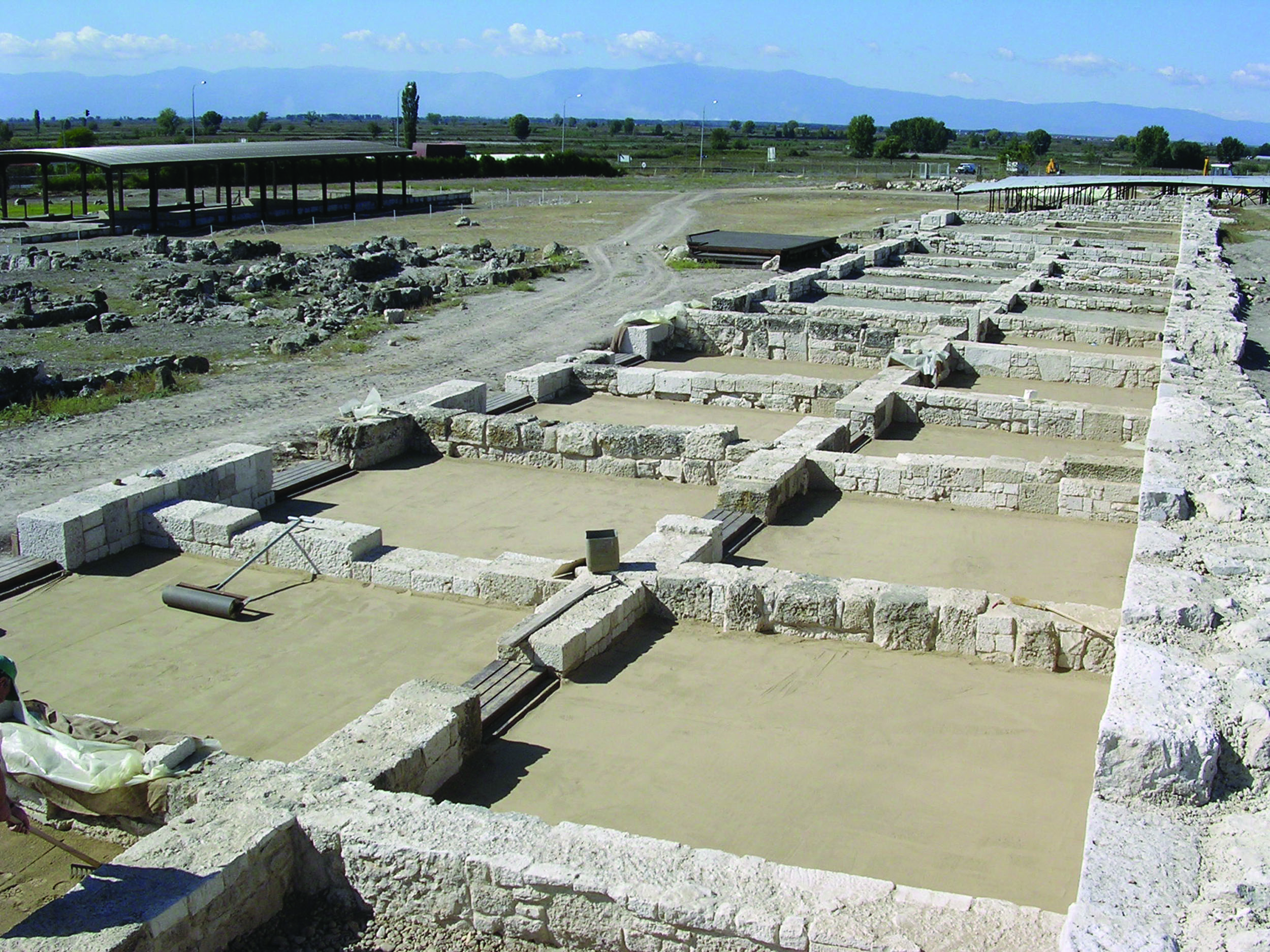
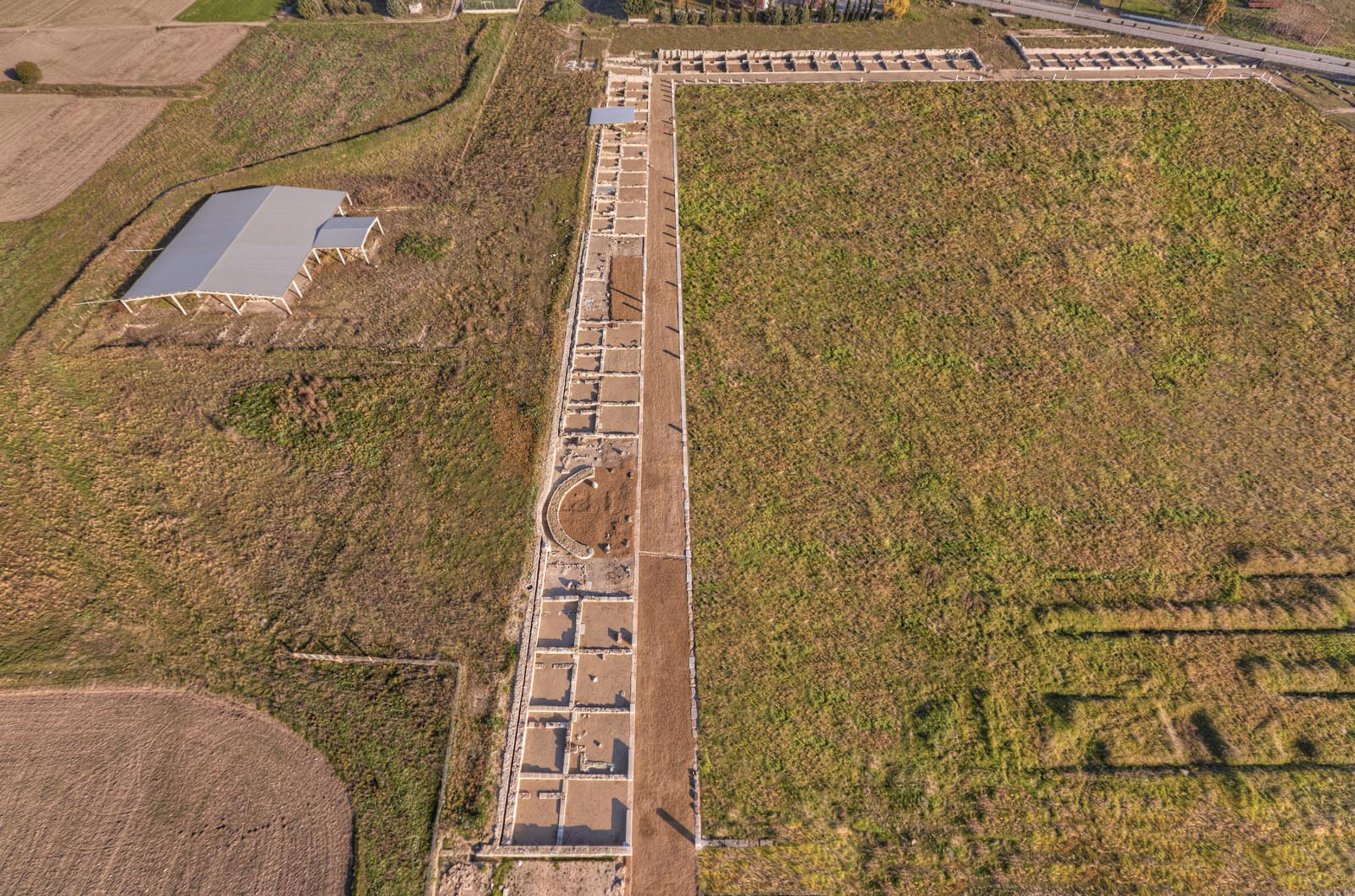
The impressive Agora, in the centre of the Macedonian capital, is the largest marketplace of antiquity, with an area of 70,000 m2, corresponding to ten insulae. From the time of its construction in the reign of Cassander (late 4th c. BC) to its destruction in the 1st century BC, it was the commercial, administrative and social centre of the city. Its nucleus is a huge square, measuring 200 x 173 m, surrounded by colonnaded arcades. At the back of the colonnades are four rows of rectangular rooms on two levels. The rooms on the lower level communicate via the colonnades with the central square, while those on the higher level communicate with the streets surrounding the complex.

The north wing of the Agora was used for administrative and religious purposes, as we see from the inscribed pedestals, pieces of bronze statues and clay document sealings found there. The east side of the Agora housed ceramic and coroplastic workshops; finds include workshop waste, numerous vases, terracotta figurines, and moulds for making figurines and relief vases. There were also other workshops in the Agora, including metal-working facilities. The various commercial shops included butcheries, identified based on the internal spaces where large numbers of animal bones have been found, some of them even sawn. The market’s perfume shops are also of interest, in the internal spaceswhereboth large and small spindle-shaped jars for perfume and aromatic oils have come to light.

Iερό του θεού Δάρρωνος / Sanctuary of the god Darron (φωτ. ΕΦΑ Πέλλας / phot. Ephorate of Antiquities of Pella)

The inhabitants of Pella worshipped the deities of the Greek pantheon, such as Athena, Poseidon and Dionysus. Three sanctuaries have been discovered to date: onededicated to Demeter Thesmophoros, the second to the Mother of the Gods and Aphrodite, and the third to the the local healer god Darron. The first of these, the Thesmophorion (in use from the late 4th to the early 1st c. BC) was a small rural sanctuary on the edge of the city, in the form of a simple circular enclosure built into the bedrock, with an altar in the centre. In its floor are twenty pits, known as megara, which contained the bones of piglets, sheep and goats. These are associated with the ceremony of the Thesmophoria, an autumn festival in honour of the goddess Demeter to ensure a good harvest. The buildings of the other two sanctuaries are not monumental, as they were small urban shrines, contained within the city blocks.

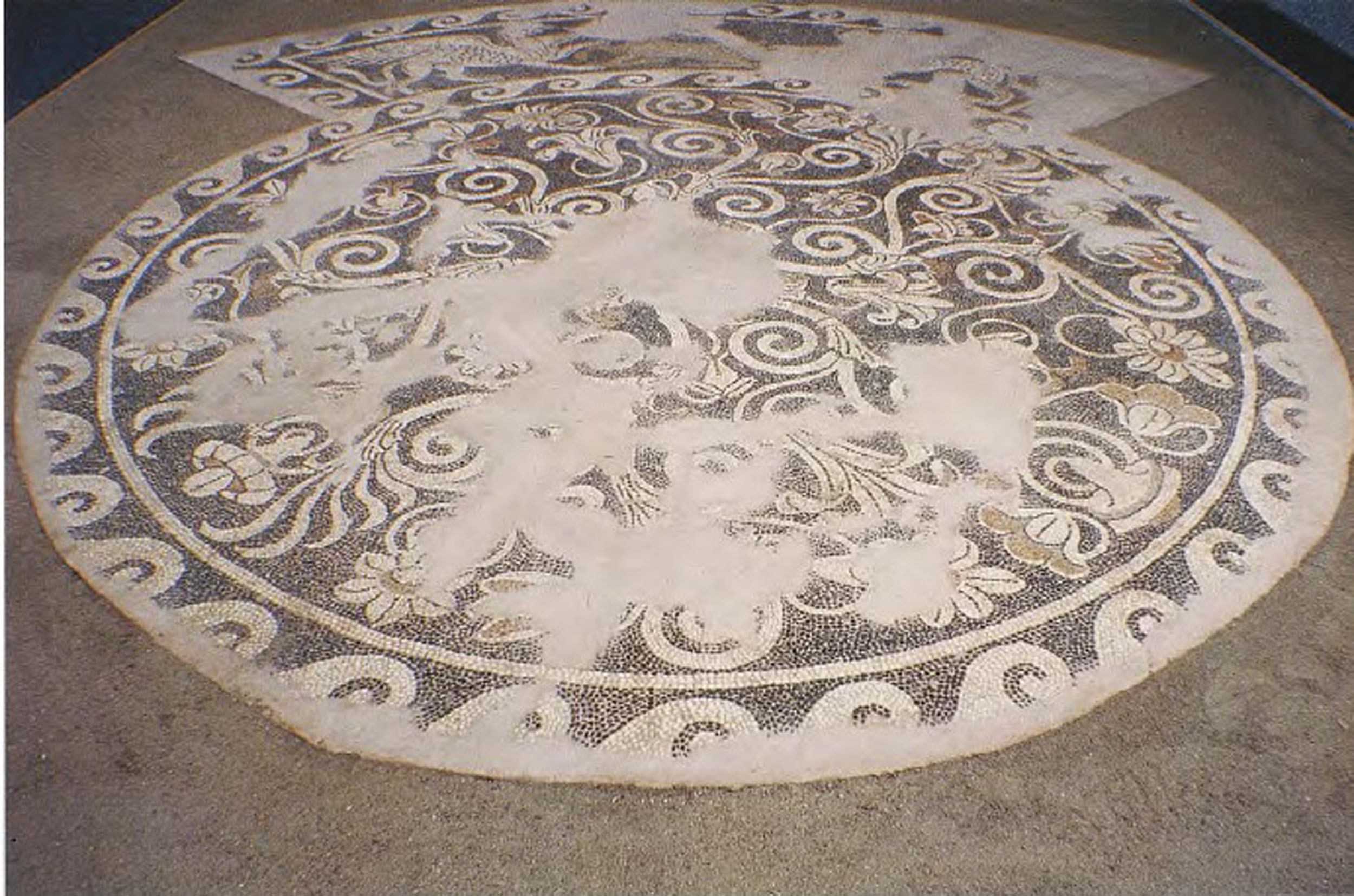
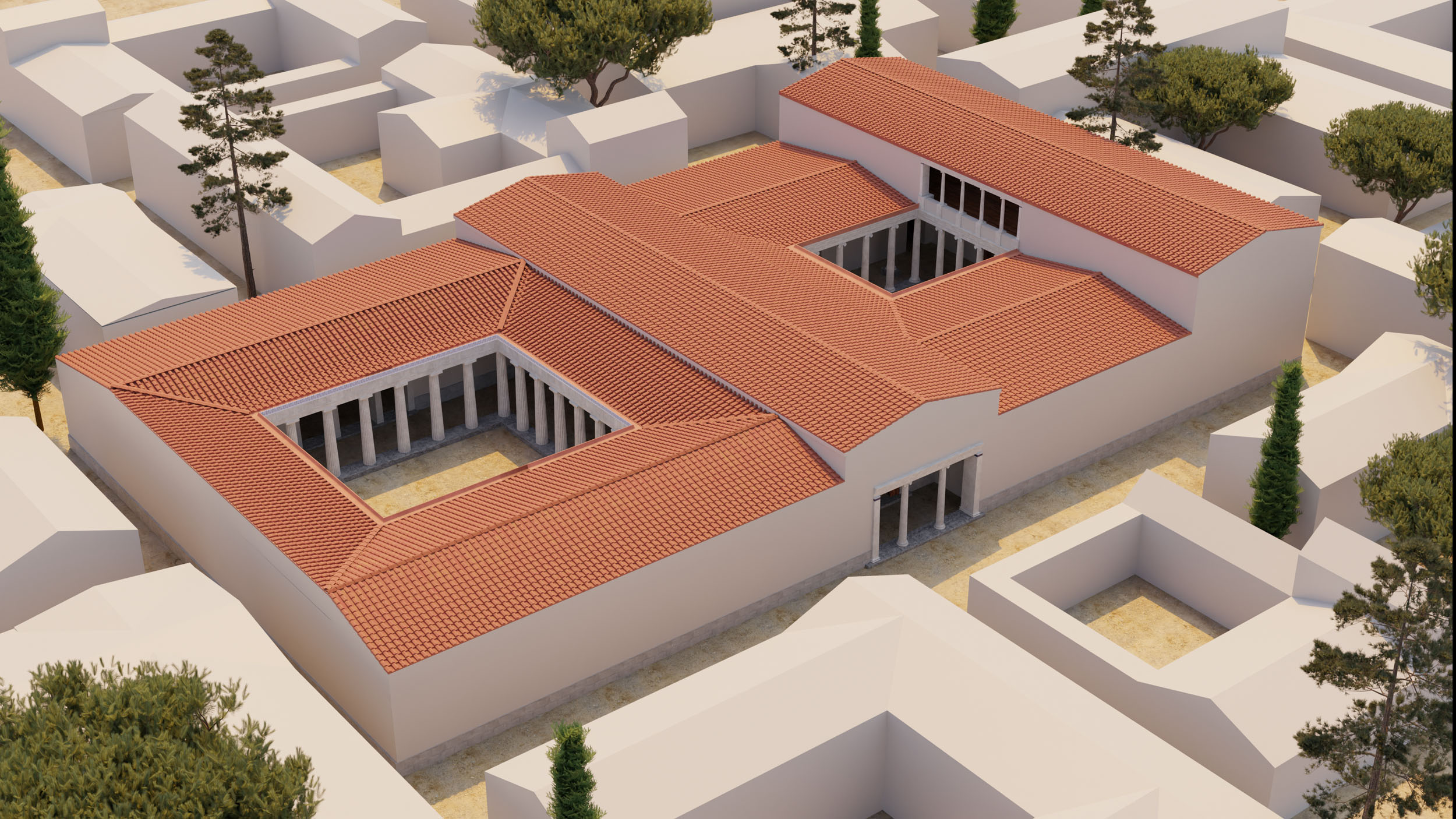
Each insula of ancient Pella contains two to eight houses which stand out for their size. The largest have an area of 2,500-3,000 m2 and the smallest 200-500 m2. Their main feature is a central courtyard surrounded by Doric or Ionic colonnades. The smaller houses usually only have one wide colonnaded porch (pastas) on the north side of the courtyard. The reception and banquet halls (androns) in the richer houses have walls decorated with coloured plaster and floors covered with mosaics, most of them splendid examples of the ancient mosaic art, inspired by paintings. The mosaic floors of Pella stand out for their thematic variety and technical excellence, and were clearly produced by organised local workshops.

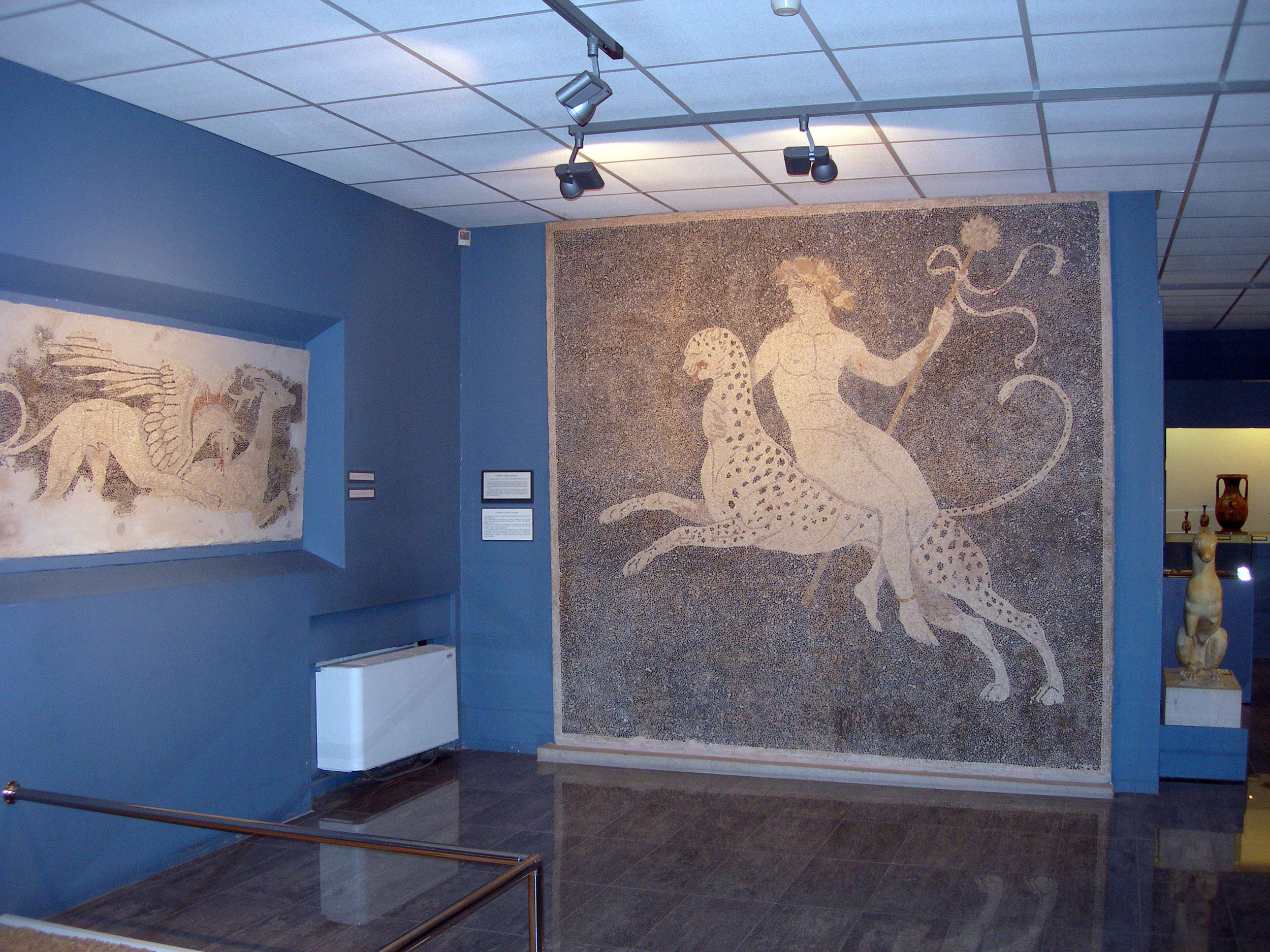
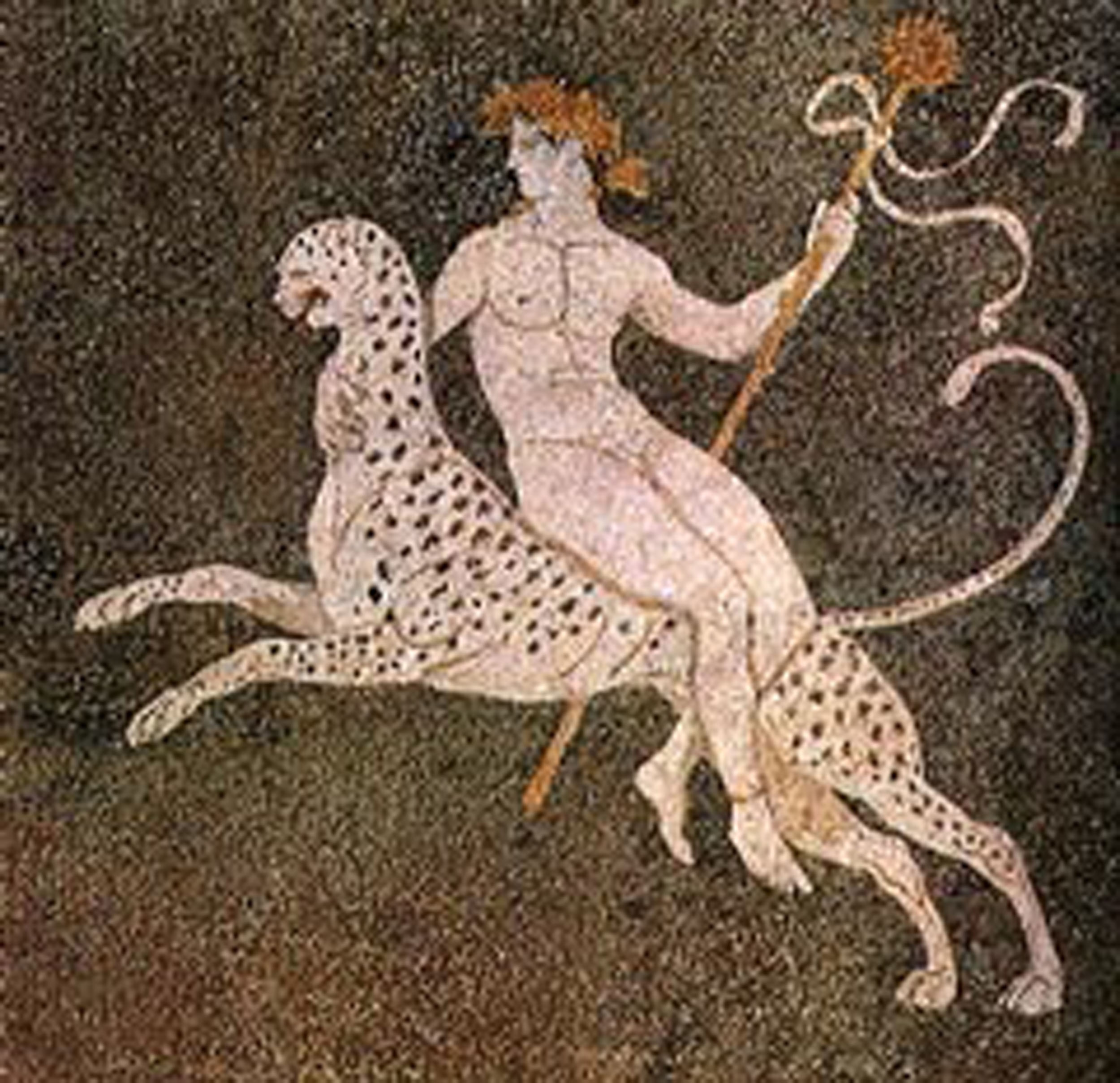
The largest residence of Pella, the House of Dionysus south of the Agora, with an area of 3,160 m2, is famous for the mosaic floors that once adorned its banqueting halls, depicting the god Dionysus riding a panther, a pair of Centaurs with vases, a lion hunt and a griffin attacking a deer (325-300 BC). The House of the Abduction of Helen is a second large residence, measuring 2,350 m2, whose mosaic floors date from the same period as those of the House of Dionysus. It is named after the mosaic floor in one of its banquet halls depicting the Abduction of Helen by Theseus. This masterpiece, measuring 8.48 x 2.84 m, is the largest known mosaic in Greece. The mosaic floor of a second banquet hall in the same house depicts a stag hunt. The maker of this perfectly executed work has signed it with his name: Gnosis. He is the first mosaic-setter in the history of the art to sign one of his works.

The colourful decoration of the walls of the houses of Pella was of a similar standard to the brilliant decoration of the floors. A typical example is the decoration in the First Pompeian Style of a wall in a room of a residence south of the House of the Abduction of Helen (House of Plaster). The wall has been restored to a height of 5 m and is on display in the Museum of Pella (late 4th-3rd c. BC).

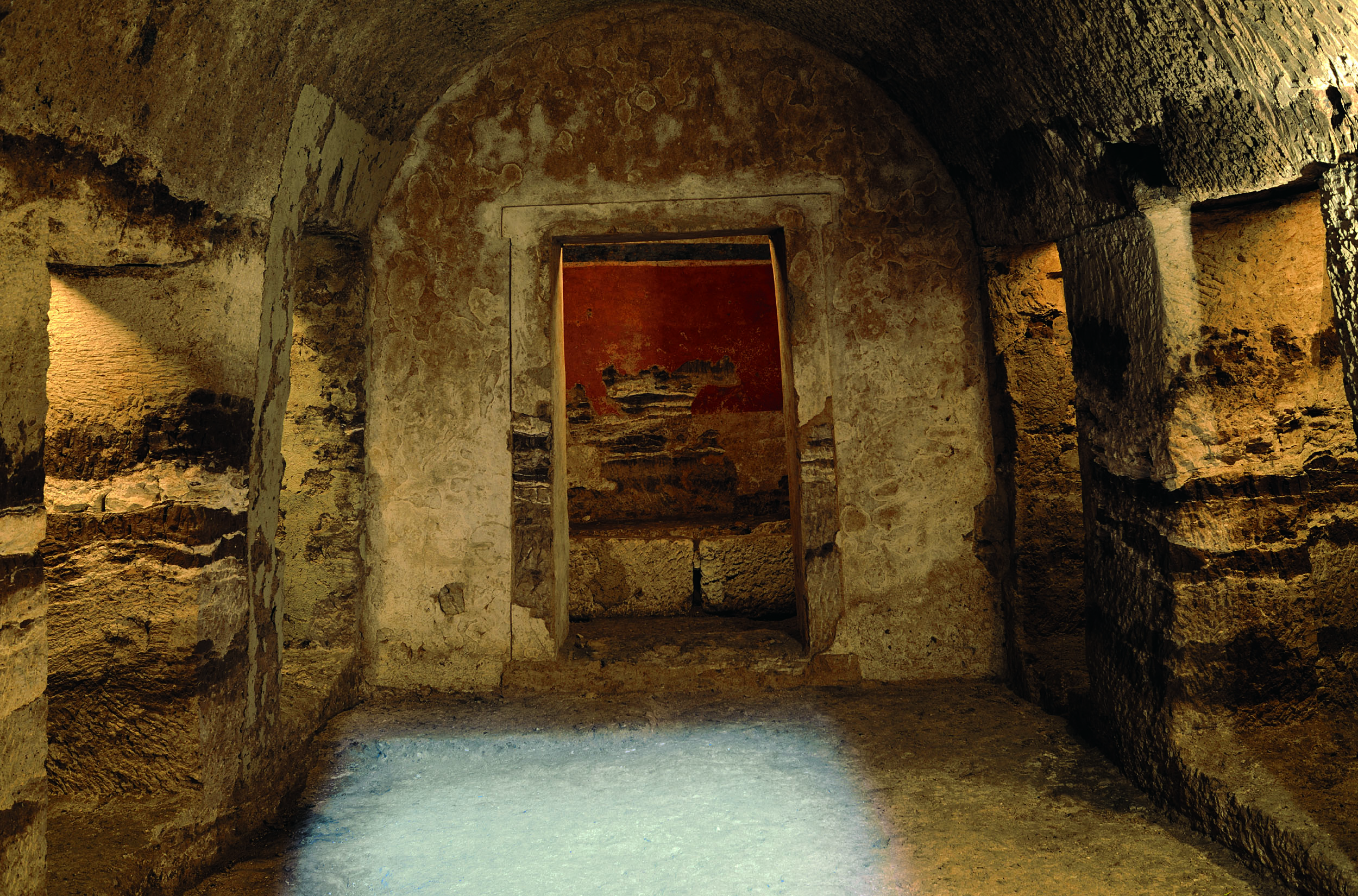
Two cemeteries arose in Pella during the Hellenistic period, the first outside the east wall and the second outside the west wall. The East Cemetery was already in use in the late 5th century BC, but it was mainly used from the mid-4th to the 1st century BC. The West Cemetery, established in the second half of the 4th century BC, remained in continuous use until the early 4th century AD. The two cemeteries extend over a large area and include all the burial types and construction methods found in cemeteries of the rest of Greece during this period, such as simple pit or tile graves and more costly underground rock-cut chamber tombs.

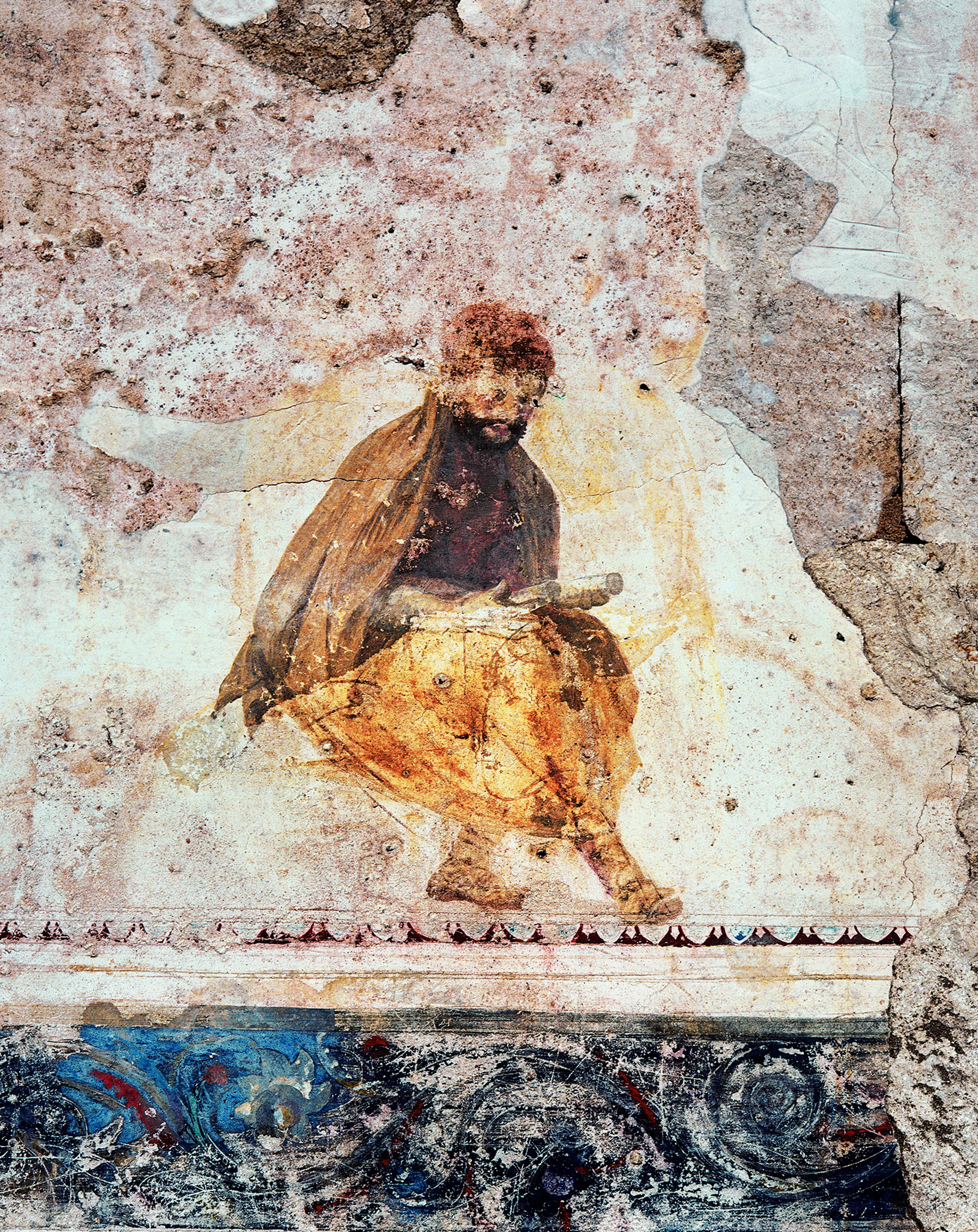
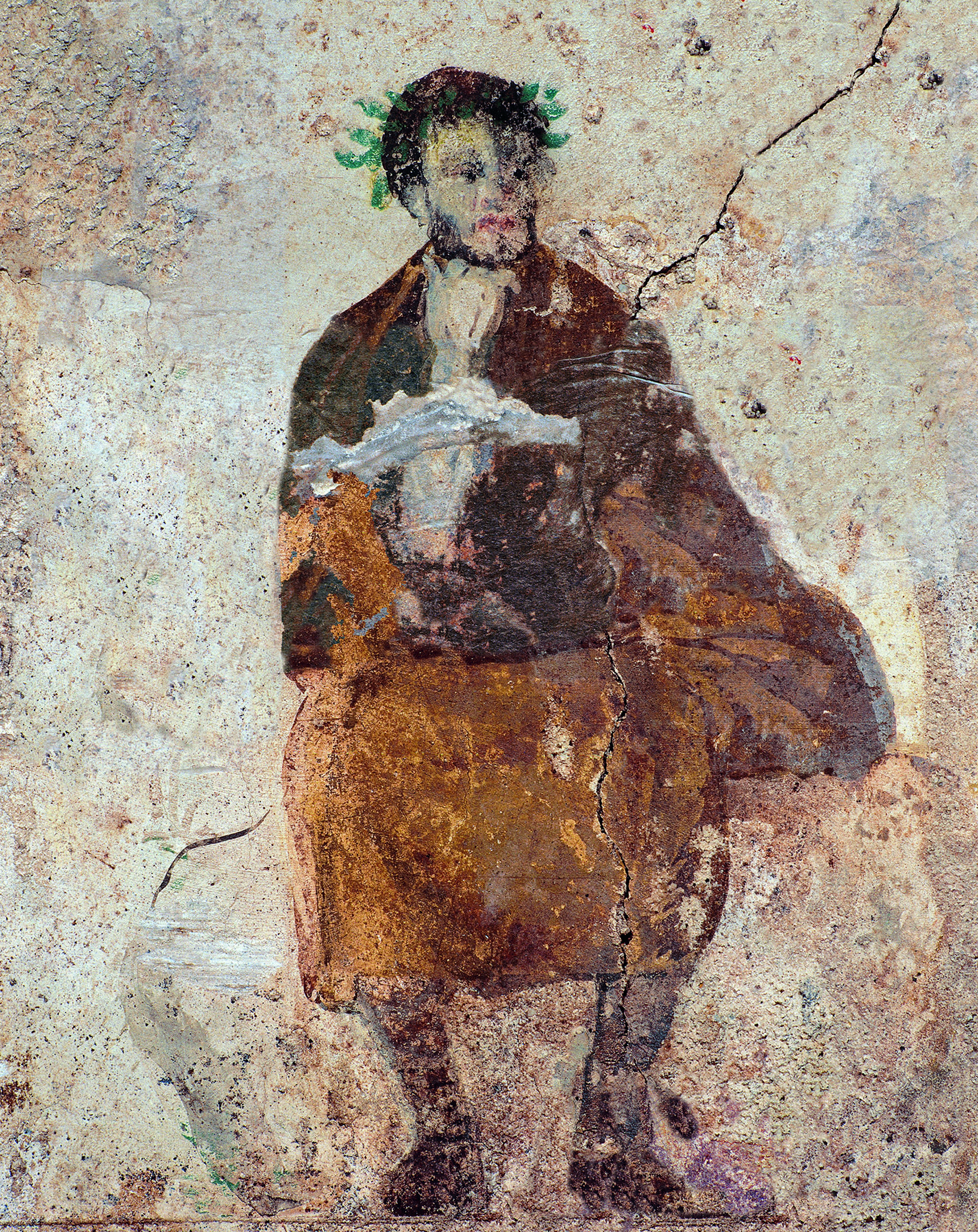
The unique Tomb of the Philosophers is a large built cist grave (5.5 x 3.5 m and 3 m high) in the East Cemetery. Constructed in the early 3rd c. BC, most of it has been carved out of the bedrock. Its walls depict philosophers, an iconographic theme that reflects the strong interest of local society in philosophy and the sciences. The figures have been executed by a skilled painter displaying excellent draughtsmanship and a sensitive use of colour. A rock-cut tomb (late 4th-late 2nd c. BC) with eight chambers, one of which is decorated with bands of coloured plaster, has also been discovered in the East Cemetery.

Five Macedonian tombs have also been excavated in Pella. Of these, Macedonian Tomb B (early 2nd c. BC), the only one discovered unlooted, stands out for the wealth of its grave goods, which include two gold myrtle wreaths.

The numerous grave goods from the cemeteries of Pella include clay, glass and metal vases, toiletry articles, tools and a few weapons. The grave goods imported from other regions are indicative of the contacts between the Macedonian Kingdom and the rest of Greece, especially Attica. The many terracotta figurines come in an impressively wide range of types and demonstrate the great development of coroplastic art in the city.

In addition to the two Hellenistic cemeteries, a cemetery of the Classical period (late 5th – first half of the 4th c. BC) has been excavated in Pella, on the site later occupied by the Hellenistic Agora.

The public baths were discovered in the area of the new entrance to the archaeological site and were in use from the last quarter of the 4th to the end of the 2nd century BC. This is the oldest bathing facility in Northern Greece known to date. During its last period of use, at the end of the 2nd century BC, it acquired underfloor heating, one of the earliest applications of this system in Greece.

Monuments - Roman and Early Christian Pella (near the village of Nea Pella)

“Baths of Alexander the Great”

The so-called “Baths of Alexander the Great” are actually a roadside spring, originally built as the basin of a Roman watermill. In Ottoman times it was adapted in order to supply a watermill south of the spring via a built duct. When the spring was cleaned, 4,500 ancient and modern coins were found, showing that the spring was considered sacred and coins were thrown into it to invoke divine blessings. The tradition of passers-by throwing coins into the spring continued until the 1970s, until the spring dried up due to the boreholes drilled in the surrounding hills, which lowered the water table.

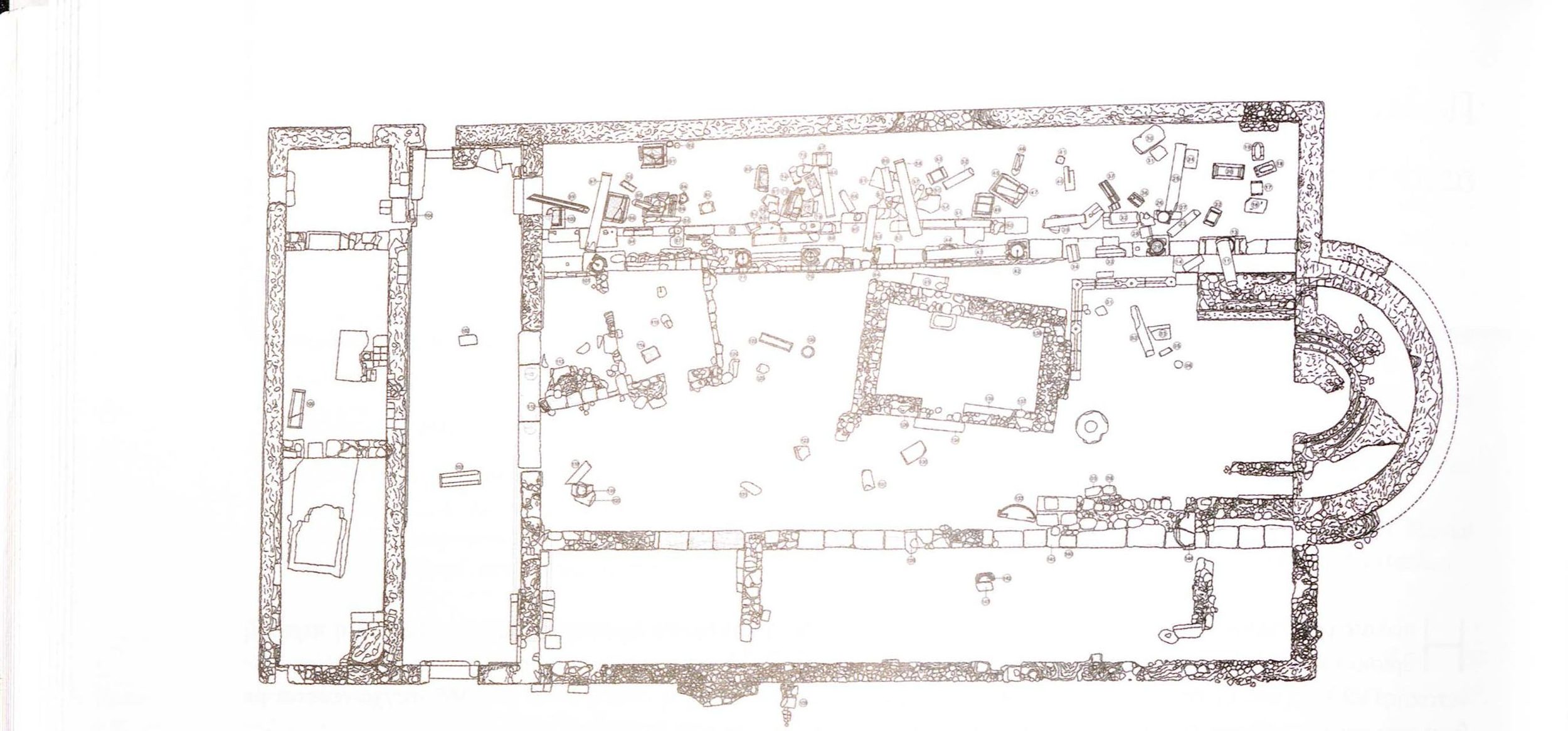
Β. Μάσεν – Χρ. Παπαοικονόμου – Γ. Καραδέδος – Φλ. Καραγιάννη – Γ. Σκιαδαρέσης, “Παλαιοχριστιανική βασιλική Νέας Πέλλας: Από την ανασκαφή στη μελέτη αποκατάστασης”, Το Αρχαιολογικό Έργο στη Μακεδονία και στη Θράκη (2016), fig. 2

This is a three-aisled timber-roofed basilica with galleries, narthex, exonarthex and atrium. In the sanctuary apse is a marble-clad built synthronon. Walls of buildings have been uncovered around the basilica, indicating that it was not a standalone building but formed part of a larger monumental complex. There is probably an atrium with a baptistery to the south, which has not yet been excavated. The basilica dates from the second half of the 5th century AD and remained in use until the early 7th century AD, when it was destroyed, probably by an earthquake. The basilica was decorated with luxurious marble revetments, mosaic floors and opus sectile (marble inlays), while its sculptural decoration is particularly fine. The size of the basilica and its elaborate sculptural decoration indicate that it served as the episcopal church of the city.

Museums

Archaeological Museum of Pella
Αρχαιολογικό Μουσείο Πέλλας / Archaeological Museum of Pella

It is located at the western edge of modern Pella. Through the rich finds from the excavations at Pella, visitors are introduced to various aspects of the daily and public life of the Macedonian capital.

The Museum operates under the auspices of the Cultural Association of Pella and is housed in a two-storey building dating from 1937 in modern Pella, which has served various purposes in the past (community store, elementary school, etc.). Its collection includes a rich variety of exhibits, including traditional costumes from Macedonia, Thrace and Eastern Rumelia.


Other Stops in the Regional Unit of Pella

error: