Moglena (Castle of Chryssi )
Moglena, a small Byzantine castle-city on the River Almopaios
The Castle of Moglena is located 1 km northwest of the village of Chryssi (formerly Slatena, Slatino or Zlatina), which is about 18 km north of Edessa and now belongs to the Municipality of Almopia, as the area was known in antiquity. The name Moglena is of Slavic origin and is believed to have prevailed after the occupation of the area by the Bulgarians in the 10th century. The castle is built in a strategic position, on the top of a low, smooth hill, from which it is possible to observe and control almost the whole western part of the small, fertile, closed plain of Almopia. The plain is delimited to the west and north by the Voras mountain range, to the east by Mount Paiko and to the south by the smaller mountains of Edessa. The River Almopaios, a tributary of the Loudias, flows around two sides of the hill on which Moglena stands. The Almopaios, also known as the Moglenitsa or Moglenitikos, was called the Ano Loudias in antiquity. The river protected Moglena on the south and west, and supplied the town with water for the inhabitants and to irrigate the cultivated fields in the surrounding plain.
The relatively small size of the castle, which covers about 4 hectares, makes it one of the medium-sized castles built during the Middle Byzantine period in order to protect the Byzantine countryside. The Castle of Moglena was an important fortified town of the period. It was also the administrative and ecclesiastical centre of the region, as the seat of the theme and the episcopal see of Moglena. The remains of two other Byzantine castles are found in the wider area; together with the Castle of Moglena, they formed a strong network of fortifications that protected the area from external dangers. The first castle, north of the modern village of Notia (formerly Noti or Nonte), is the castle of Enotia known from written sources, while the second, northeast of the village of Margarita, remains unidentified.
Moglena, north of the Via Egnatia, which passed through the Byzantine castle-city of Vodena (modern-day Edessa), was one of the provincial castle-cities of Macedonia that developed on the branches of the main road network of the region, when the network was restored from the early 11th century onwards with the abolition in 1018 of the First Bulgarian Empire by Basil II Boulgaroktonos (the Bulgar-Slayer) (976-1025) and the consolidation of Byzantine rule in the region of Macedonia.
History
The first traces of habitation in the wider area of Chryssi date back to the Iron Age (1100-700 BC). However, the only indication to date of the existence of an ancient settlement from the Castle of Moglena itself is a group of sherds of Late Classical-Hellenistic black-glaze pottery recovered from the fill of the castle gate. The question of whether the castle was occupied during the Early Christian period also remains open. The only evidence is the traces of an Early Christian structure uncovered outside the castle in illegal excavations carried out in 1980, and two pieces of Early Christian sculptures used as floor slabs in the funerary church.
There is very little information on the founding of the Castle of Moglena. Its heyday was between the 10th and 13th centuries, while it has been argued that it was constructed in the early 9th century, after the establishment of the Theme of Thessaloniki (late 8th/early 9th c.), during the time of the devastating Bulgarian raids. In 809/10, Emperor Nikephoros I (802-811) settled a number of Byzantine subjects from Asia Minor in the area to strengthen its defences against the Bulgarians. Emperor Leo V the Armenian (813-820) also attempted to revive the region in the early 9th century.
The Castle of Moglena is mentioned in Byzantine written sources in the context of the campaigns of Emperor Basil II Boulgaroktonos (the Bulgar-Slayer) (976-1025) against Tsar Samuel of Bulgaria, who had seized control of the whole region of Macedonia west of Thessaloniki in the decade 976-986. According to the sources, Basil II recaptured the Castle of Moglena from the Bulgarians in 1015 and destroyed it to prevent them from reusing it as a stronghold. In order to achieve his goal, Basil diverted the River Almopaios and undermined the foundations of the walls, placing wood and flammable materials in the pits and setting fire to them, thus destroying the castle.
A hoard of 19 gold coins of the era of the Macedonian kings, found in 1935 in the courtyard of a house in the nearby village of Chryssi, is associated with the turbulent times of the Bulgarian invasions. Sixteen of the coins in the hoard were issued between 949-959, during the reign of Constantine VII Porphyrogenitus and his son Romanos II, while the remaining three were issued during the reign of Nikephoros Phokas (963-969). The unknown owner of the hoard probably intended to conceal it in the face of the Bulgarian threat.
Moglena is mentioned for the first time as an episcopal see, subject to the Archiepiscopate of Ohrid, in a sigillion of Emperor Basil II Boulgaroktonos dated 1019. The emperor, who established the autocephalous archiepiscopal see of Bulgaria in 1019, immediately after the dissolution of Samuel’s state, issued three sigillia between 1019 and 1025 defining its boundaries and jurisdiction. The original sigillia have not survived, but their text is interpolated in a chrysobull of Michael VIII Palaiologos dated to 1272 or 1273. One of the three sigillia also mentions that before the dissolution of the Bulgarian state by Basil II, when Tsar Peter (927-968) was on the throne of Bulgaria, a period when the independence of the Bulgarian church was recognised, the seat of the Archbishop of Bulgaria had been transferred successively from Dristra (Dorystolon) to Triaditsa (Sofia), then for a brief time to Vodena (Edessa), followed by Moglena and Ohrid. However, this information on the transfer of the Bulgarian archbishop’s seat to Vodena and Moglena is unreliable, as the authenticity of the three sigillia of Basil II has been called into question.
The Castle of Moglena appears again in written sources in the context of the struggles of Emperor Alexios I Komnenos (1081-1118) against the Normans. Led by Robert Guiscard, after conquering most of Southern Italy and northern Sicily in the mid-11th century, they launched a campaign against the Byzantine Empire in 1081. According to Anna Komnene, Moglena was captured in 1082 by Bohemond, son of Robert Guiscard, the leader of the Norman campaign in the Balkans. Before continuing his march towards the River Axios, Bohemond rebuilt the kastellion (castle) of Moglena and installed a strong garrison commanded by a man named Sarakinos. A year later (1083), the Byzantine commander Gregory Pakourianos recaptured Moglena, restoring Byzantine rule in the region. Gregory, following the earlier example of Basil II, razed the walls of Moglena to the ground.
A few years later, in 1086, under Emperor Alexios I Komnenos, the region gained in importance and the Theme of Moglena was established. The historian Ioannis Zonaras informs us that in 1122 Patzinakes (Pechenegs), a nomadic people of Central Asia who had settled in the Danube region, were brought in to settle in the area. Documents from the Monastery of Great Lavra on Mount Athos, which held estates in the wider area of Moglena, show that on other occasions, too, the political administration of the Empire settled hostile tribes, such as Cumans and Vlachs, in Moglena. The documents of the Athonite monastery show that in the environs of Moglena there were cultivated fields, vineyards, pastures, pens, livestock, various houses and sheds, and a mill.
In the 12th century, around 1134, St Hilarion became bishop of Moglena. One of the biggest problems he had to deal with in his jurisdiction were the Bogomils, the adherents of a heresy that had appeared in Bulgaria in the mid-10th century. Emperor Manuel I Komnenos (1143-1180) urged him to expel the Bogomils from his see if they refused to return to the fold. Hilarion, who died in 1164, was buried in Moglena and miraculous myrrh began to flow from his grave. In 1206, Moglena was conquered by the Bulgarian ruler Kalojan, (Ioannitza or “Skyloioannes”) who transferred the relics of St Hilarion to Tirnovo (now Veliko Tarnovo) in Bulgaria, which, as the new capital of the Bulgarian state, had to be consecrated with the relics of various saints.
In 1246, the region of Moglena was conquered by the Emperor of Nicaea, John III Vatatzes (1222-1254). John was campaigning against the Despot of Epirus, who had expanded his possessions in Macedonia and conquered Thessaloniki in 1244. In 1261, Moglena was incorporated, along with the rest of Macedonia, into the restored Byzantine Empire.
The area of Moglena was conquered by the Ottomans at the end of the 14th century, while neighbouring Vodena came under Ottoman rule in 1385 or 1389. The castle fell into decline and was gradually abandoned, while the inhabitants seem to have moved to new sites scattered across the surrounding plain. In Ottoman times, the episcopal see of Moglena was transferred to the mountain village of Notia, due to the conversion to Islam of the inhabitants of the lowland area. In 1759, Metropolitan John urged the local Christian faithful to convert to Islam for their own safety. Typical of the prevailing climate of the time is the example of Saint Chryssi, who was tortured by the Turkish authorities and died a martyr’s death in 1795. The saint came from the village of Slatena , which was renamed Chryssi in her honour in 1926. The area, which was incorporated into the Greek State in 1912, was controlled by the Serbs during World War I (1914-1918) and the Allied army’s line of defence was very close to the castle. In 1922, with the population exchange, Christian refugees settled in Chryssi and used a substantial amount of building material from the castle for their houses.
Monuments
Fortifications
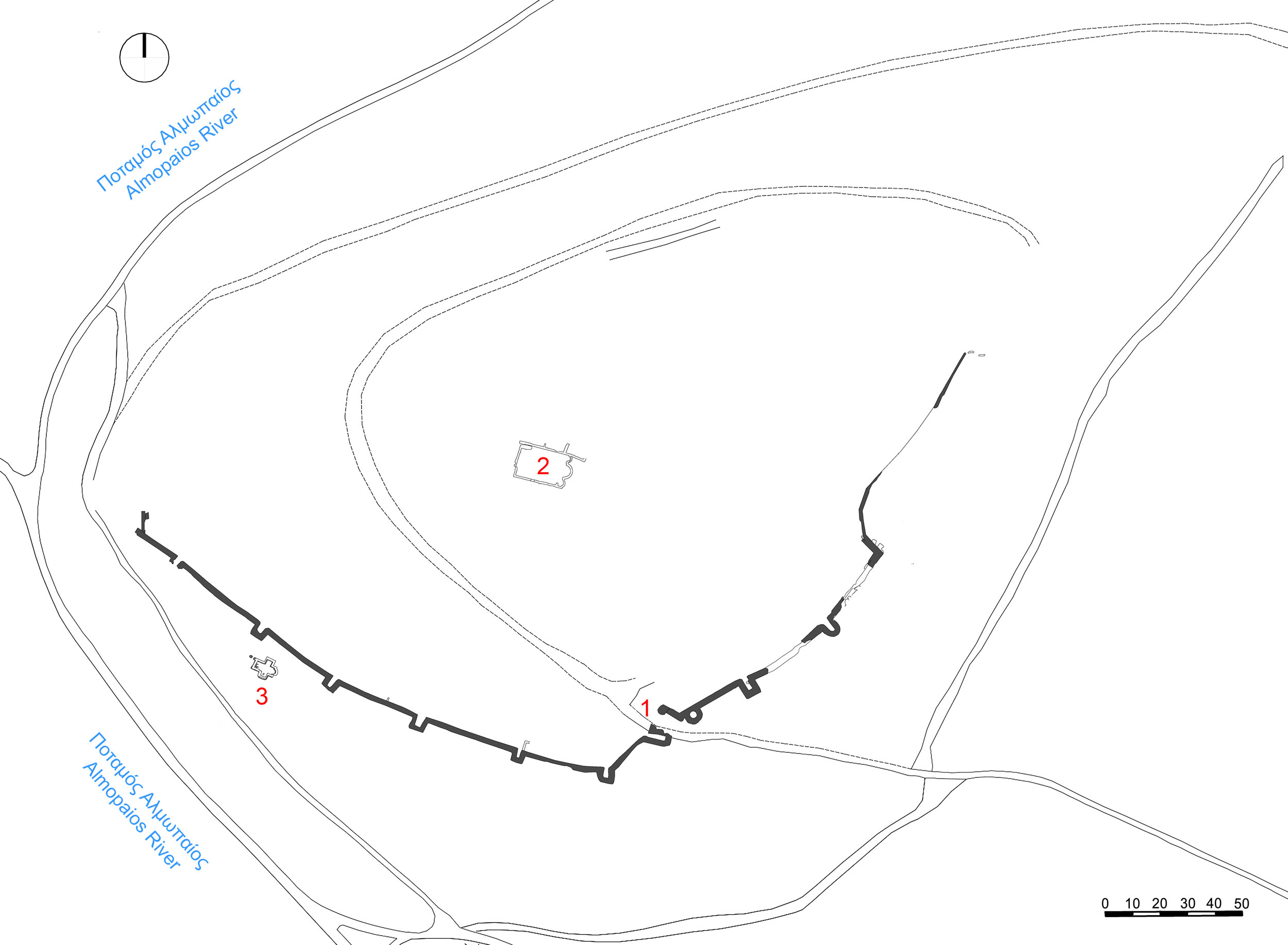
Of the fortified enclosure of the Castle of Moglena only the east and south parts are visible, as the north and west are covered by earth and dense vegetation.
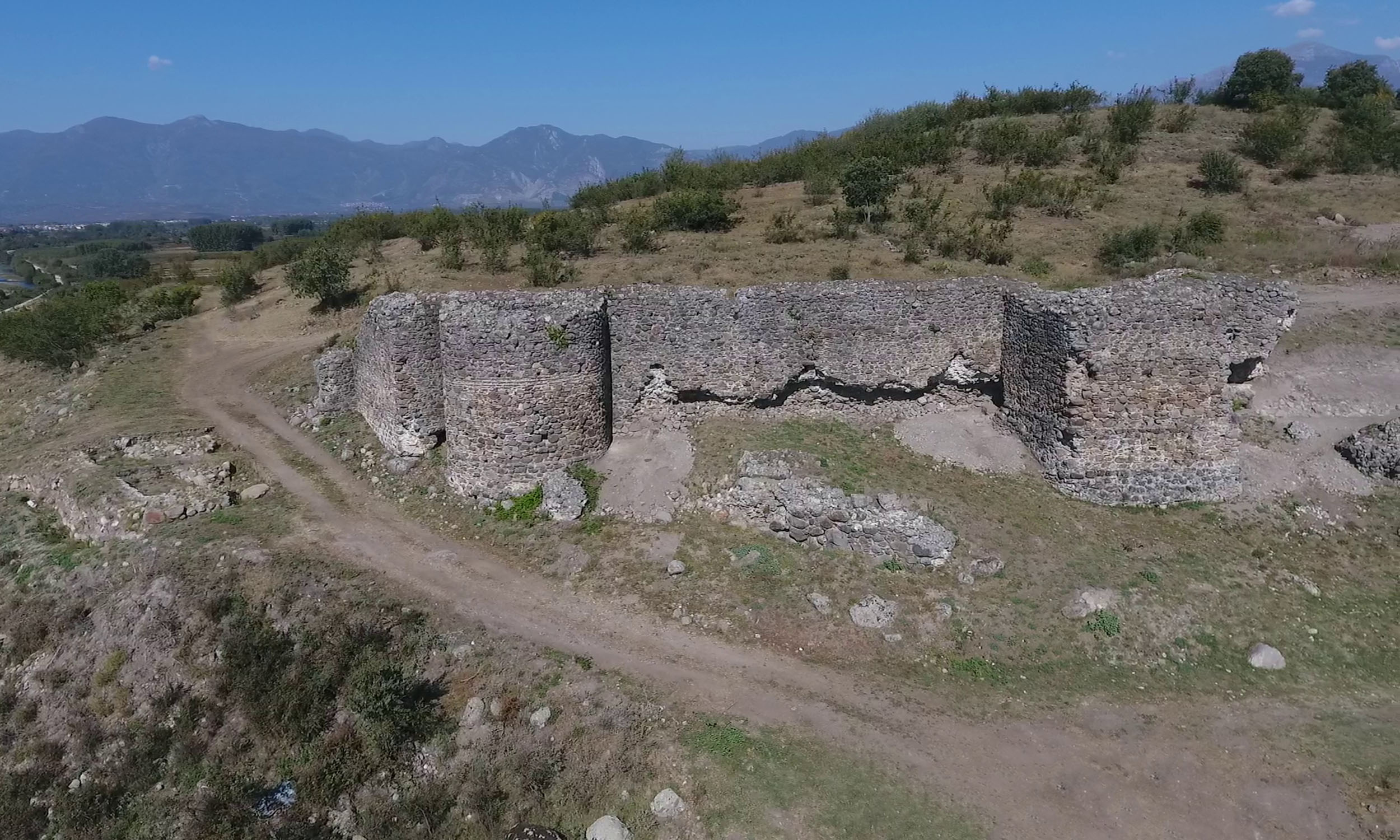
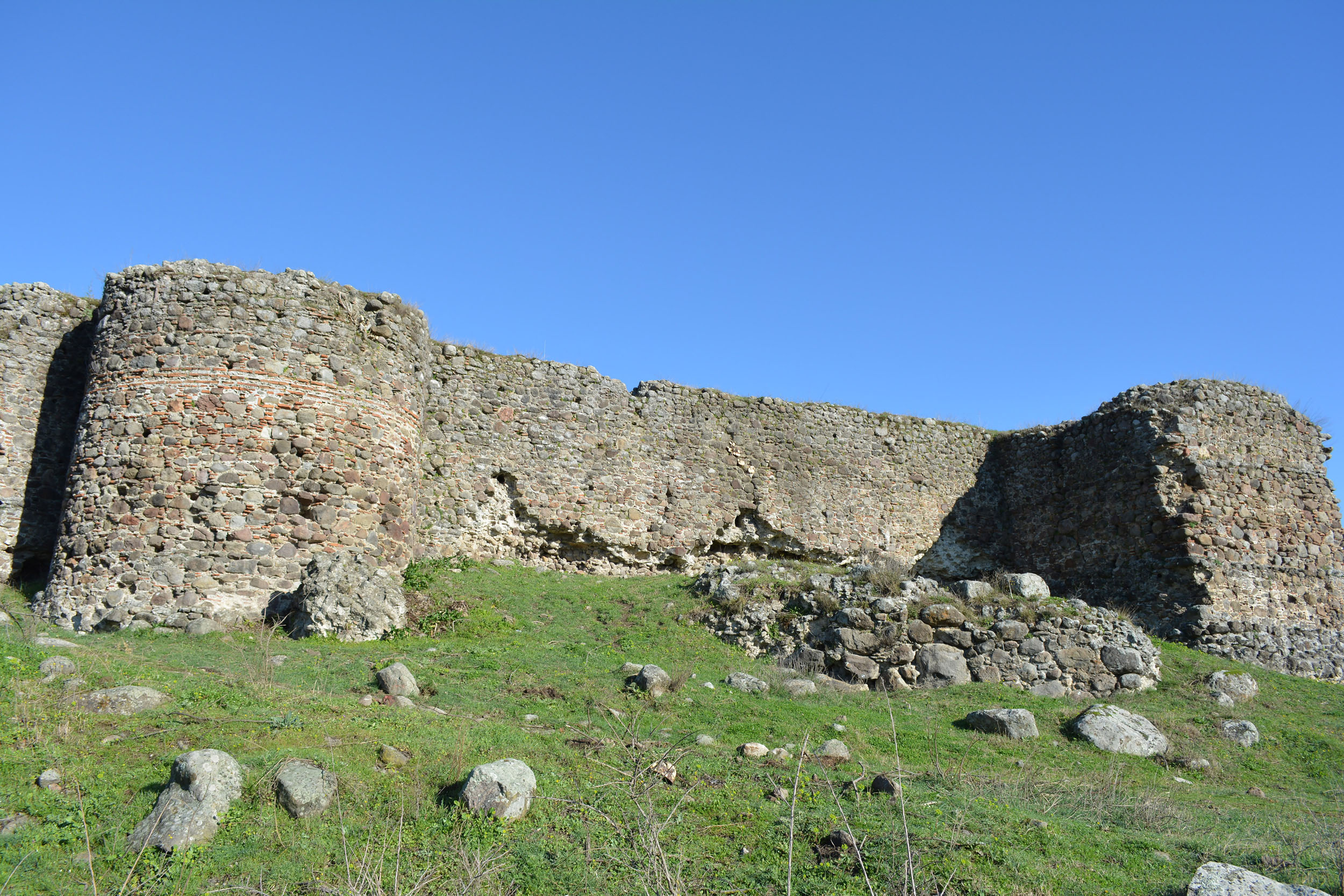
The best-preserved part of the castle is the east wall, which is 180 m long and has a maximum height of 6-7 m. On the south side of the castle are the remains of a gate protected by a strong circular tower. The east side of the wall is further protected by a square tower and an oval one.
The wall on the south side, 200 m long and 2.30 m thick, is only partially preserved and only reaches a height of 2-3 m in places. Its course, however, can be traced for 200 m to the southwest corner, where it curves north. The wall is protected by strong square and oval towers set 30 to 40 m apart.
To date, ten towers attached to the wall have been uncovered, all of which, except the circular one, were open on their rear side, are almost as thick as the wall and measure approximately 4 x 5 m.
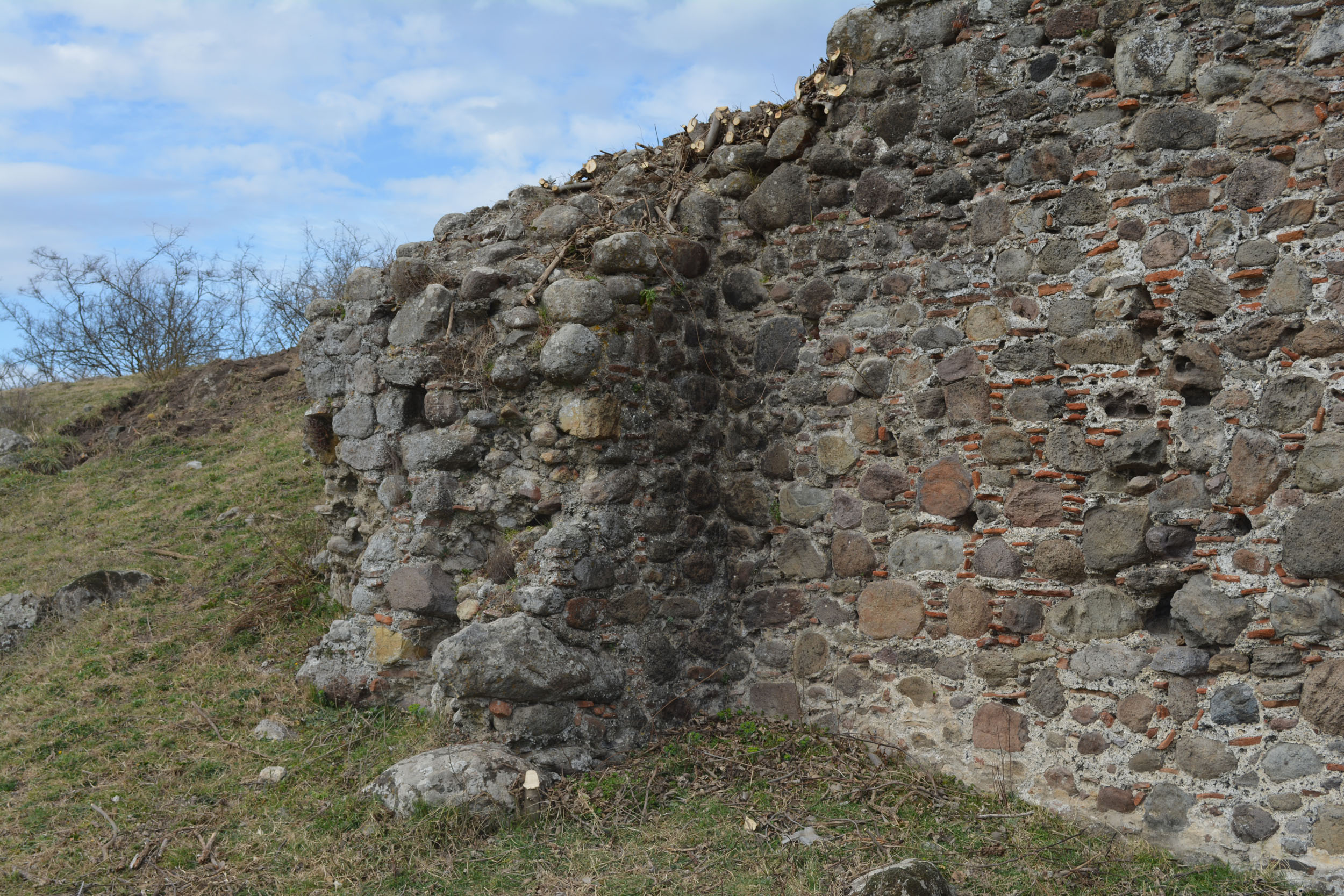
Two different building methods are visible in the masonry of the fortifications. In the first, used in the south wall and some parts of the east wall, the masonry consists almost exclusively of roughly dressed stones with a few randomly placed bricks.
The second building method is seen in a large part of the wall on the east side. There the masonry consists of roughly dressed stones, with one row of bricks inserted in the horizontal joints and three or four successive rows of bricks in the vertical joints. The masonry of the round tower protecting the castle gate has a more decorative appearance, with the insertion of a horizontal band of three rows of bricks using the recessed brick technique, in which two rows of thinner bricks and tiles are interspersed between the three rows of bricks. A brickwork cross is set above the band of bricks. The upper part of the square tower on the east side of the wall is also decorated with a radiating brickwork ornament. The masonry and the brickwork ornaments of the second building method indicate a date in the mid-13th century, linking this phase of the castle’s construction with the conquest of Moglena by the Emperor of Nicaea, John III Vatatzes, in 1246.



Episcopal church
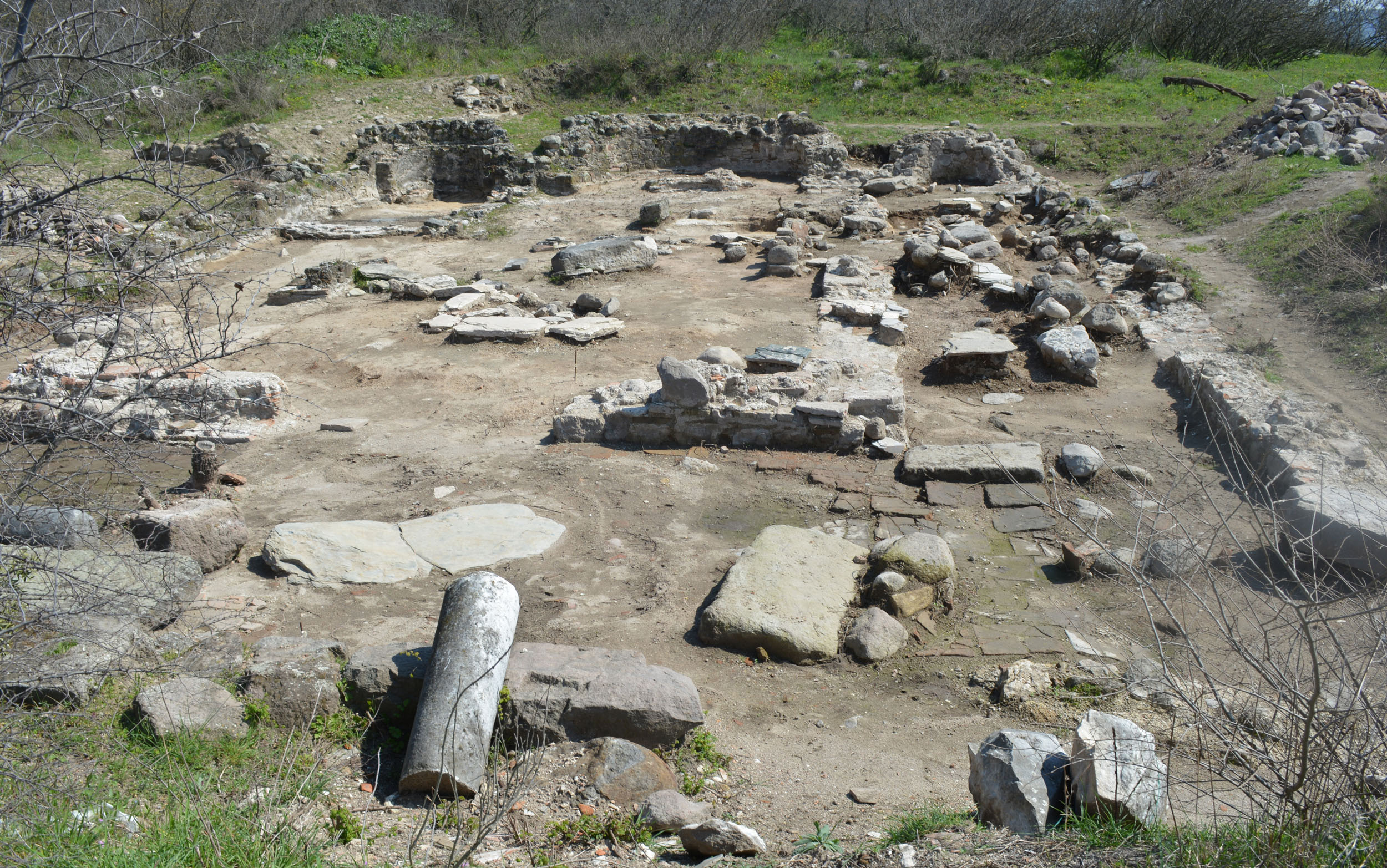
Inside the castle, the remains of a large three-aisled basilica with a narthex have come to light. The basilica, measuring 21 x 13.5 m, is dated between the 10th and 12th centuries. The aisles are separated by pillar walls. Traces of a synthronon have been found in the sanctuary apse. The church had a mosaic floor, fragments of which have been uncovered in the apse of the prothesis. Tesserae from mosaics were also found between the pillar walls. Slabs of marble and grey stone were found in situ in the nave, while in front of the sanctuary were fragments of opus sectile (marble inlay). The church was once decorated with frescoes, of which a few remains are preserved in the apses of the prothesis and the sanctuary apse, while fragments of frescoes were recovered from every part of the church. Only very small pieces of the church sculptures have been found, but they nevertheless testify to the rich sculptural decoration of the 11th-12th centuries. The size of the basilica, its rich decoration and the synthronon all indicate that this was the episcopal church of Moglena.
Funerary church
On the south side of the hill, outside the walls, a free cross-plan church measuring 9.50 x 8.40 m has been excavated, dating from the Middle Byzantine period (9th-10th c.). The church had frescoed decoration, traces of which are preserved in the north arm of the cross. In the central part of the church floor, two pieces of Early Christian sculptures, a colonette and a panel, have been used. A total of 53 burials have been unearthed both inside and outside the church, attesting to its function as a funerary church. The most remarkable find from the cemetery is a cross-shaped reliquary dated to the 8th or 9th century.