Grevena
Stone bridges of Grevena: the largest and most impressive in Macedonia
The region of Grevena, due to its position between the rest of Macedonia, Epirus and Thessaly, has been an important road hub since ancient times, with a dense network of roads, their layout dictated by the mountainous, rugged terrain and the complex river system of the Haliacmon and its tributaries. To serve the land road network of the region in Ottoman times, a large number of stone arch bridges were constructed along the Venetikos, the river of emerald-green waters, the Haliacmon and other rivers of the region. Besides facilitating communication and movement between local communities, they served to link the region with the major highways of Macedonia, Epirus and Thessaly, particularly with the road that split off from the Via Egnatia and connected Ioannina with Thessaloniki, and with the “Vasiliki Strata” (Royal Road), which ran a little north of the first road and connected Grevena with Ioannina via Eastern Zagori. The bridges of Grevena, among the largest and most impressive in the whole of Greece, built in idyllic natural landscapes, in dense forests and steep gorges, are major attractions of the region today.
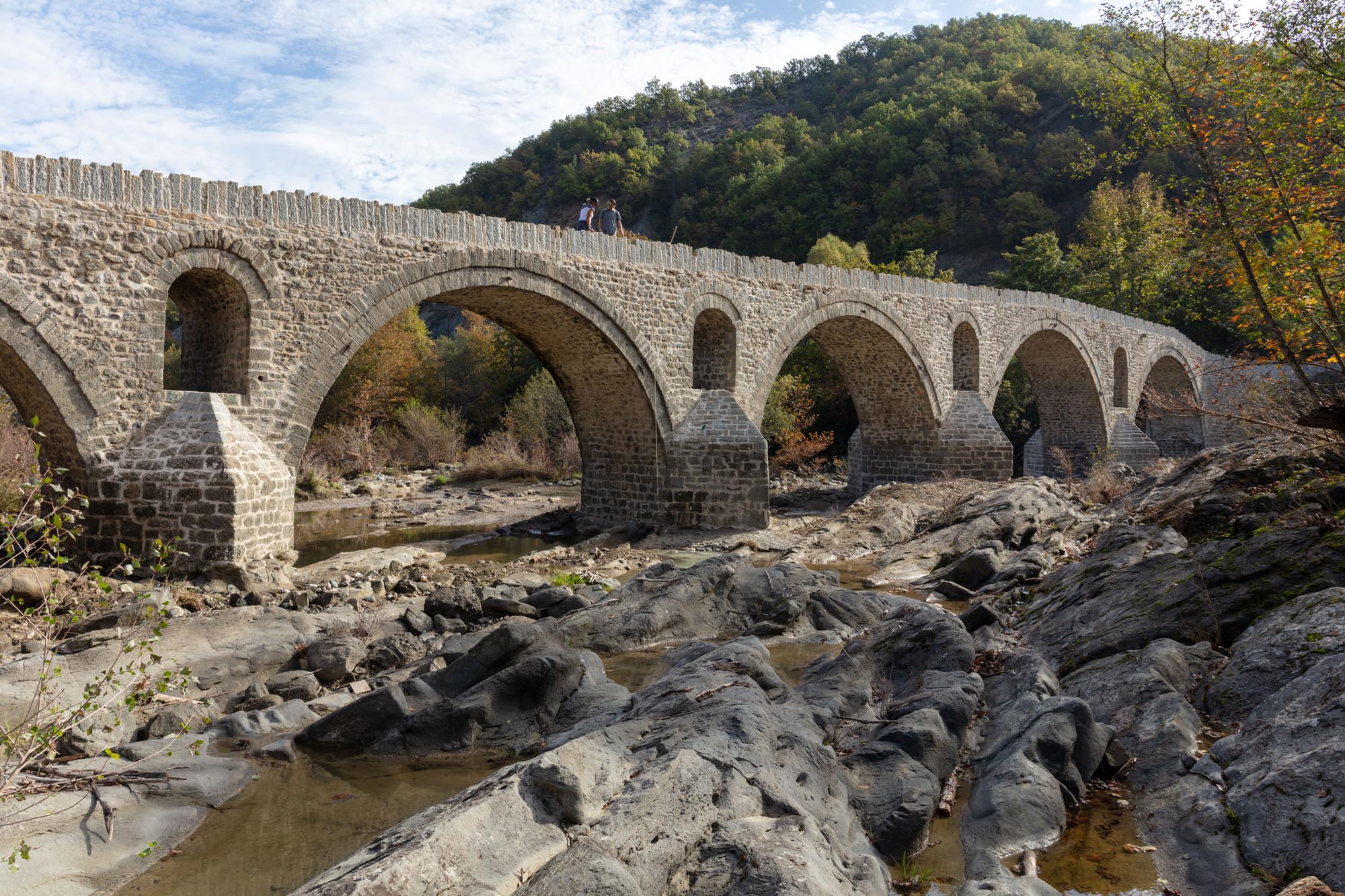
Most of the stone bridges of Grevena are single-arch, two-arch or three-arch. Only in some cases, when they span wide rivers, are they are multi-arch, with five (Spanos Bridge) or six arches (Pasha Bridge). The arches are usually semicircular, with the exception of the Portitsa Bridge, which has a slightly pointed arch, and the bridge at Nidrouzi, which was built using the more advanced technology of the segmental arch, i.e. an arch that is less than semicircular. In order to channel the rushing waters of the rivers in the event of flooding without endangering the stability of the bridges, there are arched relief flood openings in the piers between the arches, while triangular cutwaters with a stepped end are formed at the base of the mid-piers. In some cases, a copper bell (kypri) was suspended in the middle of the central arch, warning passers-by of danger when the wind was blowing or the river overflowed.
The bridges of Grevena date between the late 17th and the late 19th century, when the trade of the region flourished and important commercial and industrial centres of Western Macedonia and Epirus arose, such as Kastoria, Siatista, Kozani, Metsovo and Ioannina. Constructed by master builders known as kioproulides, who came from the mastorochoria (master craftsmen’s villages) of Grevena, Kozani (Voio Province), Kastoria and Ioannina (Konitsa Province), they served the caravans of the merchants, not only from the wider region but also from the Balkans generally, who came to the great fairs of Grevena, the most important of which was held at Mavronoros every summer. At the same time, the bridges served, among other things, the movements of shepherds with their flocks from the pastures of Pindos to their winter quarters in the plain of Thessaly, as well as the movements of the groups of journeyman builders and fresco painters who flourished during this period and travelled all over the Balkans

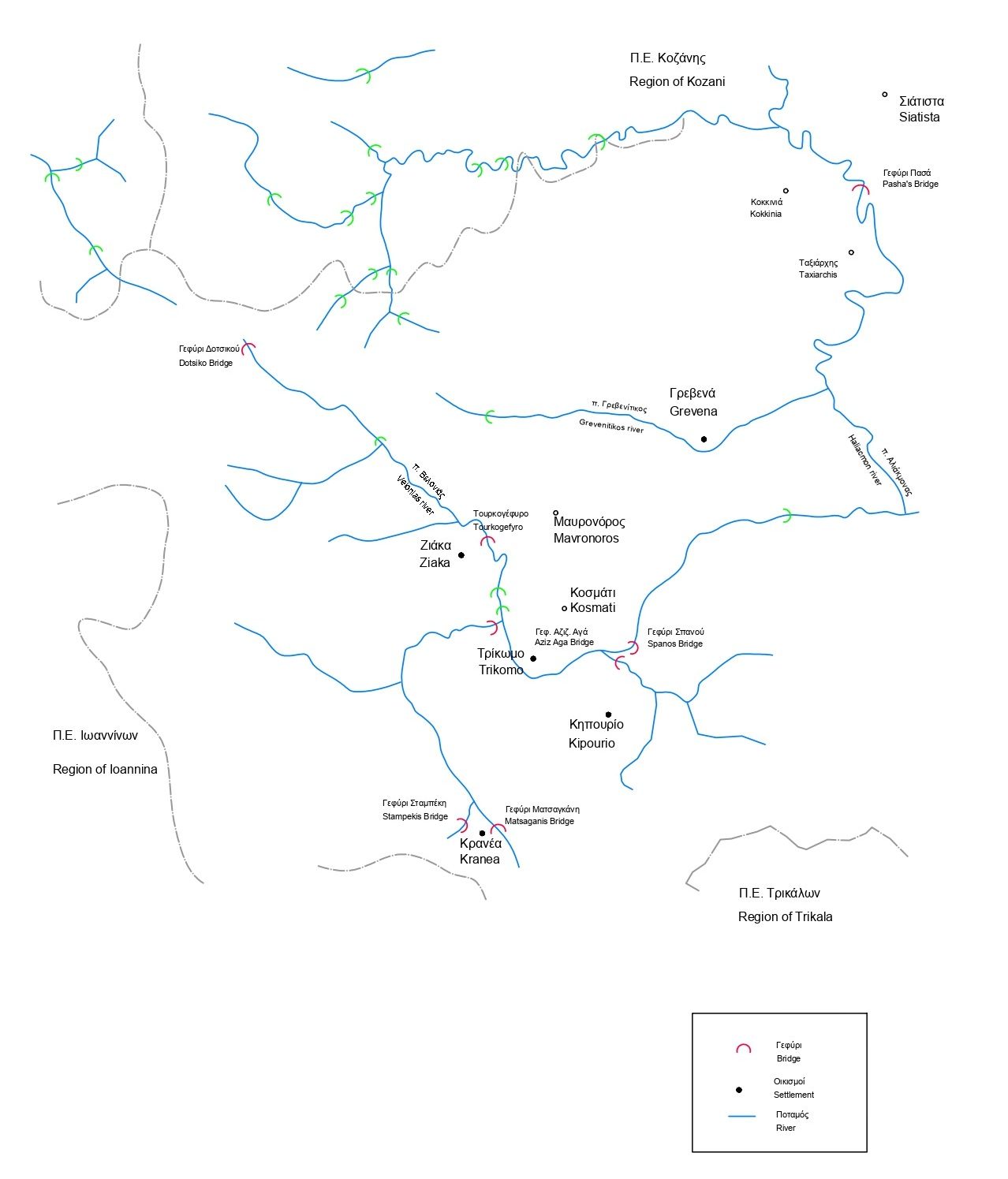
Some of the most notable bridges of Grevena are presented below, moving from south to north in the order in which they are encountered as we ascend the River Venetikos, its tributaries and then the River Haliacmon.
Stone bridges
Matsaganis and Stampekis Bridges
Spanning the River Venetikos, shortly after its confluence with its tributary, the Stavropotamos or Sitovitikos, the Spanos Bridge linked the villages of Kosmati and Pigaditsa, and the villages of northeast Pindos with Macedonia in general. The restored bridge is located next to the Grevena–Krania–Metsovo national highway, just a few metres east of the Egnatia Motorway. It is still used to this day by the local shepherds who drive their flocks on foot from the mountains of the region down to the plain of Thessaly and vice versa each year.
The bridge has five arches and is the largest surviving bridge in Macedonia, with a length of about 90 m. It is of impressively massive, solid construction, and is still used by vehicles today. One of the arches bears the date 1846, believed to be its year of construction. The Epirote scholar Ioannis Lambrides (1880) says that the construction of the bridge was funded by Mustafa Pasha of Argyrokastro, who was nicknamed “Spanos” (meaning “Beardless”). His tomb was located next to the bridge until 1980, but it has been destroyed by looters.
Spanos Bridge
Spanning the River Venetikos, shortly after its confluence with its tributary, the Stavropotamos or Sitovitikos, the Spanos Bridge linked the villages of Kosmati and Pigaditsa, and the villages of northeast Pindos with Macedonia in general. The restored bridge is located next to the Grevena–Krania–Metsovo national highway, just a few metres east of the Egnatia Motorway. It is still used to this day by the local shepherds who drive their flocks on foot from the mountains of the region down to the plain of Thessaly and vice versa each year.
The bridge has five arches and is the largest surviving bridge in Macedonia, with a length of about 90 m. It is of impressively massive, solid construction, and is still used by vehicles today. One of the arches bears the date 1846, believed to be its year of construction. The Epirote scholar Ioannis Lambrides (1880) says that the construction of the bridge was funded by Mustafa Pasha of Argyrokastro, who was nicknamed “Spanos” (meaning “Beardless”). His tomb was located next to the bridge until 1980, but it has been destroyed by looters.
Aziz Aga or Zizaha Bridge
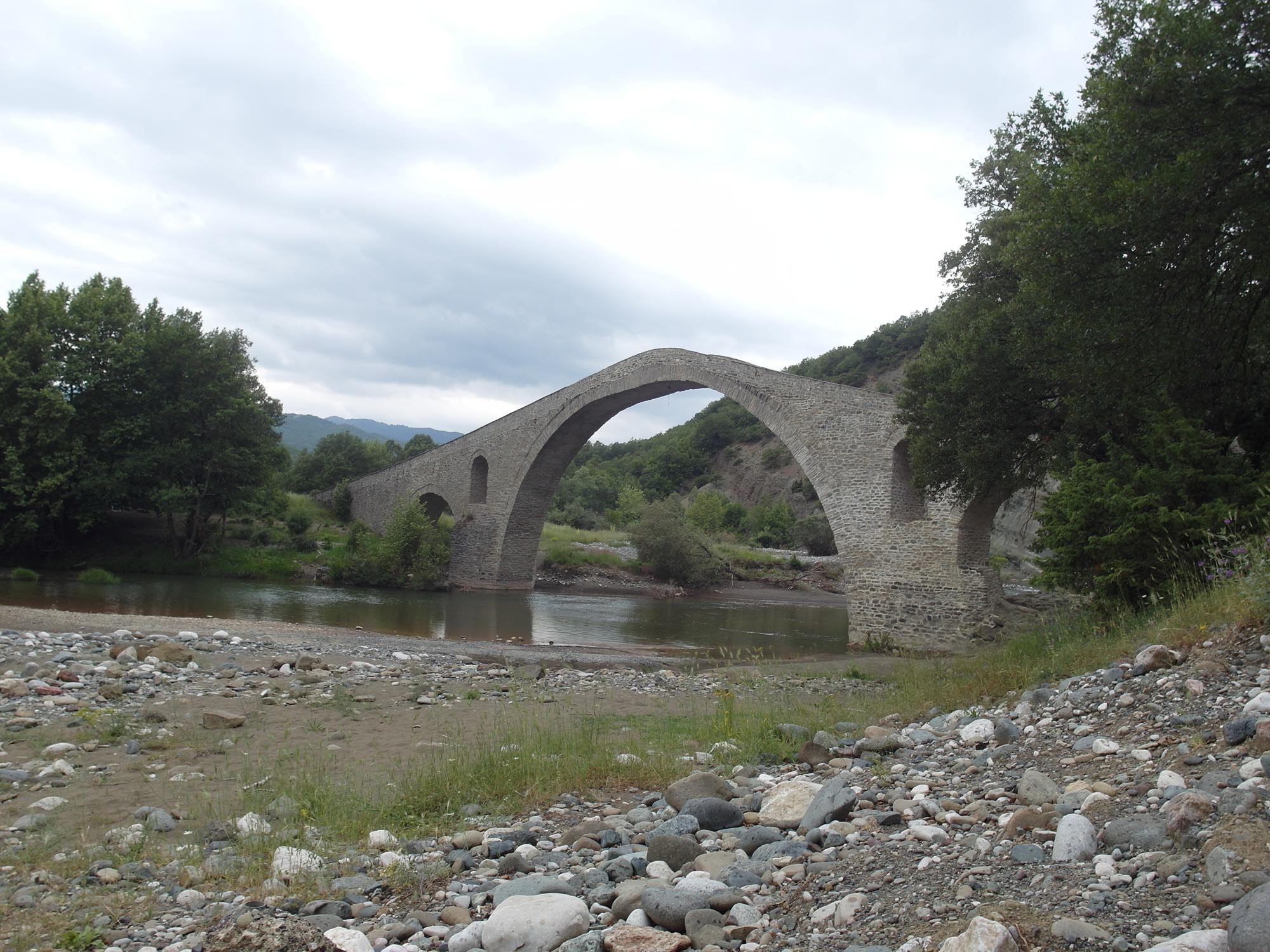
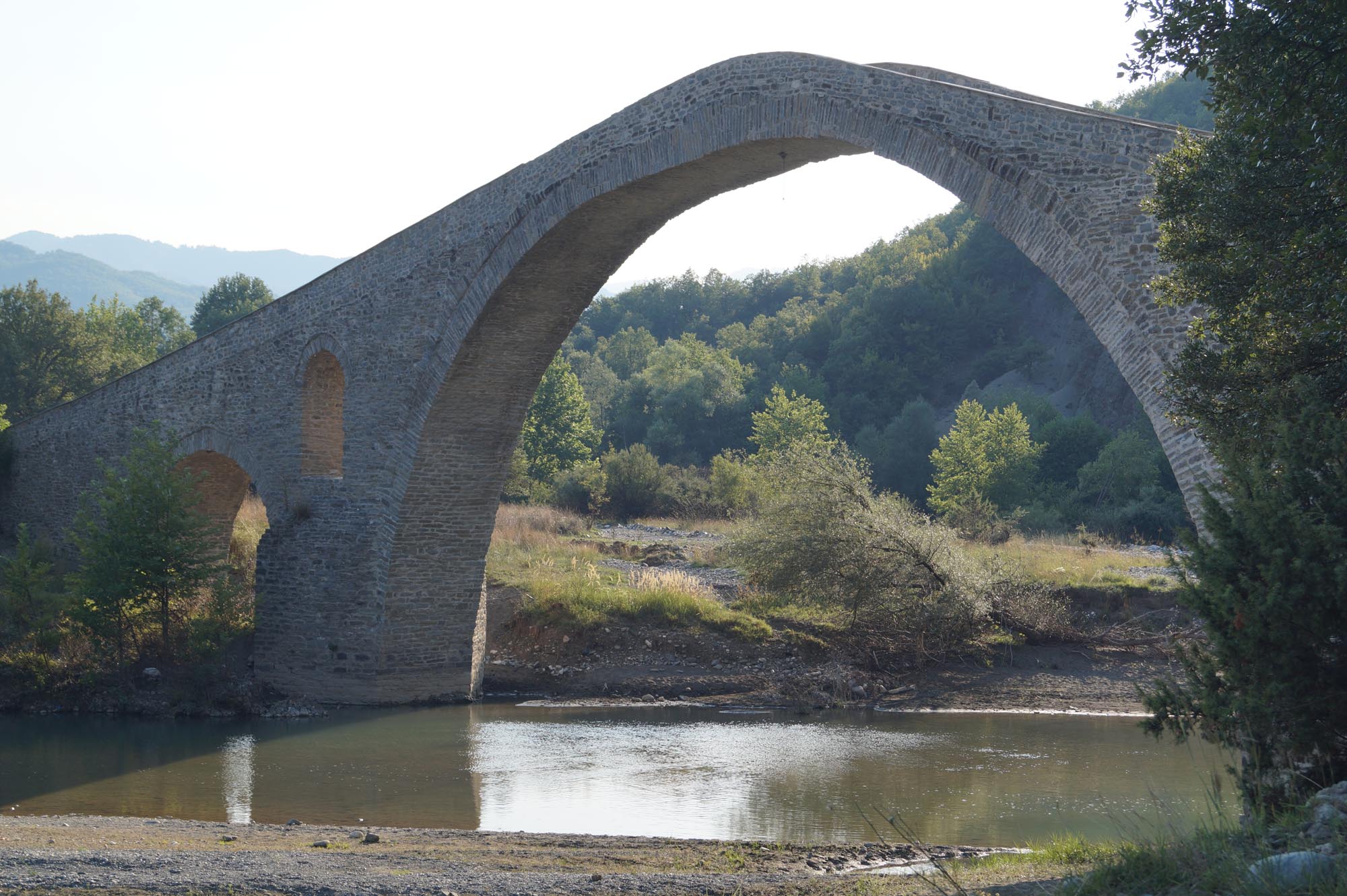
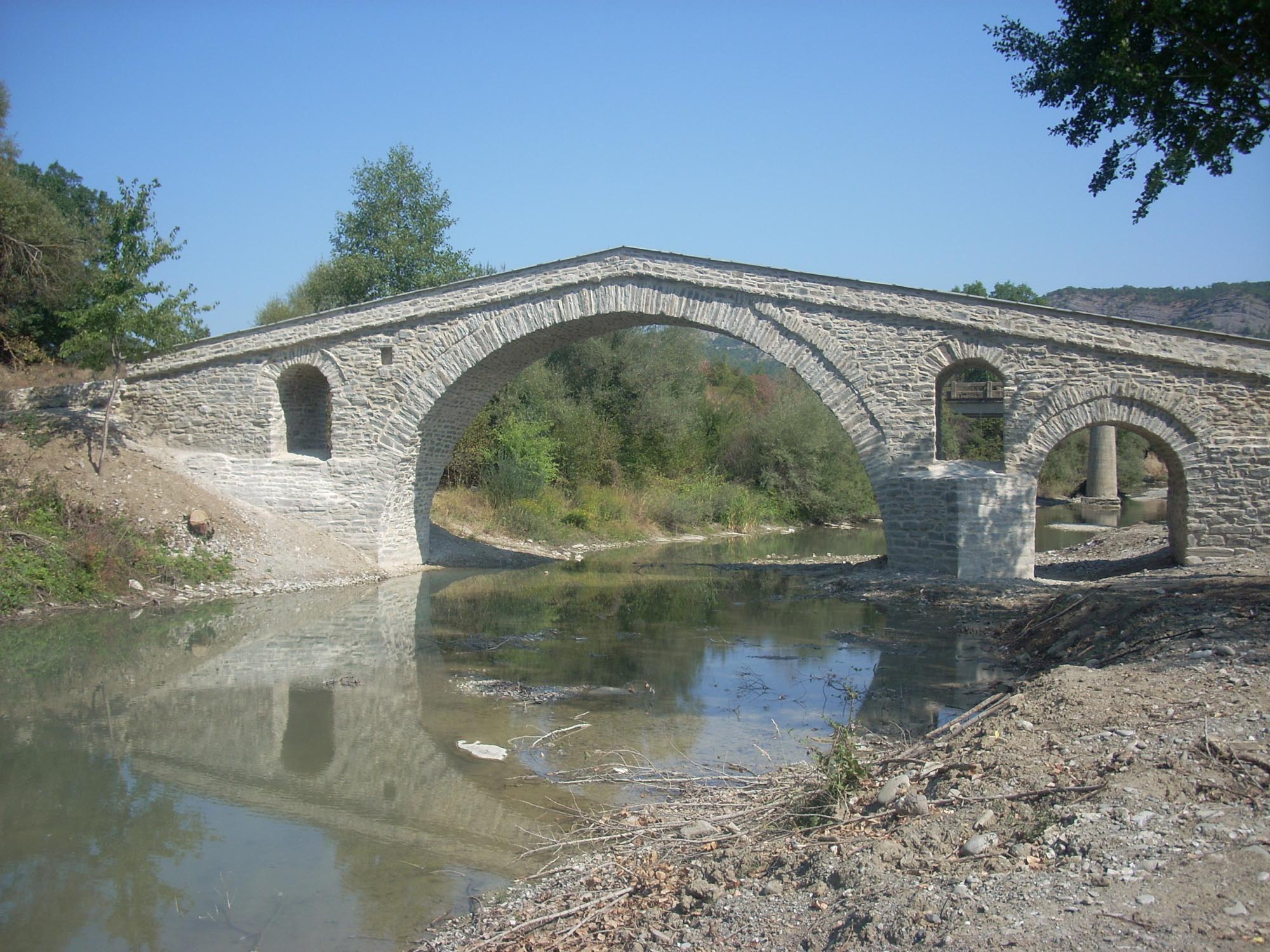
The bridge is located east of the village of Trikomo, a short distance west of the Egnatia Motorway. It spans the River Venetikos just before it meets its tributary the Stavropotamos or Sitovitiko, connecting the villages of Trikomo and Kosmati on one side and Kipoureio on the other, while facilitating the crossing from Macedonia to Epirus. The restored bridge, 71 m long, built in a beautiful narrow valley among oak forests, is one of the most popular stone bridges in Grevena. It has three arches, of which the central one is much larger than the auxiliary arches on either side. The central arch is impressive both for its height (15 m), which makes it the highest in Macedonia, and for its wide span (28 m).
According to a dedicatory inscription, now lost, the bridge was built in 1727. Legend, which survives through the accounts of local residents, has it that the great arch of the bridge collapsed twice and that Aziz Aga, the Ottoman official who undertook the construction of the bridge, threatened to behead the master builder. Finally, the third time, the arch stayed firm and the master builder, who had been fearfully watching the whole process from afar, accepted a generous reward from Aziz Aga.
Bridge in Portitsa Gorge
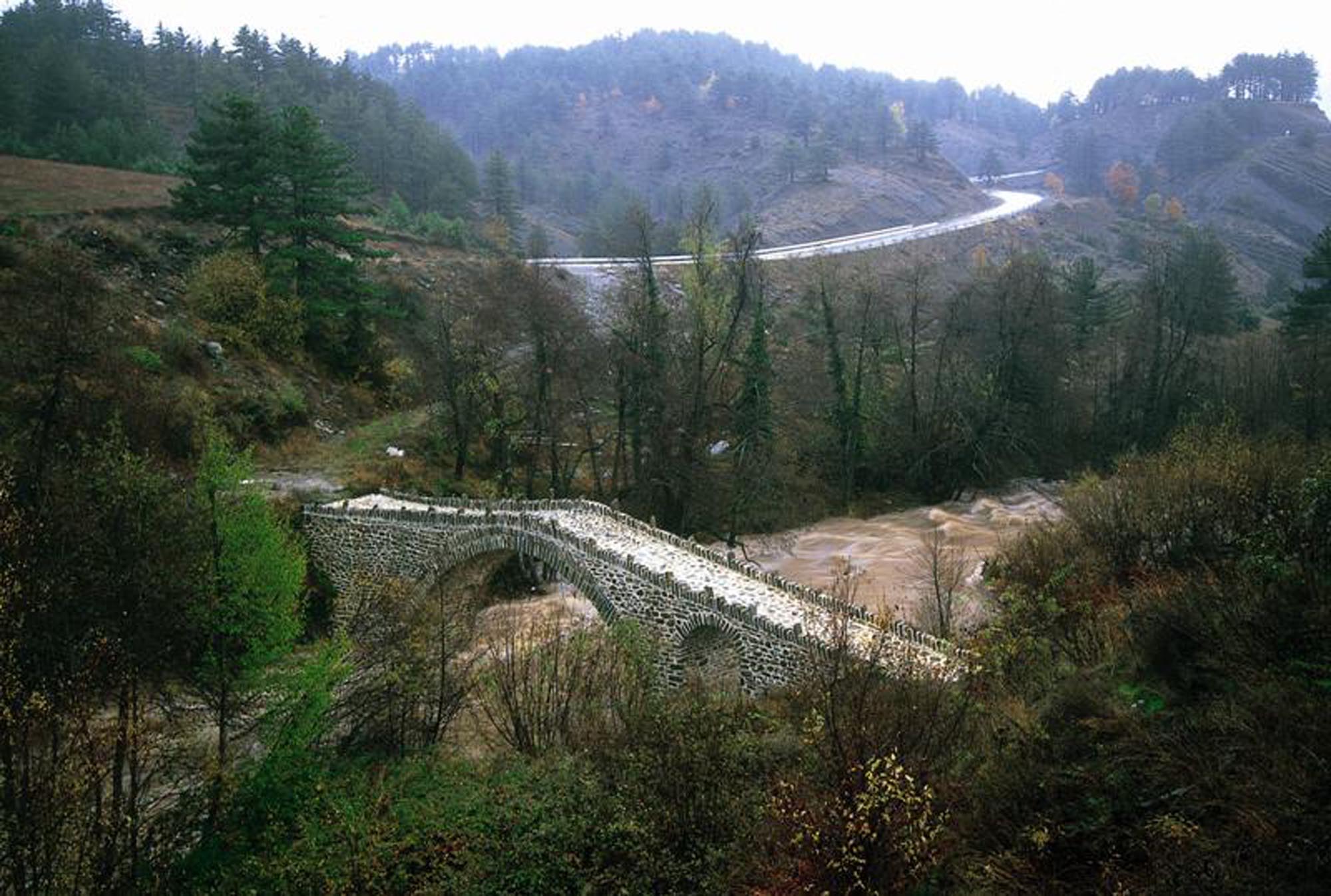
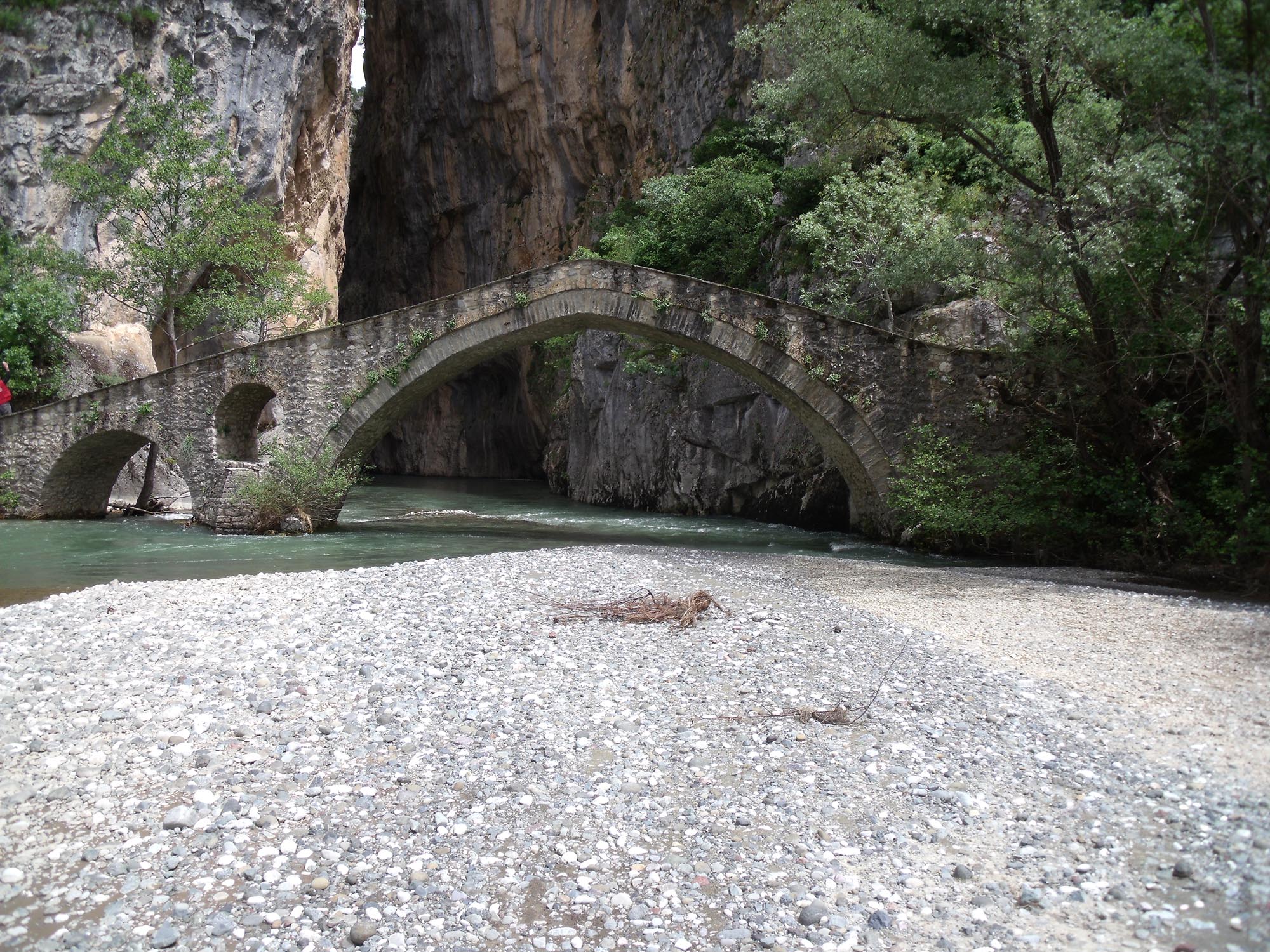
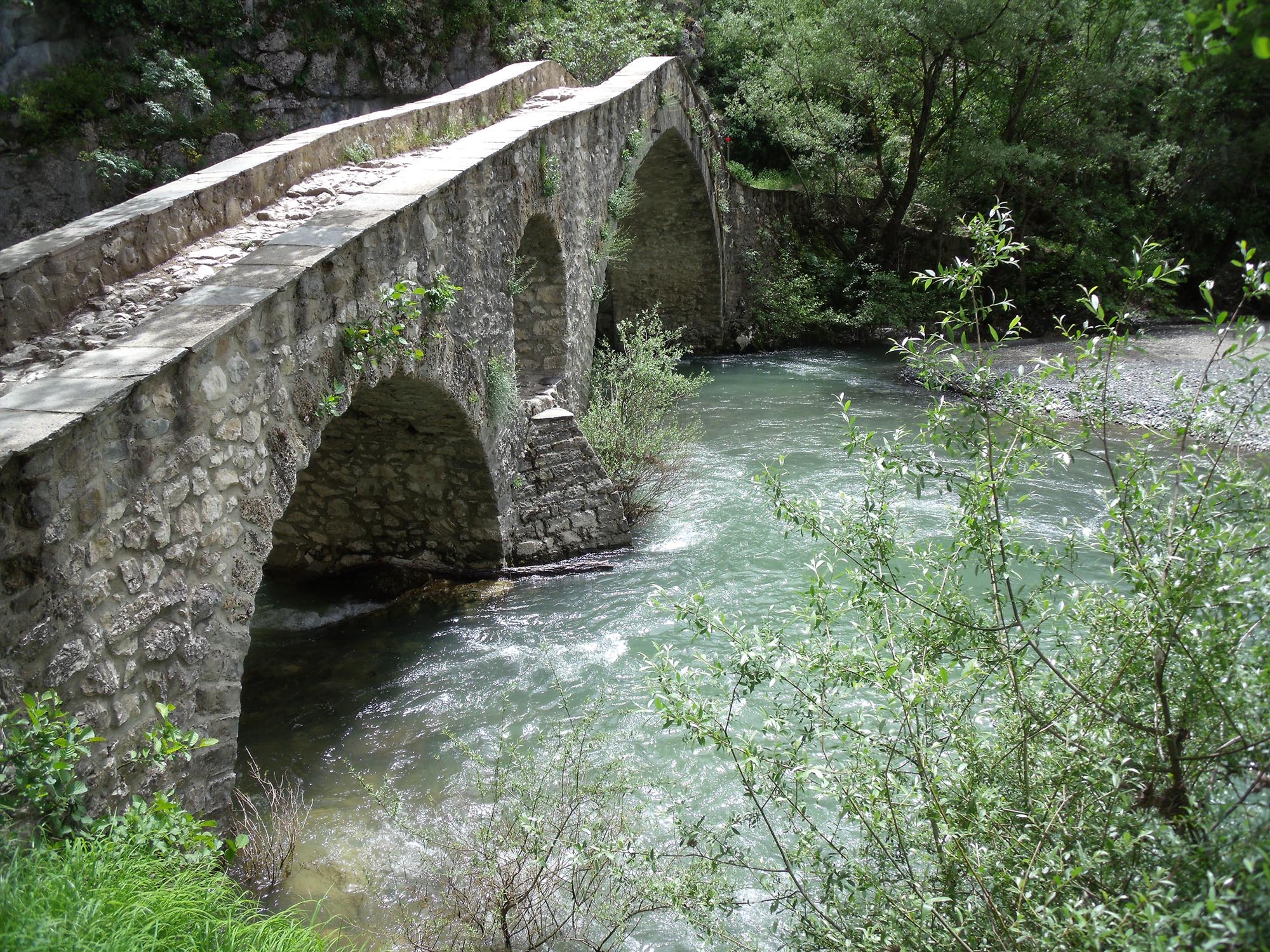
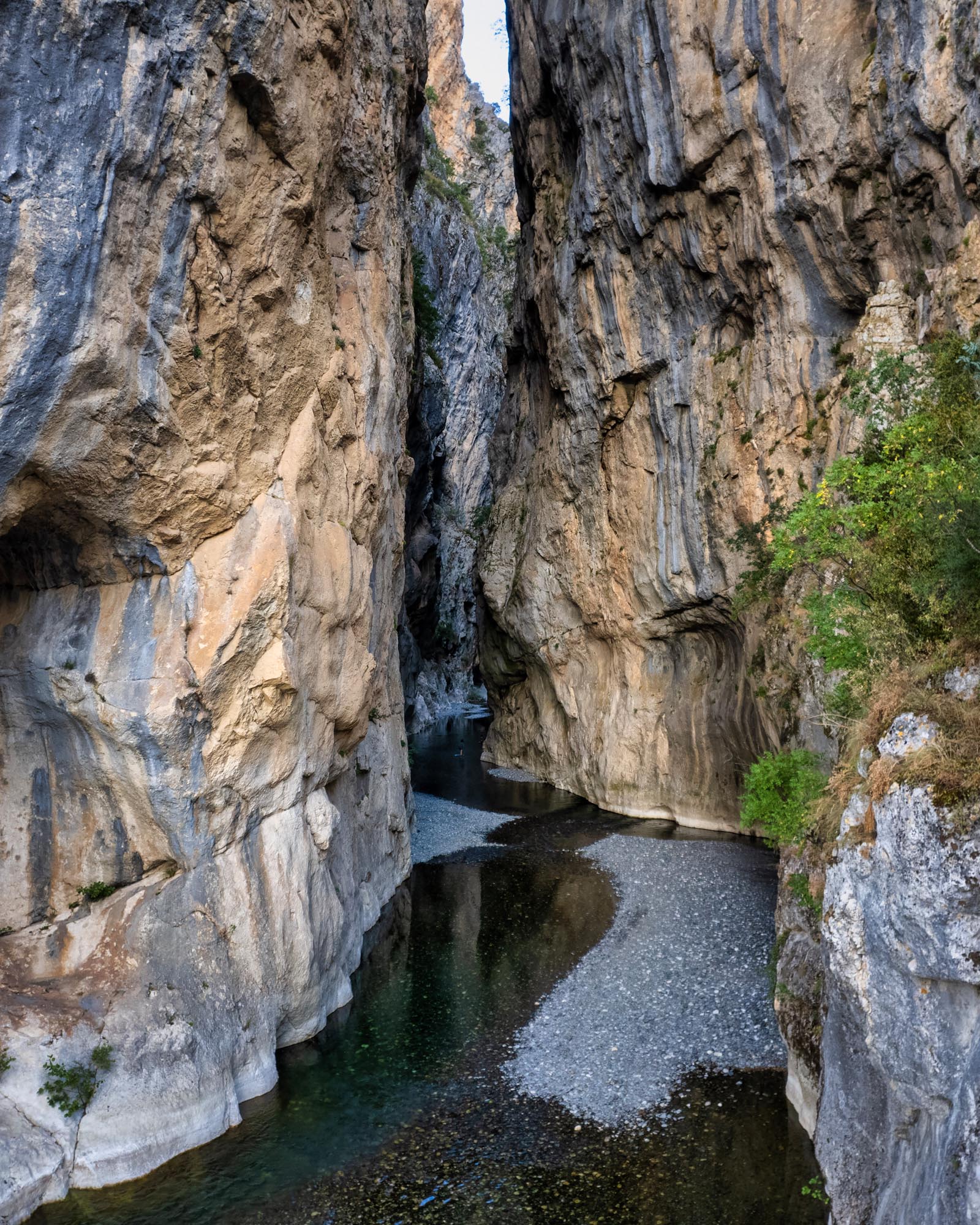
Built in a magnificent landscape at the entrance of the Portitsa Gorge – which the locals call Symplegades, the “Clashing Rocks”, due to its massive, steep cliffs, 200 metres high – this is one of the most imposing bridges of Grevena. It spans the River Venetikos, which fills the whole width of the bed of the gorge, making the gorge impassable unless one walks through the river.
The bridge, which was restored in the 1930s, connects the villages of Spilaio and Monachiti. It is 34 m long and has two arches, one large and slightly pointed, with a span of 24 m, and a second, much smaller one. According to oral testimonies, it is thought to have been built between 1830 and 1850, at the expense of the historic Monastery of the Dormition of the Virgin in the village of Spilaio.
Ziaka Bridge (“Tourkogefyro”)
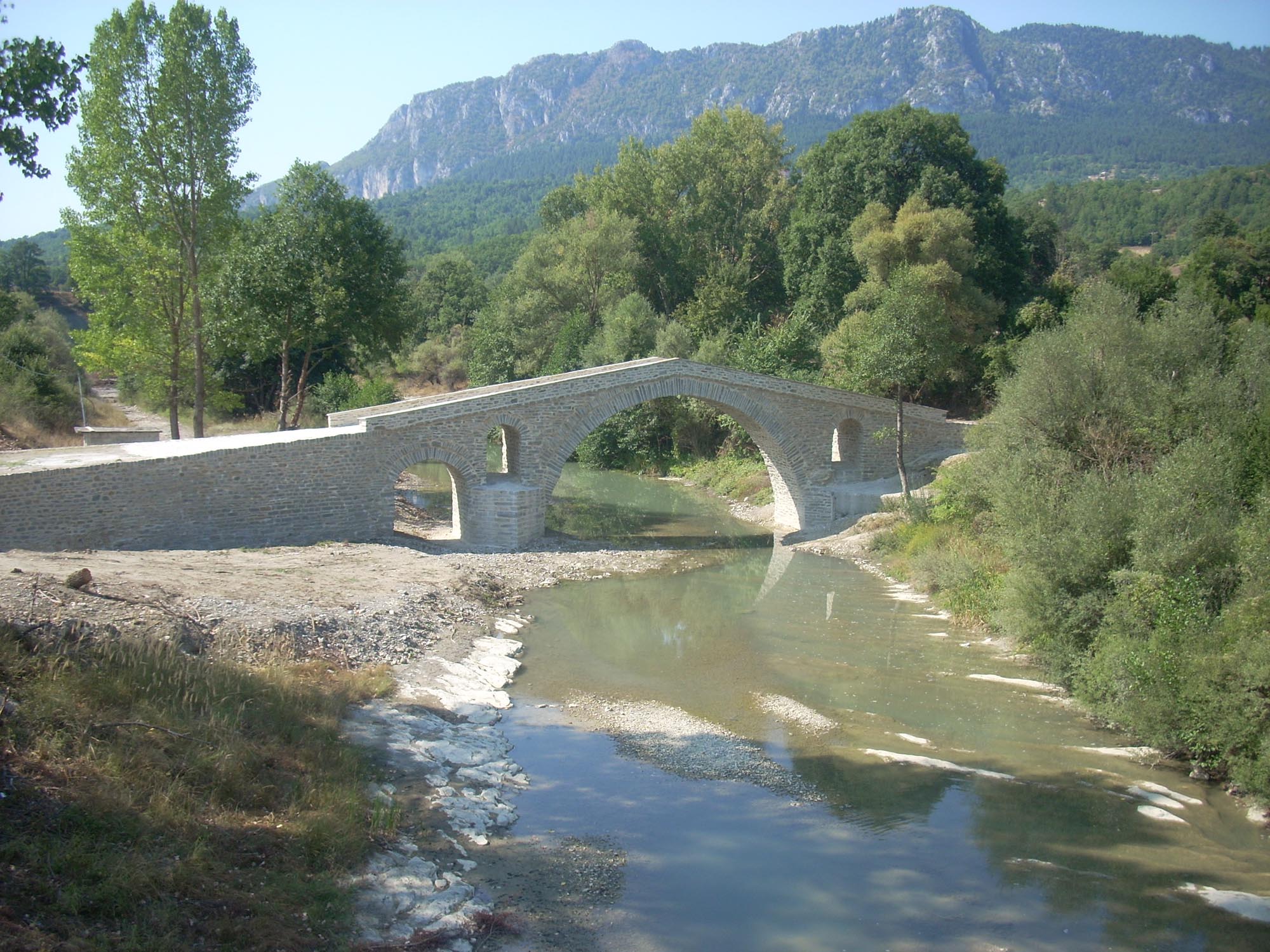
Built in a beautiful valley at the foot of the imposing Mount Orliakas, it spans the River Velonia, a tributary of the Venetikos. The restored bridge once linked the historic village of Ziaka (Tista), home of the legendary chieftain Theodoros Ziakas, with the villages of Mavranaioi and Mavronoros. It also served the “Vasiliki Strata” or Royal Road, one of the busiest roads in the region. According to historical accounts, the bridge was the site of a battle between Theodoros’s brother, Giannoulas Ziakas, and the Ottomans.
The bridge, whose nickname of Toukrogefyro (“Turkish Bridge”) indicates that it was built at the expense of an Ottoman, is 41 m long and has two arches: a main, much larger arch and a second auxiliary one. It was built in the 19th century, after 1806, when the French traveller François Pouqueville visited the area but did not mention the bridge, and before 1885, when the army officer Nikolaos Schinas passed through the area and described it.
Bridge in the village of Dotsiko
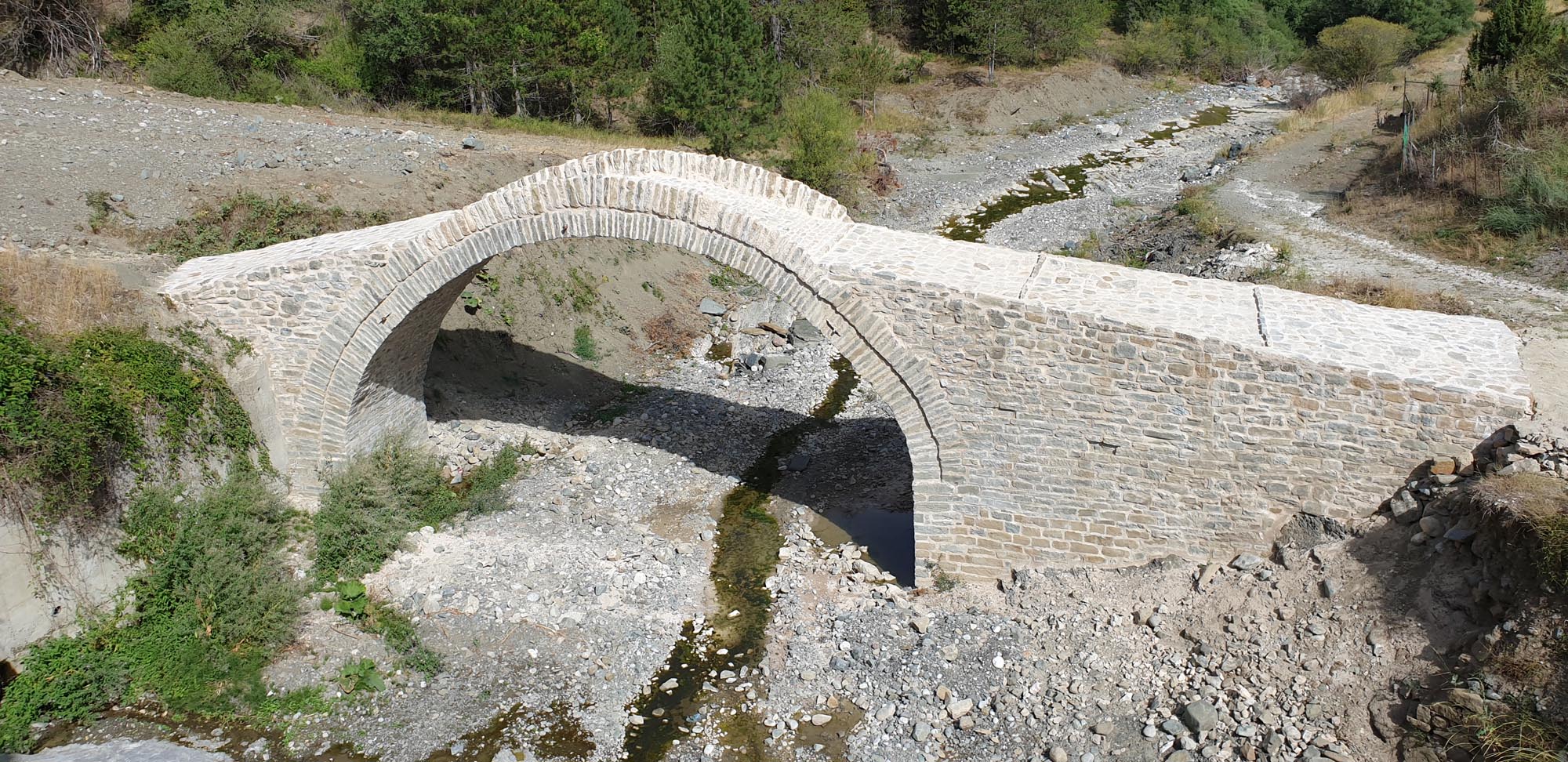
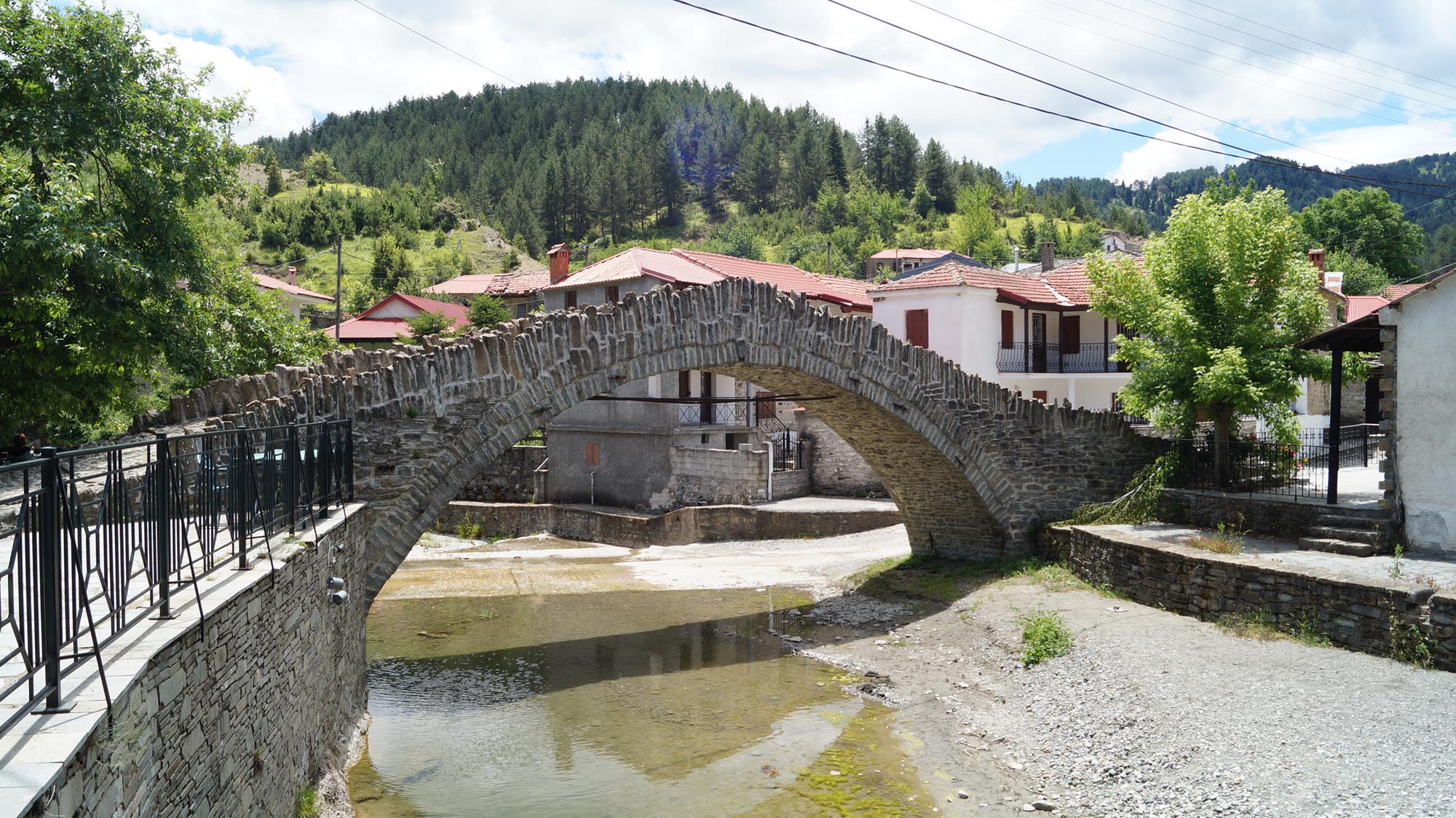
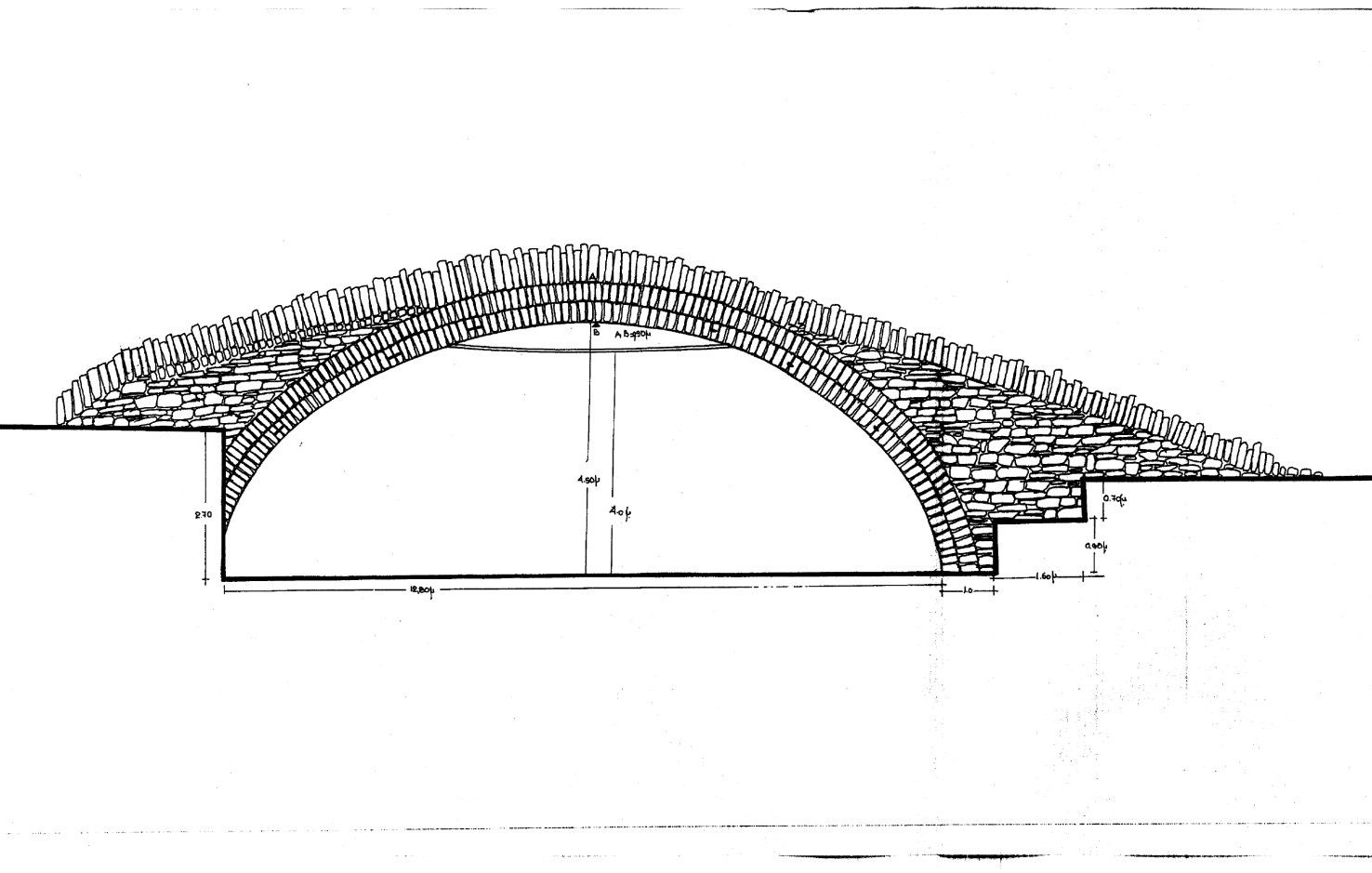
This is the only bridge in Grevena that is built in a village. It spans the Dotsikiotikos River, a tributary of the Venetikos, and allows communication between the two neighbourhoods of the village. The bridge, 24 m long, is single-arched, with an arch span of about 13 m, which is particularly wide in relation to its low height (4 m). A man’s face is carved on the keystone of the arch on the south side, a common feature on the houses of Dotsikos and the front of traditional houses in Macedonia and Epirus in general. Of particular interest is the parapet, which is made of dressed rectangular stones (arkades) symmetrically placed upright, giving the bridge a particularly picturesque appearance.
The bridge was built in the 19th century, in 1804 according to one view, or after 1865, the year of construction of the village church, according to another. The second date is consistent with the oral testimony of Aris Mitakos, a local resident, who says that the bridge was built in 1883 by his grandfather, the master builder Giorgos or Mastrogoulas Mitakos from the nearby stone-built mountain village of Liountzi, now known as Kalloni. The restored bridge appears in scenes from the award-winning film Alexander the Great (1980) by Theodoros Angelopoulos, which was partly filmed in Dotsiko.
Pasha Bridge
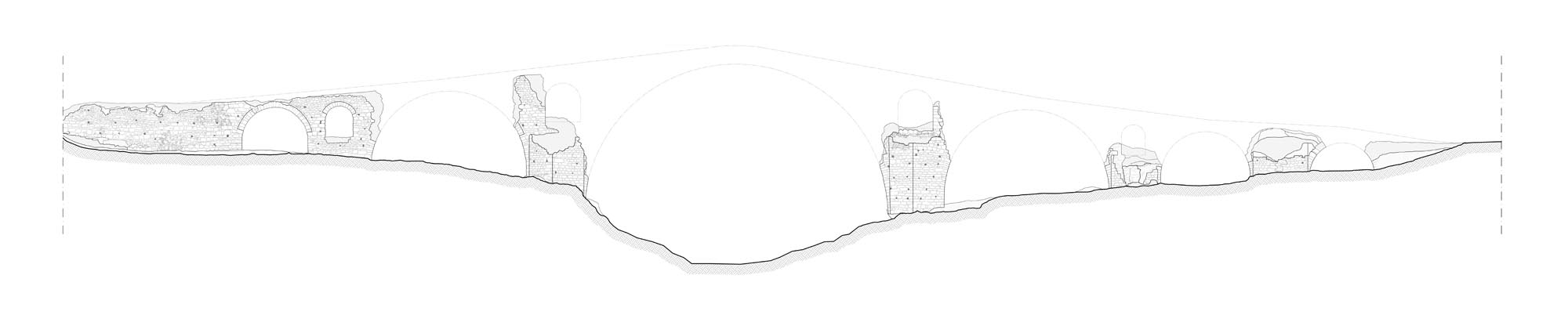
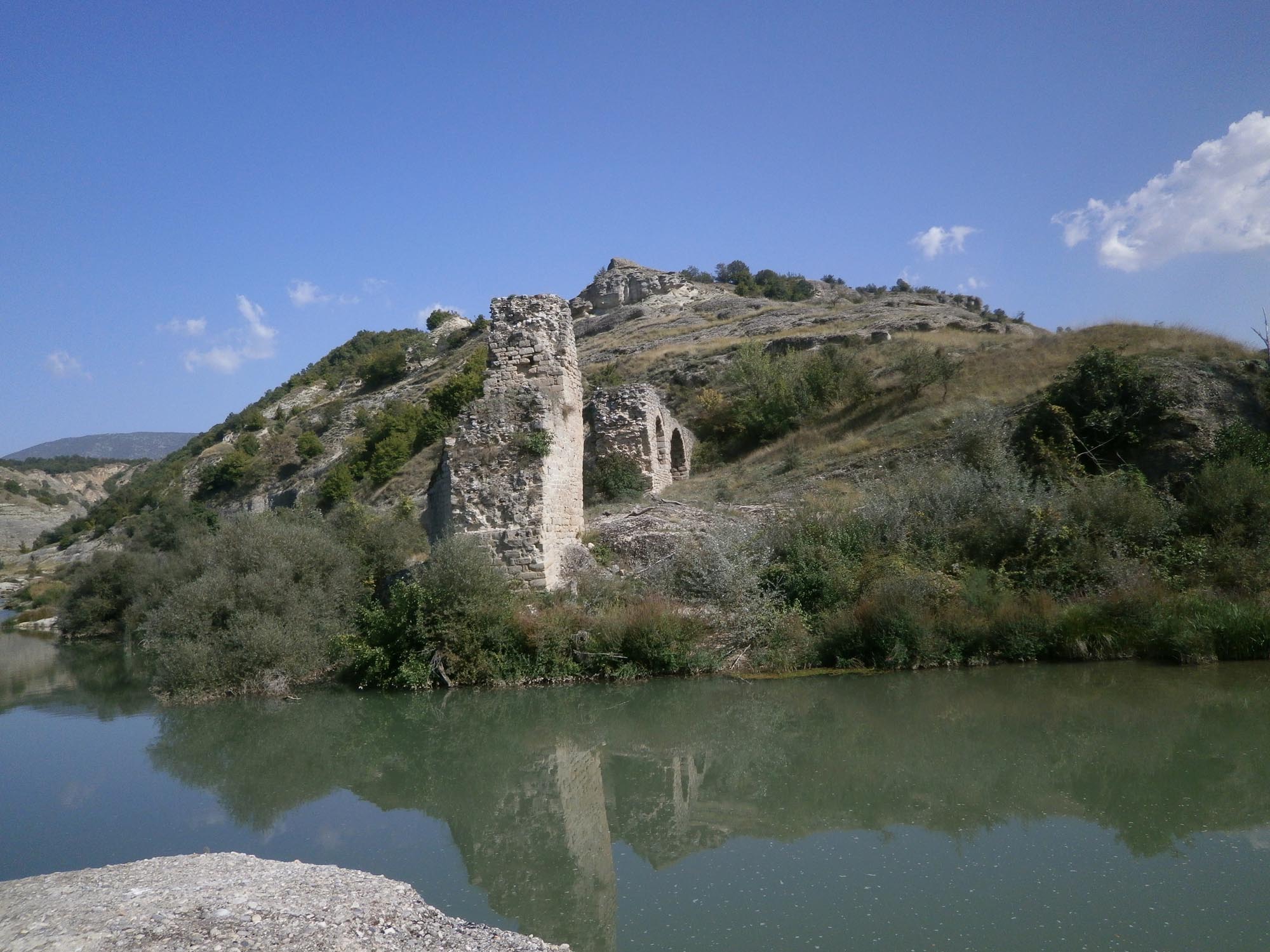
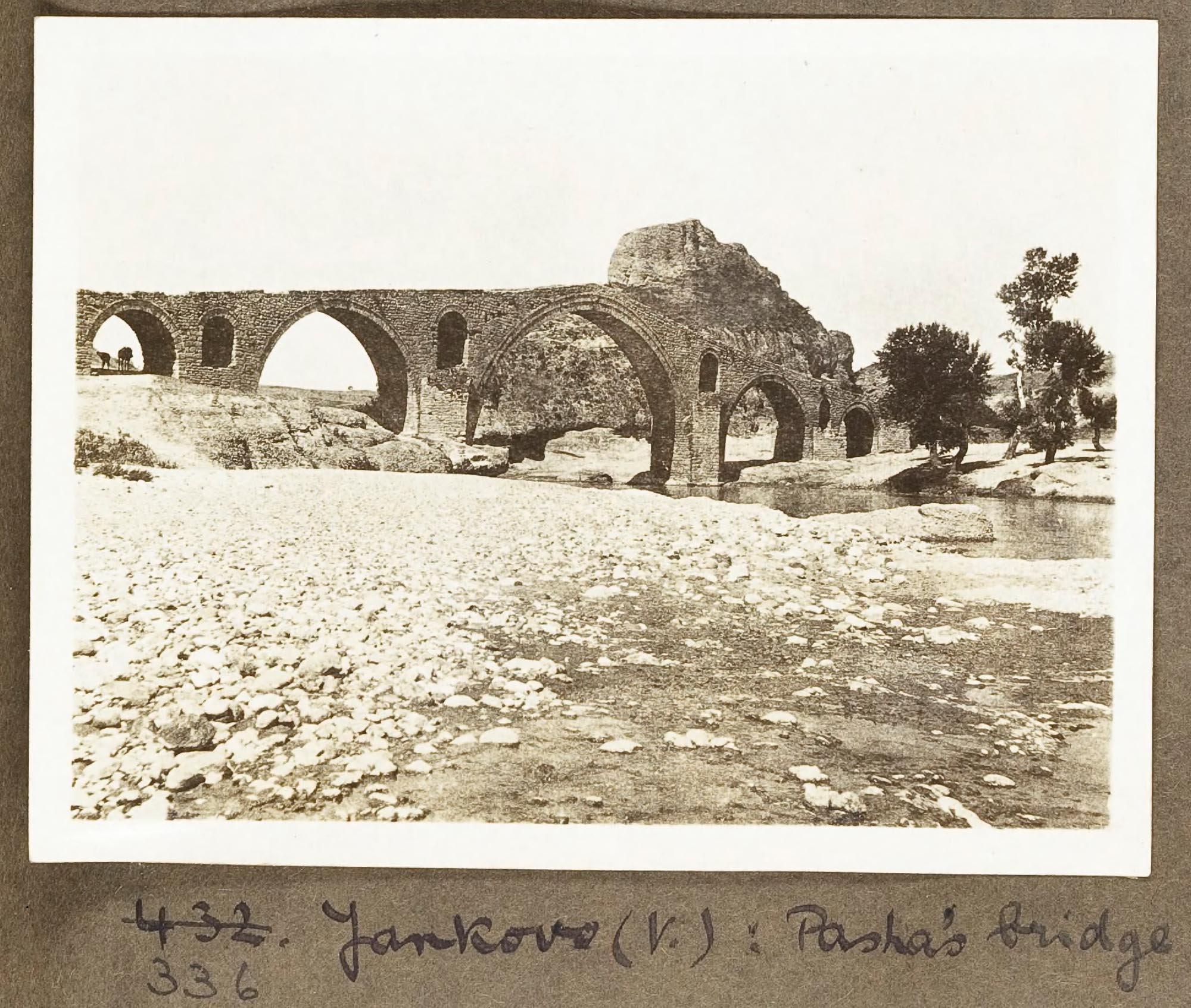
This was once the largest bridge in Macedonia, over 100 m long, and had six large arches. In 1941, during the Second World War, it was blown up by the British and New Zealanders in order to prevent the German invasion of the region, so that only the remains of its piers and the last arch to the east are preserved today. Built on the River Haliacmon, at a key point on the military and commercial road that connected Thessaloniki with Ioannina, it is located alongside the modern Egnatia Motorway, on the border of the Regional Units of Grevena and Kozani, northeast of the villages of Kokkinia and Taxiarchis.
According to the testimony of Ioannis Lambrides (1880), the bridge was built in 1690 by someone named Mahmud Pasha. If the date is correct, then this is the oldest known bridge in Western Macedonia. The French traveller François Pouqueville, who visited the area in 1806, records that the bridge, according to a long Ottoman inscription, now lost, was built by a Roumeliote valesi, a commander of the European part of the Ottoman Empire, to thank God for the rescue of one of his wives who had fallen in the river. The bridge was also visited by the English traveller William Martin Leake (1810), who reported that there was a han near the bridge, to which the ruins visible nearby probably belong. The folklorist Dimitrios Loukopoulos recorded a popular tradition, according to which the building of the bridge is connected with the legend of the master builder, known from the Bridge of Arta. As in the famous folk ballad, the master builder of the Pasha Bridge had to wall his wife up alive in the foundations of the bridge so that it would stand firm.
-

Archive of the Ephorate of Antiquities of Grevena, project funded by the Region of Western Macedonia, scientific directors: Georgios Ch. Manos, Emeritus Professor, Department of Civil Engineering, AUTH; Konstantinos Katakolos, Assistant Professor, Department of Civil Engineering, AUTH; Civil Engineering: Lambros Kotoulas, Lazaros Melidis; Department of Architecture: Ioannis Mourtos, Iordanis Sinamidis, Stavros Apotsos, Demosthenes Sakkos; Department of Spatial Planning and Development: Efstratios Stylianidis, Ioannis Tavantzis, Ioannis Giannaris, Eleni Karachaliou
Museum
Mushroom Museum, Lavdas
Lavdas, a small mountain village in Grevena, is located 11 km west of the village of Ziakas, home to the historic Ziakas Bridge. The Mushroom Museum, housed in a traditional stone building, showcases the many different species of mushrooms found in the region, highlighting the area’s rich and diverse natural environment.